People conflate these two constantly, and I understand why — they both involve machines listening to voices. But speaker identification vs speech recognition is the difference between answering “who said it?” and “what did they say?” One identifies the voice; the other transcribes the words. They’re different problems, different technologies, different accuracy profiles, and confusing them leads to real misunderstandings about what voice AI can and can’t do.
I like to frame it with a simple test: if you muted the meaning and kept only the voice’s character — the pitch, timbre, rhythm — that’s what speaker identification works with. If you kept only the words and discarded who spoke them, that’s speech recognition. Same audio, opposite questions. Let’s take them apart properly. For the transcription side in depth, see my guide on how voice recognition works.
Table of Contents
- The Core Distinction
- Speech Recognition: What Was Said
- Speaker Identification: Who Said It
- The Family Tree: Related Voice Technologies
- How Speaker Identification Works Technically
- Where They Meet: Diarization
- Accuracy: A Tale of Two Curves
- Applications: Different Tools, Different Jobs
- The Privacy Asymmetry
- Frequently Asked Questions
The Core Distinction
Speech recognition (automatic speech recognition, ASR) converts spoken audio into text. Input: waveform. Output: “the quick brown fox.” It doesn’t care who spoke — the same sentence from a child, an elder, or a synthetic voice should produce the same transcript. The voice’s identity is noise to be normalized away.
Speaker identification determines who is speaking from their voice characteristics. Input: waveform. Output: “this is Speaker #3” or “this matches the enrolled voiceprint of Alice.” It doesn’t care what was said — the same person saying different sentences should produce the same identity. The words are noise to be normalized away.
Notice the beautiful symmetry: each treats the other’s signal as noise. Speech recognition wants to be speaker-independent (understand everyone equally); speaker identification wants to be content-independent (recognize you regardless of what you say). They’re solving opposite invariance problems on the same input.
This is why a system can be excellent at one and terrible at the other. Your phone transcribes strangers accurately (good ASR, no identification needed) but might not distinguish your voice from your sibling’s (weak identification). Different tasks, different training, different expectations.
Speech Recognition: What Was Said
The transcription problem, briefly: map acoustic signals to words. Modern ASR uses end-to-end neural networks trained on millions of hours of speech, learning the statistical relationship between sound patterns and language. The goal is speaker independence — a model that transcribes a Texan, a Scot, and a non-native speaker with equal accuracy (an aspiration more than an achievement, as the accent gaps show).
Key properties of speech recognition:
- Content-focused. The output is words. Everything else — emotion, identity, health indicators in the voice — is discarded (or handled by separate systems).
- Trained for invariance to speaker. Data augmentation deliberately varies speaker characteristics so the model learns to ignore them. A good ASR system is blind to identity by design.
- Evaluated by word error rate. How many words wrong? The metric cares about text fidelity, nothing else.
- Mature and deployed. Dictation, captions, voice assistants — ASR is infrastructure now.
The philosophical point: speech recognition treats your voice as a channel — a noisy medium carrying a linguistic message. The person behind the voice is irrelevant to the task. That’s a feature for transcription and a limitation for everything else.
Speaker Identification: Who Said It
The identification problem: map acoustic signals to identity. Given a voice sample, determine which enrolled speaker it belongs to — or whether it matches a claimed identity. This is voice biometrics, and it works on the characteristics that make your voice yours: vocal tract shape, pitch patterns, speaking rhythm, pronunciation habits.
The process has two phases:
Enrollment. You provide voice samples (“say these phrases”), and the system builds a voiceprint — a mathematical embedding capturing your voice’s distinctive characteristics. This isn’t a recording; it’s a compact representation, typically a few hundred numbers describing where your voice sits in acoustic space.
Matching. New audio is converted to an embedding and compared against enrolled voiceprints. Close enough to Alice’s voiceprint? It’s Alice. This can be 1:1 verification (“is this Alice claiming to be Alice?”) or 1:N identification (“which of these thousand speakers is this?”).
Key properties:
- Identity-focused. The output is a person (or “unknown”). The words spoken are irrelevant — ideally, the system recognizes you whether you’re ordering pizza or reading poetry.
- Trained for invariance to content. The model must ignore what was said and focus on how it sounds — the mirror image of ASR’s training.
- Evaluated by error rates. False accept rate (impostor accepted) versus false reject rate (legitimate user rejected) — the classic biometric tradeoff curve.
- Probabilistic, not certain. Voiceprints are statistical matches, not fingerprints. Identical twins, illness, aging, and recording conditions all shift the voice.
The Family Tree: Related Voice Technologies
The confusion multiplies because several related technologies share the “voice AI” umbrella. Here’s the family:
Speech recognition (ASR): what was said → text. (This article’s co-star.)
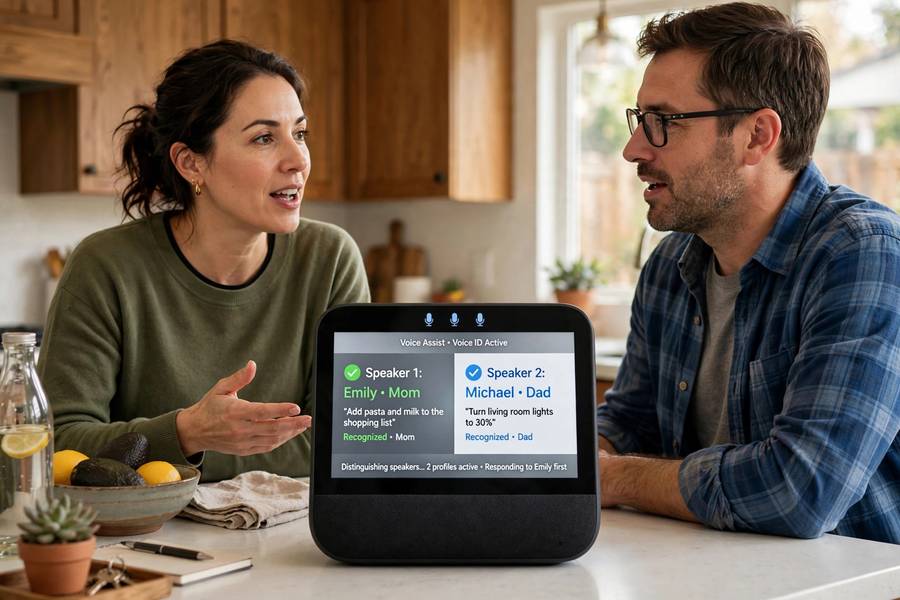
Speaker identification: who spoke → identity from a known set. “Which enrolled user is this?”
Speaker verification: is the speaker who they claim to be? 1:1 check, used for voice authentication (“my voice is my password”).
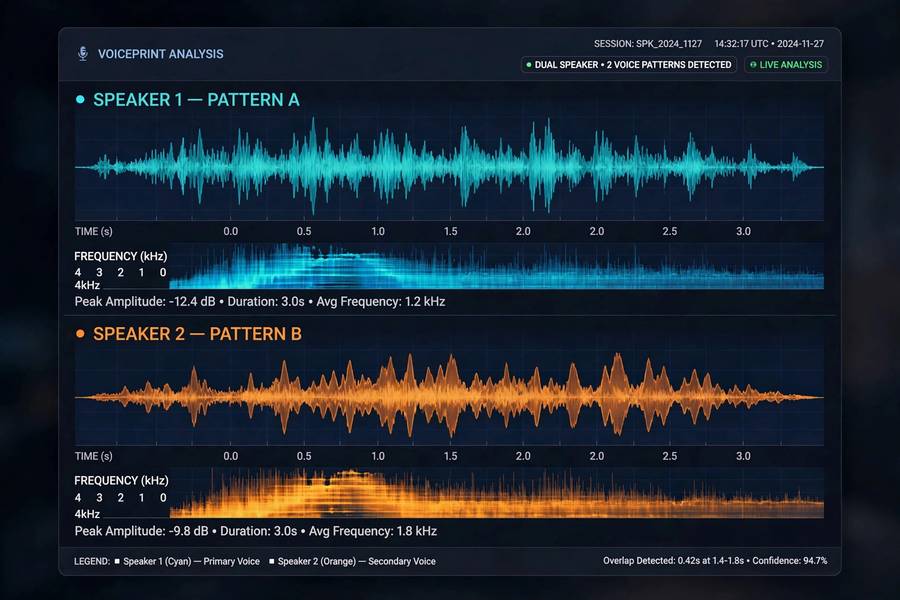
Speaker diarization: who spoke when? Segmenting multi-speaker audio — “Speaker 1: hello [Speaker 2: hi there]” — without necessarily knowing who the speakers are. The backbone of meeting transcription.
Voice conversion/cloning: making audio sound like a different speaker. The generative mirror of identification — and the technology that makes voice biometrics spoofable.
Emotion/sentiment from voice: what feeling does the voice convey? Yet another invariant — this time to both words and identity, focusing on prosody.
Each is a distinct model trained for a distinct invariance. The industry sometimes bundles them (“voice AI”), but they’re as different as fingerprint matching and handwriting recognition — both involve hands, completely different problems.
How Speaker Identification Works Technically
For the technically curious, the modern approach:
1. Feature extraction. Audio becomes features — but different features than ASR uses. Speaker identification cares about characteristics stable across utterances: vocal tract resonances (formants), pitch distributions, speaking rate patterns. The features emphasize the instrument (your vocal apparatus) over the music (the words).
2. Embedding. A neural network (architectures with names like x-vector, ECAPA-TDNN) maps variable-length audio to a fixed-size embedding — a point in “voice space” where similar voices cluster together. Training uses a clever objective: make embeddings of the same speaker close together and different speakers far apart, regardless of what’s said.
3. Comparison. Cosine similarity or a probabilistic model (PLDA) scores how close a new embedding is to enrolled voiceprints. Above threshold: match. The threshold sets the false-accept/false-reject tradeoff.
4. Anti-spoofing. Because voiceprints can be attacked with recordings or synthetic voices, serious systems add liveness detection — challenge-response (“say this random phrase”), or detecting the acoustic artifacts of playback and synthesis. The arms race between voice cloning and spoof detection is active and unsettled.
The deep learning revolution improved speaker identification enormously — error rates dropped by orders of magnitude — but the fundamental limits remain: voices change, channels distort, and determined attackers adapt.
Where They Meet: Diarization
The most interesting intersection is speaker diarization — “who spoke when” — which fuses both technologies. Meeting transcription needs ASR (what was said) and speaker segmentation (who said each part). The pipeline: segment audio by speaker changes, cluster the segments by voice similarity, transcribe each cluster’s speech, and output attributed text.
Diarization is harder than either task alone because the errors interact. Mis-segment the speakers and the transcript attribution is wrong even if every word is right. It’s also where the technologies’ different maturity shows: ASR on clean meeting audio is excellent; diarization with overlapping speech, similar voices, and room acoustics remains genuinely difficult.
This is the technology behind “smart” meeting notes, and its limitations explain why those notes still need human cleanup. The what is solved; the who-when is approximate. Another case of the pipeline being only as strong as its hardest stage.
Accuracy: A Tale of Two Curves
The accuracy profiles differ in ways that matter for deployment:
Speech recognition degrades gracefully with conditions — noise, accents, distance all cost accuracy incrementally. A 5% word error rate on clean audio might become 15% in noise. Bad, but the transcript is still mostly usable.
Speaker identification degrades catastrophically across conditions. A system with 1% equal error rate on matched conditions (same microphone, same session) might hit 10-20% with channel mismatch (enrolled on a phone, tested on a smart speaker) or voice changes (cold, aging, emotion). The voiceprint is fragile in ways transcripts aren’t.
This asymmetry drives deployment reality: ASR is trusted for infrastructure (captions, dictation) while speaker identification is trusted only for low-stakes convenience (personalized responses on a smart speaker) — never for high-stakes security alone. Banks that offer “voice passwords” layer them with other factors, because voice alone is spoofable and variable. The AI bias examples literature also notes demographic skews in speaker recognition accuracy — another reason for caution.
Applications: Different Tools, Different Jobs
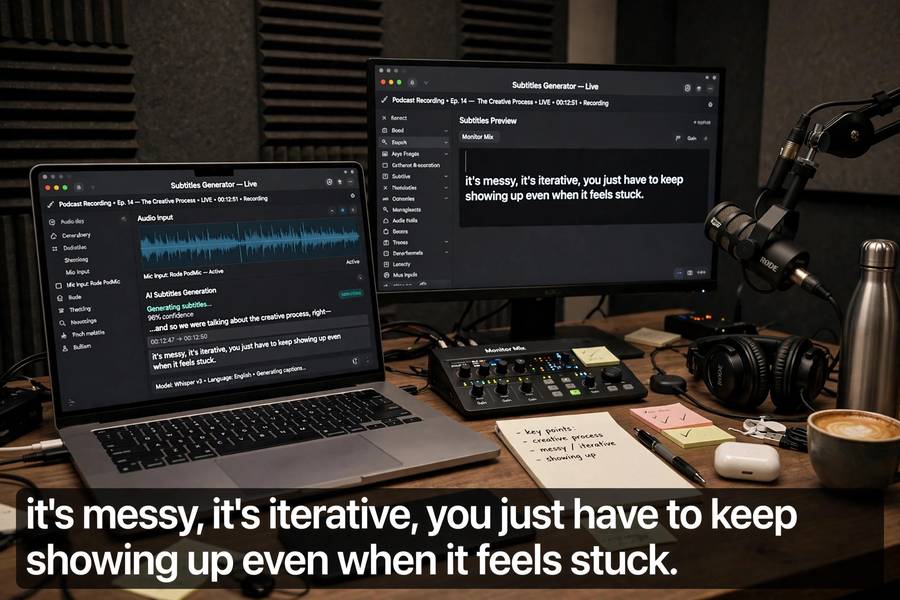
Speech recognition applications: dictation, live captioning, voice assistants’ transcription layer, call analytics, meeting notes, accessibility tools. The common thread: the words matter, the speaker doesn’t.
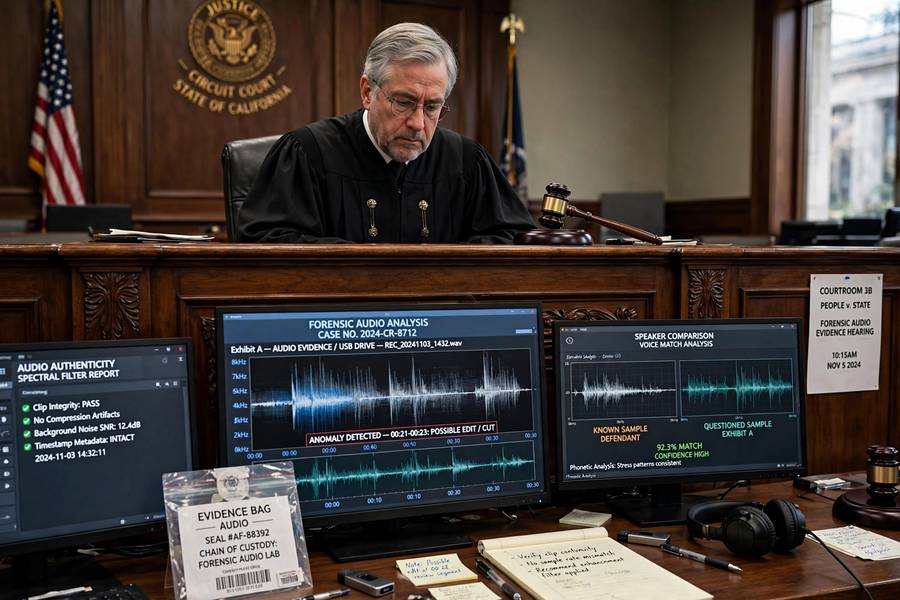
Speaker identification applications: personalized smart speaker responses (“whose calendar?”), voice-based login (as one factor), forensic analysis, call center agent verification, broadcast monitoring (which politician spoke?). The common thread: the identity matters, the words don’t.
Combined applications: meeting transcription with attribution, personalized voice assistants (identify the speaker, then transcribe and act on their personal data), forensic transcription of surveillance audio.
Choosing wrong has consequences. Using speaker identification where you need speech recognition (or vice versa) isn’t just suboptimal — it’s a category error. I’ve seen product specs conflate them, with predictable results. Name the question first — who or what — then pick the tool.
The Privacy Asymmetry
Here’s the part with teeth: the two technologies have radically different privacy implications.
Speech recognition is content-extractive but identity-blind (by design). A transcript of what you said is sensitive because of the content, but the ASR system itself doesn’t know or care who you are. Transcripts can be anonymized meaningfully.
Speaker identification is identity-extractive by definition. A voiceprint is a biometric identifier — like a fingerprint, it identifies you across contexts, and you can’t change it if compromised. Voiceprints enable tracking: the same voice identified across different services, locations, and times. And unlike a password, you broadcast your voice constantly — anyone with a microphone can capture the raw material.
This asymmetry should shape regulation and product design. AI policy increasingly treats voiceprints as biometric data subject to consent requirements — which is correct. The rule of thumb: transcription processes your words (protect the content); identification processes your identity (protect the biometric). Different data, different risks, different rules.
My practical advice: use speech recognition freely — it’s infrastructure. Treat speaker identification enrollment as a biometric decision — ask what the voiceprint is used for, where it’s stored, whether you can delete it, and what happens if it’s breached. The answers vary enormously, and the technology’s convenience shouldn’t override the questions.
Frequently Asked Questions
Speech recognition converts spoken audio to text — it answers “what was said” and is designed to ignore who’s speaking. Speaker identification determines who is speaking from voice characteristics — it answers “who said it” and is designed to ignore what’s being said. Same audio input, opposite questions.
Speaker verification is a 1:1 check — “is this person who they claim to be?” (like a voice password). Speaker identification is 1:N — “which known speaker is this?” from a set of enrolled voices. Verification is used for authentication; identification for personalization and forensics.
Speaker diarization answers “who spoke when” — it segments multi-speaker audio and labels each segment by speaker, without necessarily knowing their identities. It combines speaker identification techniques with speech recognition and powers attributed meeting transcripts.
Not on its own. Voiceprints are probabilistic, affected by illness, aging, and recording conditions, and vulnerable to replay attacks and AI voice cloning. Serious deployments layer voice with other factors and add anti-spoofing measures. Treat voice as a convenient identifier, not a strong authenticator.
It depends on the service. Most consumer products (smart speakers, phone assistants) offer voice profile deletion in privacy settings. However, voiceprints held by other parties — employers, banks, government systems — follow their own retention policies, and regulations on biometric deletion vary by jurisdiction.