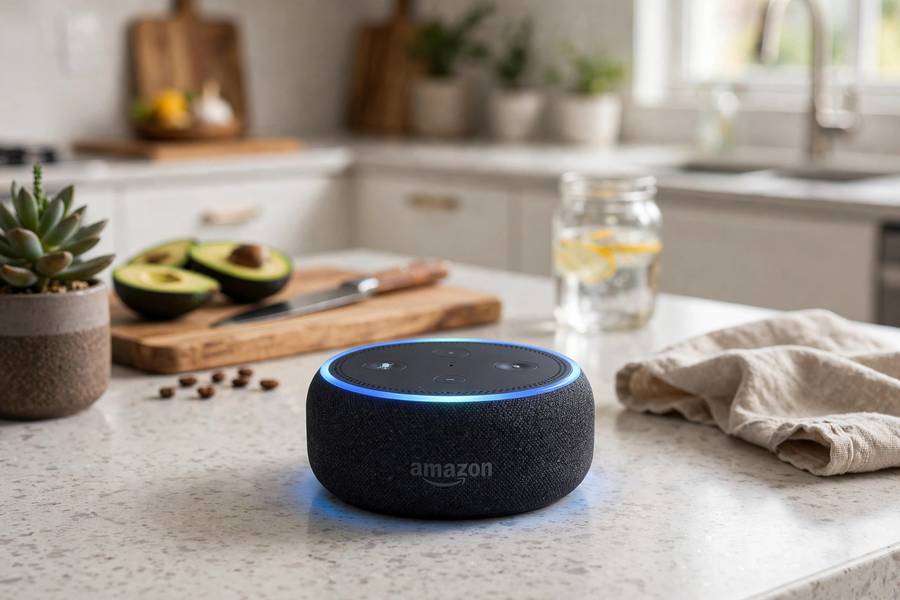
Your Echo sits on the counter, apparently dormant, until you say the magic word — and then it answers questions, plays music, controls your lights, and orders your groceries. The whole interaction feels like talking to a helpful ghost in the machine. But Alexa’s understanding of your voice commands is a carefully engineered relay race between your living room and Amazon’s data centers, and the baton passes through more stages than you’d guess.
I’ve always thought Alexa’s architecture is the clearest illustration of cloud-first voice AI: unlike Apple’s on-device approach, Alexa leans hard on the cloud, which gives it different strengths and different tradeoffs. Let’s trace a single command — “Alexa, turn off the living room lights” — from your mouth to the light switch and back. For the general science underneath, see my guide on how voice recognition works.
Table of Contents
- The Wake Word: Alexa’s Ear Is Always Open
- Far-Field Listening: Hearing You Across the Room
- The Cloud Handoff
- Speech Recognition in the Cloud
- Alexa’s Brain: Understanding Intent
- Skills: Alexa’s App Store for Voice
- Executing the Command
- Talking Back: Alexa’s Voice
- Why Alexa’s Cloud-First Design Matters
- Frequently Asked Questions
The Wake Word: Alexa’s Ear Is Always Open
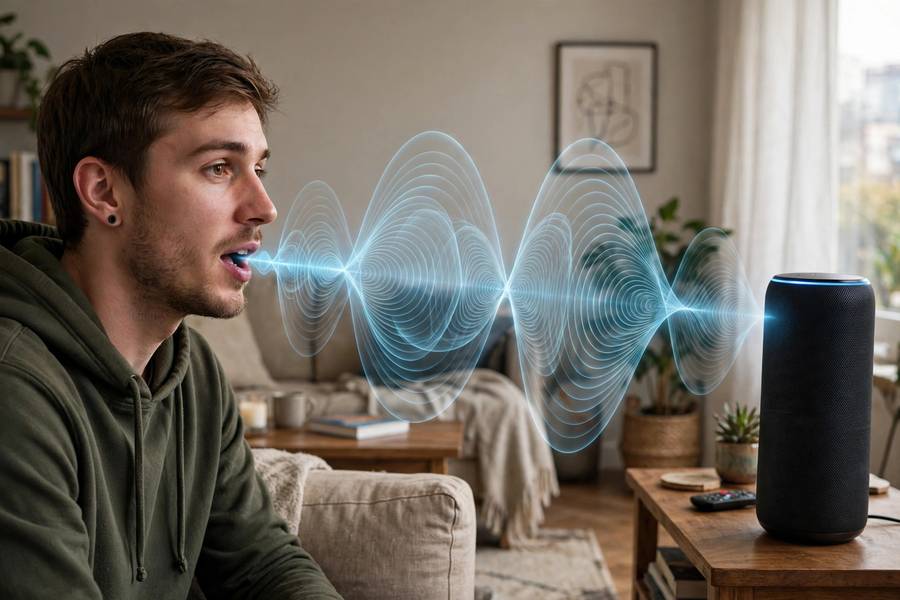
Everything starts with the wake word — “Alexa” by default, changeable to “Amazon,” “Echo,” or “Ziggy” if you prefer. Your Echo is continuously monitoring ambient audio with a small, dedicated processor running a wake-word detection model. Like all such systems, it’s listening for a pattern, not recording conversations — the audio is analyzed in a rolling buffer and discarded.
Amazon’s wake-word engine is tuned aggressively for recall over precision: it would rather wake up occasionally when you didn’t mean it than miss you when you did. That’s a deliberate product choice — a missed command feels broken; a false wake-up is a minor annoyance. The tradeoff shows up in those moments when Alexa chimes in during a TV show because a character said something vaguely Alexa-shaped.
When the wake word is detected, the Echo’s light ring glows blue — the universal signal that it’s now actively listening — and it begins streaming your audio to the cloud. That blue ring is doing important UX work: it tells everyone in the room that the device has transitioned from monitoring to capturing. Transparency through industrial design.
Far-Field Listening: Hearing You Across the Room
Here’s where Echo hardware genuinely shines. Unlike a phone you hold to your mouth, an Echo might be fifteen feet away, behind a couch, with music playing. Hearing you under those conditions is a serious engineering problem, and Amazon attacked it with microphone arrays and beamforming.
Echo devices pack multiple microphones (seven in the classic Echo) arranged to capture sound from all directions. The device combines these signals using beamforming algorithms that focus on your voice’s direction while suppressing everything else — the TV, the dishwasher, its own speaker output. It also does acoustic echo cancellation: when Alexa is playing music and you talk over it, the device subtracts its own output from what the microphones hear, so it can detect your voice underneath.
This far-field capability is arguably Alexa’s defining hardware achievement. Phone assistants get clean, close-range audio handed to them. Alexa has to extract your voice from a noisy room at distance — and usually succeeds. When voice recognition fails on an Echo, it’s rarely the cloud models’ fault; it’s usually that the audio captured in your chaotic kitchen defeated even excellent signal processing.
The Cloud Handoff
Once the wake word fires, your Echo opens an encrypted connection and streams your voice to Amazon’s cloud — specifically to the Alexa Voice Service (AVS) infrastructure. This is the fundamental architectural difference from Apple’s approach: the Echo is essentially a smart microphone and speaker, while the actual intelligence lives in data centers.
The audio stream includes a short pre-roll — the fraction of a second before the wake word — so the beginning of your command isn’t clipped. The stream continues until endpoint detection determines you’ve finished speaking, using a combination of acoustic pauses and linguistic completeness.
Everything after this point happens in the cloud, on hardware thousands of times more powerful than the Echo itself. That power is Alexa’s superpower: it can run enormous, constantly updated models that no smart speaker could host locally. The cost is the round-trip — your voice travels to a data center and back, adding latency and creating the privacy considerations we’ll discuss.
Speech Recognition in the Cloud
In the cloud, your audio hits Amazon’s automatic speech recognition (ASR) system — large neural networks that convert speech to text. Because these run on data-center hardware, they can be far bigger and more sophisticated than on-device models: deeper networks, larger vocabularies, more context.
Amazon’s ASR is trained on staggering amounts of speech data — including, controversially, anonymized snippets of real Alexa interactions that humans review to improve the models. This training loop is why Alexa’s recognition has improved dramatically over the years: every interaction is potential training data, creating a flywheel where more users mean better models mean more users.
The cloud ASR also handles the messy realities of human speech: accents, dialects, disfluencies (“um,” restarts, corrections), children’s voices, elderly voices. It does this better than smaller models precisely because it has seen more variation. Scale is a feature here — the model’s breadth of experience is its accuracy.
The output of this stage is text — “turn off the living room lights” — plus confidence scores and alternative interpretations. That text, not your audio, is what flows to the understanding layer.

Alexa’s Brain: Understanding Intent
Now the key question: how does Alexa go from the text “turn off the living room lights” to actually turning off lights? Through natural language understanding — intent classification plus entity extraction.
Alexa’s NLU maintains a vast catalog of intents: TurnOffIntent, PlayMusicIntent, SetTimerIntent, GetWeatherIntent, thousands more. Each intent has a schema of expected entities (slots). For our command: intent = turn off a device, entities = device type (lights), location (living room).
The NLU model — trained on billions of historical Alexa interactions — classifies the intent and fills the slots. It’s remarkably good at paraphrase: “kill the living room lights,” “living room lights off,” “turn the living room lights off please” all map to the same intent and slots. This robustness to phrasing variation is what makes Alexa feel like it “understands” — it’s pattern-matching across an enormous space of examples, not truly comprehending, but the effect is convincing.
For ambiguous commands, Alexa uses context: your device locations, your past behavior, your smart home configuration. “Turn off the lights” with no location means the lights in the room where the Echo sits — a sensible default that required the system to know which Echo heard you and which room it’s in.
Skills: Alexa’s App Store for Voice
Here’s where Alexa’s architecture gets interesting: third-party extensibility through Skills. A Skill is essentially a voice app — a package of intents, sample utterances, and backend logic that developers build and users enable. “Alexa, ask Domino’s to order my usual” works because Domino’s built a Skill defining those intents.
When your command matches a Skill’s intents, Alexa routes the structured intent data to the developer’s backend (usually an AWS Lambda function), which executes the logic and returns a response for Alexa to speak. This is voice AI as a platform — Amazon provides the speech recognition and NLU infrastructure; developers provide the domain logic.
The Skills ecosystem peaked years ago — tens of thousands of Skills exist, though usage concentrates in a handful — but the architecture reveals Amazon’s strategy: Alexa as the voice interface to everything, with Amazon owning the platform layer. It’s the same playbook as the App Store, applied to voice. Whether voice apps were ever the right paradigm is debatable, but the infrastructure thinking was sound.
Executing the Command
For smart home commands like ours, execution flows through Alexa’s Smart Home API. The structured intent (turn off, lights, living room) gets translated into device commands routed to the relevant manufacturer’s cloud or local integration — Philips Hue, in this example. The light turns off. Total time from end of speech to action: typically under two seconds.
For Amazon’s own services — music, shopping, Audible — execution stays in-house, which is why those integrations feel smoothest. “Alexa, reorder paper towels” flows directly into Amazon’s retail systems, complete with your purchase history and preferences. This vertical integration is Amazon’s structural advantage and, critics note, its structural conflict of interest.
The execution layer also handles the multi-step: “Alexa, good night” might lock doors, turn off lights, set the thermostat, and arm the security system — a routine composed of multiple device commands orchestrated by a single intent. Routines are where Alexa’s utility compounds: one phrase, many actions.
Talking Back: Alexa’s Voice
Alexa’s spoken responses are generated by neural text-to-speech — the same technology family behind all modern voice assistants. Amazon’s TTS produces the familiar Alexa voice, with natural prosody that has improved enormously from the robotic early days. For the synthesis technology in detail, see how text-to-speech works.
Amazon has experimented with expressive and emotive speech — Alexa can sound excited about good news or subdued about bad — though the results remain in uncanny-valley territory for many listeners. There’s also the celebrity voice feature and, more substantively, the ability for Skills to use custom voices.
An underappreciated detail: Alexa’s responses are generated in the cloud and streamed to the Echo as audio. The Echo itself does no speech synthesis — it’s a playback device for cloud-generated audio. This keeps the device simple and lets Amazon update the voice without touching your hardware.
Why Alexa’s Cloud-First Design Matters
Alexa’s architecture — dumb-ish device, smart cloud — creates a specific profile of strengths and weaknesses worth understanding.
Strengths: The models are huge and constantly improving without hardware upgrades. New capabilities deploy server-side to every Echo simultaneously. The training flywheel (more users → more data → better models) compounds. Complex multi-step reasoning is possible with data-center compute. And the device stays cheap — the intelligence isn’t in the $30 speaker.
Weaknesses: No internet, no Alexa — the device is a paperweight offline. Latency is inherent to the round-trip. Privacy is structural: your voice necessarily leaves your home for processing, creating a data trail that on-device architectures avoid. And you’re dependent on Amazon’s continued investment — if the economics of Alexa ever stop working for Amazon, the cloud brain could atrophy while your Echo still sits on the counter.
That last point isn’t hypothetical. Alexa’s business model — sell cheap hardware, monetize through engagement — has been questioned even inside Amazon. The devices are remarkable; the economics are murky. It’s worth knowing that your smart speaker’s intelligence is a service, not a possession, and services can change.
Still, as a demonstration of how AI agents work in the consumer wild — perceiving, understanding, acting across domains — Alexa remains the most deployed example on earth. Hundreds of millions of devices, billions of interactions. Whatever its future, it’s already the largest-scale voice AI experiment ever run.

Frequently Asked Questions
Alexa uses a cloud-based pipeline: the Echo detects the wake word locally, streams your voice to Amazon’s cloud, where large neural networks convert speech to text, natural language understanding extracts your intent and the relevant details, the command executes (via smart home APIs, Amazon services, or third-party Skills), and Alexa responds with cloud-generated synthesized speech.
No. The Echo continuously monitors for the wake word using a local detector that discards audio, and only streams to the cloud after the wake word is detected (indicated by the blue light ring). However, unlike on-device assistants, the voice audio of your actual commands is processed in Amazon’s cloud, and snippets may be human-reviewed to improve the models unless you opt out.
Essentially no. Because Alexa’s speech recognition, understanding, and response generation all happen in Amazon’s cloud, an Echo without internet access can’t process commands. This is the main tradeoff of its cloud-first architecture versus on-device assistants like Siri.
Skills are third-party voice apps built on Alexa’s platform. Developers define custom intents and utterances; when your command matches, Alexa routes the structured data to the developer’s backend to execute. Skills extend Alexa into domains like food ordering, games, and smart home devices Amazon doesn’t natively support.
Amazon tunes wake-word detection for high recall — it prefers occasional false activations over missed commands. TV dialogue, conversations, or sounds resembling “Alexa” can trigger it. The blue light ring indicates when the device is actively streaming, so you can always tell when it’s listening versus merely monitoring.