Destination Wedding Pros and Cons: The Honest Breakdown

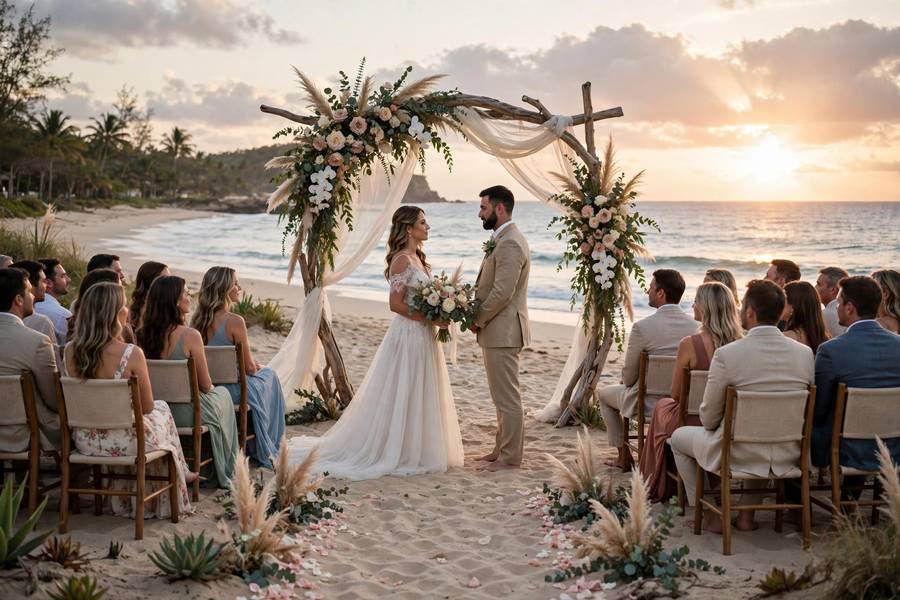
Married with your toes in the sand, 30 of your favorite people, no seating chart drama. That’s the dream. The reality includes guest guilt, vendor unknowns, and planning a wedding in a place you’ve visited twice. I’ve planned destination weddings that were pure magic and ones that were pure stress. Here’s the honest breakdown.
The Pros
Built-in intimacy. Destination weddings naturally stay small (20–60 guests) — the travel filters your list for you. Extended celebration. It’s not 5 hours; it’s 3–5 days with your favorite people. Stunning backdrops that need minimal decor — the location IS the decor. Simplified planning with resort packages that bundle venue, catering, and coordination. Honeymoon built in — you’re already somewhere beautiful.
The Cons
Guest burden. You’re asking people to spend $1,000–3,000+ to attend your wedding. Some will decline, some will resent it silently. Less control. You’re planning remotely, often with vendors you’ve never met, sometimes across language barriers. Legal complexity. Marriage requirements vary wildly by country — some are simple, some take months. Fewer vendor choices. You’re limited to who’s local or who’ll travel. Weather risk with fewer backup options.
The Cost Reality
Here’s the surprise: destination weddings are often CHEAPER for the couple. A resort package wedding for 40 guests might run $10,000–20,000 all-in, versus $30,000+ at home. But the cost shifts to guests — and that’s the ethical math you need to do honestly. A $15,000 destination wedding where guests spend $60,000 collectively is not actually a budget choice.
Guest Experience
Your guests are spending serious money and vacation days. Honor that: give 8–12 months notice (save-the-dates are mandatory, not optional). Be transparent about costs upfront. Plan group activities but don’t over-schedule — people need downtime. And genuinely, graciously accept declines without guilt-tripping. Some people can’t come, and that’s okay.

Logistics and Legalities
Legal marriage: Many couples legally marry at home before/after and do a symbolic ceremony abroad — simpler and stress-free. If marrying legally abroad, research requirements 6+ months ahead (blood tests, translations, residency periods vary). Vendors: Hire a local planner or use the resort’s coordinator. Visit once beforehand if possible. Travel: Block hotel rooms, arrange group transfers, and have a communication hub (WhatsApp group) for the weekend.
Learn the basics in what is a destination wedding, and compare with affordable wedding ideas at home.
How to Decide
Choose destination if: you want intimacy, love travel, have a flexible guest list, and the thought of a big hometown wedding exhausts you. Choose home if: grandparents or key people can’t travel, you want 100+ guests, or control over every detail matters deeply to you. There’s no wrong answer — only the right one for your people and your priorities.
The Real Cost Math
Let’s do honest math for 50 guests. Local wedding: venue $8,000 + catering $7,500 (50 × $150) + everything else $10,000 = ~$25,500. Destination (Mexico/Caribbean): resort package $5,000–10,000 (often includes venue, catering, coordination) + your travel $2,000 + extras $3,000 = ~$10,000–15,000. The destination looks cheaper — and for the COUPLE, it often is.
But: guests pay $1,000–2,500 each to attend YOUR wedding. Ethically, that matters. The couples who do destination weddings well acknowledge this: they keep the guest list to people who’d genuinely enjoy the trip, they don’t guilt anyone who declines, and they host generously on-site (welcome party, group activities) since guests already paid to be there.
Guest Experience: The Make-or-Break Factor
Your guests’ experience determines whether your destination wedding is remembered fondly or with resentment. Do: give 8–12 months notice (people need to save and plan), negotiate a room block with real discounts, plan group activities (not mandatory — options), host a welcome event, and provide a detailed info packet (transfers, what to pack, local customs).
Don’t: plan during hurricane season to save money (your guests’ ruined vacation isn’t worth it), schedule events at dawn after a late welcome party, or assume everyone can afford it — privately tell budget-conscious loved ones you understand if they can’t come, and mean it.
Legal Requirements by Popular Destination
Marriage laws vary wildly: Mexico: blood tests and 2–4 day residency required in most states — many couples marry legally at home first, then have the symbolic ceremony in Mexico. Hawaii: simple — license online, no residency or blood test. Italy: beautiful but bureaucratic — documents, translations, and timing requirements; most couples do the legal part at home. Caribbean islands: generally easy, 24–48 hour residency common.
The pro move most planners recommend: legal ceremony at home (courthouse, 20 minutes, $50), symbolic ceremony at the destination. You get the dream wedding without the foreign paperwork nightmare — and nobody needs to know unless you tell them.
The Guest List Question
The hardest destination wedding decision: who makes the cut?
The tiers: Tier 1 (must invite — parents, siblings, best friends). Tier 2 (want to invite — close extended family, good friends). Tier 3 (would be nice — colleagues, distant relatives, acquaintances). For destination weddings, most couples invite Tiers 1–2 and let distance naturally filter Tier 3.
The honest math: expect 60–70% attendance for domestic destinations, 50–60% for international. A 100-person invite list becomes 60 guests. Price your wedding for the EXPECTED count, not the invited count — but confirm minimums with your venue (many resorts require 20–30 rooms).
The guilt problem: you’ll feel guilty about people who can’t come. Reframe: you’re not excluding them; you’re hosting an event with real costs (to them). The people who matter will either come or celebrate with you separately. And for those who DO come, make them feel cherished — wedding welcome bags with local treats and a personal note are the minimum; a hosted welcome event is the gold standard.
How to Decide: The 5-Question Test
Answer honestly:
1. Will your must-have people come? List your 10 most important guests. Will at least 8 travel? If not, reconsider — a wedding without your people isn’t a wedding, it’s a vacation. 2. Can YOU afford to host generously? Destination weddings shift costs to guests; the ethical response is hosting well on-site (welcome party, activities, great food). If your budget can’t cover that, a local wedding is kinder.
3. Do you actually love travel, or just the IDEA? Planning a wedding remotely is stressful. If logistics stress you out, the destination dream becomes a nightmare. Be honest about your planning personality. 4. What’s your backup if key vendors fail? Remotely, you can’t just drive over. You need a planner or a venue with strong in-house coordination. 5. Will you regret who can’t come? Fast-forward 10 years: will you wish Grandma had been there? If yes, that’s your answer.
Scoring: 4–5 enthusiastic yeses = destination wedding. 2–3 = consider a “destination-feel” local wedding (a venue 2 hours away gives adventure without the logistics). 0–1 = have the local wedding and take an amazing honeymoon. There’s no wrong answer — only the right one for YOU.
Destination Wedding Insurance: What You Need
Destination weddings have unique risks. Insure against them:
Wedding insurance ($150–500): covers vendor no-shows, venue bankruptcy, extreme weather, and military deployment. For destination weddings, it’s not optional — you’re planning remotely with vendors you barely know, in places with weather you can’t control. What it covers: deposits lost to vendor failure, additional costs from postponement, and (with premium policies) honeymoon disruption.
Travel insurance (for you): separate from wedding insurance — covers YOUR trip (flights, hotels, medical). If you’re traveling internationally, medical coverage is essential (your domestic health insurance may not apply). Guest travel insurance: you can’t buy it for them, but RECOMMEND it (on your wedding website). If a hurricane disrupts travel, insured guests recover costs; uninsured ones don’t.
Read the fine print: “extreme weather” has specific definitions. “Vendor failure” requires documentation. File claims promptly. And buy early — most policies must be purchased 12+ months before (or within 14 days of the first deposit for maximum coverage).
The cost-benefit: $300 for wedding insurance on a $15,000 destination wedding is 2%. It’s the cheapest peace of mind in the entire budget. The couples who needed it are evangelists; the ones who didn’t are just lucky.

Often yes for the couple ($10,000–20,000 for 40 guests vs $30,000+ at home), but the cost shifts to guests who spend $1,000–3,000+ each on travel. Consider the total cost honestly.
8–12 months minimum with save-the-dates. Guests need time to budget, request time off, and arrange travel.
Yes, if you follow the country’s requirements — but many couples marry legally at home and do a symbolic ceremony abroad to avoid paperwork complexity.
Some might decline, and that’s okay. Be transparent about costs, give plenty of notice, and never guilt-trip. The guests who come will be your nearest and dearest.
20–60 is the sweet spot — intimate enough to feel special, large enough to feel like a celebration.