A friend of mine built a small side business selling AI-generated poster designs. Six months in, doing fine, real customers — then someone asked him the question he’d been avoiding: “Do you actually own these?” He didn’t know. I didn’t know either, which is embarrassing for someone who writes about AI for a living, so I went and found out. The answer is messier than either of us expected, and it matters whether you’re selling prints, illustrating a book, or just posting art online. This is the practical guide I wish he’d had on day one. For the creative side of the question, see can AI make art — this one is about the legal side.
Quick note: I’m a writer, not a legal expert. This is a plain-English summary of public rules and cases. If real money or real disputes are involved, check the U.S. Copyright Office’s official guidance.
Table of Contents
- The Short Answer
- The Human-Authorship Requirement
- What the US Copyright Office Actually Said
- The Cases That Set the Tone
- Where Human Touch Changes Everything
- What About Outside the US?
- Can You Still Sell AI Art?
- Protecting Your Work in Practice
- Frequently Asked Questions
The Short Answer
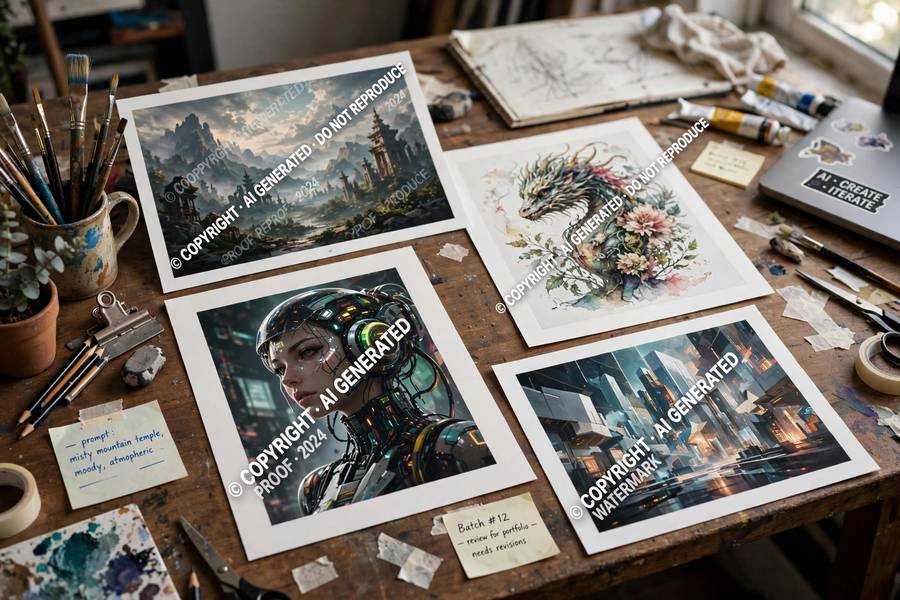
In the United States, a purely AI-generated image — one you produced by typing a prompt and taking what the model gave you — almost certainly cannot be copyrighted by you. No copyright means no exclusive ownership: you can’t stop others from copying it, and you can’t really claim it as protected intellectual property. What you can do is use it, sell prints of it, and build on it — you just can’t lock others out of doing the same.
That distinction — use versus own — is the whole game. Most of the anxiety around AI art copyright dissolves once you separate “can I sell this?” (usually yes) from “can I stop others from using it?” (usually no). The rules below fill in the edges, because the edges are where real projects live.
The Human-Authorship Requirement
US copyright law protects “original works of authorship.” For over a century, courts and the Copyright Office have read “authorship” to mean human authorship. A monkey’s selfie can’t be copyrighted (yes, that was a real case). A garden arranged by nature can’t be. And — the current position — an image generated by an AI model from a text prompt can’t be, because the human didn’t actually author the expressive choices.
The reasoning goes like this: when you type “a lighthouse at dusk,” you specified an idea. The model made thousands of micro-decisions — composition, brushwork, color relationships, texture — that constitute the actual expression. Copyright protects expression, not ideas. Since the machine produced the expression, there’s no human author, and with no author there’s no copyright.
I find this logic coherent even if I don’t love every consequence. It also draws a clean line that matters for the next section: the more expressive decisions you make, the stronger your claim gets.
What the US Copyright Office Actually Said
The US Copyright Office has addressed AI-generated works directly, and its position has been consistent: it will register works containing AI-generated material only where there is sufficient human authorship, and it will refuse registration for works produced by a machine operating “randomly or automatically without any creative input or intervention from a human author.”
The practical landmarks:
- 2023 guidance: The Office confirmed it evaluates AI-assisted works case by case, asking whether the AI’s contributions are “the result of mechanical reproduction” or reflect the author’s “own original mental conception.” Prompts alone, it said, function more like instructions to a commissioned artist than authorship — you told the artist what to paint, but the artist painted it.
- The registration form question: The Office now asks applicants to disclose AI-generated content and disclaim it, registering only the human-authored portions. If your comic has AI-generated panels and human-written dialogue, the dialogue can be registered; the panels can’t.
- The direction of travel: Every statement has reinforced the human-authorship line rather than softening it. Don’t bet on a reversal.
The commissioned-artist analogy is the one to remember. Typing a prompt is like hiring a painter and describing the painting. The description isn’t the painting, and describing isn’t authoring.
The Cases That Set the Tone
A few real disputes shaped the current landscape:
Thaler v. Perlmutter (2023). Stephen Thaler tried to register an AI-generated image listing the AI as the author. The court upheld the Copyright Office’s refusal: copyright requires a human author, full stop. This closed the door on “the AI owns it” as a workaround.
Zarya of the Dawn (2023). Kristina Kashtanova’s graphic novel used Midjourney-generated images with human-written text and arrangement. The Office granted copyright for the text and the selection/arrangement of images — the human-authored parts — but not the individual AI-generated images. This is the template case: hybrid works get partial protection, split along the human/machine line.
The Théâtre d’Opéra Spatial episode (2022). Jason Allen’s AI-generated piece won a Colorado state fair art competition, sparking the whole public debate. He later sought copyright registration and was refused for the AI-generated elements. Winning a prize and owning a copyright turned out to be very different things.
The pattern across all of them: courts and the Office keep landing in the same place. Pure AI output: no copyright. Human creative contribution on top: that contribution is protectable. The image itself remains unprotectable.
Where Human Touch Changes Everything
Here’s where it gets practical and, frankly, encouraging. The rule isn’t “AI touched it, it’s unprotectable” — it’s about how much human creative expression is in the final work.
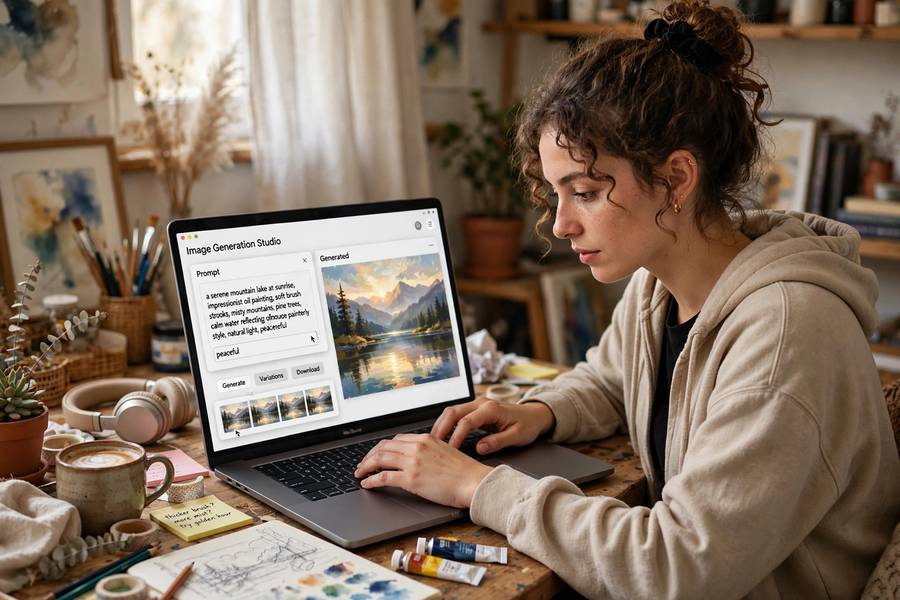
Likely protectable: You generate a base image, then substantially transform it — detailed Photoshop compositing, manual painting over, creative arrangement into a larger designed work, significant curation and editing that reflects creative judgment. The Zarya precedent says your contributions are yours.
Gray area: Heavy prompt engineering — 200 iterations, carefully crafted negative prompts, precise parameter tuning. The Office’s current stance treats even elaborate prompting as instructions, not authorship. I personally think this undervalues the craft involved, but it’s the current rule, and I’d never advise a client to rely on prompt-craft alone for protection.
Not protectable: Type prompt, take first result, post it. This is the vast majority of AI art online, and none of it carries copyright.
My working rule: if you could plausibly describe what you created versus what the machine created, and your part involved genuine expressive choices, you have something. If your contribution was “I had the idea and pressed go,” you don’t.
What About Outside the US?
Copyright is territorial — the rules change at the border, and the world hasn’t converged:
- UK: Uniquely, UK law has a provision for “computer-generated works” granting 50 years of protection to the person who made the arrangements for creation. In theory, this covers AI output. In practice, it’s untested at scale for modern generative AI, and experts disagree about how courts will apply a 1980s provision to diffusion models.
- EU: The trend follows the human-authorship line — originality requires the author’s “own intellectual creation,” which implies a human. No member state has firmly established AI-output copyright.
- China: A 2023 Beijing court decision actually granted copyright to AI-generated images in one case, finding sufficient human intellectual input in the prompting process. It’s one decision, not a settled doctrine, but it’s the most pro-protection ruling anywhere so far.
- Everyone else: Most jurisdictions haven’t ruled definitively. The default assumption worldwide is: no clear protection for pure AI output.
If you operate internationally, the safest posture is the strictest one — assume no copyright in the AI-generated elements, and build your protection on the human-authored layers.
Can You Still Sell AI Art?
Yes — and this is the part people get backwards. Copyright and commerce are different things. You don’t need to own the copyright to sell a poster, license an illustration to a client, or take commissions. What you lack without copyright is exclusivity: you can’t stop someone else from selling the same or a similar image.
Practical implications for sellers:
- Your business model can’t rely on exclusivity. Don’t sell “exclusive rights” to an AI image you can’t exclusively own. Sell the artifact, the service, the curation, the customization — things that don’t require copyright.
- Platform terms matter more than copyright law. Midjourney’s paid tiers grant commercial use rights; free tiers historically didn’t. How Midjourney works covers the tool, but always check the current terms of whatever generator you use — the license you get from the platform is separate from copyright.
- Client contracts need honesty. If a client expects to own exclusive rights to illustrations, AI-generated art may not deliver that. Disclose the limitation upfront; it’s a contract issue, not just a legal one.
- Your brand and curation are protectable. A distinctive style of selection, a curated collection, your marketing and presentation — these involve human authorship and can be protected even when individual images can’t.
My friend’s poster business? Still running. He just stopped promising exclusivity he couldn’t deliver, and leaned into curation and custom commissions — the human parts.
Protecting Your Work in Practice
Given the rules as they stand, here’s the pragmatic playbook:
- Add real human authorship. Edit, composite, paint over, arrange. The more transformative your touch, the stronger your claim to the result.
- Document your process. Save iterations, keep layered files, note your creative decisions. If authorship is ever questioned, a paper trail of human choices is your evidence.
- Disclose AI use where required. Copyright applications, stock platforms, and some marketplaces require AI disclosure. Non-disclosure can void protections you do have.
- Read platform licenses. Your generator’s terms define what commercial use is allowed. This is contract law doing the work copyright law won’t.
- Use contracts for client work. Spell out what rights transfer. Don’t let a client assume they’re buying exclusive copyright in something uncopyrightable.
- Watermark and monitor. Without copyright you can’t sue for infringement, but practical deterrents — watermarks, low-res previews, takedown requests on platforms — still reduce casual copying.
- Watch the law move. This area is evolving fast. The Beijing decision, pending legislation, new Office guidance — set a calendar reminder to re-check yearly if your livelihood depends on it.
None of this is as satisfying as “it’s mine, all mine.” But it’s the honest map of the territory, and honest maps beat comforting ones.
Frequently Asked Questions
In the US, purely AI-generated images likely can’t be copyrighted by anyone, since copyright requires human authorship. You can use and sell the images, but you generally can’t claim exclusive ownership or stop others from copying them.
Only the human-authored portions. The US Copyright Office refuses registration for purely AI-generated content but will protect human contributions like written text, creative selection and arrangement, or substantial manual editing layered on top of AI output.
Generally yes. Selling doesn’t require copyright ownership. Check your AI generator’s terms of service for commercial use rights, and don’t promise clients exclusive rights to images you can’t exclusively own.
Substantial human transformation — detailed compositing, manual painting, creative arrangement — can create protectable human authorship in the final work. Simple prompt engineering alone is currently treated as instructions, not authorship, by the US Copyright Office.
Yes. The US requires human authorship; the UK has an untested provision for computer-generated works; the EU leans toward human authorship; and a 2023 Beijing court granted copyright to AI images in one case. Assume the strictest rule if you operate internationally.