Let me save you some time: nobody is getting rich selling raw, unedited Midjourney generations as “art prints” anymore. That window opened in 2022 and closed hard. What’s left — and it’s real — is a set of narrower, more honest markets where AI art sells because it solves a problem or serves a taste, not because it’s novel. I spent a few months studying sellers who actually move product, and the pattern is clear: the winners sell curation, customization, and convenience. The losers sell “I typed a prompt.” Here’s the map. For the bigger creative question, see can AI make art.
Table of Contents
- The Honest State of the Market
- What Actually Sells (and What Doesn’t)
- Platforms: Where to List
- Print-on-Demand vs. Selling Files vs. Physical Prints
- Pricing Without Guessing
- The Legal and Disclosure Basics
- Marketing: How Buyers Find You
- Building Something That Lasts
- Frequently Asked Questions
The Honest State of the Market
The AI art market has matured past its gold-rush phase, and the honest picture has three parts:
Supply exploded; generic supply is worthless. Millions of AI images flood every marketplace. A generic “fantasy landscape #4,000,001” has no scarcity, no story, and no buyer. The novelty premium is gone — nobody buys AI art because it’s AI anymore.
Demand concentrated in niches. What sells now: art matched to specific tastes (cottagecore botanicals, dark academia portraits, minimalist Japandi abstracts), art serving specific uses (book covers, game assets, printable wall decor in trending styles), and customized/personalized pieces. Specificity beats quality; quality beats novelty.
The money is in the service layer. The sellers I watched succeed weren’t selling images — they were selling outcomes: “your pet as a Renaissance portrait,” “a matching gallery-wall set in sage green and cream,” “custom D&D character art in 48 hours.” The AI is the production method; the product is the curation, customization, and convenience wrapped around it.
Bottom line: treat this like any small creative business. The AI part is 20% of the work. The other 80% — niching, presentation, customer service, marketing — is what determines whether you sell anything.
What Actually Sells (and What Doesn’t)
Based on what’s visibly moving across marketplaces:
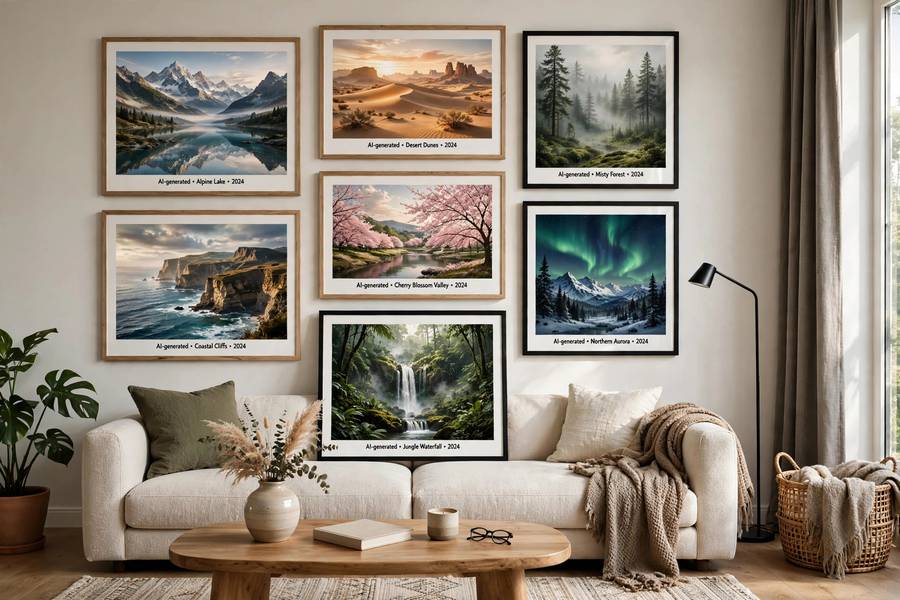
Sells: niche wall decor sets. Coordinated print sets (3-6 pieces) in a defined style and palette for specific aesthetics — boho, Japandi, dark academia, coastal grandmother, whatever’s trending. Buyers aren’t buying “AI art”; they’re buying a solved decorating problem. Sets outsell singles because they answer “what goes together?”
Sells: personalized pet and family portraits. “Your dog as a Victorian aristocrat” remains evergreen because it’s funny, giftable, and personal. The personalization — their pet — is the product; AI is just the fast brush.
Sells: book covers and creative assets. Self-published authors need covers; indie game devs need sprites and backgrounds; content creators need thumbnails. These buyers care about fit-for-purpose and price, not provenance. (This is a whole sub-business — more below.)
Sells: printable party and event designs. Invitations, nursery art, seasonal decor — high-volume, trend-driven, price-sensitive. AI’s speed is a genuine advantage here.
Doesn’t sell: generic single prints. One more moody astronaut, one more neon city. The market is drowning in these. Unless your single image is genuinely exceptional or perfectly on-trend, it vanishes.
Doesn’t sell: “AI art” as the pitch. Leading with the technology dates you to 2022 and attracts bargain hunters. Lead with the style, the use case, the feeling. Nobody buys a painting because of the brush brand.
Doesn’t sell: uncurated dumps. Uploading 500 raw generations to a marketplace isn’t a store; it’s a junk drawer. Every successful seller I studied had tight, curated collections — 30-80 pieces max, coherent style, clear theme.
One more lever on cost: the generator you use. If you’re weighing the free, open-source route against paid subscriptions, my breakdown of what Stable Diffusion is will help you pick the right tool for your workflow.
Platforms: Where to List
Different platforms, different games:
Etsy. The natural home for printable wall art and personalized pieces. Buyers already shop for decor here; search-driven discovery works in your favor. Fees are real (listing + transaction + payment processing), so price accordingly. Competition is fierce — niching down is mandatory, not optional.
Print-on-demand marketplaces (Redbubble, Society6, TeeSpring-style). Zero upfront cost, zero inventory — upload designs, they print and ship, you take a margin. The tradeoff: thin margins and total dependence on their traffic. Good for testing which designs resonate before investing further.
Your own site (Shopify, Squarespace). Highest margins, full control, but you’re also the entire marketing department. Worth it once you have an audience or a clear niche; premature if you’re starting from zero traffic.
Stock/asset sites (Adobe Stock accepts AI content with disclosure; various asset marketplaces). Selling to creators rather than consumers — lower per-sale prices, higher volume potential, and buyers who care about utility over uniqueness.
Fiverr/Upwork (services, not products). Custom AI art services — pet portraits, book covers, character art. You’re selling labor and turnaround, which sidesteps the “why pay for something AI made” objection because the client is paying for their thing, made to order.
Social + DMs. TikTok and Instagram sellers move surprising volume through “comment your pet’s name” style content funnels. It works, but it’s a content-creation job wearing an art-store costume.
My recommendation for starting: Etsy for products or Fiverr for services — both have built-in buyer traffic, so you learn what sells before investing in your own storefront.
Print-on-Demand vs. Selling Files vs. Physical Prints
Three fulfillment models, three different businesses:
Print-on-demand (POD). You upload; the service prints and ships per order. Pros: no inventory, no upfront cost, global shipping handled. Cons: thin margins (often a few dollars per sale), limited quality control, your work sits alongside millions of others. Best for: testing designs, passive-ish income, zero-capital starts.
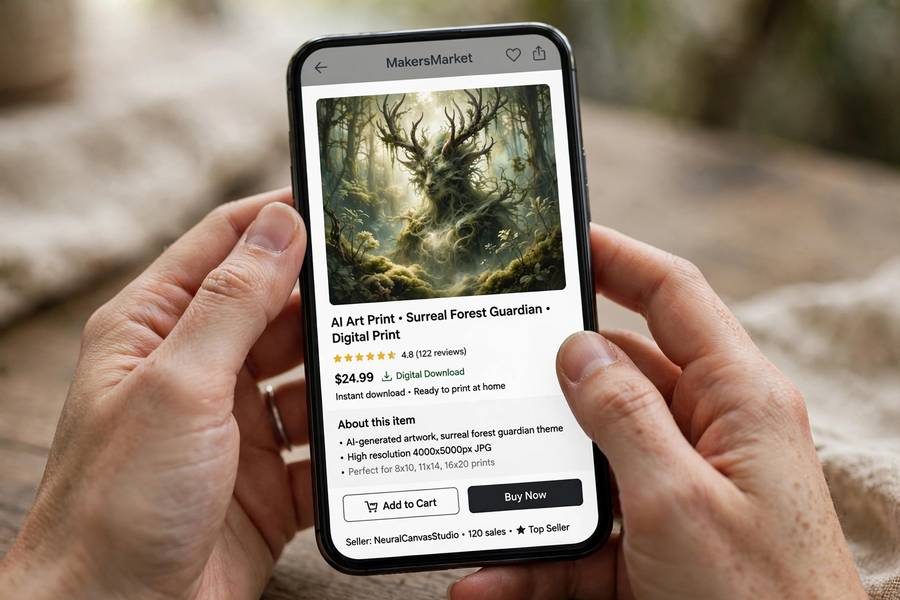
Digital downloads. You sell the file; the buyer prints it themselves. Pros: near-100% margins, instant delivery, no shipping. Cons: piracy is trivial (it’s a file), buyers need to handle printing, price ceiling is low ($3-15 typical). Best for: printable wall art, planners, party designs — high-volume, low-price niches.
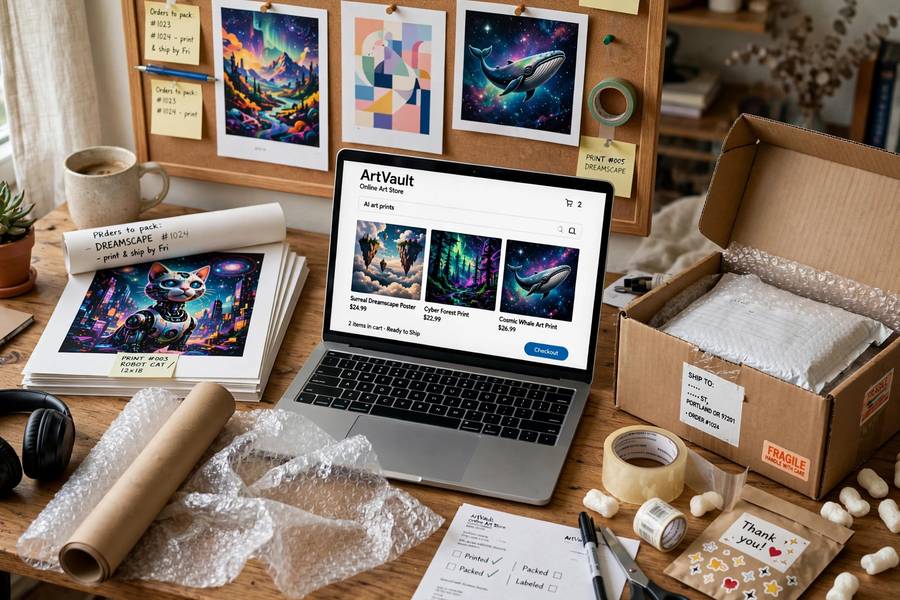
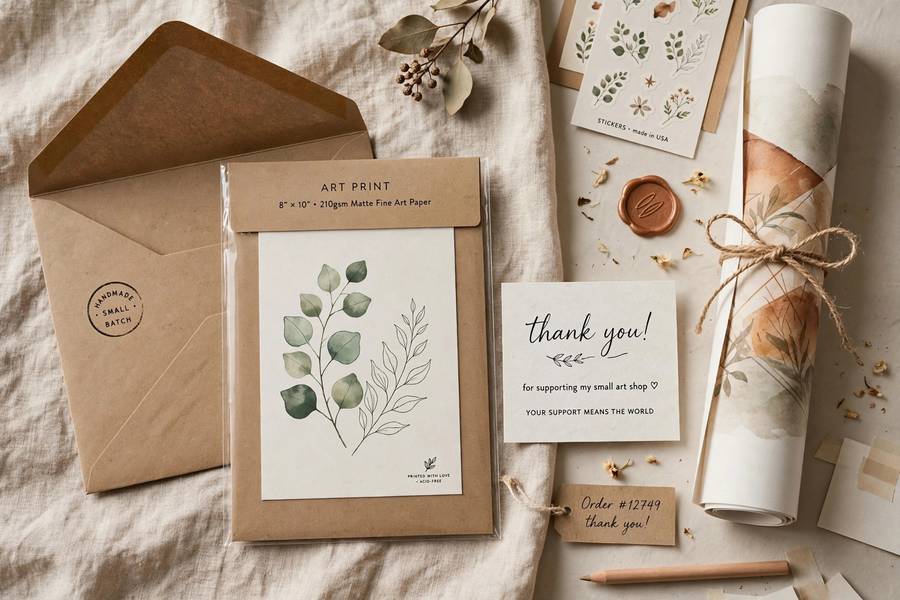
Physical prints you fulfill. You print (local print shop or home printer), package, and ship. Pros: best margins on premium products, quality control, unboxing experience you design. Cons: upfront costs, inventory, shipping logistics, your time. Best for: premium positioning, local markets, gift products where presentation matters.
Most successful sellers I studied used a ladder: start with POD or downloads to validate designs, then move winners to self-fulfilled physical prints at premium prices. Let the market tell you what’s worth investing in.
Pricing Without Guessing
Pricing AI art trips people up because the production cost is near zero. Forget cost-plus pricing; price on positioning:
- Digital downloads: $3-15. The market has spoken; fighting it is optional and usually futile. Compete on volume and collection size.
- POD products: whatever the platform’s base + your margin — typically $5-15 profit per item. Price at the platform’s normal range for the product type; undercutting signals low quality.
- Self-fulfilled prints: $25-150+ depending on size, framing, and presentation. Here you’re selling a product, and product pricing follows perceived value — good photography, nice packaging, and a coherent brand justify the upper end.
- Custom services: $20-200+ per piece depending on complexity and turnaround. Price the service (consultation, revisions, speed), not the image.
Three pricing rules that matter more than the numbers:
- Never compete on price alone. Someone will always undercut you to zero. Compete on niche, style, curation, service.
- Anchor with a premium option. A $120 framed set makes the $35 print look reasonable. Decoy pricing works on art buyers too.
- Raise prices as you get proof. First ten sales at low prices for reviews and validation, then raise. Your early prices are market research, not your forever prices.
The Legal and Disclosure Basics
The unsexy part that protects you:
- Check your generator’s commercial terms. Midjourney’s paid plans include commercial rights; free tiers historically didn’t. Every platform differs — read the actual terms, not a summary. This is the single most important legal step and it takes ten minutes.
- Disclose AI use where required. Etsy requires disclosure of AI-generated content in relevant categories; Adobe Stock requires it; some marketplaces ban undisclosed AI content. Non-disclosure risks takedowns and account strikes.
- Don’t promise exclusivity you can’t deliver. AI-generated images generally can’t be copyrighted (in the US), which means you can’t guarantee a buyer exclusive rights. Sell the product or service, not exclusivity — and say so in your terms if relevant.
- Trademarks still apply. Generating “Mickey Mouse as a cyberpunk warrior” and selling it is trademark infringement regardless of how the image was made. AI doesn’t launder IP violations.
- Watch for lookalikes. If your generation closely resembles a living artist’s distinctive style or a copyrighted character, you’re in risky territory even if unintentional. When in doubt, regenerate with more original direction.
For real disputes or significant revenue, check official guidance from the Copyright Office and each platform’s terms. But handling these five points covers the vast majority of what trips up small sellers.
Marketing: How Buyers Find You
“If you list it, they will come” is not a strategy. What works:
SEO on marketplace search. Etsy is a search engine wearing a store costume. Titles, tags, and descriptions should mirror what buyers type: “sage green abstract wall art set,” not “ethereal dreamscape no. 7.” Study the search terms in your niche and match them.
Pinterest as a discovery engine. Wall art and decor are Pinterest-native categories. Pin your products with keyword-rich descriptions; Pinterest traffic compounds over time and converts well for visual products.
Short-form video for personalized products. The “watch me turn your pet into art” format is endlessly watchable and drives custom orders directly. One viral video can fill an order queue for weeks.
Email list from day one. Marketplace customers are rented; email subscribers are owned. A simple “10% off your first order” capture on your own site builds an asset no algorithm change can take away.
Mockups that sell the outcome. Nobody buys a JPEG; they buy “this on my wall.” Invest in good mockup photography (or quality mockup templates) showing your art in real rooms, on real products. Presentation is the difference between a $5 download and a $60 framed print of the same file.
Building Something That Lasts
The sellers who survive market shifts share traits worth copying:
- A recognizable style. Not “AI art” — a look. Buyers follow aesthetics, and a coherent feed/collection builds repeat customers. Develop 2-3 signature styles and go deep.
- An audience, not just listings. The sellers with newsletters, social followings, or repeat-buyer bases weather algorithm changes. Listings are inventory; audiences are businesses.
- Adjacent revenue. The art store funds the audience; the audience funds courses (“how I make my wall art”), affiliate tools, custom work, licensing. Diversification isn’t greed — it’s survival in a market where any single product can be undercut.
- Real human touchpoints. Hand-written thank-you notes, custom tweaks, responsive messages — the human layer is your moat against both competitors and the “soulless AI” perception. Ironically, selling AI art successfully requires being more human, not less.
The through-line of everything above: the AI is the least interesting part of an AI art business. Taste, niching, presentation, service — the ancient fundamentals of selling creative work — are the whole game. The tool changed; the business didn’t.
Frequently Asked Questions
Yes, but not by selling generic generations. Successful sellers focus on niches (coordinated wall decor sets, personalized pet portraits, book covers), sell curation and customization rather than raw images, and treat it as a real creative business.
Etsy works well for printable wall art and personalized pieces thanks to built-in buyer traffic. Print-on-demand sites (Redbubble, Society6) need no upfront cost. Fiverr and Upwork suit custom AI art services like pet portraits and book covers.
Generally yes, provided your AI generator’s terms allow commercial use (e.g., Midjourney paid plans). Disclose AI use where platforms require it, don’t promise exclusive rights you can’t deliver, and avoid trademarked characters or distinctive living artists’ styles.
Price on positioning, not production cost: digital downloads $3-15, print-on-demand items at platform norms, self-fulfilled prints $25-150+ based on presentation, custom services $20-200+ based on complexity. Never compete on price alone.
Niche wall decor sets in trending aesthetics, personalized pet and family portraits, book covers and game assets, and printable event designs. Generic single images and uncurated bulk uploads consistently fail to sell.