The two giants of AI image generation couldn’t be more different in philosophy: Stable Diffusion is open-source, runs on your own hardware, and can be customized endlessly — if you’re willing to tinker. Midjourney is a polished closed service that produces stunning images from simple prompts — if you’re willing to pay and play by its rules.
I’ve used both extensively, and the honest answer to “which is better” is “better at what, for whom?” This comparison covers quality, cost, control, ease of use, and the practical trade-offs — so you can pick the right tool for your needs. For background on the open-source contender, see my guide on what is Stable Diffusion.
In This Guide
- The Quick Verdict
- How They Differ: Open vs. Closed
- Image Quality Comparison
- Ease of Use
- Cost Comparison
- Customization and Control
- Commercial Use and Licensing
- Which Should You Choose?
- Frequently Asked Questions
The Quick Verdict
| Stable Diffusion | Midjourney | |
|---|---|---|
| Philosophy | Open-source, yours to run | Polished closed service |
| Image quality | Excellent (with effort) | Stunning (out of the box) |
| Ease of use | Technical setup required | Extremely simple |
| Cost | Free (your hardware/electricity) | Subscription ($10–$60+/mo) |
| Customization | Unlimited (models, training, code) | Limited to parameters |
| Privacy | Everything stays local | Prompts processed on their servers |
| Best for | Tinkerers, developers, specific needs | Artists, designers, quick results |
One-line summary: Midjourney if you want beautiful images now; Stable Diffusion if you want control and don’t mind working for it. For the mechanics behind Midjourney’s side of this, see how Midjourney works.
How They Differ: Open vs. Closed
This is the fundamental divide, and it shapes everything else:
Stable Diffusion is open-source. The model weights are public. You download them, run them on your own GPU, modify them, fine-tune them on your own images, build products on them. No account, no subscription, no one watching your prompts. A massive community has built thousands of custom models, tools (like AUTOMATIC1111, ComfyUI), and extensions.
Midjourney is a closed service. You access it through Discord or their web app; the model runs on their servers. You can’t download it, inspect it, or modify it. What you get is a refined experience — carefully tuned defaults, beautiful aesthetics baked in, and continuous improvements you receive automatically.
The trade-off: openness gives you freedom and privacy but demands technical effort. Closedness gives you polish and simplicity but demands money and trust. Neither is wrong — they’re optimized for different users.
A note on the landscape: this comparison focuses on the two most culturally significant options, but the field includes DALL-E (OpenAI’s, integrated with ChatGPT), Adobe Firefly (commercially-safe training data), and others. The open-vs-closed framing applies broadly.
Image Quality Comparison
The honest assessment, as of 2026:
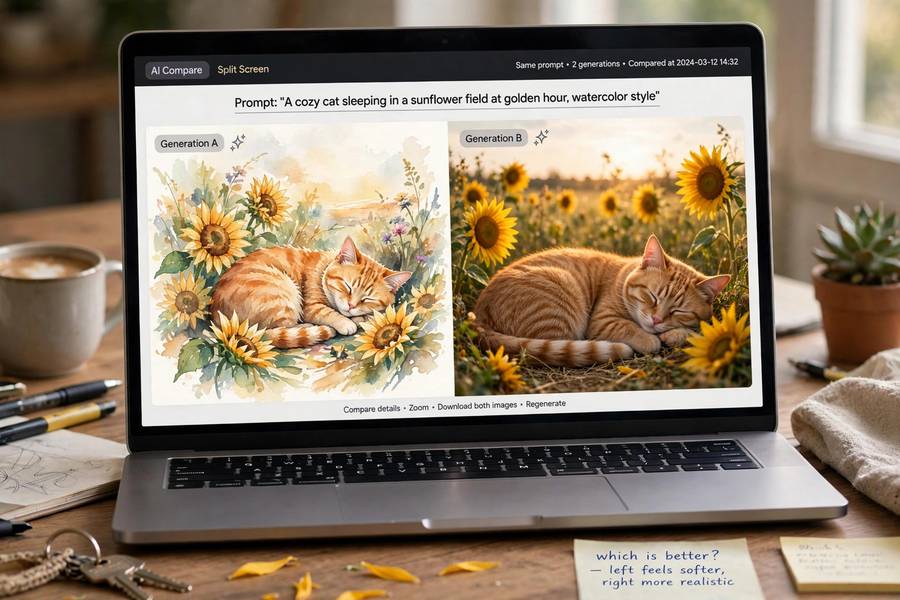
Out of the box, Midjourney wins. Give both the same simple prompt (“a cozy cabin in snowy mountains at dusk”), and Midjourney’s output will typically look more polished — better composition, richer detail, more aesthetically pleasing. Midjourney’s team has tuned their model relentlessly for beauty, and it shows. Their default aesthetic is so distinctive that “Midjourney look” is recognizable.
With effort, Stable Diffusion matches or exceeds. The base Stable Diffusion model is a starting point, not the ceiling. With the right custom model (there are thousands fine-tuned for photorealism, anime, specific styles), careful prompting, and tools like ControlNet (for pose/composition control), skilled users produce results rivaling or surpassing Midjourney — for their specific needs.
The difference: Midjourney optimizes for impressive average output; Stable Diffusion optimizes for ceiling with effort. If you want great images from lazy prompts, Midjourney. If you want exactly the image you envisioned and will work for it, Stable Diffusion’s controllability wins.
Specific strengths: – Photorealism: both excellent; Stable Diffusion has more specialized photoreal models – Artistic/stylized: Midjourney’s default aesthetic is hard to beat for beauty – Consistency (same character across images): Stable Diffusion, via training custom LoRAs — Midjourney has improved but SD’s fine-tuning is more powerful – Text in images: both improved significantly; check current versions – Hands/anatomy: both improved; neither perfect
Ease of Use
Midjourney: trivially easy. Type /imagine + your prompt in Discord (or use the web interface), get four images in under a minute. Variations, upscaling, and remixing are button clicks. A complete beginner produces stunning images in five minutes. This ease is Midjourney’s superpower — it removed every barrier between imagination and image.
Stable Diffusion: a project. The path looks like: choose an interface (AUTOMATIC1111 for simplicity, ComfyUI for power), install it, download models (choosing from thousands), configure settings, learn prompting syntax, troubleshoot GPU issues. A beginner might spend a weekend before their first good image. But that weekend buys permanent, free, unlimited capability.
The middle ground: hosted Stable Diffusion services (various web UIs) offer SD’s models without the setup — but then you’re paying similarly to Midjourney while getting less polish. The real SD advantage is local operation.
My take: ease-of-use isn’t just convenience — it determines who gets to participate. Midjourney democratized AI art for non-technical creatives; Stable Diffusion democratized it for everyone with a GPU and patience. Both expanded access, differently.
Cost Comparison
Midjourney: subscription-only. Tiers historically ranged from ~$10/month (limited generations) to $60+/month (unlimited relaxed generations), with annual discounts. No free tier (they discontinued it). Costs are predictable: you pay monthly, you generate.
Stable Diffusion: the software is free. The costs are: – Hardware: a decent GPU (6GB+ VRAM minimum, 12GB+ comfortable). If you already have one, marginal cost is ~zero. If buying, $300–$1,500+. – Electricity: non-trivial for heavy generation, but modest for typical use. – Time: setup, learning, troubleshooting — the real cost, and substantial.
Break-even math: if you already own a capable GPU, Stable Diffusion is essentially free forever — unbeatable for heavy users. If you’re buying hardware for SD, compare against ~2 years of Midjourney subscription. For light/occasional use, Midjourney’s $10 tier is cheaper than any hardware purchase.
Hidden costs: Midjourney’s subscription incentivizes using it (sunk cost); SD’s setup incentivizes learning it (sunk effort). Both shape behavior beyond the dollars.
Customization and Control
Where the philosophical difference becomes practical:
Stable Diffusion lets you: – Fine-tune on your own images (your face, your product, your art style) – Train LoRAs (lightweight style/subject adapters) in hours on consumer hardware – Use ControlNet for precise pose, depth, and composition control – Swap models freely (photoreal, anime, architectural, cinematic…) – Build it into your own applications and products – Run fully offline — no internet, no account, no oversight
Midjourney lets you: – Adjust via parameters (–ar for aspect ratio, –style, –chaos, version selection) – Remix and vary images easily – Use style references and character references (their implementation is user-friendly) – That’s… about it. The model itself is a black box you can’t modify.
For professionals with specific needs (consistent brand characters, product visualization, specialized styles), SD’s fine-tuning is transformative — Midjourney can’t do “my client’s mascot in 50 poses.” For general creative exploration, Midjourney’s simplicity wins — most people don’t need fine-tuning.
Commercial Use and Licensing
Practical, not legal advice — check current terms yourself:
- Midjourney: paid subscribers generally get commercial rights to images they create (terms have evolved; verify current policy). The company asserts rights over the service; you own your specific generations under their terms.
- Stable Diffusion: the open license (CreativeML Open RAIL-M) permits commercial use with behavioral restrictions (no illegal content, etc.). Images you generate locally are yours, full stop — no terms-of-service ambiguity.
The training-data question shadows both: lawsuits allege training on copyrighted works without permission. This affects the models’ legal standing more than individual users currently, but it’s unresolved — worth watching if you build a business on AI imagery.
My non-lawyer take: for commercial work, SD’s local generation gives cleaner ownership (nothing uploaded, no service terms on your outputs). But consult actual counsel for business-critical decisions.
Which Should You Choose?
Choose Midjourney if you: – Want beautiful images immediately, with minimal learning – Are a designer, artist, or creative who values aesthetics over control – Don’t have a capable GPU and don’t want to buy one – Prefer subscriptions over setup projects – Value simplicity over customization
Choose Stable Diffusion if you: – Want unlimited free generation (and have/plan a GPU) – Need fine-tuning (your face, products, specific styles) – Care about privacy (everything local, nothing uploaded) – Are technical and enjoy tinkering – Want to build products or workflows on the model – Prefer owning your tools to renting them
Choose both if you: use Midjourney for quick exploration and Stable Diffusion for serious production work. Many professionals do exactly this — they’re complements, not rivals.
The meta-advice: start with whichever matches your temperament. Tinkerers who start with Midjourney get bored; artists who start with SD get frustrated. Know yourself, pick accordingly, and remember — the images matter more than the tool.
Stable Diffusion vs Midjourney is really openness vs polish, control vs convenience, owning vs renting. Midjourney makes AI art effortless; Stable Diffusion makes it yours. There’s no wrong answer — only the wrong tool for your particular needs. And in a field moving this fast, today’s comparison is a snapshot: the right move is picking the philosophy that fits you, because the specific models will keep evolving.
Frequently Asked Questions
Midjourney produces more polished images from simple prompts with zero setup; Stable Diffusion offers unlimited customization, local private generation, and fine-tuning — but requires technical setup. Choose Midjourney for ease and beauty, Stable Diffusion for control and ownership.
The software and model weights are free and open-source. You need a capable GPU (6GB+ VRAM) to run it locally — if you already own one, generation is essentially free forever. Midjourney requires a paid subscription ($10+/month).
Paid subscribers generally receive commercial rights to their generations under Midjourney’s terms (verify current policy). Stable Diffusion images generated locally have cleaner ownership — no service terms attach to your outputs. Neither is legal advice; check terms yourself.
Both are excellent. Midjourney’s default output is beautifully polished; Stable Diffusion with specialized photorealistic fine-tuned models can match or exceed it, especially for specific subjects. SD wins for consistent characters via custom training.
For local use, yes — a GPU with at least 6GB VRAM (12GB+ recommended). Without one, hosted Stable Diffusion web services offer the models without local hardware, though at that point costs approach Midjourney’s subscription.