
Every few months, a headline announces that an AI model “scores X% on SWE-bench,” and everyone nods as if that’s meaningful. I used to nod too, before I actually understood what the benchmark measures — and more importantly, what it doesn’t. SWE-bench is genuinely one of the most important evaluations in AI right now, because it tests something benchmarks usually avoid: can the AI do real work, on real code, with real consequences for being wrong?
SWE-bench is a benchmark that evaluates AI coding agents on real GitHub issues from popular open-source Python repositories. This guide explains how it works, how scoring happens, what the leaderboard tells us, and how to read those headlines critically. For context on the agents being tested, see my explainer on how AI agents work.
Table of Contents
- The Problem With Coding Benchmarks
- How SWE-Bench Works: Real Issues, Real Tests
- The Dataset: 2,294 Tasks From the Wild
- How Scoring Works: Tests Don’t Lie
- SWE-Bench Verified and the Variant Zoo
- Reading the Leaderboard: What Scores Mean
- What SWE-Bench Doesn’t Measure
- Why It Changed Agent Development
- How to Use SWE-Bench Thinking in Your Own Work
- Frequently Asked Questions
The Problem With Coding Benchmarks
Classic coding benchmarks like HumanEval ask models to write small functions from docstrings — “write a function that returns the nth Fibonacci number.” These test code generation in a vacuum: no existing codebase, no dependencies, no ambiguity.
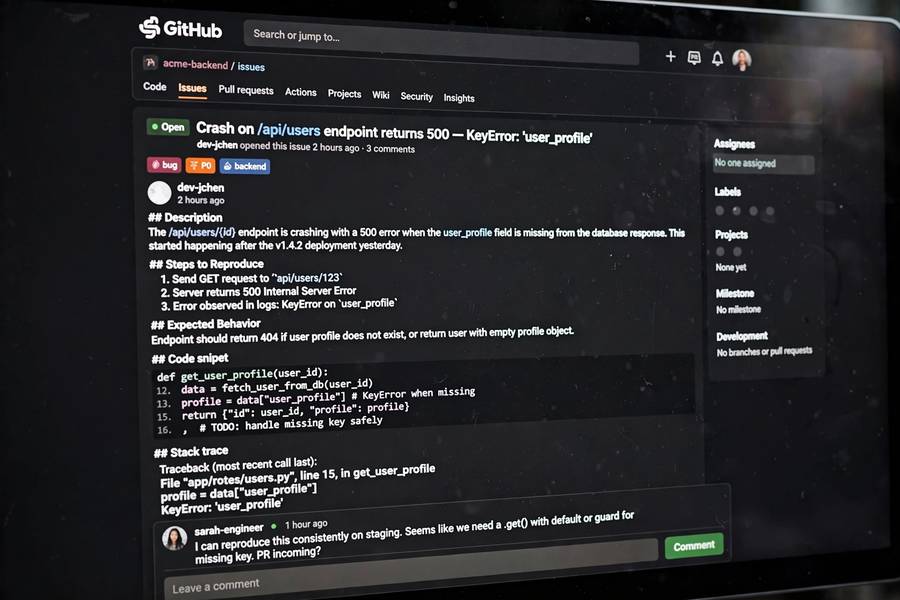
Real work: a bug report from a frustrated user, a repository with 50,000 lines you didn’t write — figure out what’s wrong, fix it without breaking anything else. The gap between “write Fibonacci” and “fix this issue” is the gap between a spelling test and a novel. SWE-bench measures the novel.
This matters: models aced HumanEval while being useless at real engineering, and the numbers created false confidence. SWE-bench’s creators understood that evaluation drives development — measure the wrong thing and you optimize for the wrong thing. They measured the real thing, messiness included.
How SWE-Bench Works: Real Issues, Real Tests
The elegant core idea: take a real GitHub issue plus the actual pull request that resolved it. Give an agent the issue text and the repo at the state before the fix, ask it to produce a fix, then evaluate: does the agent’s fix pass the tests?
The evaluation uses the repo’s own test suite: FAIL_TO_PASS tests failed before the real fix and must pass after; PASS_TO_PASS tests passed before and must stay green. An agent “solves” the task only if its patch flips the failing tests while keeping everything else green.
This design is brilliant three ways: objective (tests pass or fail, no LLM judge), realistic (actual problems developers faced, ambiguity included), and adversarial to memorization (the agent must navigate an unfamiliar codebase and produce a working change).
The agent works like a developer: browse the repo, read files, reproduce the issue, write a fix, run the tests, iterate. This is why SWE-bench became the benchmark for coding agents — it tests what the agent can do, not what the model knows.
The Dataset: 2,294 Tasks From the Wild
The original SWE-bench contains 2,294 task instances from 12 popular Python repositories — Django, SymPy, scikit-learn, matplotlib, requests. Battle-tested libraries with rigorous test suites and demanding maintainers.
Each instance bundles: the issue text (often incomplete, sometimes confusing, always human), the repo snapshot at the parent commit of the fix, the test patch (tests added by the real fix, applied at evaluation), and metadata. The agent never sees the real fix — the evaluation uses its tests as ground truth.
The variety is the point: some issues are one-line fixes, others require deep architectural understanding. This variance mirrors real engineering, where problem finding is often harder than problem solving.
Constructing this dataset took serious engineering — mining GitHub for issue-PR pairs, verifying test discrimination, containerizing each repo state. Benchmarks this good don’t happen by accident.
How Scoring Works: Tests Don’t Lie
The scoring rule is simple: a task is solved if the patch makes all FAIL_TO_PASS tests pass while keeping PASS_TO_PASS green. The headline number — “X% on SWE-bench” — is the fraction solved.
Why it’s robust: evaluation uses the repository’s own tests, so gaming requires actually fixing the bug; PASS_TO_PASS tests mean sloppy fixes that break other functionality don’t count.
Edge subtleties: the benchmark doesn’t judge elegance, only correctness — an uglier fix scores the same. A “morally correct” fix can fail on brittle tests. Acceptable tradeoffs: at scale, tests are the best proxy for functional correctness.
Evaluation happens in containers with the real repo and dependencies — an agent operating in a realistic development environment. Scores reflect system capability (agent + tools + model), not just model capability.
SWE-Bench Verified and the Variant Zoo
The original dataset had quality issues — underspecified tasks, flaky tests, unresolvable issues. In response, OpenAI and partners released SWE-bench Verified: 500 human-validated tasks. The canonical leaderboard set — headline numbers are usually on Verified.
The variant zoo expanded: SWE-bench Multimodal (JS/TS, visual elements), live variants with continuously refreshed issues (anti-contamination), and training variants like SWE-Gym that flip the benchmark into RL training data.
When reading headlines, check which variant the number refers to — the variant is part of the claim.
Reading the Leaderboard: What Scores Mean
The trajectory: early 2024’s best systems solved ~15-20% of Verified tasks. Through 2024 into 2025, scores climbed — 30%, 40%, 50%, past 60%, frontier systems pushing toward 70%+. Each jump meant real capability gains: better tool use, planning, test-driven iteration.
What does 70% mean? The agent resolves seven in ten real GitHub issues in these repos — remarkable, but not “70% of a developer.” Solved tasks skew easier; these are Python library issues with good test suites — the friendliest possible evaluation environment.
Top systems share patterns: strong base models, agentic loops with test execution (write fix, run tests, iterate), good repo navigation, specialized scaffolding. The write-run-fix loop that coding agents run — AI agent examples in real life shows it in production — is essentially what SWE-bench rewards. The benchmark didn’t just measure progress; it shaped it, by defining what good looks like.
A skeptical note: leaderboard scores come from labs incentivized to optimize for the benchmark — tuned scaffolding, best-of-many attempts reported. Treat them as “what’s possible,” not “what you’ll get.”
What SWE-Bench Doesn’t Measure
Critical literacy requires knowing the gaps:
It doesn’t measure code quality. A hacky fix that passes tests scores the same as an elegant one. Real engineering values maintainability, and the benchmark is blind to it.
It’s Python-library-centric. Web development, systems programming, mobile, DevOps — vast territories of software engineering look different from fixing Django bugs. Generalizing from SWE-bench to “coding ability” overstates the evidence.
It doesn’t test greenfield development. Every task starts from an existing codebase with existing tests. Designing systems from scratch and making architectural decisions — none of this is measured.
It doesn’t measure collaboration. Real developers discuss, review, negotiate requirements. SWE-bench agents work alone from a static issue description.
Issue quality varies. Some issues are well-specified; others are cryptic. An agent failing a cryptic issue might have failed where a human would have asked a clarifying question — but the benchmark doesn’t allow questions. This penalizes a very human and very correct behavior.
Contamination is a permanent shadow. Popular repositories’ issues may appear in training data. The Verified set and live variants mitigate this, but perfect decontamination is impossible to prove.
None of this invalidates the benchmark. It just means “scores X% on SWE-bench” is the beginning of understanding, not the end. The right question is always: “X% on which variant, with what scaffolding, and what does that imply for my use case?”
Why It Changed Agent Development
SWE-bench’s influence goes beyond measurement — it reorganized how the field builds coding agents. Before it, “coding AI” mostly meant autocomplete and chat. After it, the target became clear: agents that can independently resolve real issues, verified by tests.
Three shifts trace directly to it. First, test-driven agent loops became standard architecture — the write-run-fix cycle is what the benchmark rewards, and what the benchmark rewards gets built. Second, repository understanding became a first-class problem — navigating unfamiliar code turned out to be as important as writing the fix. Third, evaluation culture improved across AI — SWE-bench showed execution-based, real-world evaluation was feasible, inspiring similar benchmarks elsewhere.
There’s a meta-lesson here about benchmarks as coordination mechanisms. SWE-bench gave hundreds of teams a shared target and a shared scoreboard. Progress that might have taken years of scattered effort compressed into months of focused competition. Whatever you think of benchmark-chasing, its power to focus a field is undeniable.
How to Use SWE-Bench Thinking in Your Own Work
You probably don’t need to run the benchmark, but its philosophy transfers:
Evaluate with execution, not vibes. If your agent writes code, run the code. If it produces analysis, check it against ground truth. SWE-bench’s core insight — tests don’t lie — applies to any agent evaluation. LLM-judged evals have their place, but execution-based checks are the gold standard wherever they’re feasible.
Test on real tasks, not toy ones. The benchmark’s power comes from real GitHub issues with real ambiguity. Your internal evals should similarly use real examples from your actual workload — not sanitized demos. The messiness is the point; it’s where agents actually fail.
Measure the system, not the model. SWE-bench scores reflect agent scaffolding plus model plus tools. When evaluating your own agents, vary the scaffolding too — better tool design and iteration loops often beat model upgrades.
Frequently Asked Questions
SWE-bench is a benchmark that evaluates AI coding agents on real GitHub issues from popular Python repositories. Agents receive an issue description and the pre-fix codebase, produce a patch, and are scored on whether the repository’s own tests pass — FAIL_TO_PASS tests must flip to passing, PASS_TO_PASS tests must stay green.
A task counts as solved only if the agent’s patch makes all previously-failing tests pass while keeping all previously-passing tests passing. The headline score is the percentage of tasks solved. Evaluation runs in containers with the real repository, so scores reflect whole agent systems, not just models.
SWE-bench Verified is a 500-task subset human-validated as well-specified and fairly testable, addressing quality issues in the original 2,294-task dataset. It’s the canonical set for leaderboard comparisons — headline numbers usually refer to Verified unless stated otherwise.
They measure what fraction of real GitHub issues an agent system can resolve, verified by tests. Scores climbed from ~15% to 70%+ on Verified, showing real progress. But they’re ceiling numbers under favorable conditions — they don’t measure code quality, greenfield design, or collaboration, and contamination can’t be fully ruled out.
It was among the first benchmarks to test what agents can do rather than what models know, using real tasks with objective test-based evaluation. It shaped agent development — popularizing test-driven write-run-fix loops — and demonstrated that execution-based, real-world evaluation focuses a field effectively.