The Best Way to Learn AI for Beginners (An Honest 2026 Guide)


Everyone wants to learn AI right now, and everyone has a course to sell you. Most advice falls into two useless camps: “just watch YouTube tutorials” (too shallow) or “start with linear algebra and calculus” (a great way to quit by week three). The truth is somewhere in between, and it depends on what you actually want from AI.
I’m going to give you the path I’d recommend to a smart friend starting from zero — the sequence that builds real understanding without unnecessary suffering. No course pitches, no affiliate links, just the honest curriculum. For the complete deep-dive, see my full guide on how to learn artificial intelligence.
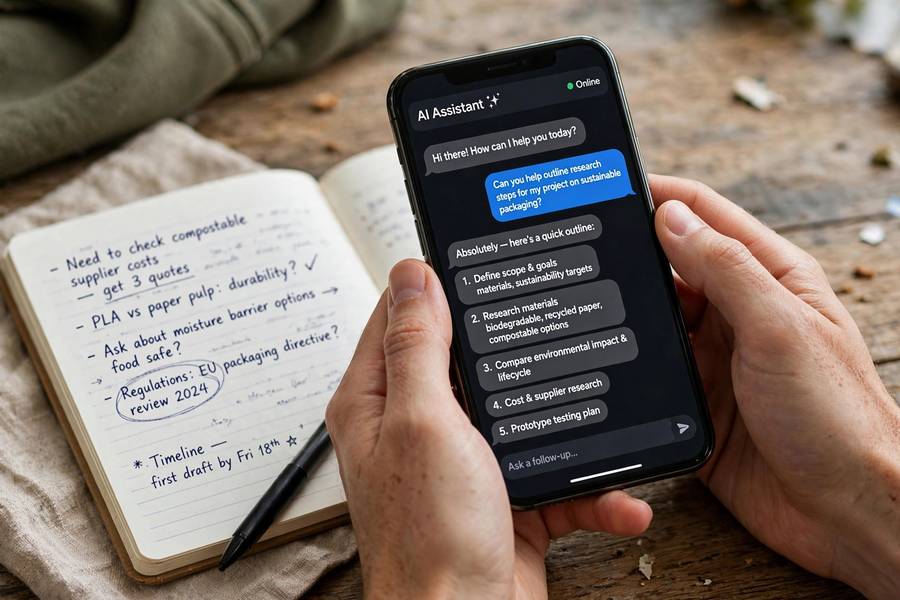
First: Decide What “Learn AI” Means for You
“Learn AI” is three different goals wearing one trench coat:
Use AI well. You want AI as a tool — for your job, your business, your creativity. You need prompting skill, tool knowledge, and judgment about outputs. No coding required. This is the goal for most people, and it’s the fastest to achieve.
Build with AI. You want to create AI-powered products, automations, or applications. You need some technical skill — APIs, no-code platforms, or programming — plus enough conceptual understanding to design things that work.
Understand AI deeply. You want to know how models work, possibly as a researcher or engineer. This is the long road: math, programming, machine learning theory. Rewarding, but a multi-year commitment.
Be honest about which one you want. Most beginners say “understand deeply” but mean “use well” — and then burn out on calculus they didn’t need. Start with the goal you actually have; you can always go deeper later.
Phase 1: Use AI Daily (Weeks 1–4)
The best way to start learning AI is embarrassingly simple: use it every day for real tasks.
Get accounts on the major AI assistants — ChatGPT, Claude, Gemini — and route actual work through them: drafting emails, summarizing documents, brainstorming, learning new topics, debugging problems. Don’t do toy exercises; do your real work with AI assistance and pay attention to where it helps and where it fails.
While you do this, learn deliberately:
- Prompting as a skill. Notice what makes some prompts work and others fail. Be specific, provide context, ask for formats, iterate. My guide on getting better answers covers the techniques systematically.
- The failure modes. Watch for hallucinations (confident falsehoods), sycophancy (agreeing with your wrong premises), and context loss. Knowing how AI fails is as important as knowing what it can do.
- Tool differences. ChatGPT, Claude, and Gemini have different strengths. Learn which you prefer for which tasks — this comparative judgment is genuine expertise.
Four weeks of serious daily use teaches you more about AI’s practical reality than any course. You’ll develop intuitions that theory-first learners take months to build. And if you decide you don’t need to go further — that using AI well is enough — that’s a completely valid stopping point.
Phase 2: Understand the Concepts (Months 2–3)
Once you have practical experience, learn what’s happening under the hood — conceptually, not mathematically (yet):
- What machine learning is. The core idea: systems that improve at tasks through exposure to data, rather than explicit programming. Start with my overview, then read about how AI models are trained.
- Neural networks, intuitively. Layers of simple units, weights adjusted by training. You don’t need the calculus yet — just the mental model of what a network is.
- What large language models do. They’re prediction machines trained on vast text. Understanding this — really internalizing it — explains both their brilliance and their failures. See the explainer on what a large language model is.
- Training, in plain English. Data goes in, the model adjusts, capabilities emerge. The details can come later; the shape of the process matters now.
- Limitations and risks. Bias, hallucinations, data privacy, over-reliance. A beginner who understands AI’s limits is more advanced than an enthusiast who doesn’t.
Good resources for this phase: 3Blue1Brown’s neural network videos (visual, math-light), popular books like The Alignment Problem or Co-Intelligence, and quality newsletters. Avoid anything that promises mastery in a weekend.
Phase 3: Build Things (Months 3–6)
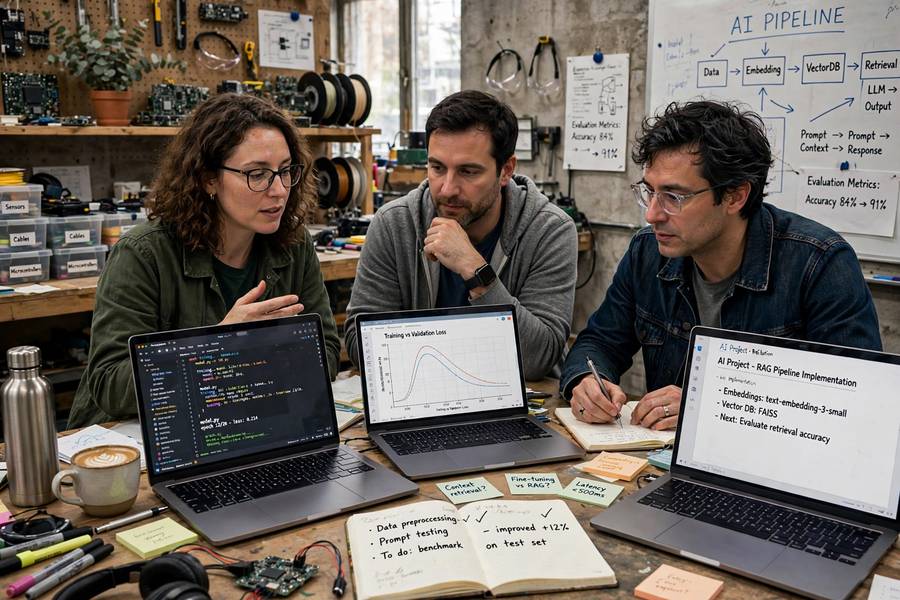
Here’s where learning gets real: build something. Consuming tutorials creates the illusion of knowledge; building exposes what you actually understand.
Beginner-appropriate builds:
- A useful prompt system. Design a multi-step AI workflow for a real task in your work or life — not a demo, something you actually use weekly.
- An automation. Connect AI to your tools (email, documents, calendar) with Make, Zapier, or simple scripts. Automate one genuinely annoying task.
- A small AI app. Use an API (OpenAI, Anthropic, or open models) to build something with a simple interface — a specialized writing helper, a study tool, a data analyzer.
- A no-code project. Chatbots, AI-assisted content pipelines, internal tools. My piece on AI projects for beginners has concrete ideas.
The rule: every project must do something real. “Tutorial projects” that nobody uses teach tutorial-following, not AI. The gap between “I followed a guide” and “I built a thing that works” is where actual skill lives.
Phase 4: Go Deeper or Go Wide
After six months of use, concepts, and building, you’ll know which direction pulls you:
Deeper (technical): Learn Python properly, then math (linear algebra, probability, calculus — in that order of importance for AI), then machine learning fundamentals, then deep learning. This is the path to ML engineering or research. It’s a 1–2 year commitment from here.
Wider (applied): Go deep on AI strategy, product thinking, evaluation, and domain applications. Learn to assess AI vendors, design AI features, manage AI risks. This is the path to AI product management, consulting, and leadership roles — and it’s where much of the job market actually is.
Specialized: Pick a frontier — AI safety, robotics, creative AI, AI for science — and go deep there. Specialists with genuine depth are rare and valuable.
There’s no wrong choice. The market needs all three.
The No-Code Path Is Legitimate
Let me be explicit: you can learn AI deeply without coding. I’ve written a full guide on learning AI without coding because the question comes up constantly, and the answer is yes — with a ceiling.
The no-code path covers: expert AI tool use, prompting, automation platforms, AI strategy, evaluation, and conceptual understanding. That’s enough for careers in AI consulting, product management, content, and operations. The ceiling appears at custom model work and novel engineering — real, but irrelevant to most goals.
Don’t let programmers gatekeep you. And don’t let no-code marketers tell you code never matters. Both are selling something.
Mistakes Beginners Always Make
Tutorial hell. Watching courses feels like learning but isn’t. The fix: build after every tutorial. No exceptions.
Math first. Starting with linear algebra before you know why you need it kills motivation. Learn concepts first, add math when you hit walls that require it.
Tool collecting. Trying twenty AI tools shallowly instead of mastering three deeply. Pick your stack and go deep.
Chasing every new release. The field moves fast; beginners who try to track everything learn nothing deeply. Check in monthly, not hourly.
No portfolio. Learning without evidence is invisible to employers. Document everything you build — write-ups, demos, code. Your portfolio is your credential.
Comparing to experts. The people writing impressive AI threads have years of head start. Compare yourself to yourself last month.
How Long Does It Really Take?
Honest timelines (assuming consistent effort, ~5–10 hours/week):
- Use AI well: 1–2 months
- Build useful AI things: 4–6 months
- Work professionally with AI: 6–12 months
- ML engineering competence: 1.5–3 years
- Research-level understanding: 3+ years
Anyone promising faster is selling something. Anyone saying it’s impossible is wrong. I’ve covered timelines in detail in how long it takes to learn AI.
The best way to learn AI is the way you’ll actually stick with: start by using it daily, add concepts as curiosity demands, build real things, and let your goals — not someone else’s curriculum — set the pace. The field rewards the curious and the persistent far more than the credentialed. Start today, build in public, and in a year you won’t recognize your own understanding.

Frequently Asked Questions
Start by using AI tools daily for real tasks (weeks 1-4), then learn core concepts like machine learning and neural networks (months 2-3), then build real projects (months 3-6). This use → understand → build sequence works better than starting with theory or math.
Absolutely. Most applied AI roles don’t require a CS degree — they require demonstrated skill with AI tools, prompting, building, and evaluation. The degree matters mainly for research roles and some big-tech engineering positions.
Not necessarily first. Start with using AI and understanding concepts; learn Python when you want to build things that require code. Learning Python with a clear AI goal in mind is far more motivating than learning it abstractly beforehand.
For using and building with AI: almost none initially. For ML engineering: linear algebra, probability, and calculus become important. Learn math when you hit walls that require it, not before — premature math study is the top beginner motivation-killer.
3Blue1Brown’s neural network series (YouTube), Google’s Machine Learning Crash Course, Hugging Face’s free courses, and quality newsletters. But resources matter less than practice: daily AI use plus real building projects beat any course collection.