Study Techniques for Visual Learners: A Complete Guide

I have tutored hundreds of students over the years, and the pattern is always the same: some people can read a chapter three times and still draw a blank, then sketch one quick diagram and suddenly remember everything. If that sounds like you, you are probably a visual learner, and the study techniques for visual learners below were built exactly for how your brain works.
Visual learners remember what they see. Shapes, colors, layouts, spatial relationships — these stick in memory far better than walls of plain text. Research on the picture superiority effect backs this up: people remember images far better than words alone. The good news is that almost any subject can be turned into something visual, from biology to history to math formulas. This guide walks through every technique I actually recommend to my students, with honest notes on which ones work for which subjects and how to start each one today.
What Makes Study Techniques for Visual Learners Different
Most study advice is secretly written for reading-and-writing learners. “Take notes, re-read, summarize” — all fine, but if you learn visually, a paragraph of summary notes gives you far less than a single diagram. Visual learning is not just about liking pretty materials; it is about encoding information through imagery and spatial organization so it is easier to retrieve later.
The key shift is this: stop asking “how do I read this better?” and start asking “how do I draw this?” That does not mean you need art skills. Ugly sketches work just as well as beautiful ones — sometimes better, because the effort of translating an idea into a simple drawing is exactly what builds the memory trace. Every technique below follows that same principle in a different form.
1. Mind Maps: See the Whole Topic at Once
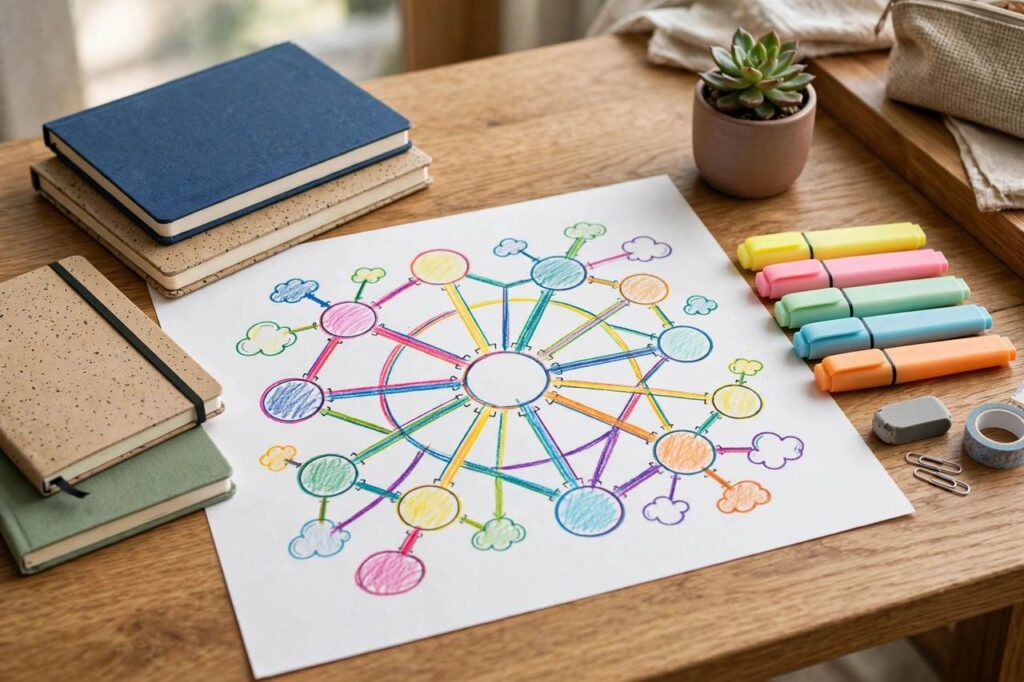
Mind mapping is the single most powerful technique for visual learners, and it is the first one I teach every student. You start with the main topic in the center of a page, then branch out into subtopics, then branch again into details. The result is a map of the whole subject you can see in one glance.
This works because exams rarely test isolated facts — they test connections. A mind map forces you to build those connections while you study. Colors help too: give each branch its own color, and use simple icons or symbols for recurring ideas (a star for “will be on the exam,” an arrow for cause-and-effect).
How to start: pick one lecture or chapter, grab a blank sheet of paper (landscape orientation), and put the topic in the center. Set a timer for 20 minutes and branch out everything you remember first — then go back to your notes to fill gaps. The finished map becomes your one-page revision sheet before the test.
One honest caveat: mind maps are terrible for memorizing long lists of unrelated facts. For those, use flashcards instead (more on that below). But for understanding how concepts fit together, nothing beats them.
2. Color-Coding Systems That Actually Stick
Color-coding is the technique most people do wrong — they highlight everything and call it studying. Real color-coding is a system: each color has a fixed meaning, used consistently across all your notes.
Here is the system I give students: yellow for key terms and definitions, green for examples, blue for processes or steps, pink for things you got wrong or need to review. When you flip through your notes, pink immediately tells you where to spend time. The colors become visual landmarks — you will remember “the definition in the yellow box on the top-right page.”
You can apply the same logic to Cornell notes, where the cue column becomes a color-coded question column. The important rule: keep your legend to four or five colors maximum. More than that and the colors stop meaning anything.

3. Visual Flashcards: Pictures Beat Words
Standard flashcards are text-on-text. Visual flashcards put an image, diagram, or color cue on one side and the term or concept on the other. Even a crude doodle — a mitochondria drawn as a blob with squiggles, a timeline arrow, a quick symbol — dramatically improves recall compared to a word-only card.
Digital apps make this easy. Anki and Quizlet both let you add images, and tools that generate quick diagrams can feed straight in. But do not outsource all the drawing to AI-generated images. The memory benefit comes partly from creating the visual yourself. Draw it badly first, then check an accurate version. That comparison pass is real learning.
I recommend visual flashcards most for vocabulary, anatomy, formulas, and any subject where you need exact recall of terms. Combine them with spaced repetition — review cards at increasing intervals — and they become the highest-ROI habit a visual learner can build.
4. Storyboarding: Turn Processes into Comic Strips
History timelines, biology processes, math proofs, literature plots — anything with a sequence can be storyboarded. Divide your page into panels like a comic strip and draw one simple frame per step. Add a one-line caption under each.
Storyboarding works because it combines two memory systems: sequential narrative (your brain loves stories) and visual encoding. Students who storyboard the causes of a historical event consistently outperform students who memorize bullet lists of the same causes.
Try this with active recall: after storyboarding a process from your notes, cover the captions and try to narrate each frame from the image alone. If you can, you know it. If you stumble on a frame, that is exactly the step to review.
5. Sketch Notes: Draw While You Learn
Sketch notes are hand-drawn notes that mix text, doodles, arrows, boxes, and layout to capture ideas visually in real time. They look intimidating on social media, but the real technique is simple: write key phrases in big lettering, draw arrows showing relationships, box important ideas, and add tiny doodles as memory hooks.
You do not need to sketch note everything. The technique shines during lectures and video lessons, where it forces you to process ideas while they arrive instead of transcribing words passively. Passivity is the enemy of visual learners — a page of verbatim transcription is nearly useless to you.
Start small: for one lecture, commit to using at least five boxes, five arrows, and three doodles. Within a week it feels natural. Your notes will also become far more pleasant to revise, which matters more than people admit — you are more likely to re-read notes you actually enjoy looking at.
6. Charts, Graphs, and Comparison Tables
Some subjects come pre-visualized, and smart visual learners lean into that. For economics, physics, statistics, and chemistry, the graph is the concept. Do not just memorize what a supply-and-demand curve means — draw it yourself from scratch, shift the curves, and narrate what happens. That exercise teaches more than ten re-reads.
Comparison tables are the visual learner’s secret weapon for “compare and contrast” exam questions. Instead of writing paragraphs about the differences between two theories, build a table: rows for dimensions, columns for theories, and fill each cell with a phrase. Color the similarities green and the differences pink. When the exam asks you to compare, you will picture the table.
For dense reading subjects, build tables from your textbook chapters the same way. The act of compressing paragraphs into cells is active studying — it is how you find out what you do not understand yet.
7. Memory Palaces and Visual Association
The memory palace technique is old — ancient, actually — and it works spectacularly for visual learners. Pick a place you know well (your house, your route to school), and mentally place the items you need to remember along a path through it. To recall them, you walk the path in your mind and “see” each item.
The weirder the image, the better it sticks. If you need to remember that the mitochondria is the powerhouse of the cell, picture a tiny power plant exploding out of your kitchen sink. Absurdity is a feature, not a bug — unusual images are more memorable than ordinary ones.
This technique is overkill for daily studying but unbeatable for high-stakes lists: the bones of the hand, the order of US presidents, foreign vocabulary, formulas. I have had students memorize 50-item sequences in under an hour with it. If you only use one technique before a big exam, make it this one or visual flashcards.
Building Your Own Visual Study Routine
Techniques only work inside a routine. Here is the weekly structure I recommend to visual learners:
- During class: sketch notes with boxes, arrows, and doodles.
- Same evening: convert the day’s notes into a mind map or storyboard — this is your first review.
- Two days later: turn the hard facts into visual flashcards and run a spaced-repetition session.
- End of week: build comparison tables for the week’s topics and walk one memory palace for the trickiest list.
Total added time is maybe 30 minutes a day beyond regular studying, but the retention difference is enormous. One more tip: keep a single “visual notebook” where all your maps, boards, and palaces live. Flipping through it before exams is the visual learner’s equivalent of re-reading — except it actually works.
Pair this routine with faster reading strategies from my guide on how to read faster and remember more, and you cover both intake and encoding — the two halves of studying that visual learners usually neglect in different ways.
FAQs
What are the best study techniques for visual learners? Mind maps, color-coded notes, visual flashcards, storyboarding, sketch notes, comparison tables, and memory palaces consistently rank highest. The best approach combines a big-picture technique (mind maps) with a detail-memorization technique (visual flashcards).
How do I know if I am a visual learner? Common signs: you remember faces better than names, you prefer diagrams to verbal explanations, you get lost in text-heavy instructions but thrive with maps and charts, and you doodle while thinking. Most people benefit from visual techniques regardless of their “learning style” label.
Can visual study techniques work for math? Yes — draw graphs, storyboard multi-step proofs, color-code formula components, and use visual flashcards for formulas. Geometry is naturally visual, and algebra becomes visual when you map what each symbol represents.
Do I need to be good at drawing to use these techniques? No. Research consistently shows that even crude sketches improve memory. The benefit comes from the act of translating ideas into images, not from artistic quality. Stick figures are perfectly fine.
How long before I see results from visual study techniques? Most students notice better recall within one to two weeks of consistent use, especially with mind maps and visual flashcards. Spaced repetition compounds the effect over a month.