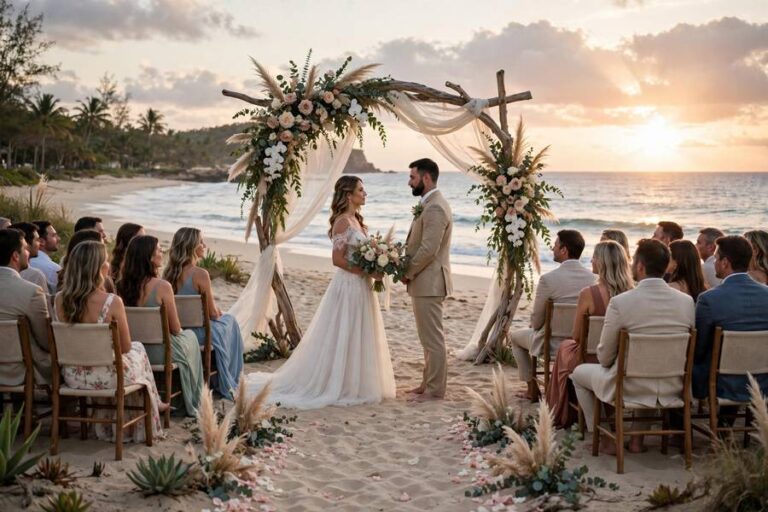
Wedding Vow Examples for Her: 20 Heartfelt Templates to Adapt

Writing your own vows is the most personal thing you’ll do for your wedding — and the most intimidating blank page. I’ve heard hundreds of vows, and the ones that wreck the room (in the best way) all share a formula: specific memories, honest promises, and your actual voice. Here are 20 examples to spark yours.
The Vow Formula
Great vows have three parts: past (a specific memory that shows why you love them), present (what they mean to you now), future (2–3 concrete promises). “I promise to always…” beats “I will love you forever” — specific promises feel real; abstract ones feel like greeting cards.
Romantic Vows
“From the moment you stole my fries on our third date, I knew my life was better with you in it. You make ordinary days feel like occasions. I promise to choose you every morning, to listen even when I’m tired, and to keep stealing your fries for the rest of our lives.”
“You are my favorite notification, my best decision, my calm in every storm. I promise to stand beside you in the hard seasons and dance with you in the good ones.”
Funny Vows
“I promise to love you even when you leave cabinet doors open, to pretend your snoring is charming, and to always let you have the last bite — except dessert, which we split, as the law requires.”
“I vow to be your partner in crime, your co-pilot on road trips, and the person who kills the spiders. I promise to laugh at your jokes, even the ones I’ve heard forty times.”
Short and Sweet
“I choose you. Today, tomorrow, in every version of the future. I promise to love you fiercely, laugh with you daily, and never let you face anything alone.”
Under 100 words can be more powerful than 500. If you’re not a words person, short and sincere beats long and rambling.
Modern and Non-Traditional
“I don’t promise perfection — I promise presence. I’ll show up for the hard conversations, celebrate your wins like they’re mine, and build a life with you that’s honest, joyful, and ours.”
Write vows that sound like YOU talking, not like a wedding website. If you’re sarcastic, be sarcastic. If you’re earnest, be earnest. Authenticity is the whole point.
Writing Your Own: Step by Step
1. List 5 specific memories. 2. List what you love about them (be specific — not “you’re amazing” but “you always text me before big meetings”). 3. Write 3 concrete promises. 4. Draft it in your speaking voice — read it aloud as you write. 5. Keep it to 1–2 minutes (150–250 words). 6. Don’t show your partner beforehand — the surprise is half the magic.
For more inspiration, browse wedding vow examples for every style. Pair them with short ceremony readings for a complete ceremony.
Delivery Tips
Print them large — don’t trust your phone (notifications, battery, brightness). It’s okay to cry; pause and breathe. Make eye contact, not paper contact. And speak slowly — nerves speed everyone up.
Vows for Second Marriages
Second weddings deserve vows that honor the journey: “I know what love costs — I’ve paid the price of losing it. That’s why I don’t say this lightly: I choose you, with open eyes and a full heart, knowing exactly how precious this is.” Acknowledge the past without dwelling on it. Mention the courage it takes to love again. If children are involved, include them — they’re part of this promise.
What to avoid: comparing (even favorably), over-explaining the past, or apologizing for having history. Your history is what makes these vows deep. Own it briefly, then look forward.
Vows That Include Children
Blending families? Make promises to the kids too: “And to [names]: I promise to love you, to show up for you, to be someone you can count on — not to replace anyone, but to add another person in your corner.” Keep it age-appropriate, keep it sincere, and keep it brief — the kids’ section shouldn’t overshadow the couple’s vows.
Consider giving the children a small token during the ceremony (a necklace, a special hug, a family vow moment). It acknowledges that this wedding creates a family, not just a marriage — and kids remember being included.
Cultural and Religious Blends
Interfaith or intercultural couples: vows are where your worlds meet. Include a phrase in each other’s language, reference both traditions’ views on love and commitment, or incorporate a ritual from each background. “In the words of my grandmother… and in the words of yours…”
Discuss with both families beforehand — not for permission, but for inclusion. When families see their culture honored in your vows, it transforms the ceremony from “their wedding” to “our family’s wedding.” That’s worth more than perfect prose.
Vows for Blended Families
When children are part of the wedding, vows can honor the whole family:
“And to [names]: I promise to love you, to show up for you, to be someone you can count on — not to replace anyone, but to add another person in your corner. You’re stuck with me now, and I couldn’t be happier about it.”
Principles for family vows: keep them age-appropriate (simple language for young kids, more depth for teens). Keep them brief — the kids’ section shouldn’t overshadow the couple’s vows. Be honest about your role (“I’m not replacing anyone” matters enormously to kids). And make a promise you can KEEP — children remember broken promises longer than adults do.
Consider a family ritual: a family unity ceremony (blending sand with the kids, a family handfasting, giving the children a small token). It acknowledges that this wedding creates a family, not just a marriage. Kids who feel included become invested — and the photos of the whole family together are the ones that go on the wall.
What to avoid: promising to “be their new mom/dad” (that’s their decision, not yours to declare), making promises about the other biological parent, or putting kids on the spot publicly if they’re shy. Discuss with your partner (and the kids, if old enough) beforehand. Intimate ceremonies suit blended families beautifully — see how to elope for inspiration on keeping it personal.
Vows for Long-Distance Love Stories
If your relationship survived distance, your vows should honor it:
“We loved each other across [miles/time zones] — through screens, through layovers, through countdown apps. If we can love this well from far away, imagine what we’ll do side by side.”
“I fell in love with your voice before I knew your touch, with your words before I knew your habits. Loving you at a distance taught me what matters: it’s not proximity, it’s presence. You’ve always been present.”
What distance teaches: communication (you had to talk — there was nothing else), intentionality (every visit was planned, every call mattered), and certainty (you chose this person repeatedly, despite the difficulty). Name these in your vows — they’re the foundation of your marriage.
The closing line: something about home. “No more goodbyes at airports. No more countdowns. Just us, home, together. Finally.” The couples who’ve done distance have EARNED their vows. Say them like it.
Writing Vows Together vs Apart
Should you write vows together or separately? Both work — here’s the trade-off:
Together (collaborative): You write them side by side, sharing drafts, laughing, crying, editing. Pros: matched tone and length (no surprises), less anxiety (you know what to expect), genuinely fun process. Cons: no surprise on the day (the reveal is part of the magic for many couples).
Apart (secret): You write separately, revealing them at the ceremony. Pros: the surprise is electric — hearing their words for the first time, in front of everyone, is unforgettable. Cons: risk of mismatch (one funny, one serious; one long, one short), more anxiety (the unknown).
The hybrid (recommended): agree on structure together (length: 1–2 minutes; tone: heartfelt with humor; format: memory + promises + future), then write separately. You get coordination without spoiling the surprise. Share with ONE trusted person each (not each other) for a sanity check.
Whichever you choose: the vows should sound like YOU, not like a greeting card. Write in your voice. Be specific. And practice aloud — vows that read beautifully can stumble when spoken. Your partner fell in love with how you talk; let your vows sound like that.
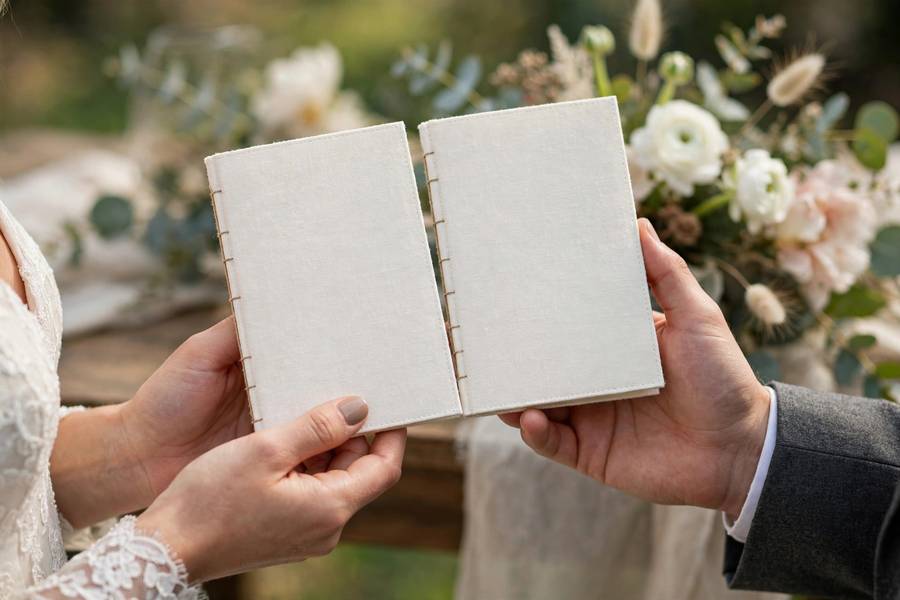
1–2 minutes spoken (150–250 words). Long enough to be meaningful, short enough to hold the room.
Your choice — many couples do one personal vow each plus traditional vows from the officiant. There’s no rule; do what feels authentic.
Yes — humor makes vows memorable and personal. Balance funny with at least one sincere moment so it doesn’t feel like a comedy routine.
Don’t show each other beforehand — the surprise is powerful. But do coordinate on length and tone so one person’s 3-minute epic doesn’t follow another’s 30-second quip.
Totally normal and nobody minds. Pause, breathe, take a sip of water, and continue. Some of the most beautiful vow moments include tears.