Buying a Business vs Starting One From Scratch: Which Wins?


It’s the fundamental fork in the road: buy a business that’s already running, or build one from nothing. Both paths lead to ownership. They get there through completely different terrain — different costs, different risks, different timelines, and different demands on who you are.
I’ve guided people down both paths, and the pattern is consistent: buyers tend to overestimate how easy acquisitions are (‘it’s already working!’) and founders tend to underestimate how long building takes (‘I’ll be profitable in six months!’). Both illusions cost real money.
Here’s the honest comparison across every dimension that matters, so you choose with clear eyes.
Speed to Revenue
Buying wins decisively. An existing business generates revenue from day one of ownership — you’re acquiring cash flow, not hoping for it. The average acquisition closes in 3–6 months from search to ownership, and you’re profitable (if the business is) immediately.
Starting from scratch means months or years before meaningful revenue. The typical service business takes 6–12 months to stabilize; product businesses often take 12–24 months. You’re funding the ramp with savings or debt, watching cash drain while you build. starting a business
But speed has a price: you’re paying for that existing revenue in the purchase price (typically 2–4x annual earnings). The question isn’t whether buying is faster — it’s whether the premium is worth the time saved. If your alternative is two years of ramen-profitability building, the premium often is.
Total Capital Required
Buying requires more upfront: $100K–$1M+ for most small business acquisitions, versus $5K–$100K to start most service businesses from scratch. The acquisition premium is real and substantial.
But compare total capital to profitability, not just day-one outlay. A $300K acquisition generating $100K/year from month one versus a $30K startup losing money for 18 months before breaking even — the acquisition’s higher upfront cost may represent lower total risk. Cash flow timing matters as much as cash flow amount.
Financing differs too. Acquisitions qualify for SBA loans based on the business’s track record — banks lend against proven cash flow. Startups get funded by savings, credit cards, and hope. The financing advantage alone makes buying accessible to people who couldn’t fund a startup’s ramp.

Risk Profile
Buying transfers startup risk (will anyone buy this?) into execution risk (can I run this well?). The market is proven, the customers exist, the systems work. Your risk is concentrated in the transition and your own competence — narrower, more manageable risks.
Starting concentrates risk in the unknown: unproven concept, unproven market, unproven unit economics. The failure rate reflects this — roughly half of startups don’t survive five years, while established small businesses being acquired have already survived the startup gauntlet.
But buying has unique risks startups don’t: hidden liabilities, customer concentration, key employee departures, and the ever-present danger of overpaying. Due diligence mitigates these but never eliminates them. You’re trading the risk of building something nobody wants for the risk of breaking something that works. For the acquisition process done right, see my buying guide.
Control and Customization
Starting from scratch offers total freedom: your vision, your brand, your systems, your culture. Every decision reflects your judgment. For founders with a specific vision — a novel concept, a better way — this freedom is the entire point.
Buying means inheriting: existing brand, existing systems, existing culture, existing customer expectations. Change too fast and you break what you paid for; change too slow and you stagnate. The art of acquisition is evolving the business without destroying its foundation — a subtler skill than building fresh.
The personality fit matters enormously. Creators who need a blank canvas will suffocate in an acquisition. Operators who excel at optimization will flounder in the ambiguity of a startup. Know which one you are — this isn’t about capability, it’s about wiring.
Learning Curve
Buying compresses learning: you inherit trained staff, working systems, and established relationships. But you must learn THEIR business quickly — its quirks, its customers, its unwritten rules — while keeping it running. The learning is intense but bounded.
Starting means learning everything from zero: the market, the operations, the hiring, the marketing. The learning curve is longer but more fundamental — you understand every part because you built every part. Founders often emerge with deeper business education than buyers, simply because they had to figure out more.
Time to competence: 3–6 months for a buyer to run confidently, 12–24 months for a founder to achieve the same operational mastery. But the founder’s knowledge is transferable to the next venture in a way the buyer’s specific-business knowledge sometimes isn’t.

Wealth Building Potential
The math favors buying for steady wealth, starting for outlier wealth. Acquisitions offer predictable returns: buy at 3x earnings, improve operations 20%, sell at 4x in 5–7 years. It’s a proven wealth-building formula without lottery tickets.
Startups offer uncapped upside: the $30K startup that becomes a $30M company happens — rarely, but it happens. No acquisition offers 1000x returns, because you’re buying at fair value. The startup’s lower entry price is what enables the multiple.
Portfolio perspective: buying is the higher-probability, moderate-return play; starting is the lower-probability, higher-upside play. Most wealth builders I know did both across their careers — bought stability, then swung for upside with startups funded by acquisition cash flow. It’s not either/or across a lifetime.
Which Should You Choose?
Buy if: you have capital ($100K+), you want cash flow now, you’re a strong operator rather than a visionary creator, you value proven markets over novel ideas, and you can handle the diligence process rigorously.
Start if: you’re capital-constrained but time-rich, you have a differentiated concept, you need creative freedom, you’re comfortable with 12–24 months of ramp, and you want maximum long-term upside.
Do neither yet if: you haven’t worked in the industry (get experience first), you can’t afford the downside, or you’re motivated by escape rather than opportunity. The best business decision is sometimes preparation, not action.
There’s a third path gaining popularity: buy a small, boring, profitable business and use its cash flow to fund startup experiments. Stability plus upside, sequenced intelligently. It’s how I’d do it with a decade of hindsight.
Key Takeaways
Buying offers immediate cash flow, proven markets, and financability at the cost of higher upfront capital and inherited constraints. Starting offers total freedom and uncapped upside at the cost of longer ramps and higher failure rates.
Match the path to your capital, personality, and timeline. And consider the hybrid: buy stability first, fund upside second. It’s the strategy I wish more first-time owners considered.
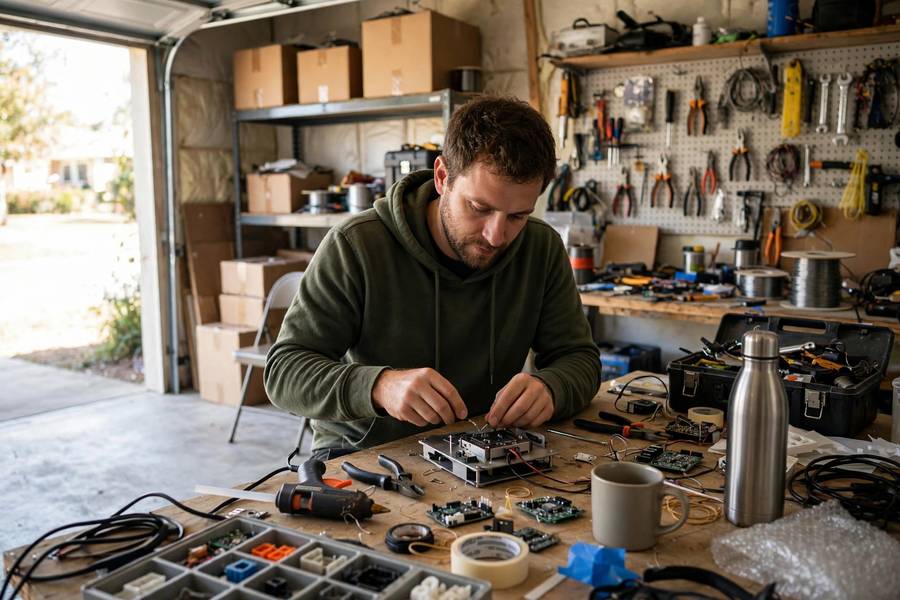
The Hybrid Path: Buy, Then Build
The smartest first-time owners I know didn’t choose — they sequenced. Buy a stable, boring, cash-flowing business first. Use its income and your growing operational skill to fund startup experiments second. Here’s why this ordering works so well.
Stability funds risk-taking. The psychological difference between experimenting with surplus cash flow and experimenting with your life savings is enormous. Owners with a profitable base business make better startup decisions — they’re patient, they don’t force timelines, and they can walk away from bad ideas because their livelihood doesn’t depend on them working.
Skills transfer both ways. Running an acquired business teaches you operations, hiring, cash management, and customer handling — exactly the skills most startup founders lack. Meanwhile, startup experiments teach you innovation and growth thinking that keeps the acquired business from stagnating. Each venture makes you better at the other.
The math compounds. A $400K acquisition generating $120K/year, held for five years while you launch two startups on the side — even if both startups fail, you’ve built wealth from the acquisition. If one startup hits, you’ve got the outlier upside without ever betting the farm. It’s asymmetric risk engineering: capped downside, uncapped upside.
This isn’t theory — it’s the most common pattern among the quietly wealthy business owners I’ve advised. The flashy stories are all startups; the bank accounts are mostly acquisitions-plus-experiments. Boring base, exciting edges. That’s the formula.
Buying offers immediate cash flow and proven markets but costs more upfront; starting offers freedom and higher upside but takes longer with higher failure rates. Choose based on your capital, personality, and timeline.
Acquisitions typically run $100K–$1M+; startups $5K–$100K for most service businesses. But compare total capital to profitability timeline, not just day-one costs.
Hidden liabilities, customer concentration, key employee departures, overpaying, and transition disruption. Due diligence mitigates these but never eliminates them.
Yes, and it’s often optimal: buy a stable cash-flowing business first, then use its income to fund startup experiments. Stability plus upside, sequenced intelligently.