Tips for Online Learning Success: A Practical Study Guide

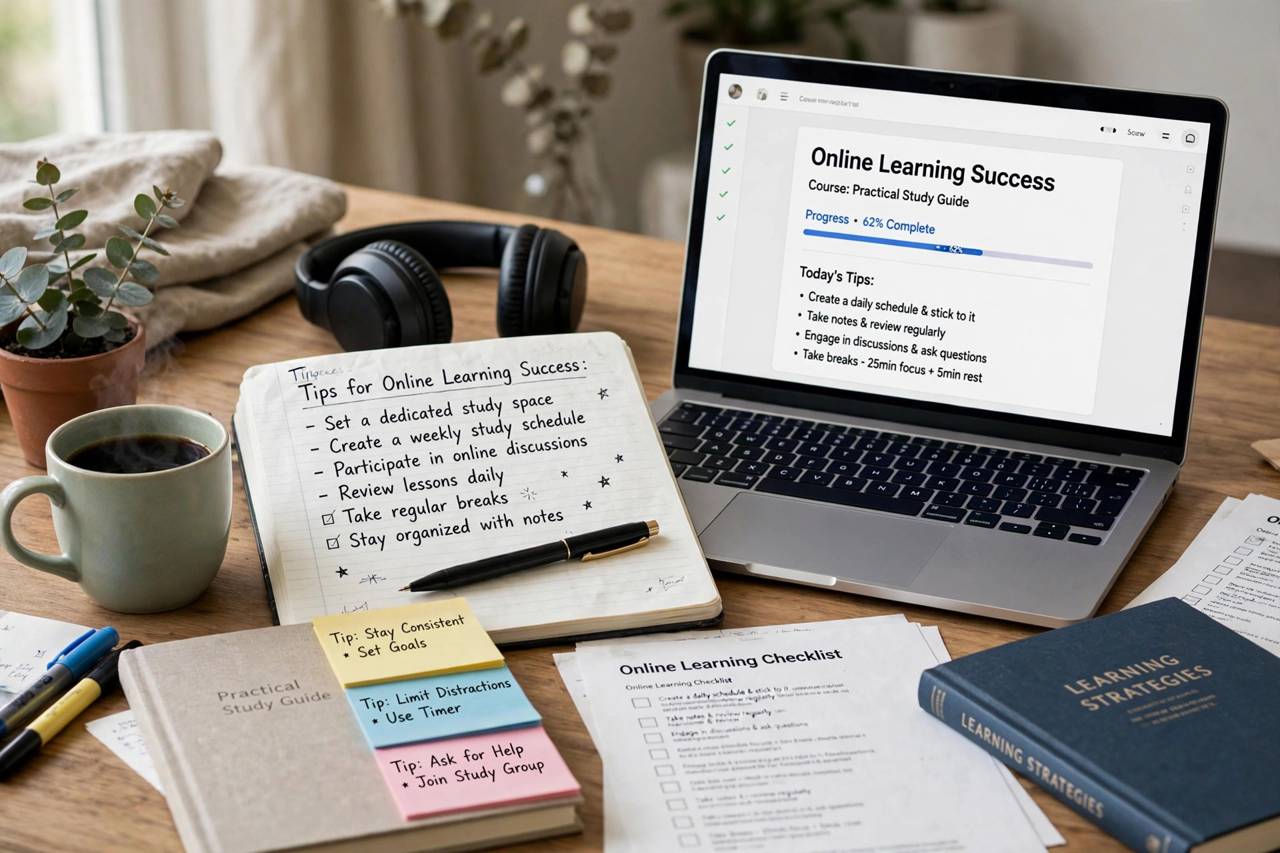
Here’s a number that should sober up anyone starting an online course: most open online courses see completion rates in the single digits or low teens. Not because the material is too hard — because learning alone, on your own schedule, is a completely different skill from learning in a classroom. The good news is that it’s a learnable skill. These tips for online learning success come from years of teaching online students and watching which habits separate the finishers from the dropouts.
The core problem of online learning isn’t content — it’s structure. In a classroom, structure is handed to you: show up Tuesday, homework due Friday. Online, you have to build that structure yourself. Everything below is really about one thing: becoming your own best teacher, scheduler, and accountability partner.
Tips for Online Learning Success Start With Your Environment
Your brain takes cues from your surroundings, and “the couch where I watch shows” is telling it the wrong story. You don’t need a home office — you need a consistent spot that means “learning happens here.” A specific chair at the kitchen table, a corner desk, even the same library carrel. The consistency matters more than the furniture.
Set up that spot once, properly. Keep your charger, notebook, headphones, and water there permanently so every session starts with learning, not with a fifteen-minute scavenger hunt. Good lighting and a chair that doesn’t hurt after an hour are worth more than any productivity app. If you’re sharing space, noise-canceling headphones or even simple earplugs create a portable bubble of focus — and they signal to housemates that you’re working.
Then there’s the digital environment, which is where most online learners actually lose the battle. Close the tabs. Put the phone in another room, not face-down next to you — studies on attention consistently show that the mere presence of a phone degrades focus, even when it’s silent. Log out of social media on your study browser, or use a site blocker during study hours. Willpower is a depleting resource; environment design is permanent.
Build a Schedule You’d Actually Keep
“I’ll study when I have time” is how courses die. The fix is embarrassingly simple: put study sessions on your calendar like appointments, with start times and end times. Two focused 45-minute sessions beat one heroic three-hour marathon almost every time — attention fades, and the spacing between sessions actually helps memory.
Be honest about your energy, not aspirational. If you’re a morning person, don’t schedule deep study at 10 p.m. If you work full-time, three 30-minute lunch sessions a week will outperform a vague plan to “catch up on weekends.” The best schedule is the one you’ll still be following in week six, so design for your real life, not your ideal one.
Build in a weekly review — fifteen minutes every Sunday to look at what’s due, what you finished, and what slipped. This is the single highest-leverage habit in online learning. Students who do a weekly review almost never fall catastrophically behind, because they catch slippage when it’s a one-week problem instead of a five-week disaster. Pair this with solid studying strategies for final exams as assessments approach, and you’ll walk into tests prepared instead of panicked.
Learn Actively, Not Passively

Watching a lecture is not learning — it’s the feeling of learning. The research on this is unambiguous: passive review (re-reading, re-watching, highlighting) produces the illusion of mastery, while active recall (testing yourself, explaining concepts, solving problems) produces actual mastery. Your study sessions should be at least half active.
The simplest active technique: after each lecture or chapter, close the material and write down everything you remember. Then check what you missed. That gap between what you thought you knew and what you actually retained is where the real learning happens. It’s uncomfortable, which is exactly why it works.
Teach it to someone — or to an empty room. Explaining a concept out loud forces you to organize it, and the places where you stumble are precisely the places you don’t understand yet. Study groups help here even online: a weekly video call where each person teaches one concept turns solitary learning into something social and far more effective.
Take real notes, by hand if you can. The point isn’t transcription — it’s processing. Summarize each section in your own words, write questions in the margins, and connect new ideas to things you already know. A notebook full of your own paraphrases is worth ten times a folder of printed slides.
Staying Motivated When Nobody’s Watching
Motivation follows action more reliably than action follows motivation. Don’t wait to feel like studying — start the session, and the feeling usually arrives within ten minutes. The “just five minutes” trick works because starting is the hard part; continuing is easy once you’re in motion.
Connect the course to a concrete goal, and keep that goal visible. “Finish the Python course” is abstract and easy to abandon. “Finish the Python course so I can automate the monthly report at work by March” is a commitment with a deadline and a payoff. Write it on a sticky note on your monitor. When week-four fatigue hits — and it will — that note is doing real work.
Track your streaks visibly. A calendar with X’s on study days, a progress bar on the course dashboard, a journal where you log what you learned each session — visible progress is motivating in a way that vague “I’m doing fine” never is. And when you miss a day, the rule is simple: never miss twice. One missed day is life; two is the start of a new habit.
Finally, use the humans. Online learning feels solitary, but every course has forums, study groups, or office hours — and the students who use them finish at dramatically higher rates. Asking a “dumb” question in a forum takes thirty seconds and often saves three hours of confused re-reading. Instructors notice engaged students, too, and that attention pays off when you need help.
Handle the Tech Before It Handles You
Nothing kills momentum like fighting your tools. Before the course starts, verify the boring stuff: your login works, videos play smoothly, downloads open, and you know where assignments are submitted. Do this in week one, not the night before the first deadline.
Have a backup plan for the essentials. Know where the nearest library or café with Wi-Fi is in case your internet drops on exam day. Keep important files in cloud storage, not just on one device. Screenshot or save confirmation pages when you submit work — “the system ate my assignment” is a much weaker position without proof.
And learn the platform’s actual features. Most learning platforms have speed controls, transcripts, downloadable slides, and mobile apps that students never discover. Watching lectures at 1.25x speed with the transcript open is a legitimate strategy for dense material — you cover more ground and the transcript gives you searchable text for review.
Note-Taking Systems That Actually Work
Most students take notes the way they’ve always taken notes — transcribing what the instructor says — and then wonder why the notes don’t help. Effective note-taking for online learning is a different discipline, because you’re both the student and the lecturer’s audience, with a pause button as your superpower.
The Cornell method adapts beautifully to video lectures: divide your page into a narrow cue column and a wide notes column. Take notes in the wide column while watching, then immediately after — while it’s fresh — write questions and key terms in the cue column. Those cue-column questions become your self-test later. The summary strip at the bottom of each page, written in your own words within 24 hours, is where the learning consolidates.
For concept-heavy subjects, try mind mapping instead of linear notes. Start with the central concept in the middle of the page and branch outward — causes, examples, counterarguments, connections to earlier material. It looks messier than neat outlines, but it mirrors how memory actually works: as a web of associations, not a list. Students who mind-map consistently outperform linear note-takers on tests requiring application rather than recall.
Whatever system you choose, build a review rhythm around it. Notes you never revisit are just a transcription hobby. A workable cadence: quick review within a day (the cue-column questions), a deeper pass at week’s end (the weekly review from earlier), and a final consolidation before assessments. Each pass should be faster than the last — that’s the feeling of knowledge actually sticking.
Frequently Asked Questions
How many hours per week should I study for an online course?
A common rule of thumb is 2–3 hours of study per week for each credit hour, but it varies by subject. More important than total hours is consistency — regular shorter sessions beat irregular marathons. Check your course syllabus for the instructor’s estimate and treat it as a minimum.
How do I stay focused during online lectures?
Take active notes by hand, pause frequently to summarize in your own words, and remove distractions before you start — phone in another room, unrelated tabs closed. If your attention drifts, it’s often a sign to switch to an active task like practice problems rather than continuing to watch passively.
What should I do if I fall behind in an online course?
First, do the weekly review immediately to map exactly how far behind you are — it’s usually less bad than it feels. Then triage: focus on high-weight assignments first, contact your instructor before things become critical, and rebuild with smaller daily sessions rather than one giant catch-up day.
Are online degrees taken seriously by employers?
Increasingly, yes — especially from accredited institutions. What employers actually evaluate is what you can do, so pair the credential with demonstrable skills: a portfolio, projects, or certifications. The completion itself also signals self-discipline, which hiring managers notice.
How do I avoid feeling isolated while learning online?
Join or form a study group, participate actively in course forums, attend live office hours, and find an accountability partner. Even one regular video call a week with a fellow student transforms the experience from solitary to social.