How to Memorize Vocabulary Fast: 5 Science-Backed Methods

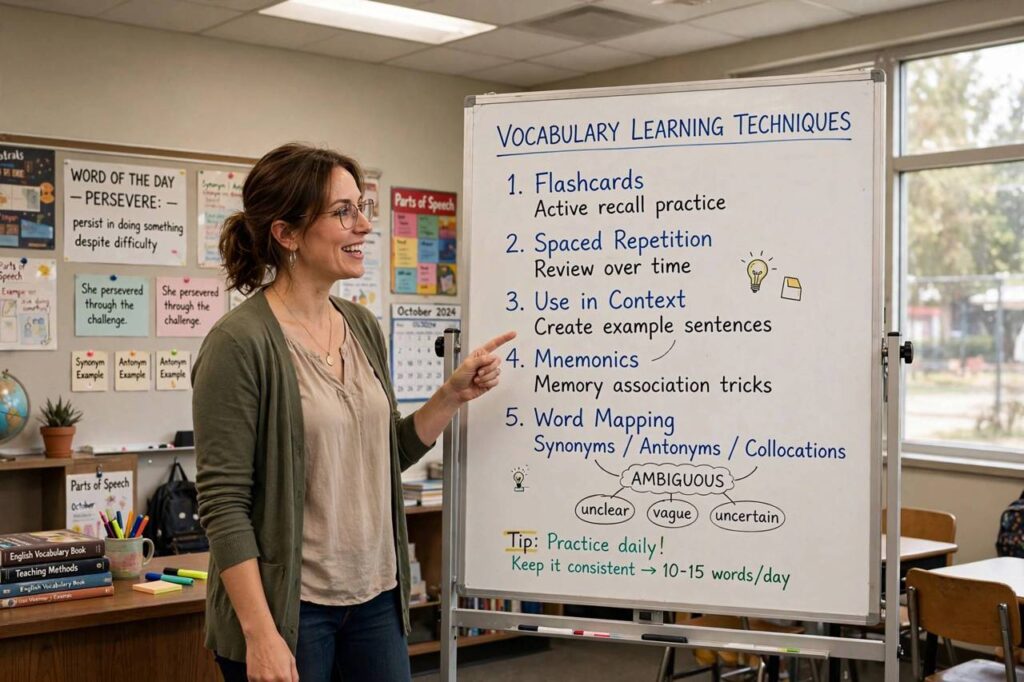
Staring at a vocabulary list, reading the same words over and over, and then blanking on every single one during the quiz — if that sounds familiar, you’re not bad at languages. You’re just using a method that doesn’t work. Rote repetition feels productive, but the science is clear: it’s one of the least effective ways to learn words. If you want to know how to memorize vocabulary fast, the answer isn’t more hours — it’s better techniques.
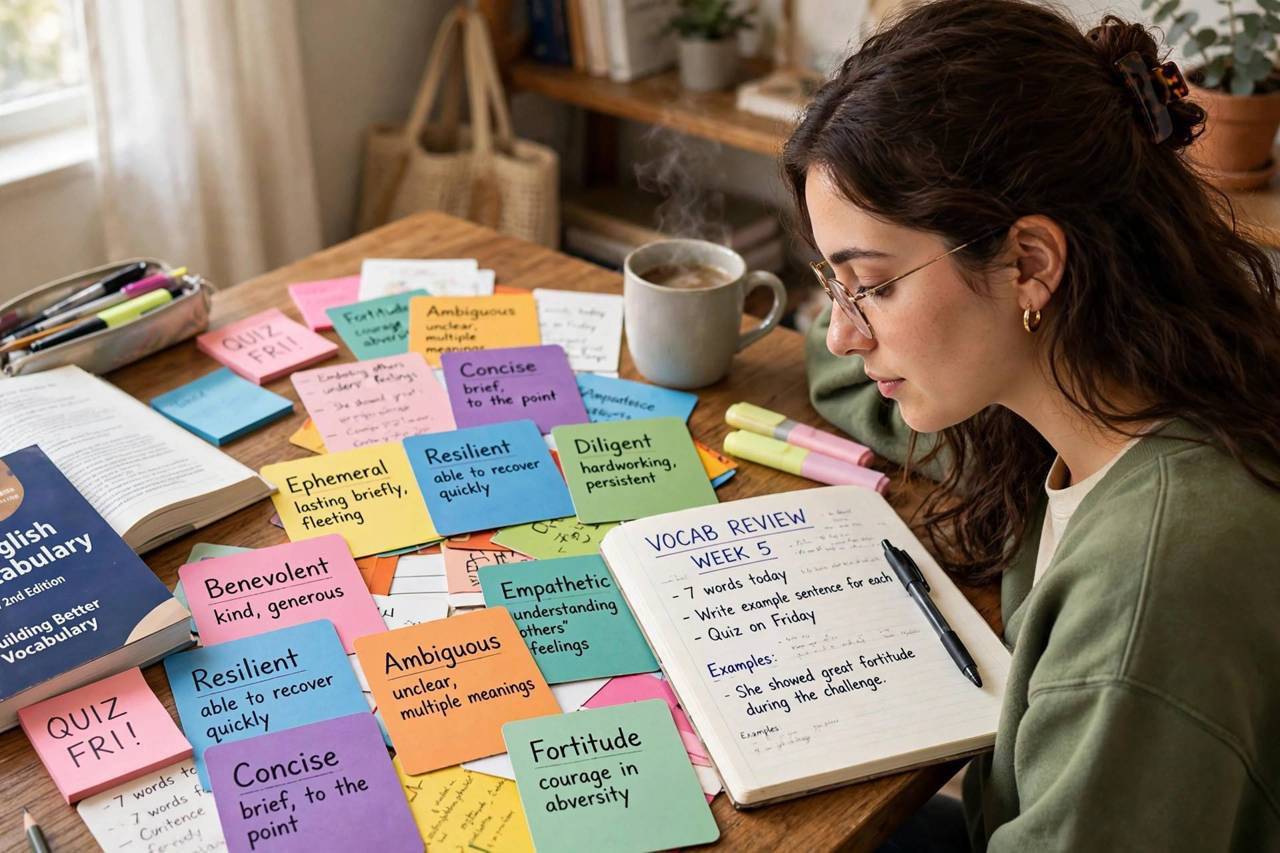
I’m going to show you the methods that actually move words into long-term memory: spaced repetition, mnemonics, active recall, and contextual learning. These aren’t tricks — they’re how memory works, applied deliberately.
How to Memorize Vocabulary Fast: Why Rereading Doesn’t Work
When you reread a word list, your brain recognizes the words — and mistakes recognition for knowledge. “Oh yeah, I know that one,” you think, seeing the word and its translation together. But recognition isn’t recall. In a real conversation or test, you have to produce the word from nothing, and rereading never trains that.
The fix is active recall: testing yourself instead of reviewing. Cover the translation, try to recall it, then check. Every successful recall strengthens the memory; every failed recall (followed by checking) also strengthens it — the effort of trying is what builds the pathway. Flashcards, self-quizzing, apps that hide answers — anything that forces retrieval works. This one shift, from passive review to active recall, is the biggest upgrade most learners can make.
Spaced Repetition: The Timing Secret
Your brain forgets on a predictable curve — fast at first, then slower. Spaced repetition exploits this by showing you each word right before you’d forget it: after 1 day, then 3 days, then a week, then two weeks, stretching further each time you get it right.
This is why spaced repetition apps are so effective for vocabulary: they automate the scheduling. But you can do it manually too — sort flashcards into boxes by how well you know them, reviewing the “weak” box daily and the “strong” box weekly. The principle matters more than the tool.
The key insight: cramming 100 words in one day gives you 100 words you forget in a week. Learning 20 words a day with spaced repetition gives you 20 words you keep for months. Speed isn’t about intensity — it’s about timing. If you’re working toward fluency broadly, becoming fluent in a language puts vocabulary in the bigger picture of language learning.
Mnemonics: Make Words Unforgettable
A mnemonic is a memory hook — a vivid, often silly association between the new word and something you already know. The sillier and more visual, the better. Your brain remembers bizarre images far longer than abstract definitions.
The keyword method: find a word in your own language that sounds like the target word, then build a mental image connecting them. Learning Spanish carta (letter)? Picture a cart full of letters. Absurd? Yes. Memorable? Extremely.
Stories and chains: link a set of new words into one ridiculous story. The narrative structure gives each word a retrieval cue — remembering the story pulls the words along with it.
Personal connections: attach words to your own life. A word you connect to a memory, a person, or a place sticks far better than one floating in abstraction. This is also why how actors memorize lines techniques overlap so much with language learning — professional memorizers use the same association principles.
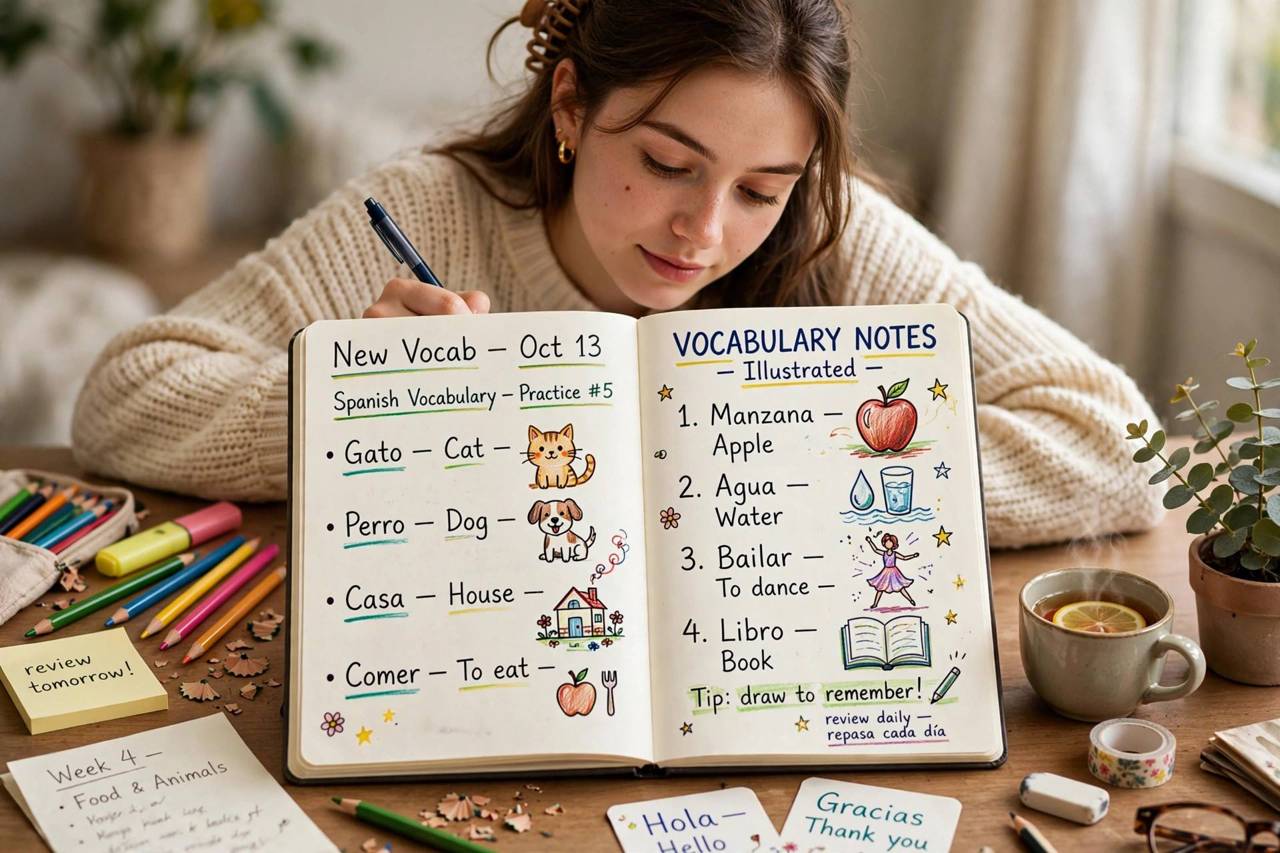
Let me show you the keyword method in action, because it’s the mnemonic technique with the strongest research behind it. Take the Spanish word pato (duck). It sounds like “pot.” Picture a duck wearing a cooking pot as a hat. Silly? Completely. Memorable? Extremely — you’ll remember pato months from now because the image is absurd. The method works in three steps: find an English word that sounds like the foreign word, create a vivid (ideally ridiculous) mental image connecting the two, and link the image to the meaning.
One caution: mnemonics are scaffolding, not the building. They’re brilliant for getting a word into memory, but you still need to meet the word in real contexts — reading, listening, conversation — for it to become truly automatic. Use mnemonics to plant the seed, then let real usage grow it.
Learn Words in Context, Not in Isolation
Words learned alone are fragile; words learned in context are durable. Instead of memorizing “apple = manzana,” learn “I eat an apple every morning” as a chunk. Your brain stores the word with its neighbors, giving you multiple retrieval paths.
Practical ways to do this: read short texts slightly above your level and learn the unknown words from them; learn common phrases and collocations rather than single words; write your own example sentences for each new word (creating the sentence is itself a memory event); and when possible, encounter words in real content — shows, songs, articles — where emotion and narrative glue them in place.
This is also why learning 10 words deeply beats “learning” 50 superficially. A word you can use in a sentence is learned. A word you can only recognize on a list is rented.
The Daily Routine That Actually Works
Here’s a 25-minute routine that outperforms hours of rereading:
- 5 minutes: review due words with spaced repetition (yesterday’s words and anything scheduled for today).
- 10 minutes: learn 5-10 new words — create a mnemonic for each, say each aloud three times, and write one original sentence per word.
- 10 minutes: active use — write a short paragraph or have a brief conversation using as many new words as possible. Production cements memory like nothing else.
Do this daily rather than in weekend marathons. Twenty-five focused minutes a day beats three hours on Sunday — consistency is the entire game in vocabulary learning. Track your streak; the visual chain of unbroken days is motivating in itself.
For exam preparation specifically, studying for final exams covers how to structure review sessions, and if your goal is a whole new language rather than just words, learning a new language faster has strategies for accelerating the overall process.
If your schedule is genuinely packed, here’s the minimum effective dose: five new words a day, reviewed with the retrieval workout above, plus one short session of reading or listening where you hunt for those words “in the wild.” That’s about 20 minutes total. Five words a day is 150 a month — and unlike cramming 50 words the night before a test, those 150 actually stay. Consistency at small doses beats heroic sessions every time; your memory consolidates during sleep, so daily short sessions literally work with your brain’s wiring instead of against it.
Common Vocabulary Mistakes to Avoid
Learning too many words at once. Five words learned deeply beat twenty skimmed. Cap new words at 5-10 per day.
Only learning translations. Learn the word’s usage, common phrases, and pronunciation too — a “known” word you can’t pronounce or use correctly isn’t really known.
Never revisiting old words. Without spaced review, everything fades. The review pile is more important than the new-words pile.
Studying only one direction. Practice both recognition (see foreign word → recall meaning) and production (see meaning → recall foreign word). Production is harder and more valuable.
Giving up after the first forgetting. Forgetting is part of learning — each cycle of forgetting and re-recalling makes the memory stronger. The words you struggled with become your most durable ones.
The Retrieval Workout: 15 Minutes That Beat an Hour of Review
Here’s a paradox that surprises my students: the harder your brain works to remember a word, the better it remembers it. Passively rereading a word is easy — and nearly useless. Forcing yourself to pull it from memory is hard — and that’s exactly why it works. Researchers call this retrieval practice, and it’s the single most underused study technique I know.
Try this 15-minute workout with any word list:
- Minutes 1-5: Cover and recall. Look at each word, cover the definition, and say the meaning out loud before checking. Saying it aloud matters — it engages a different memory pathway than silent reading.
- Minutes 6-10: Backwards recall. Now flip it: look at the definition (or a picture) and recall the word itself. This direction is harder and builds the skill you actually need — producing the word, not just recognizing it.
- Minutes 11-15: Use them. Write three original sentences using the words you just studied — not copied example sentences, your own. A word you’ve used in your own sentence is a word you own.
Do this instead of rereading, and you’ll feel the difference within a week. It feels slower and more effortful than skimming a list. That’s the feeling of actual learning happening.
FAQ
How many vocabulary words should I learn per day?
Five to ten new words per day is the sweet spot for most learners. Fewer, learned deeply with mnemonics and example sentences, beats dozens skimmed and forgotten.
What is the fastest way to memorize vocabulary?
Combine active recall (testing yourself instead of rereading), spaced repetition (reviewing at increasing intervals), and mnemonics (vivid associations). Together they’re dramatically more effective than rote repetition.
Why do I forget vocabulary words so quickly?
Because recognition isn’t recall — rereading creates familiarity without building retrieval pathways. Forgetting is normal; the fix is spaced repetition, which schedules reviews right before you’d forget each word.
Are vocabulary apps worth using?
Apps that use spaced repetition and active recall are genuinely effective and worth using. But they’re a tool, not a complete method — combine them with learning words in context and producing your own sentences.
Should I learn words in isolation or in sentences?
In sentences and phrases. Words learned in context have multiple retrieval cues and stick far longer than isolated word-translation pairs. Learn collocations and chunks, not just single words.
How long does it realistically take to memorize 100 new words?
At a sustainable pace of 5-10 words a day with spaced repetition and retrieval practice, most learners genuinely retain 100 words in two to three weeks. Cramming 100 words in a weekend is possible for a Monday test, but without spaced review you’ll lose most of them within a month. If you need them long-term, budget the three weeks — your future self will thank you.