How to Organize a Garage: The One-Weekend Method

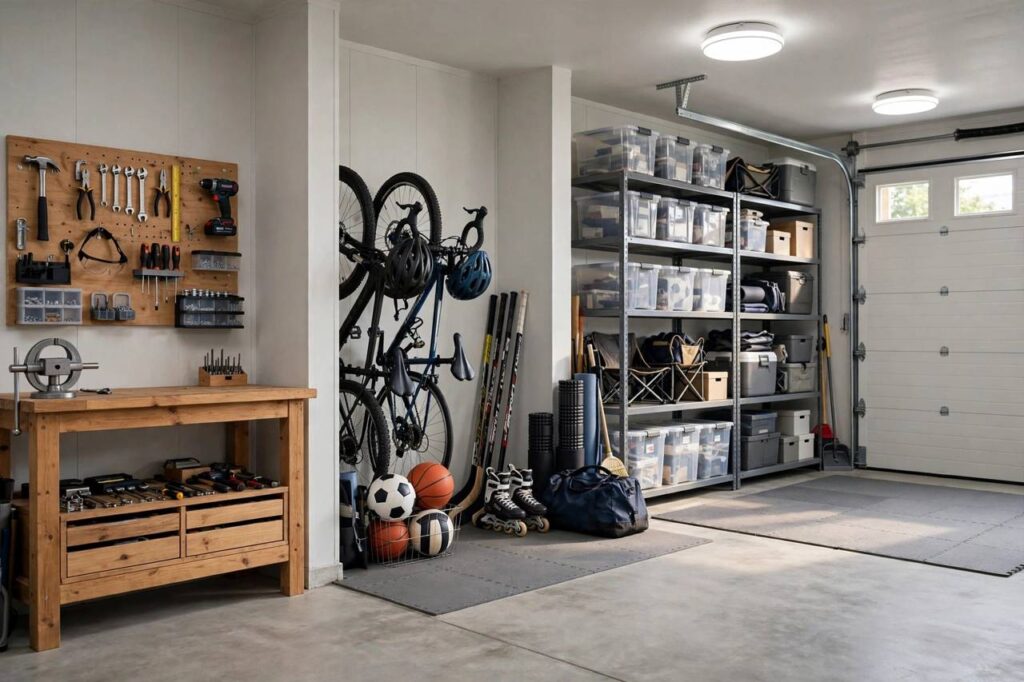
Every garage reaches the same tipping point: you cannot find the screwdriver, the car barely fits, and you have started storing things in front of other things. I have organized more garages than I can count — mine, friends’, neighbors’ who bribed me with barbecue — and I can tell you the standard advice (“buy more bins”) fails because it treats the symptom. If you want to know how to organize a garage so it stays organized, the answer is a method, not products: pull everything out, sort ruthlessly, assign zones, and build upward. One weekend, done right, and the garage stays functional for years.
This guide walks through the one-weekend method step by step: the pull-everything-out sort, the zone map that gives everything a home, the vertical-storage-first rule that reclaims floor space, and the maintenance habits that keep it from sliding back into chaos.
How to Organize a Garage: The One-Weekend Method
Day one starts with the nuclear option: take everything out of the garage. Everything. Pile it in the driveway, grouped loosely by type. This feels dramatic, and that is the point — you cannot organize around the clutter, and you cannot see what you own until it is all in front of you. Sweep the empty garage while it is bare; you will probably find things you forgot you owned under the piles.
Now sort every item into four piles: keep in the garage, relocate elsewhere, donate or sell, and trash. Be ruthless. The broken weed trimmer you will “fix someday,” the paint cans from three moves ago, the box of cables for devices you no longer own — these are garage kryptonite. A good rule: if you have not used it in two years and it is not seasonal or emergency gear, it goes. The average garage I have organized loses a third of its contents in this step, and nobody misses any of it.
Clean as you sort. Wipe down shelves, sweep corners, check for moisture issues or pest evidence while the space is empty. This is also the moment for quick wins: touch up floor paint, replace a dead light bulb with a bright LED shop light, note where outlets are. You are about to design the space; start from a clean, well-lit baseline.
The Zone Map: Every Category Gets a Territory
With the keep pile sorted, assign zones before anything goes back in. A zone is a dedicated territory for one category of stuff, and it is the single most important organizing concept in a garage. The standard zone map: tools and workshop (one wall), automotive (near the car bay — fluids, cleaning supplies, emergency kit), sports and recreation (bikes, balls, camping gear), seasonal (holiday decorations, seasonal tools), and household overflow (the stuff that genuinely belongs in the garage, like the recycling center and trash cans).
Draw the map on paper first, considering workflow. Tools go where you work on projects — usually a workbench wall with good light. Automotive supplies live near where the car parks. Sports gear goes near the garage door for grab-and-go access. Seasonal stuff goes to the least accessible spots (high shelves, back corners) because you touch it twice a year. Heavy items stay low; light, rarely-used items go high.
The zone rule that makes it stick: nothing crosses zones. When the hedge trimmer lives in the garden zone, you always know where it is and where it goes back. The moment items start migrating — “I will just set this here for now” — the system decays. Zones work because they eliminate decisions: everything has exactly one home.
The Vertical-Storage-First Rule (Especially for Small Garages)
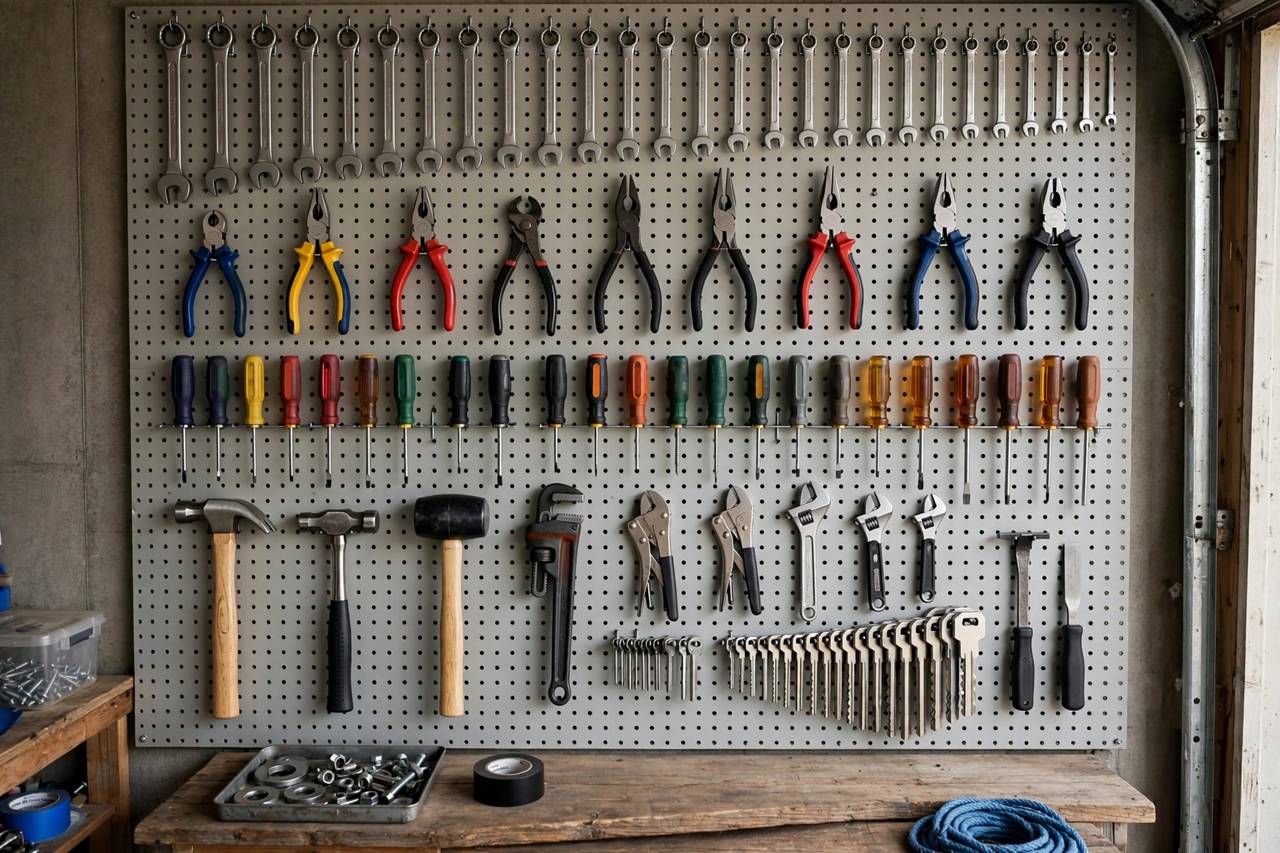
Here is the rule that transforms small garages: floor space is sacred; walls and ceilings are free real estate. Before buying a single floor-standing shelf, max out vertical storage. Pegboard or slatwall on the workshop wall holds hand tools visibly — visible tools get used and get put back; tools in drawers get forgotten. Heavy-duty wall-mounted shelving keeps bins off the floor. Ceiling-mounted racks swallow seasonal bins and rarely-used gear whole.
Bikes are the classic floor-space thieves. Wall-mounted bike hooks or a ceiling pulley hoist get them off the ground entirely — a pulley system lets one person lift a bike overhead easily. Garden tools hang on wall brackets. Sports balls go in wall-mounted racks or bungee-cord corrals. Ladders hang horizontally on wall brackets. Every item you lift off the floor is floor you get back for the car, the workbench, or just walking without sidestepping.
For the floor space that remains, think in rectangles: the car bay (measure your car and mark the parking spot — a tennis ball on a string from the ceiling is the classic parking guide), the work zone in front of the bench, and clear walkways. If the car does not fit with everything stored, storage has to go more vertical, not the car out to the driveway. The garage’s first job is sheltering the car; storage serves that mission, not the other way around.
Storage That Actually Works: Bins, Labels, and the Right Shelving
Clear bins beat opaque ones — you can see what is inside without opening six lids. Uniform bin sizes stack cleanly and look intentional; a jumble of mismatched containers always looks chaotic no matter how organized the contents. For small parts (screws, bolts, fittings), use compartmented organizers or stackable small-parts cabinets, labeled by content, not by project.
Label everything. A label maker is the highest-ROI organizing purchase that exists — ten dollars that eliminates a hundred future “what is in this bin?” moments. Label the shelf edge too, so the bin goes back to the right spot. This sounds obsessive until you live with it for a month; then it feels like the garage runs itself.
Shelving: freestanding heavy-duty metal shelving for the big stuff, anchored to the wall for safety — a loaded shelf tipping over is genuinely dangerous. Adjustable shelves accommodate bins of different heights. And leave breathing room: shelves packed edge-to-edge with no empty space are shelves that cannot absorb anything new, which means the next item you acquire lands on the floor and the decay begins. Plan for 20 percent empty space.
Day Two: Put-Back Day and the Details
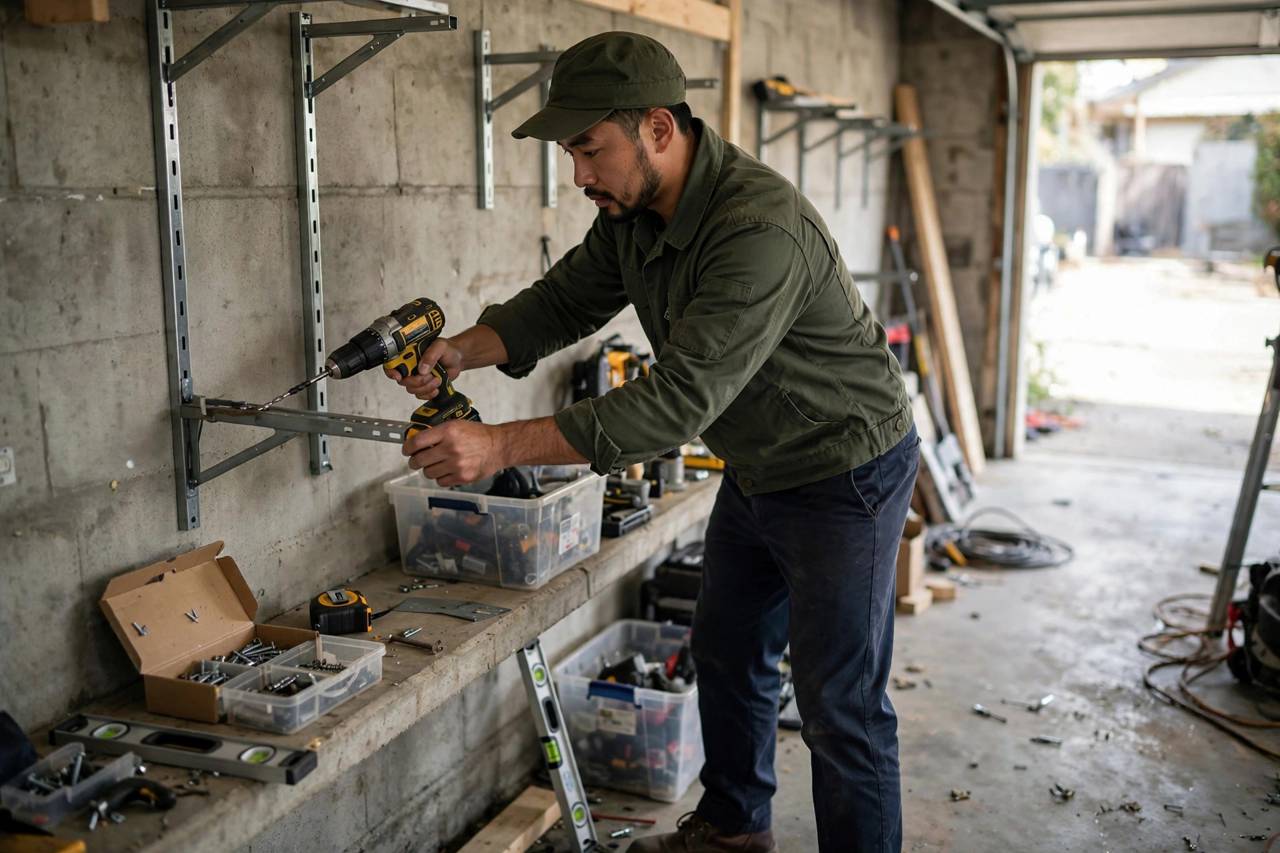
Day two is put-back day, and order matters: install storage first (shelving, pegboard, hooks, racks), then place items by zone, heaviest and least-used highest. Work zone by zone, not item by item — finish the tool wall completely before starting the sports zone. This keeps the driveway pile shrinking visibly, which keeps morale up.
Details that separate good from great: put the most-used tools at chest height on the pegboard (the “golden zone”), less-used higher and lower. Keep a small “inbox” bin near the workbench for items that need a decision — the battery to recycle, the tool to return — and empty it monthly. Mount a power strip on the workbench for chargers and small tools. Keep cleaning supplies (broom, dustpan, shop vacuum) accessible, because a garage that is easy to sweep stays clean.
End day two with the car test: pull the car in. Do the doors open fully? Can you walk around it? Can you open the trunk? If anything fails, adjust now — a garage that does not comfortably fit the car is a storage unit with a door, and that was never the goal.
Special Problem Areas: Chemicals, Hazard Zones, and Kids
Garages concentrate hazards, so handle them deliberately. Flammable liquids (gasoline, solvents, oil-based paints) store in a flammable-storage cabinet or at minimum on low shelves away from ignition sources like water heaters and furnaces — never on high shelves where a falling can becomes a disaster. Keep them in original labeled containers; the mystery jar of “something flammable” is how accidents happen.
Pesticides, antifreeze, and automotive chemicals go in a locked cabinet if kids or pets access the garage — antifreeze in particular is lethally attractive to pets. Power tools get unplugged with blades guarded; sharp garden tools hang high or sheathed. A basic fire extinguisher mounted near the exit, checked annually, is non-negotiable.
If kids use the garage (bikes, sports gear), their zone goes lowest and nearest the door — they should never need to climb or reach past hazards to get their stuff. Teach the boundary early: your zone is yours, the workshop wall is off-limits. Physical separation beats rules every time.
Keeping It Organized: The Maintenance System
The weekend method creates order; the maintenance system preserves it. Three habits: the one-in-one-out rule for garage contents (new tool in, old tool out — donate, sell, or trash), the five-minute reset (at the end of any garage project, spend five minutes putting tools back before you go inside — future you will be grateful), and the seasonal review (twice a year, spring and fall, walk the zones and evict anything that migrated or stopped earning its space).
These habits take almost no time because the system does the heavy lifting — putting a tool back takes seconds when its spot is labeled and visible. The garages that slide back into chaos are always the ones where the maintenance stopped, not the ones where the initial organization was flawed. Protect the system and it protects you.
For the decluttering mindset that powers the whole method — the ruthless sort, the category thinking — our guide on how to declutter your house covers the same principles applied indoors. The garage is just the final boss of decluttering.
Frequently Asked Questions (FAQ)
How long does it take to organize a garage?
A typical two-car garage takes one full weekend with the pull-everything-out method: day one for emptying, sorting, and cleaning; day two for installing storage and putting everything back by zone. Add time if you are also painting the floor or doing repairs. Rushing it produces a tidier mess, not an organized garage.
What is the best storage system for a small garage?
Vertical-first: wall-mounted shelving, pegboard or slatwall for tools, ceiling racks for seasonal bins, and bike hoists to reclaim floor space. In a small garage, every square foot of floor matters — if it can hang, it should hang. Freestanding shelving is the last resort, not the first.
How do I organize a garage on a budget?
The method is free — sorting, zoning, and purging cost nothing and deliver most of the result. For storage, start with what you have, add a label maker first, then invest in one good wall system (pegboard or slatwall) and uniform clear bins bought gradually. Expensive cabinet systems are nice but unnecessary.
Should I epoxy my garage floor?
If the concrete is in decent shape, epoxy or floor paint is a worthwhile upgrade: it seals against oil stains, reflects light (brightening the whole space), and makes sweeping dramatically easier. Do it during the empty-garage phase of the weekend method — it is the only time the floor is fully accessible. Proper prep (degreasing, etching) matters more than the product brand.
How do I keep the garage organized with kids?
Give kids their own low, accessible zone near the door with labeled bins and hooks at their height — and keep everything else physically separated. Kids maintain systems they can reach and understand; they destroy systems built for adults. The five-minute reset applies to them too: sports gear goes back before anyone goes inside.
What should not be stored in a garage?
Anything damaged by temperature swings or humidity: photographs, important documents, electronics, musical instruments, fine art, and anything fabric that pests love (upholstered furniture, clothing in non-sealed containers). Paint and caulk degrade in freezing garages. When in doubt, the garage is for tools, equipment, and hardy household overflow — not for anything irreplaceable.
The Bottom Line
Learning how to organize a garage is learning a method, not buying products: pull everything out, sort ruthlessly, map zones before anything returns, build storage upward before outward, and maintain with tiny habits. One weekend of real work, and the garage becomes what it was always supposed to be — a place where the car fits, the tools are findable, and you can walk from the door to the workbench without an expedition.