How Often Should You Post on a Blog? An Honest Answer

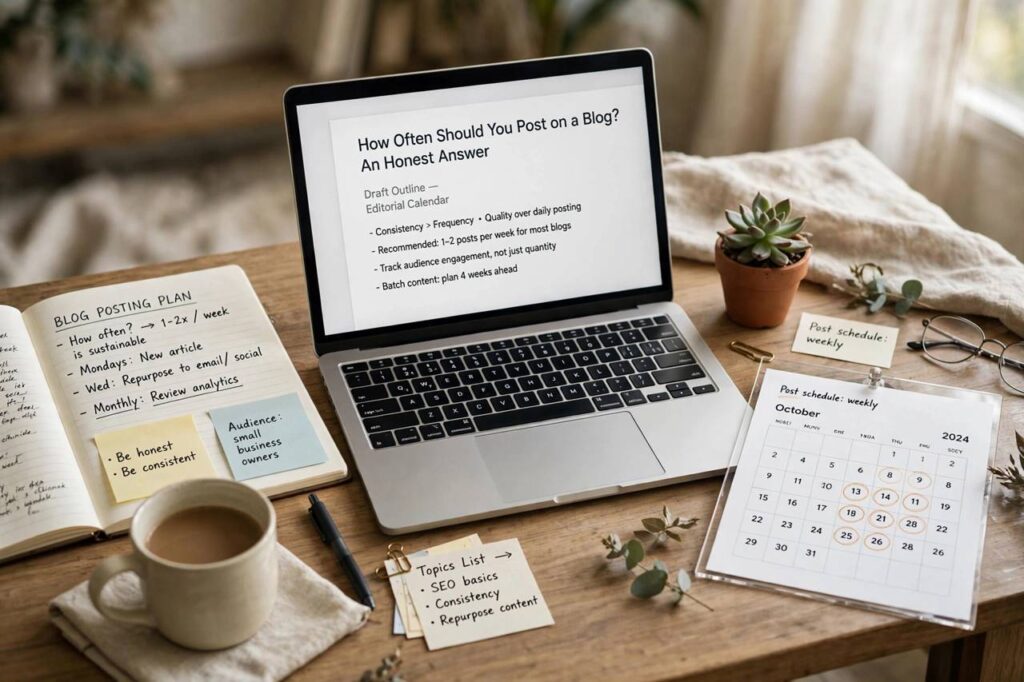

How often should you post on a blog? If you are hoping for a magic number, here is the honest version: there isn’t one, but the right answer is almost certainly less than you think. After watching blogs succeed and stall for years, I have landed on a principle that beats any fixed schedule: publish as often as you can sustain without the quality dropping, and never slower than your readers need to remember you exist. For most people, that means somewhere between once a week and twice a month. The rest of this piece is about figuring out your number, and why the number matters less than the habit.
Somewhere along the way, blogging picked up a folk belief that daily posting is the price of admission. It came from an era when feeds were chronological and volume was the only way to be seen. That era is over. Search engines and readers now reward depth, clarity, and consistency over sheer output. A blog that publishes one genuinely useful article a week will outrun a blog that publishes five thin ones, every single time. The bloggers I know who burned out fastest were the ones who set a daily pace on day one and treated missing a day like failure.
Why Consistency Beats Frequency
Think about the blogs you actually read. You probably cannot name how often they publish. What you notice is whether they show up reliably. A reader who finds a great article, subscribes, and then hears nothing for three months assumes the blog died. A reader who gets a thoughtful piece every other Tuesday builds a small ritual around it. That reliability is the entire game.
Consistency also does something quiet to your own work. A sustainable schedule turns writing from an event into a habit. Habits produce compound results: the blogger who writes one solid post a week for two years has 104 articles working for them around the clock. The blogger who posted daily for six weeks and then quit has 42 posts and a dead site. Slow and steady is not a platitude here; it is the actual mechanism of how blogs grow.
What the Research Suggests, Roughly
You will find plenty of studies claiming that more posts mean more traffic, and they are mostly true in a narrow sense: sites with larger libraries do tend to attract more visitors, because each article is another chance to be found. But those studies measure totals, not pace. Publishing 100 posts over two years and publishing 100 posts in three months both give you 100 posts. The fast version just also gives you exhaustion.
What the data does support is a floor, not a ceiling. Blogs that publish at least monthly grow faster than blogs that publish sporadically or go quiet for seasons at a time. Beyond that floor, the gains from extra frequency shrink quickly, while the cost in quality rises. One thorough, well-researched article will outperform three rushed ones on nearly every measure that matters: time on page, shares, links, and whether the reader comes back.
Finding Your Own Sustainable Pace
Start with an honest audit of your week. How many hours can you genuinely give writing, not counting the hours you wish you had? A solid blog post, from idea to published, takes most people four to eight hours when you include research, drafting, editing, and images. If you have five spare hours a week, that is one post a week at best. If you have five hours a month, that is one post a month, and that is perfectly fine.
Then run a two-month trial. Pick a pace one notch slower than you think you can handle, publish on the same day each cycle, and watch what happens to your energy. If writing feels like a pleasure, you can add a post. If every deadline feels like a crisis, you set it too fast. The right pace is the one you can keep on your worst week, not your best one.
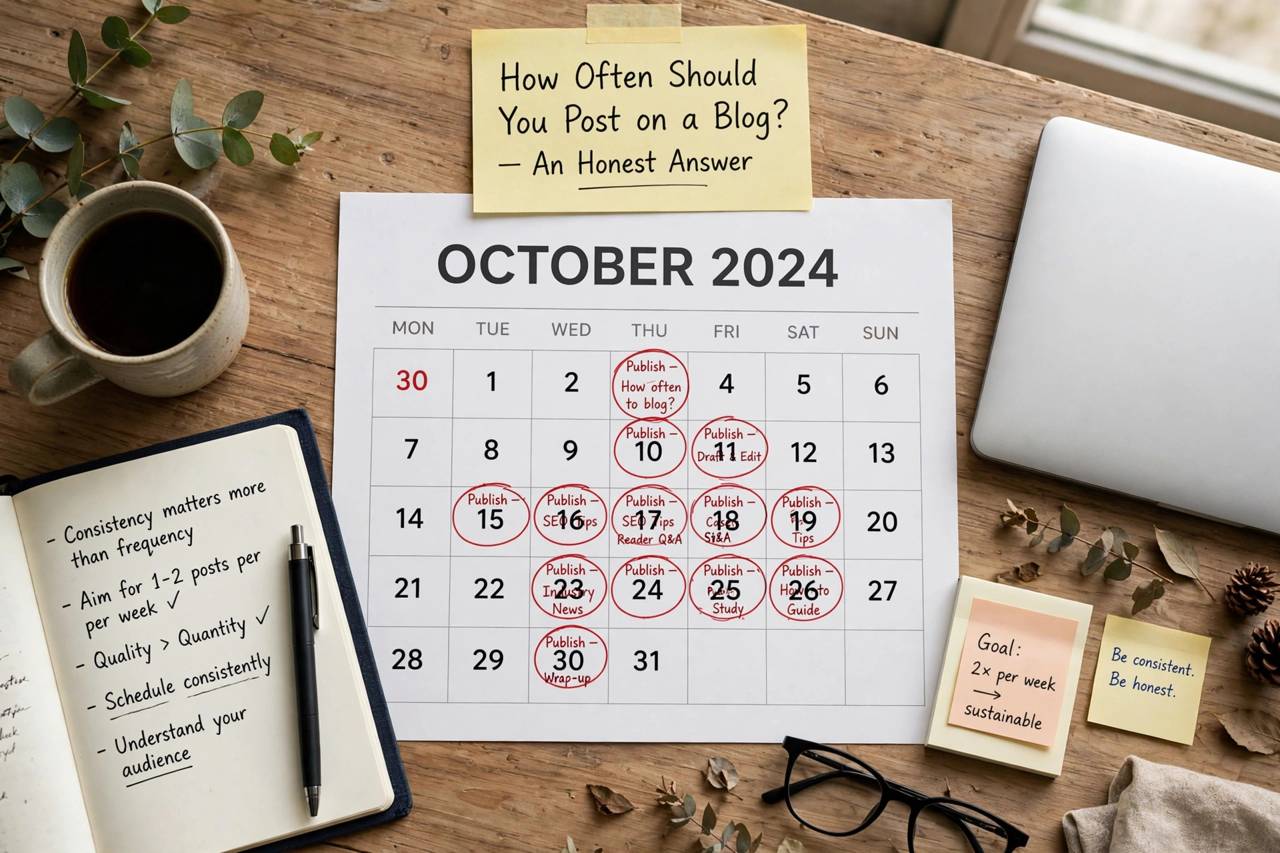
Posting Schedules That Work for Different Blogs
Different blogs have different jobs, so the right cadence differs too.
News and trend blogs
These live on freshness, so they need volume: several posts a week at minimum. But most personal bloggers are not running news desks, and should not try. If you are covering breaking topics solo, three short, sharp posts a week beats one long essay nobody reads in time.
How-to and evergreen blogs
This is where most blogs live. One to two posts a week is the sweet spot, and one excellent post every two weeks outperforms weekly filler. Evergreen content keeps working for years, so each piece is an investment. Spend the extra week making it definitive.
Personal essays and opinion blogs
These run on voice, and voice cannot be manufactured on a quota. Twice a month is plenty; some of the best essay blogs publish monthly. Readers of this kind of blog forgive slowness instantly and punish phoniness immediately.
Business and company blogs
Two to four posts a month is the standard for small businesses, and it works. The goal is steady credibility, not content volume. One practical article that answers a real customer question beats five keyword-stuffed posts that answer nothing.
Signs You Are Posting Too Often
The symptoms are easy to spot once you know them. Your drafts start sounding alike. You catch yourself padding articles to hit a word count. Editing time shrinks to nothing because the next deadline is already looming. You dread the publishing day instead of looking forward to it. And the tell I see most: you stop promoting older posts because you are too busy making new ones, which means your best work is gathering dust while mediocre work takes its place.
When you notice these signs, the fix is not to quit; it is to slow down on purpose. Announce the new schedule plainly. Readers respect honesty far more than they respect frequency, and almost no one unsubscribes over a shift from weekly to biweekly.
Signs You Are Posting Too Rarely
The opposite problem is real too. If your analytics show returning visitors dropping to near zero, your audience has forgotten you. If you feel rusty every time you sit down to write, the habit has atrophied. If you have a backlog of half-finished drafts older than three months, the pace has slipped from relaxed to stalled. A blog needs a pulse. Monthly is the slowest heartbeat that still counts as alive.
Quality Beats Quantity, Every Time
Let me put this as plainly as I can: one article that fully answers a reader’s question is worth more than ten that gesture at it. Search engines have become remarkably good at telling the difference. Readers were always good at it. The bloggers who worry about frequency are usually avoiding a harder question, which is whether each post is genuinely worth someone’s time.
Before you raise your pace, raise your standard instead. Would you email this post to a friend? Would you be proud if it were the first thing a stranger read? If the answer is no, the problem is not that you post too rarely; it is that you are spending your limited writing hours on work that does not deserve them.
A Practical Framework to Decide
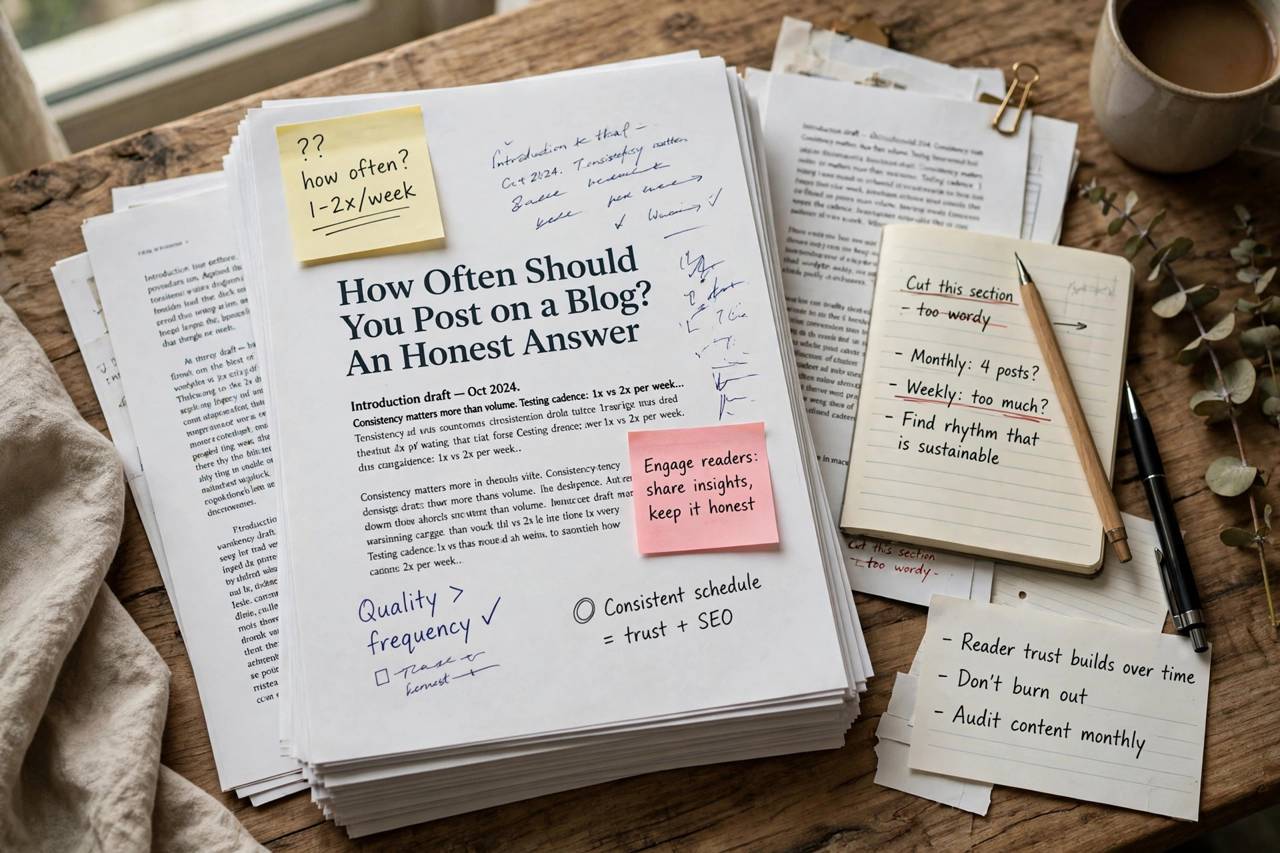
Here is a simple way to settle it. First, decide how many hours per month writing gets, honestly. Second, divide by six, a realistic per-post cost including editing. Third, that is your monthly post count; schedule it on fixed days. Fourth, keep a buffer of two finished drafts so a bad week never breaks the streak. Fifth, review every quarter: is the pace still sustainable, and is the quality still high? Adjust one notch at a time.
New bloggers should start at the slow end. Your first ten posts will be your worst, and that is fine; everyone starts there. Publishing biweekly gives you room to learn what your readers want before you commit to a pace. Established bloggers with an audience can test going faster, but only if the analytics justify it: more posts should mean more engaged readers, not just more posts.
How Often Should You Post on a Blog When You’re Just Starting?
New bloggers should start slower than they want to. Your first twenty posts are where you learn your voice, discover what readers respond to, and build the basic systems: images, formatting, promotion. Posting every two weeks during this phase gives each article room to breathe and gives you room to learn from it. I have watched too many new bloggers launch with a blaze of daily posts, run out of ideas by week three, and abandon the whole project by month two. The tortoise wins this race so reliably it is almost boring.
There is also a strategic reason to start slow: your early posts are your worst posts, and that is fine, but you want the freedom to improve them later. A blogger with thirty thoughtful posts can go back and upgrade the weakest five. A blogger with ninety rushed posts has a cleanup job that never gets done. Start at a pace that lets every post be something you would still be proud of in a year.
What to Do With the Time You Save by Posting Less
Posting less only works if the freed-up time goes somewhere useful. Spend it updating your best older posts, because a refreshed article often gains more traffic than a brand-new mediocre one. Spend it promoting: one great post shared thoughtfully in five relevant places outperforms five posts nobody sees. Spend it learning: read the analytics, notice which topics earn attention, and let that shape the next quarter. And spend some of it resting. A blogger who enjoys writing writes better, and readers can tell the difference.
Frequently Asked Questions
Is posting once a week enough for a new blog?
Yes. One quality post a week is an excellent pace for a new blog. It builds a library of 50+ articles in a year, which is plenty for search engines to work with, while leaving you time to learn, promote, and improve each piece.
Will posting less hurt my search rankings?
Not if the posts you do publish are strong. Search engines rank individual pages on their merit; a slow blog with excellent articles outranks a fast blog with thin ones. What hurts rankings is going completely quiet for months, which signals an abandoned site.
Should I post daily to grow faster?
Almost certainly not. Daily posting only works for teams or for very short news-style content. Solo bloggers who try daily almost always burn out within months, and the quality drop usually erases any traffic gain.
What if I miss my publishing day?
Nothing happens. Publish the next day, or fold the post into the next cycle. One missed day has zero measurable effect; apologizing excessively draws more attention to it than the miss itself. Keep a two-draft buffer and misses become rare anyway.
How long should each blog post be?
As long as the topic needs. A focused answer can be 800 words; a definitive guide might need 2,500. Length should follow the reader’s question, not a quota. Posts that fully satisfy the reader tend to perform best regardless of length.