Basketball Shooting Drills for Beginners: 20 That Actually Work

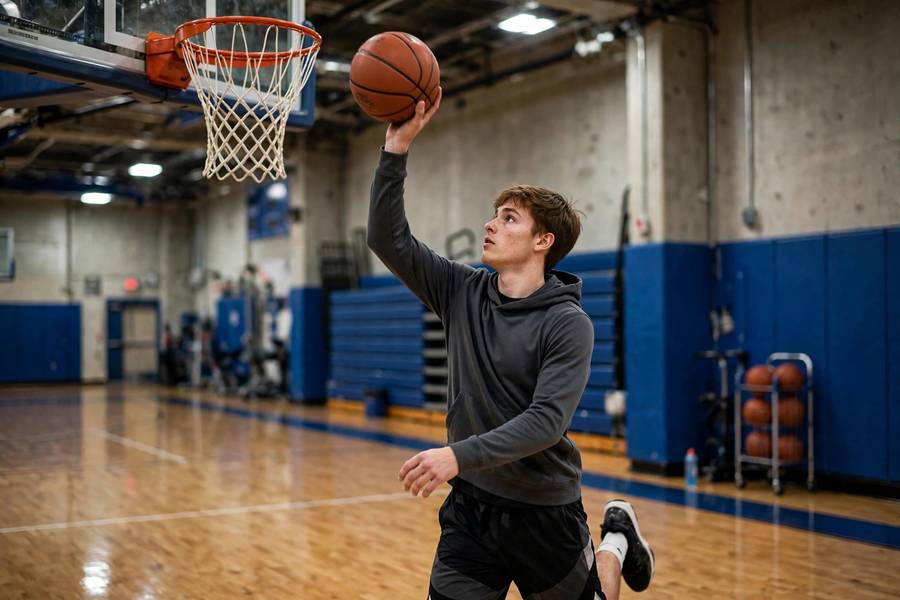
Here’s what nobody tells beginners: shooting drills aren’t about making shots. They’re about building a motion so repeatable that makes become boring. I learned this coaching youth players who wanted to launch threes on day one — the ones who trusted the boring close-range drills were outshooting the chuckers within two months, and it wasn’t close.
These 20 basketball shooting drills for beginners are organized from simplest to most game-like. Start at the top, master each level, and don’t skip ahead — the progression is the program. For the mechanics behind the drills, our guide to proper shooting form is the companion piece.
In this guide:
- How to Use These Drills
- Form Drills: Build the Shot
- Close-Range Drills: Groove the Motion
- Movement Drills: Shoot Like You’ll Play
- Fun Competitive Drills
- A Sample 30-Minute Session
- When to Level Up: Drill Progressions
- Drill Mistakes That Waste Your Time
- Tracking Progress
How to Use These Drills
Three rules before you start: 1) Quality over quantity — 50 focused reps beat 200 lazy ones. 2) Stay in your range — if your form breaks down, move closer; the drill is grooving motion, not testing distance. 3) One drill at a time — master each before adding the next. Beginners who try all 20 in one session learn none of them.
Form Drills: Build the Shot
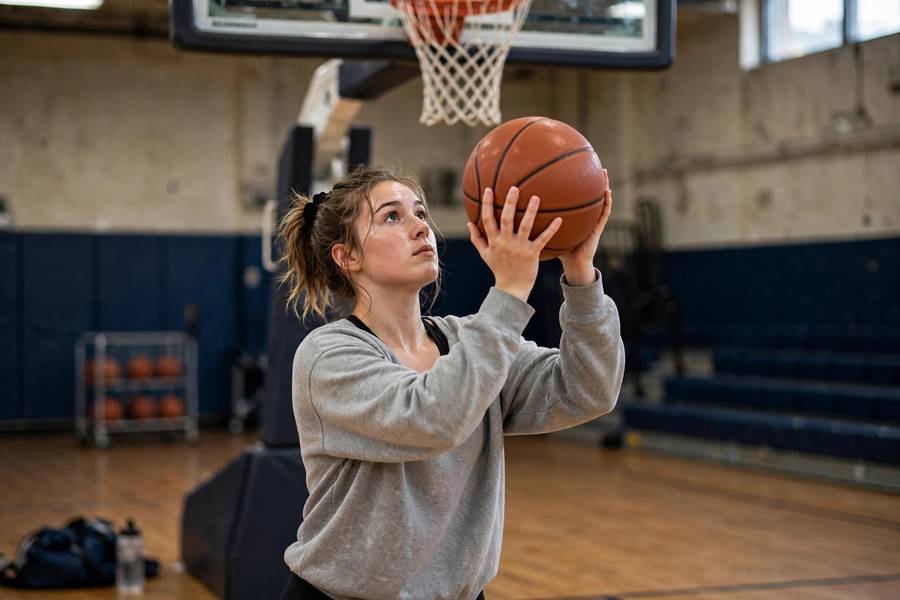
- 1. One-hand form shooting: 3 feet from the basket, shooting hand only, guide hand behind your back. 20 makes. This exposes every flaw in your release — there’s no guide hand to hide behind.
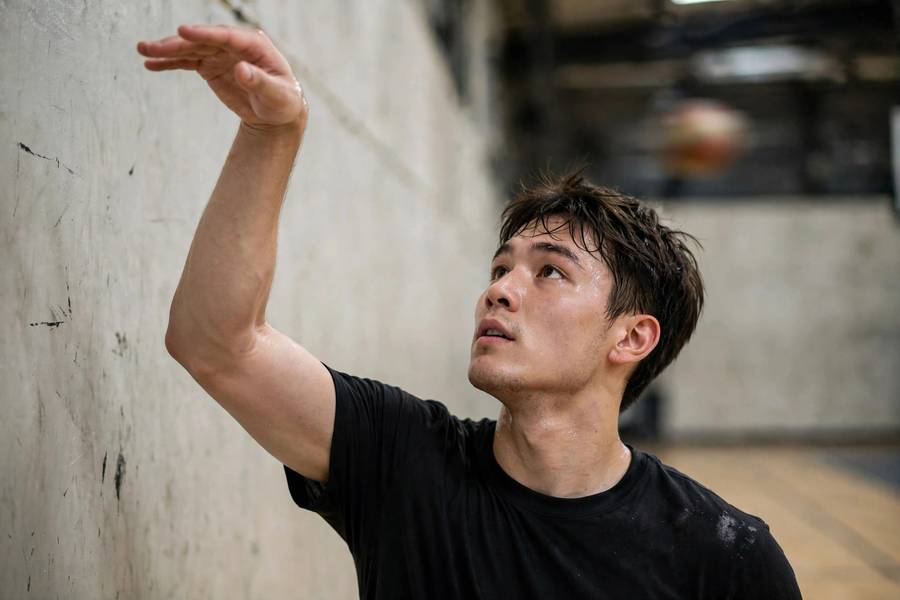
- 2. Wall shooting: stand 4 feet from a wall, shoot the ball with perfect form so it comes straight back. 50 reps. Pure release mechanics, no rim to distract you.
- 3. Chair shooting: sit on a chair and shoot with upper body only. Eliminates leg compensation and teaches you what your arms should actually do.
- 4. Spin-back drill: shoot one-handers focusing only on backspin — the ball should spin backward cleanly off your fingertips. 20 makes. Backspin is the fingerprint of a good release.
- 5. Form shooting ladder: make 5 in a row from 3 feet, then 5 feet, then 7 feet. Miss twice at any spot and restart that spot. Builds pressure tolerance early.
Close-Range Drills: Groove the Motion
- 6. Mikan drill: the classic — alternate right and left-handed layups under the basket, 30 seconds, count makes. Footwork, touch, both hands.
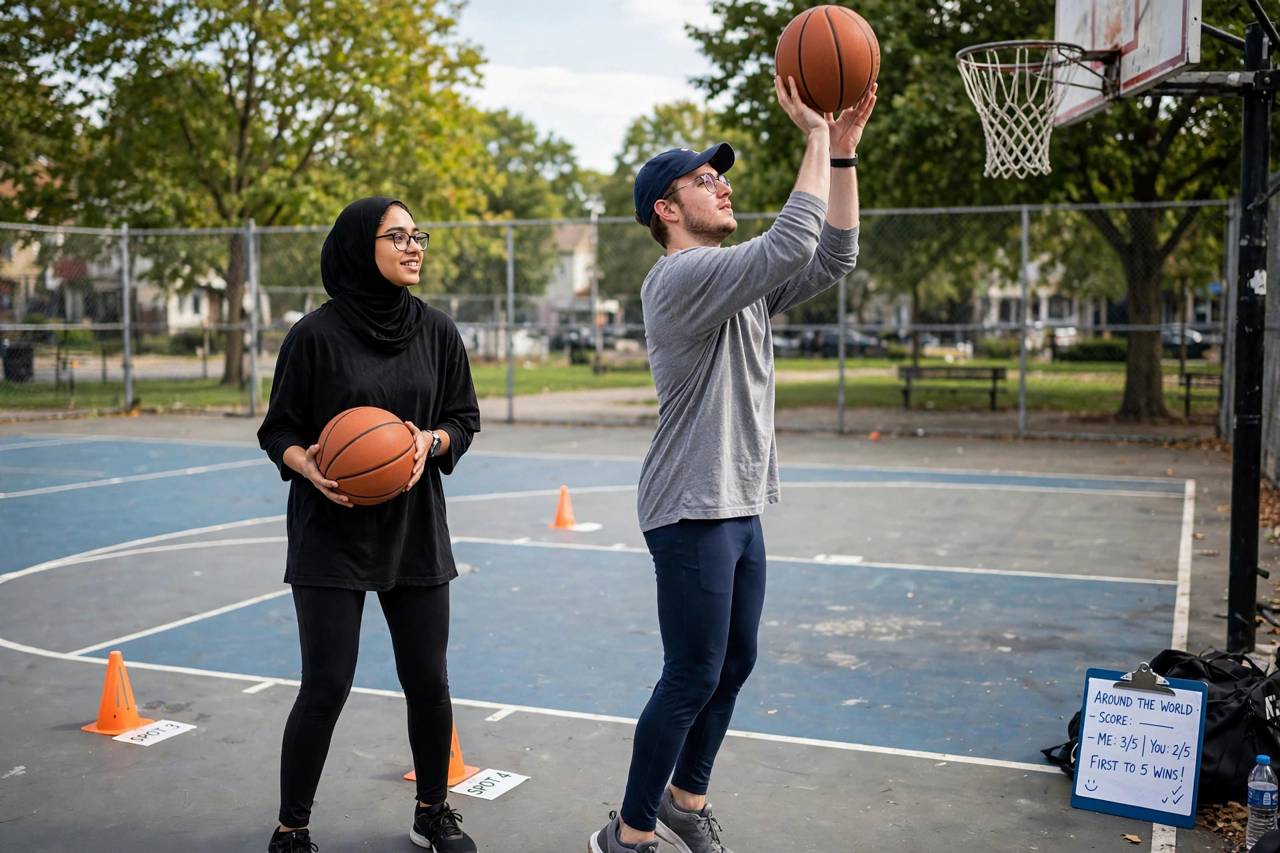
- 7. Around the world: 5 spots in an arc from 8 feet, make one from each before moving on. Miss and stay. Teaches shooting from different angles.
- 8. Bank shot series: 10 makes off the glass from each block. Beginners ignore the backboard; good players weaponize it.
- 9. Free throw routine: develop YOUR routine (dribbles, breath, shoot) and shoot 20. Same routine every time — this is mental training disguised as shooting.
- 10. 5-spot closeout: from 10 feet, 5 spots, 2 makes each. Move at half speed between spots. Introduces movement without chaos.
Movement Drills: Shoot Like You’ll Play
- 11. Catch-and-shoot 3-2-1: partner passes, you shoot from three spots, sprinting between them. 2 minutes, count makes. First taste of game rhythm.
- 12. One-dribble pull-ups: from the wing, one hard dribble into a 1-2 step and shot. 10 each side. The foundation of creating your own shot.
- 13. Shot-fake one-dribble: shot fake, one dribble, pull-up. 10 each side. Teaches the game’s most common scoring move.
- 14. Elbow curls: start under the basket, curl around the elbow, catch and shoot. 10 makes. Simulates coming off a screen.
- 15. Transition threes (or mid-range): sprint from half court, catch at the arc, shoot. Stay in YOUR range — beginners shoot mid-range here. 10 reps.
Fun Competitive Drills
- 16. Around the world (competitive): race a partner through the spots — winner finishes first. Loser does push-ups. Suddenly every rep matters.
- 17. 21 (cutthroat): classic playground game to 21, 2s and 3s, win by 2. Shooting under real competitive pressure.
- 18. Beat the pro: you vs an imaginary pro — you get 1 point per make, the ‘pro’ gets 2 per your miss, first to 11. Surprisingly hard, strangely addictive.
- 19. Free throw pressure: shoot 2 free throws; swish both and you’re done, miss one and run a sprint, then repeat. Teaches performing when it costs something.
- 20. 3-minute shooting: pick 3 spots, 3 minutes, count total makes. Write it down. Beat it next week. The simplest progress tracker in basketball.
A Sample 30-Minute Session
- 0–5 min: warm-up — one-hand form shooting (drill 1), 20 makes close range.
- 5–12 min: form block — wall shooting + spin-back drill (2, 4).
- 12–20 min: close range — Mikan + around the world (6, 7).
- 20–27 min: movement — one-dribble pull-ups (12), both sides.
- 27–30 min: competitive finisher — beat the pro (18) or 3-minute shooting (20).
Do this 3–4 times a week and you’ll outshoot 90% of casual players within two months. It really is that simple — and that hard, because simple requires showing up. If you want this structured into a full daily plan, our 30-minute shooting routine expands it. And for perspective on how long the real games last, check how long a basketball game is — you’ll want stamina to match your new shot.
When to Level Up: Drill Progressions
The most common question I get: “when do I move to the next drill?” Here are the gates I use with players:
- Form drills → close range: when you can make 20 one-hand form shots in a row with clean backspin and a held follow-through. If the ball is not spinning backward consistently, you are not ready.
- Close range → movement: when your around-the-world percentage from 10 feet is above 60% and your free throw routine feels automatic. Movement magnifies flaws, so the base must be solid.
- Movement → competitive: when you can hit one-dribble pull-ups at 50%+ in practice. Competition adds pressure that exposes any remaining mechanical leak.
- Adding range: extend one step at a time. Own 12 feet before you touch 15; own 15 before the three-point line. Every step back must keep the same form — the moment your arc flattens or your guide hand takes over, you have gone too far.
Rushing the progression is the number one reason beginners plateau. Each level builds the neuromuscular pattern the next level depends on. Skip a step and the gap shows up later — usually as a mysterious slump you cannot explain. Trust the gates.
Drill Mistakes That Waste Your Time
- Practicing tired form. When your legs go and your shot turns into an arm-heave, you are grooving a bad motion. Stop, rest, or move closer — never rehearse broken mechanics.
- No target, no counting. “Just shooting around” feels productive and teaches almost nothing. Every drill needs a make-target or a timer, or your brain checks out.
- Changing something every session. Beginners watch a video, change their release, watch another, change their stance. Pick a form, commit for a month, evaluate with film and numbers — then adjust once.
- Skipping the boring drills. Everyone wants to do the fun competitive ones. But the Mikan drill and wall shooting are the vegetables: unglamorous, essential, and the reason the fun stuff works.
- Comparing to others. Your teammate makes 80% in a drill and you make 50%. Irrelevant. Compare to your own numbers from last week — that is the only comparison that matters.
Tracking Progress
Beginners who track improve faster — it’s that simple. Keep a notes app log: date, drills done, makes/attempts on two or three key drills. Watch the numbers climb. When your 3-minute shooting score jumps from 18 to 30, that’s not luck, that’s a rebuilt shot. And when progress stalls for two weeks (it will), don’t change everything — film yourself, find the one mechanical leak, fix it, and watch the numbers move again.
Do not neglect the physical side either. Shooting deep into a session — when your legs are heavy and your form wants to collapse — is where leg strength pays for itself. The lower-body programs in our strength training for runners build exactly the kind of durable leg power that keeps your shot mechanically sound in the fourth quarter.
One last thing: the players who improve fastest aren’t the most talented — they’re the most consistent. Twenty focused minutes, four times a week, beats a heroic two-hour session every Sunday. The rim doesn’t care about your intentions; it only remembers your reps.
Start with form drills (one-hand form shooting, wall shooting), progress to close-range drills (Mikan drill, around the world), then movement drills (one-dribble pull-ups, catch-and-shoot). Master each level before advancing — the progression matters more than any single drill.
Quality beats quantity: 100–200 focused reps per session, 3–4 sessions per week, is plenty for beginners. 50 perfect-form close-range shots teach more than 300 sloppy threes. Increase volume only when form holds up.
Named after George Mikan, it’s the foundational big-man/layup drill: stand under the basket and alternate right and left-handed layups (or baby hooks) off the glass, continuous, for 30 seconds to a minute. It builds touch, footwork, and weak-hand finishing simultaneously.
With consistent focused practice (3–4 sessions/week), beginners typically see major improvement in 6–8 weeks and a genuinely reliable shot in 3–6 months. Rebuilding a broken shot takes longer than building a new one — which is why learning correctly first matters.
Only within their range. Most beginners lack the strength for proper three-point form and develop bad habits (heaving, flat arc) forcing it. Master form shooting to free throws first, extend range gradually, and let threes come when your mechanics can handle the distance.