Handwriting Improvement Tips for Students (That Survive Exam Pressure)

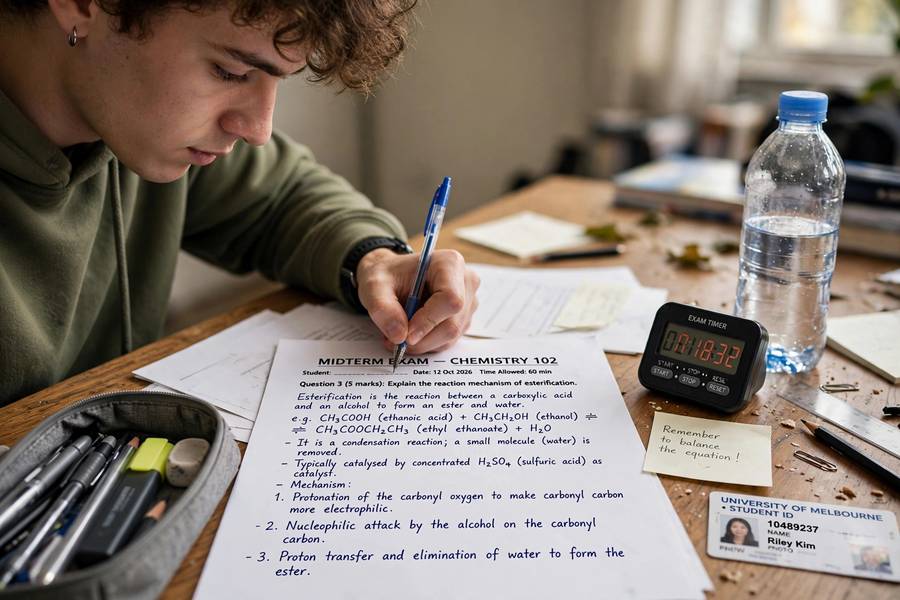
Students face a specific handwriting challenge: your writing needs to look good at speed, under pressure, when your brain is busy thinking about content. Pretty copybook writing that collapses during exams helps no one — and examiners cannot mark what they cannot read. I have coached students whose grades literally rose when their writing became legible, because markers could finally see what they knew.
These tips are built for student reality: timed exams, lecture notes, and the balance between speed and legibility. No calligraphy — just writing that holds up when it counts. tips for studying history exams
Everything here is designed to survive contact with real exam pressure — because advice that only works in calm practice sessions is not advice, it is decoration.
In this guide:
- The Speed-Legibility Balance
- Fixing the Five Common Student Flaws
- Exam-Day Tactics
- Notes vs. Exam Writing
- Building It Long-Term
- Notes for Left-Handed Students
The Speed-Legibility Balance
Here is the core student skill: writing at 80 percent of your maximum speed with 100 percent legibility. Most students write exams at 100 percent speed with 60 percent legibility — and the lost marks dwarf any time saved. Practice finding your 80 percent gear: time yourself writing a paragraph, then rewrite it slightly slower until every word is readable. That pace is your exam pace.
Train speed and neatness separately, then combine. Speed drills: write familiar text as fast as possible without worrying about looks — this builds the motor fluency. Neatness drills: write slowly focusing on form. Then do combination sets: moderate speed, full legibility. The combination is a distinct skill that needs its own practice.
In exams, budget two minutes at the end for a legibility check of key answers — numbers, names, final statements. A corrected ambiguous '7' that was read as '1' can be worth more than those two minutes spent elsewhere. how to study for final exams
Fixing the Five Common Student Flaws
Drifting baseline: writing that slopes up or downhill across the page. Fix: use lined paper always, and practice keeping descenders (g, y, p) consistently below the line. The ruled line is a tool — students who abandon it too early pay in readability.
Inconsistent sizing: giant capitals next to tiny lowercase, or letters that vary randomly. Fix: x-height drills — rows of 'a e n o' at identical height. Examiners forgive plain writing; they penalize writing they must decode.
Crowded spacing: words running together, no breathing room. Fix: the 'finger space' habit — imagine a finger's width between words. In practice, consciously exaggerate spacing for a week; it will settle at a readable normal.
Ambiguous letters: a/e/o confusion, r/v/n merges, 1/7 and 0/6 mix-ups. Fix: identify your personal ambiguous pairs (ask a friend to circle what they cannot read) and drill those specific letters. Targeted fixes beat general 'write neater' efforts.
Death grip fatigue: hand cramping by page two. Fix: lighter pen, relaxed tripod grip, and writing from the arm rather than the fingers. Cramping is a mechanics problem, not a stamina problem.
Exam-Day Tactics
Choose your pen before exam season, not on the day: a smooth, reliable pen you have used for weeks. Bring two. Exam-day pen experiments are a special category of self-sabotage I have witnessed too often.
Structure answers for the marker's eyes: clear paragraphs, underlined key terms, numbered points where appropriate. Legible structure earns goodwill — markers are human, and readable, organized answers get the benefit of the doubt on borderline calls.
Write slightly larger than usual in exams. Larger writing stays legible at speed and is easier for tired markers to read at midnight. It costs a little space; it buys a lot of clarity.

Notes vs. Exam Writing
Accept two gears: fast messy notes for yourself, and controlled legible writing for anything others read. Trying to make lecture notes beautiful wastes capture speed; trying to make exam answers fast ruins legibility. Define the gears and switch consciously.
For notes, develop a personal shorthand — symbols, abbreviations, diagrams — that trades beauty for speed. Your notes serve your memory; as long as you can read them within 24 hours for review, they are doing their job. what active recall is
Bridge the gears with weekly 'neat notes' practice: rewrite one page of the week's notes neatly. This maintains your legible gear, creates excellent review material, and takes fifteen minutes. Students who do this stop dreading essay exams.
Building It Long-Term
Fifteen minutes of targeted drills three times weekly maintains and improves student handwriting through the busiest terms — less than the time lost to rewriting illegible work. Anchor drills to an existing study break.
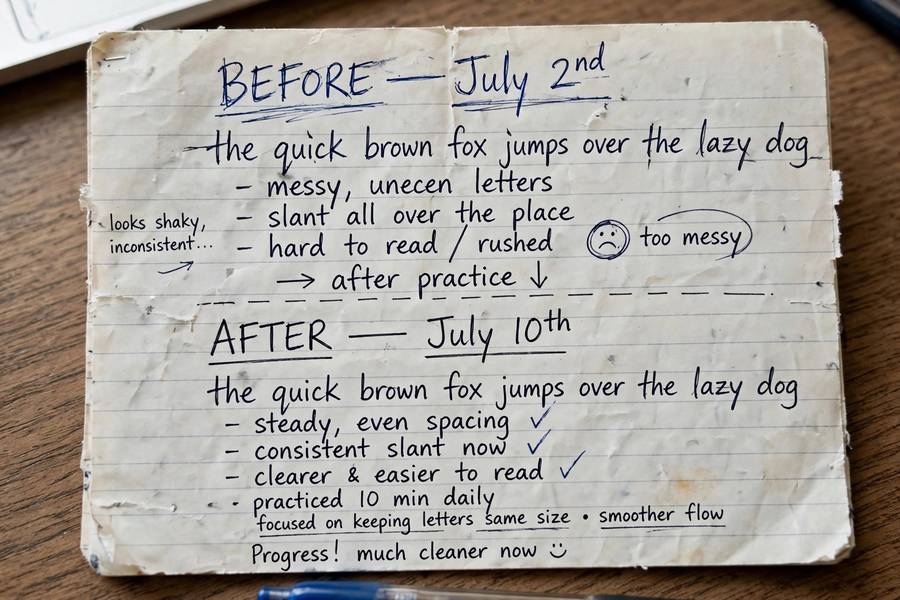
Track with monthly samples: write the same paragraph on the first of each month and compare. Visible progress is the best motivator, and the samples diagnose exactly which flaws remain.
Remember the real goal: communication. You are not training for penmanship awards — you are making sure your knowledge reaches the marker intact. Every increment of legibility is an increment of fairly-earned marks.
Notes for Left-Handed Students
Left-handed students face real mechanical disadvantages with standard handwriting advice — and most guides ignore them entirely. The core problem: left-to-right writing means the left hand pushes the pen and covers fresh ink. Acknowledging this changes the technique, and the right adjustments erase most of the disadvantage. improve your handwriting with proven techniques
Paper angle is the biggest fix: rotate the paper clockwise (top tilting right) significantly more than right-handers do — sometimes 30 to 45 degrees. This lets the hand sit below the writing line instead of dragging through it, reducing both smudging and the hooked wrist position that causes pain.
The grip adjustment: hold the pen slightly farther from the tip than feels natural — about an inch and a half — which keeps the hand off wet ink and opens the wrist angle. It feels strange for a week and then becomes the comfortable normal that prevents years of cramping.
Pen choice matters more for left-handers: quick-drying ink (many ballpoints and quick-dry gels) prevents the smearing that plagues left-handed writing, and it is worth testing pens specifically for dry time. Fountain pens are absolutely usable left-handed — with fast-drying ink and the paper angle right — despite the myth.
Underwriting versus overwriting: learn the underwriting position (hand below the line, wrist straight) deliberately, even if hooking feels entrenched. Retraining takes two to three weeks of conscious practice and pays off permanently in comfort and speed. A mirror or phone video of your hand position reveals habits you cannot feel.
Left-handed students who make these adjustments write as well as anyone — the disadvantage is mechanical, not innate, and mechanics can be fixed. Do not accept smudged, painful writing as the price of being left-handed; it is just unsolved technique.
One more exam-season habit: the night before, write out key formulas, dates, or definitions by hand on one review sheet. The act of writing is itself a final memory pass, and the sheet becomes your morning-of review — handwriting doing double duty as study technique.
Ask a friend to be your legibility checker monthly: they circle anything they cannot read in a sample paragraph. External eyes catch the ambiguities you have gone blind to — and the specific feedback beats any general advice.
On long essay exams, plan your structure in the margin first — three minutes of outlining saves fifteen minutes of rambling, and structured answers look more legible even when the handwriting is identical. Organization is legibility's quiet partner.
Coordinate with your study group: agree on shared abbreviations and symbols for course terms. A common shorthand across the group makes shared notes mutually readable and speeds everyone up — plus inventing the system together is genuinely fun.
For lab reports and practicals, printiness beats cursive — block capitals for labels and measurements eliminate the misread-data errors that cost science marks. Save your flowing hand for essays; use architectural lettering for figures.
Back up your handwriting gains each term with a fresh sample comparison. Terms get busy and form slips; the termly check catches the slide early, when a week of drills fixes it, rather than late, when it needs a month.
Practice writing at 80 percent maximum speed with full legibility, fix your specific ambiguous letters, use lined paper, and do a two-minute legibility check of key answers at the end of each exam.
Yes — examiners cannot credit what they cannot read, and readable, well-structured answers earn the benefit of the doubt. Illegible writing demonstrably costs marks across subjects.
Train speed and neatness separately first, then practice the combination deliberately. Write slightly larger in exams, maintain a relaxed grip, and accept 80 percent speed for 100 percent legibility.
Drifting baselines, inconsistent letter sizing, crowded word spacing, ambiguous letter pairs, and grip fatigue. Each has a specific drill — diagnose yours and target it.
Whichever you can keep legible at speed. Neat print beats sloppy cursive every time — markers reward readability, not style.
They cannot credit what they cannot decipher — and borderline calls go against illegible answers. Neat, structured writing consistently earns the benefit of the doubt.