
Here is something nobody tells you: messy handwriting is almost never about talent. In fifteen years of tutoring, I have never met a student with “bad handwriting genes.” What I have met, hundreds of times, are students holding the pen wrong, sitting wrong, rushing, and practicing exactly zero minutes a week — then wondering why their writing looks like a seismograph reading.
For a deeper dive, see our guide to speed reading.
The good news: handwriting is a motor skill, and motor skills respond to practice faster than you think. Two to three weeks of deliberate, short daily practice produces visible improvement at any age. Here is how to do it right.
Table of Contents
- Why Handwriting Still Matters
- Fix the Fundamentals First
- The 15-Minute Daily Practice Routine
- Improving Print Handwriting
- Improving Cursive Handwriting
- Handwriting for Kids: A Parent’s Guide
- Frequently Asked Questions
Why Handwriting Still Matters
“We all type now, so who cares?” I hear this a lot. Fair question. Three reasons to care:
First, exams. Most standardized tests and many classrooms still run on paper. Illegible handwriting genuinely costs marks — graders cannot award points for answers they cannot read.
Second, memory. Writing by hand forces your brain to process and shape each letter, which strengthens encoding. Students who handwrite summaries may remember more than students who only type them — though the research here is mixed, with several replication studies finding little difference.
Third, speed of thought. When your handwriting is labored, writing feels like a chore, so you write less — shorter answers, skipped steps in math, avoided journaling. Fluent handwriting removes friction between thinking and expressing.
None of this requires calligraphy. It requires legible, comfortable writing. That is an achievable bar for everyone.
Fix the Fundamentals First
Before a single practice drill, fix these four things. They cause most handwriting problems.
1. Grip
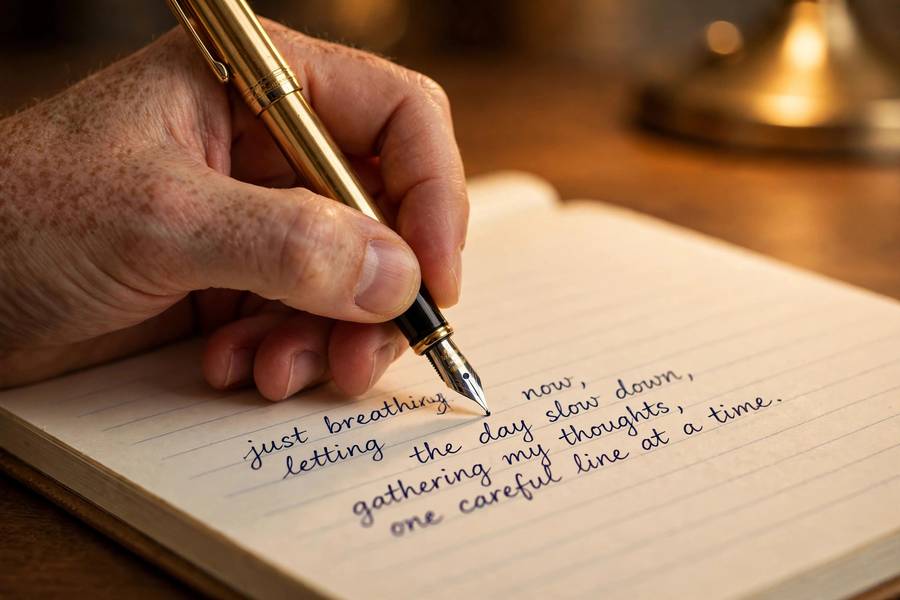
Hold the pen between your thumb and index finger, resting on your middle finger — the classic tripod grip. The pen should rest loosely, not in a death grip. White knuckles mean tension, and tension means shaky, tiring writing. If you have gripped wrong for years, a cheap foam grip adapter retrains your fingers in about a week.
2. Posture and Paper Position
Sit with both feet flat, back straight, and the paper angled slightly (top tilted toward your non-writing hand if you are right-handed; the reverse for lefties). Your writing arm should move from the shoulder and elbow, not just the wrist — wrist-only writing cramps fast and looks cramped.
3. The Right Tools
You do not need expensive pens, but you do need a pen that flows. A scratchy ballpoint forces you to press hard, which kills fluency. Try a gel pen or a smooth rollerball. Paper with lines (or a guide sheet under blank paper) keeps your sizing consistent while you rebuild the habit.
4. Slow Down (Temporarily)
Speed is the enemy of improvement at first. Write at about 70% of your normal speed during practice. Neatness first; speed returns naturally as the new letterforms become automatic — usually within two weeks.
The 15-Minute Daily Practice Routine
Consistency beats marathon sessions. Fifteen focused minutes a day:
Minutes 1–3: Warm-up strokes. Rows of loops, waves, and slanted lines. This loosens your hand and trains smooth motion. Boring? Yes. Effective? Enormously.
Minutes 4–8: Alphabet drills. Write the full alphabet slowly, focusing on consistent size and slant. Circle your three worst letters — those get extra reps tomorrow.
Minutes 9–13: Words and sentences. Copy a paragraph from a book, focusing on spacing between words (one consistent finger-width gap) and keeping letters sitting on the baseline.
Minutes 14–15: Free write. One or two sentences about your day, written at natural speed but with attention. This bridges practice and real life.
Track progress by dating a sample sentence each week. Seeing week-one versus week-three is incredibly motivating.
Improving Print Handwriting
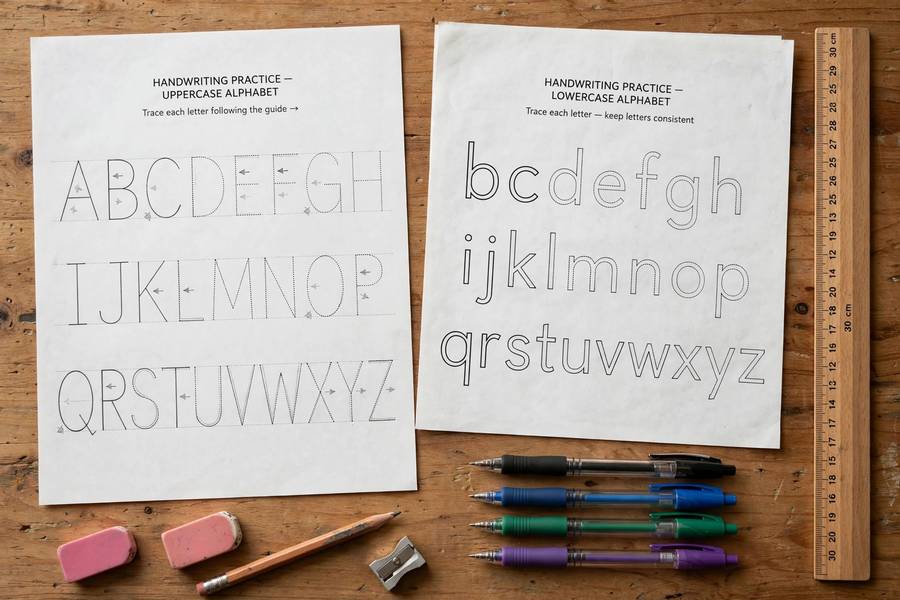
For most students and adults, print (manuscript) is the daily workhorse. Focus on:
- Consistent letter height. The x-height (body of lowercase letters) should be uniform. Use lined paper until it is automatic.
- Even spacing. Crowded words are the top legibility killer. Consciously leave clear gaps between words.
- Simple letterforms. Do not invent fancy versions of letters. Clean, standard shapes are faster to write and easier to read.
- Baseline discipline. Letters should sit on the line, not float above it or dive below (except descenders like g, y, p).
Improving Cursive Handwriting
Cursive gets a bad reputation as outdated, but it is genuinely faster once fluent, and many people find the connected flow less tiring. To improve it:
We break down how to improve reading comprehension step by step in a separate guide.
- Relearn the basic joins. Most messy cursive comes from broken or inconsistent connections between letters. Practice common letter pairs (th, er, in, ou) until the joins are smooth.
- Keep a consistent slant. Pick a slight forward slant and hold it. Mixed slants look chaotic even when the letters are fine.
- Do not over-loop. Exaggerated loops tangle into each other. Smaller, tighter loops stay legible at speed.
If you are choosing between print and cursive, pick the one you will actually use. A beautiful script you never write is worth less than decent print you use daily.
Handwriting for Kids: A Parent’s Guide
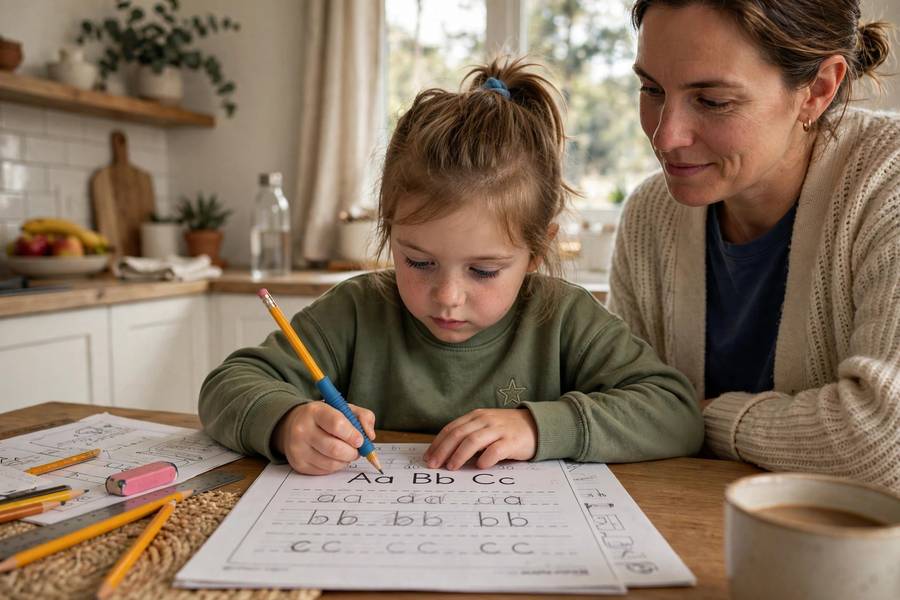
Start with the grip — most children’s handwriting problems are really grip problems. Short, fat pencils or triangular grips help small hands. Keep practice sessions to 5–10 minutes for young kids; stop while it is still fun. Praise specific improvements (“your a’s are so round now!”) rather than general neatness. And model it: kids who see parents writing by hand value it more.
Avoid turning practice into punishment. Ten happy minutes beat thirty resentful ones, every single time. Progress in children is often sudden — weeks of plateau, then a visible jump.
Good handwriting supports everything else in school — teachers can only reward what they can read.
Choosing the Right Pen and Paper
Your tools matter more than most people think. For everyday improvement, a smooth gel pen (0.5mm or 0.7mm) reduces the friction that makes writing feel like a chore — ballpoints require more pressure and tire your hand faster. Fountain pens, once you adjust, practically glide and train a lighter touch. Paper matters too: narrow-ruled or grid paper gives your letters guardrails while you rebuild consistency; cheap scratchy paper fights you. Lefties should look for quick-drying ink to prevent smudging. You do not need expensive gear — a $3 gel pen and a decent notebook beat a $50 set you never open. Match the tool to the task: fine tips for small precise writing, medium tips for comfortable daily notes.
A Note for Left-Handed Writers
Lefties face unique challenges: smudging, awkward wrist hooking, and right-handed desk setups. The fixes: angle the paper the opposite way (top tilted right), hold the pen slightly further from the tip so your hand trails below the writing line, and consider quick-drying gel pens to reduce smear. Sit on the left side of shared desks so elbows do not collide. Left-handed handwriting can be beautiful — it just needs left-handed setup, which schools too often forget to teach.

Frequently Asked Questions
With 15 minutes of deliberate daily practice, most people see visible improvement in 2–3 weeks. Fixing grip and posture first accelerates everything — many problems are mechanical, not skill-based.
Absolutely. Handwriting is a motor skill, not a talent, and adults often improve faster than kids because they can follow drills deliberately. The same routine works: fix grip, slow down, practice letterforms daily.
Cursive is faster once fluent; print is more universally legible. Choose based on what you will actually use daily — consistent, legible writing in either style beats a neglected “better” style.
The tripod grip: pen held between thumb and index finger, resting on the middle finger, held loosely about an inch from the tip. Avoid the death grip — tension causes shaky, tiring writing.
Fix the grip first with triangular pencils or grip adapters, keep sessions to 5–10 fun minutes, praise specific improvements, and never make practice a punishment. Progress often comes in sudden jumps after plateaus.
Yes, for three reasons: exams are still paper-based, handwriting strengthens memory encoding, and labored writing makes you write less. You need legible and comfortable — not beautiful.