7 Best Travel Adapters for International Travel (2026 Tested)

I’ve fried a hair straightener in Italy, watched my laptop refuse to charge in rural Vietnam, and spent $25 on an airport adapter that fell apart in a week. After 47 countries, I’ve learned that the travel adapter is the most boring essential in your bag — and the one most likely to ruin your day when it fails.
The good news: the right adapter costs $15–25, weighs almost nothing, and works everywhere. The bad news: the market is full of junk — adapters that don’t fit, don’t ground, or (worst) claim to convert voltage when they don’t. This guide is everything I know from a decade of plugging in around the world.
For the basics of how adapters differ from converters, see our what is a travel adapter explainer. This is the buying guide — the seven I’d actually recommend.
Adapter vs. Converter: The Critical Distinction
This is the #1 thing people get wrong, and getting it wrong destroys electronics. An ADAPTER changes the plug shape so your device fits the socket. A CONVERTER changes the voltage (220V to 110V or vice versa). They are completely different products, and most ‘travel adapters’ do NOT convert voltage.
Here’s what saves you: most modern electronics (phones, laptops, cameras, USB chargers) are dual-voltage — check the fine print on the charger for ‘100–240V’. If it says that, you need only an adapter (plug shape). If it says ‘110V only’ or ‘220V only’, you need a converter too — or better, leave the device home.
The danger zone: high-wattage single-voltage devices — hair dryers, straighteners, curling irons. These draw 1000+ watts and will fry (or catch fire) on the wrong voltage. Either buy a dual-voltage travel version ($25–40) or don’t bring it. I’ve seen the smoke; it’s not worth it.
The 7 Best Travel Adapters
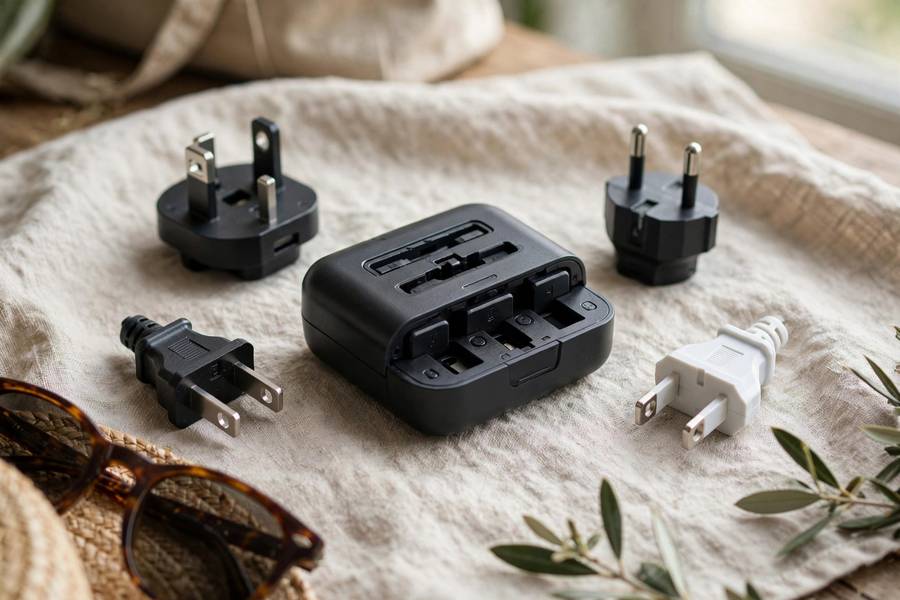
1. The universal all-in-one ($18–25): the classic cube with sliding pins for 150+ countries, plus 2–4 USB ports. Best for: multi-country trips, the ‘one adapter’ solution. Look for: surge protection, a fuse, and USB-C PD (power delivery) for fast laptop charging. Avoid: the ultra-cheap $8 versions — loose pins, no grounding, fire risk.
2. The compact regional set ($12–15): 4–5 individual plugs (UK, EU, Australia, etc.) instead of one universal. Best for: single-region trips, minimalists. Lighter and more reliable connection than universals (no moving parts to break). I carry the EU and UK plugs permanently in my bag.
3. The power-strip adapter ($25–35): a universal adapter with 3 AC outlets + 4 USB ports. Best for: hotel rooms with one outlet, families, digital nomads. Turns one foreign socket into a charging station. Slightly bulky but eliminates the ‘one outlet’ problem forever.
4. The USB-C GaN charger + adapter ($30–45): skip the AC adapter entirely — a 65W GaN charger with swappable international plugs charges laptop + phone + earbuds from one tiny brick. Best for: tech-heavy travelers. This is my current setup; it’s the future.
5. The grounded universal ($20–28): most cheap universals lack grounding (the third pin) — fine for phones, risky for laptops. A grounded universal has the full three-pin connection. Best for: anyone charging a laptop regularly. Worth the small premium.
6. The South Africa/India specialist ($10–14): these countries use the big Type M plug that most universals handle badly. A dedicated Type M adapter is cheap insurance. Best for: southern Africa, parts of India. Check before you go — this is the most commonly forgotten plug type.
7. The airport emergency ($8–12): the overpriced airport version. Best for: when you forgot everything else. It’ll work, but buy a real one at your destination (every electronics market sells them for less) and relegate the airport one to backup.
https://www.wedlockcross.com/wp-content/uploads/2026/10/best-travel-adapter-for-international-travel-2.jpgWhat to Look For (and Avoid)
Must-haves: compatibility with your destinations (check plug types — the world has 15), USB ports (at least 2 — you’ll charge phone + something simultaneously), surge protection (power grids vary wildly; a surge fried my friend’s laptop in rural India), and a fuse (replaceable — it’s the sacrificial part that saves your devices).
USB-C PD (Power Delivery) is the modern essential: it fast-charges phones and can charge USB-C laptops (45W+). An adapter with 65W USB-C PD replaces your laptop brick entirely. This single feature has simplified my tech kit more than anything in five years.
Avoid: adapters without certification marks (CE, FCC, RoHS — the bare minimum), anything that feels loose or wobbly (arcing = fire risk), ‘voltage converter’ adapters under $20 (they’re lying or dangerous), and multi-adapters daisy-chained together (each connection adds resistance and failure points).
Regional Plug Guide: What You Actually Need
Europe (most): Type C/E/F — the two-round-pin plugs. One EU adapter covers 40+ countries. Note: the UK and Ireland use Type G (three rectangular pins) — completely different, always need a separate adapter. Switzerland uses Type J (three round pins, recessed) — EU plugs sort of fit but wobble; a Swiss-specific adapter is better.
Asia: wildly varied. Japan uses Type A (same as US, but 100V — fine for dual-voltage devices). Thailand uses A/B/C (bring a universal). India uses C/D/M (the Type M is the gotcha). China uses A/C/I. Southeast Asia is mostly A/C — easy. Always check the specific country; ‘Asia’ isn’t a plug region.
Africa/Oceania/Americas: South Africa = Type M (the big one). Australia/NZ = Type I (angled pins). Most of the Americas = Type A/B (same as US). The Middle East = mixed (C, G, D depending on country — universal recommended). When in doubt, the universal all-in-one covers everything.
https://www.wedlockcross.com/wp-content/uploads/2026/10/best-travel-adapter-for-international-travel-3.jpgCharging Strategy: The Whole System
The adapter is one piece; the system is what matters. My complete charging kit: 65W GaN USB-C charger with international plugs, one universal adapter (backup), a 10,000 mAh power bank, and short cables (1ft for the power bank, 6ft for hotel rooms — outlets are never where you need them). Total weight: under 500g. Total cost: ~$60.
Hotel room tactics: the first thing I do is a socket survey — behind the TV, in the bathroom, by the desk. The power-strip adapter earns its keep here. Charge everything overnight; top up the power bank. In hostels, bring a small combination lock for the charging locker (or charge in your locked bag).
Power bank rules: keep it charged (it’s your lifeline for navigation and translation), carry it in your daypack (not checked luggage — they’re banned in holds), and know that 10,000 mAh = ~2–3 phone charges. For long travel days (overnight buses, full-day tours), it’s as essential as water. carry-on vs checked baggage
Common Mistakes
Mistake 1: assuming the hotel has adapters. Some do, most don’t, and the front desk’s loaner collection is always out. Bring your own — always.
Mistake 2: buying at the airport. The $25 airport adapter is the $12 Amazon adapter with worse quality control. Buy before you go, or at an electronics market at your destination (often cheaper and better).
Mistake 3: forgetting USB cables. The adapter is useless without the cable. Pack one more cable than you think you need — they break, get lost, and get borrowed permanently. how to pack light
Mistake 4: daisy-chaining. Adapter into adapter into power strip into another adapter — every connection is a failure point and a fire risk. One quality adapter, used properly, is always better than three chained together.
https://www.wedlockcross.com/wp-content/uploads/2026/10/best-travel-adapter-for-international-travel-4.jpgThe Future: Do You Even Need One?
The honest trend: the need is shrinking. USB-C is becoming universal — many new hotels have USB ports built into lamps and desks. Some countries are standardizing. And the ultimate adapter — a GaN charger with swappable plugs — is barely bigger than the plug itself.
But we’re not there yet. For the next 5+ years, the $20 universal adapter remains essential kit. It’s the cheapest travel insurance you can buy — the cost of one ruined device dwarfs it. Pack it, forget about it, and be grateful every time you plug in without thinking.
My recommendation for 2026: the 65W GaN charger with international plugs as your primary, plus a $15 universal adapter as backup. Total investment: ~$50. Total peace of mind: complete. Check our adapter basics guide if you want the deeper technical background.
A universal all-in-one with 150+ country compatibility, USB-C PD (45W+), surge protection, and a fuse — $18–25. For tech-heavy travelers, a 65W GaN charger with swappable international plugs is even better (smaller, faster). Avoid sub-$10 universals — loose pins and no grounding are fire risks.
Usually just an adapter. Check your device charger for ‘100–240V’ — if it says that, it’s dual-voltage and needs only plug-shape adaptation. You need a converter only for single-voltage high-wattage devices (hair dryers, straighteners) — or better, buy dual-voltage travel versions.
Often not. Uncertified adapters can have loose pins (arcing/fire risk), no surge protection, and fake grounding. Spend $15–25 on a certified adapter (CE/FCC marks) from a known brand. It’s the cheapest insurance in your bag.
Most of Europe: Type C/E/F (two round pins) — one EU adapter covers 40+ countries. UK/Ireland: Type G (three rectangular pins) — separate adapter needed. Switzerland: Type J ideally. Bring a universal to cover all three.
Yes, if the adapter is rated for it — use a grounded adapter or USB-C PD charger (45W+) for laptops. Most phone-only USB adapters can’t handle laptop wattage. Check your laptop’s power requirements and match the adapter’s rating.