
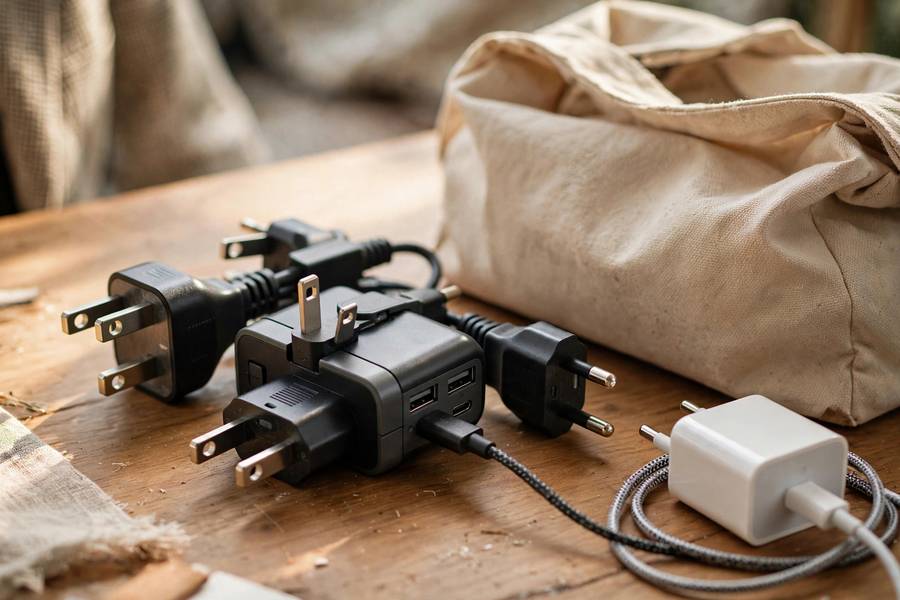
A travel adapter is the small gadget that lets your plug physically fit into a foreign wall socket. That’s it. That’s the whole job. It doesn’t change voltage, it doesn’t protect your devices, it just solves the shape problem — your American two-prong plug going into a British three-prong socket, for example.
I learned the limits of that definition the expensive way in 2017, when I plugged my US hair dryer into a “universal adapter” in Paris and watched it die in a puff of smoke within four seconds. The adapter did its job perfectly — the plug fit. The 220 volts of French electricity did the rest. That story is why this article exists: because the most important thing about a travel adapter is understanding what it doesn’t do.
Table of Contents
- The Short Answer
- Adapter vs. Converter: The Critical Difference
- The World’s Plug Types (Simplified)
- Voltage: The Thing That Actually Kills Devices
- Which Devices Are Safe Anywhere
- What Kind of Adapter Should You Buy
- My Adapter Setup (After Years of Trial and Error)
- Common Mistakes (Including Mine)
- Do You Even Need One?
- Frequently Asked Questions
The Short Answer
A travel adapter changes the shape of your plug so it fits foreign outlets. A voltage converter changes the electrical voltage so your device doesn’t fry. Most modern travel gadgets (phones, laptops, camera chargers) handle any voltage automatically — they just need the adapter for the shape. Older or simpler appliances (hair dryers, curling irons, electric shavers) often don’t — they need a converter, or better yet, leave them home.
If you remember one sentence from this article: the adapter solves shape; voltage is a separate problem.
Adapter vs. Converter: The Critical Difference
This distinction confuses almost everyone, so let’s be precise:
Travel adapter ($10–15): A passive piece of plastic and metal. No electronics inside. It maps your plug’s prongs to the foreign socket’s holes. It does nothing to the electricity itself. Safe for any device as long as the device can handle the local voltage.
Voltage converter ($25–50): An active electronic device (transformer) that steps voltage up or down — e.g., converting Europe’s 220–240V down to America’s 110–120V for a device that only handles 110V. Bulkier, heavier, and necessary only for single-voltage appliances.
The trap: products marketed as “universal travel adapters” are almost always just adapters. The word “universal” refers to fitting many plug shapes, not handling voltage. My dead hair dryer in Paris was plugged into a “universal” adapter. Universal shape. Very much not universal voltage.
The World’s Plug Types (Simplified)
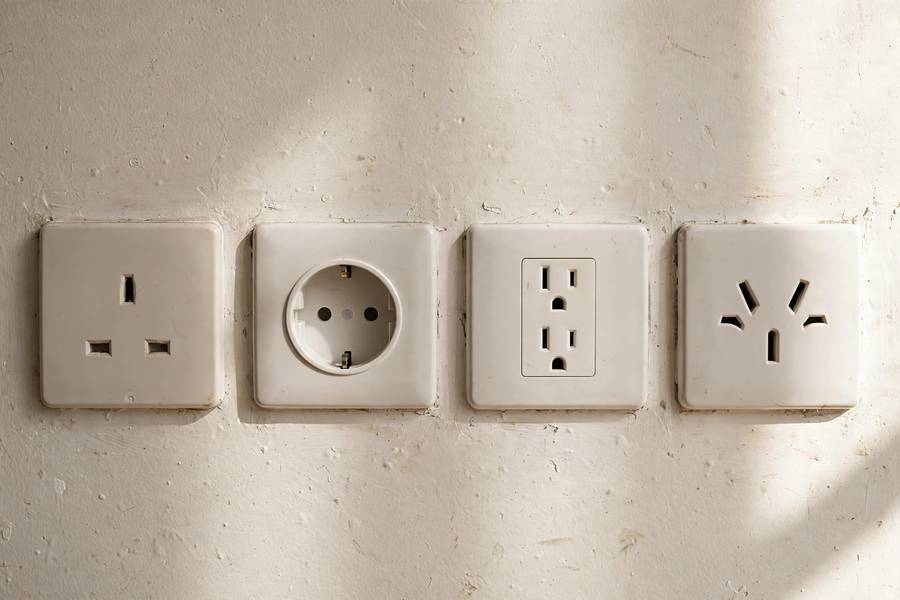
There are 15 official plug types (A through O), but for travel you really only need to know four families:
Type A/B (North America, Japan): the familiar two flat prongs (B adds the round ground pin). Used in the US, Canada, Mexico, Japan, and parts of South America.
Type C/E/F (continental Europe): two round prongs. Type C is the basic Europlug; E and F add grounding variations. Used across most of Europe, South America, and Asia.
Type G (UK, Ireland, and former British colonies): the big three rectangular prongs. Used in the UK, Ireland, Hong Kong, Singapore, Malaysia, UAE, and parts of Africa.
Type I (Australia, New Zealand, China, Argentina): two slanted flat prongs (sometimes with a third). Used in Australia, NZ, China, and Argentina.
The practical takeaway: a good universal adapter covers all four families, which covers ~95% of travel destinations. Country-specific single adapters are cheaper but you’ll accumulate a drawer of them (I have — it’s embarrassing).
Quirks worth knowing: Switzerland uses its own Type J (a universal adapter usually covers it, but the recessed sockets can be fussy). Italy’s Type L has a third prong in the middle — most universal adapters handle it. South Africa’s Type M is the outlier that cheap universal adapters often miss — check before a South Africa trip.
Voltage: The Thing That Actually Kills Devices
The world runs on two main voltage standards:
- 100–127V: North America, Japan, parts of South America
- 220–240V: Europe, UK, Australia, Asia, Africa, most of the world
Plug a 110V-only device into 220V and it will overheat, often dramatically — smoke, sparks, dead device, in that order. Plug a 220V-only device into 110V and it will just run weakly or not at all (less dangerous, still useless).
How to check your device: look at the fine print on the charger or device itself. You’re looking for the input rating:
– “100–240V” (or “110–220V”) = dual voltage, safe worldwide with just an adapter. This covers virtually all phone chargers, laptop chargers, camera battery chargers, USB chargers, and e-readers made in the last 15 years.
– “110V” or “120V” only = single voltage, will fry on 220V without a converter. This is common in hair dryers, curling irons, electric toothbrushes (older ones), CPAP machines (check!), and kitchen appliances.
Check before every trip — ten seconds per device beats a smoke event.
Which Devices Are Safe Anywhere
Safe with just an adapter (dual voltage): phone chargers, laptop chargers, tablet chargers, camera battery chargers, USB power banks, e-readers, electric toothbrush chargers (modern ones), portable speakers.
Danger zone (often single voltage — check!): hair dryers, curling irons and straighteners, electric shavers, CPAP machines, electric kettles, clothing irons.
My rule: I travel with only dual-voltage electronics. My hair dryer stays home — every hotel on earth has one, and the ones that don’t aren’t worth the converter weight. This single decision eliminates the entire voltage problem from my packing. If you absolutely must bring a heat styling tool, buy a dual-voltage travel version ($25–40) rather than hauling a converter.
What Kind of Adapter Should You Buy
The universal all-in-one ($12–20): a single cube with sliding prongs for all major plug types, plus USB ports. This is what 90% of travelers should buy. Look for: all four plug families, at least 2 USB-A and 1 USB-C port (so you can charge phone + camera + power bank from one outlet), surge protection, and a compact size.
What to avoid: the ultra-cheap $5 adapters with no brand and no certifications — loose prongs, poor contact, and in the worst cases a fire risk. And skip the giant “power strip” style universal adapters unless you’re traveling with a film crew; they’re bulky overkill.
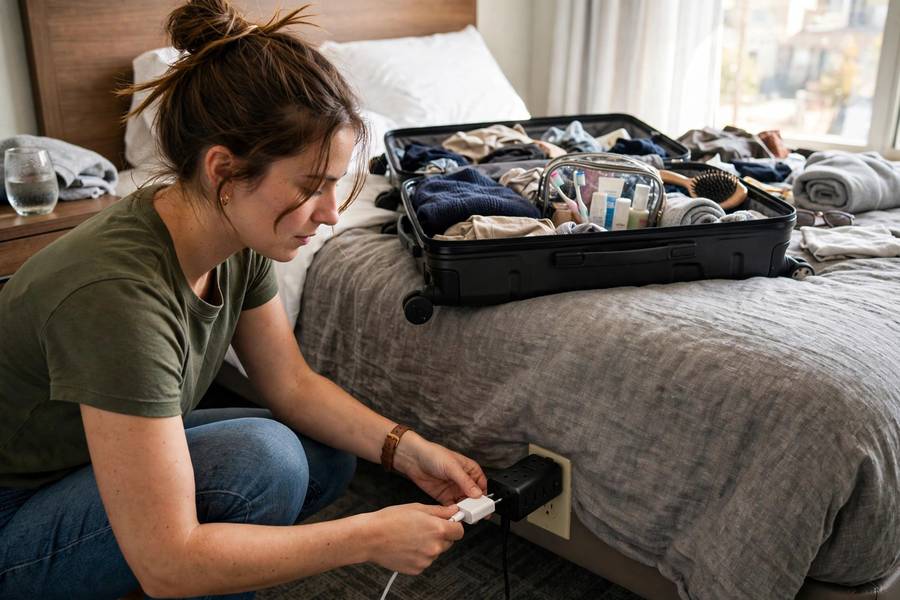
USB ports matter more than you think. Many hotel rooms — especially in older European and Asian buildings — have exactly one accessible outlet, often in an awkward spot behind furniture. An adapter with 3–4 USB ports turns that one outlet into a charging station for everything you own. This is the feature I use daily; the plug-shape part I use occasionally.
Certifications to look for: CE marking at minimum; UL or ETL listing is better. If the product page doesn’t mention any certification, keep shopping.
My Adapter Setup (After Years of Trial and Error)
After a decade of travel, here’s what actually lives in my bag:
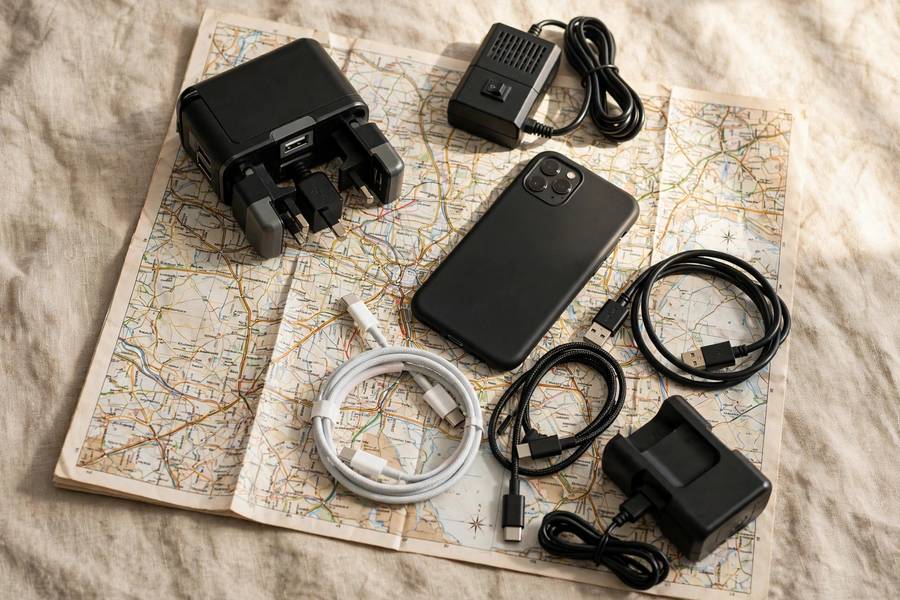
- One universal adapter with 3 USB ports + 1 USB-C — the daily driver. Charges phone, camera batteries, and power bank simultaneously from one outlet.
- One tiny single-region adapter as backup — for the current trip’s region, in case the universal one walks away (they do — hotel rooms eat adapters).
- A 6-foot USB-C cable and a 3-foot one — because the one outlet is always six feet from the bed.
That’s it. No converter (I only bring dual-voltage devices), no power strip, no drawer of country-specific adapters anymore. Total weight: under half a pound. Total cost: about $25.
The backup-adapter lesson: I once left my only adapter in a Lisbon hotel and spent a day in Madrid unable to charge anything before finding an electronics shop. Now the backup lives in a different pocket of my bag. Redundancy for a $10 item is cheap insurance.
Common Mistakes (Including Mine)
The Paris hair dryer (mine, 2017): adapter ≠ voltage protection. Four seconds, one puff of smoke, one dead dryer. Check the voltage rating, not just the plug shape.
Daisy-chaining adapters: plugging a US power strip into a travel adapter into a foreign socket. The adapter is rated for a certain wattage — a power strip full of devices can exceed it. Charge devices directly from the adapter’s USB ports instead.
Forgetting the adapter entirely: the most common mistake, and the most avoidable. My adapter lives permanently in my toiletry bag — it never gets “packed” because it never gets unpacked. Give yours a permanent home in your travel kit.
Assuming the hotel has one: some do, many don’t, and the front desk’s loaner collection is always checked out. Bring your own.
Buying at the airport: the same adapter costs 3x at airport shops. Buy before you go.
Do You Even Need One?
Going from the US to: Europe, UK, Australia, Asia, Africa, most of South America — yes, you need one.
Going from the US to: Canada, Mexico, Japan — no. Same plug shapes (Japan’s voltage is 100V but your dual-voltage devices handle it fine).
Going between European countries: usually no — the Europlug works across the continent. UK to mainland Europe (or vice versa): yes.
The USB-C wrinkle: an increasing number of hotels, airports, and cafes now have built-in USB charging ports. They’re convenient but slow and occasionally sketchy — I still bring my adapter and use the wall outlet. For the full packing picture, see my international packing guide.
A travel adapter is a $15 item that prevents a $0 problem (can’t charge your phone) from ruining a $3,000 trip. Same logic applies to documents — if you don’t have one yet, here’s how to apply for a passport before you book anything. Buy a good universal one, check your devices’ voltage ratings, leave the hair dryer home, and never think about it again.
Frequently Asked Questions
A travel adapter is a small device that lets your plug physically fit into foreign wall sockets. It only changes the plug shape — it does not convert voltage. Most cost $10–15, and a universal version covers the plug types used in ~95% of travel destinations.
An adapter only changes plug shape so it fits the socket; a converter actively changes electrical voltage (e.g., 220V to 110V). Modern phones, laptops, and camera chargers are dual-voltage and need only an adapter, while single-voltage appliances like hair dryers need a converter — or are better left at home.
Yes — virtually all phone, laptop, tablet, and camera chargers made in the last 15 years are dual-voltage (labeled “100–240V”) and work worldwide with just a plug adapter. Always check the fine print on the charger to confirm it says 100–240V.
No — an adapter alone will not protect it. Most US hair dryers are single-voltage (110V) and will overheat or burn out on Europe’s 220–240V within seconds. Either bring a dual-voltage travel dryer or use the hotel’s — it’s the simplest and safest option.
A universal all-in-one adapter ($12–20) with sliding prongs for all major plug types, multiple USB ports (including USB-C), surge protection, and CE/UL certification. Avoid ultra-cheap uncertified adapters, and buy before your trip — airport shops charge triple.
No — Japan and Mexico use the same plug shapes as the US (Type A/B). Japan’s voltage is 100V, but dual-voltage devices (labeled 100–240V) handle it without any converter. You will need an adapter for the UK, continental Europe, Australia, and most of Asia and Africa.