This is the heavyweight debate of AI image generation, and unlike most tool rivalries, both sides are right — they’re just optimizing for different things. Midjourney is a polished product: subscribe, type, get beautiful images. Stable Diffusion is an open ecosystem: download, tinker, get exactly what you want (eventually). I’ve spent serious time in both camps, and the choice comes down to one question: do you want convenience or control?
This Midjourney vs Stable Diffusion comparison covers the real tradeoffs — quality, cost, hardware, customization, and workflow — so you can pick based on your actual needs rather than internet arguments. Background: how Midjourney works and what is Stable Diffusion.
Table of Contents
- The Fundamental Difference: Product vs Ecosystem
- Image Quality: Out of the Box
- Cost: Subscription vs Free (With an Asterisk)
- Hardware: The GPU Question
- Customization: Where Stable Diffusion Dominates
- Ease of Use and Learning Curve
- Privacy and Ownership
- Community and Models
- The Verdict: Who Should Pick What
- Workflow Integration: Where Each Fits
- Where This Rivalry Is Headed
- Training Data and the Ethics Conversation
- Frequently Asked Questions
The Fundamental Difference: Product vs Ecosystem
Midjourney is a product made by one company: unified interface, curated model, consistent experience, support desk. You rent access to their computers and their taste. Stable Diffusion is open-source software released into the wild: thousands of community variants, dozens of interfaces, no official anything. You own the whole stack.
This shapes everything downstream. Midjourney optimizes for the median user’s delight — every update makes the default experience better. Stable Diffusion optimizes for possibility — the ecosystem contains models Midjourney would never ship, interfaces for every workflow, and capabilities the official product doesn’t offer. Product thinking versus ecosystem thinking; neither is superior in the abstract.
Image Quality: Out of the Box
Let’s be blunt: install Stable Diffusion fresh, type a prompt, and compare with Midjourney’s output — Midjourney wins. Its default aesthetic is more polished, its lighting more cinematic, its compositions more reliably pleasing. This is the result of deliberate curation: one team tuning one model for beauty.
But “out of the box” is where Stable Diffusion is weakest and the comparison least fair. The ecosystem’s best community models, paired with good samplers and settings, match or exceed Midjourney in specific domains — photorealism, anime, architectural visualization. The catch is the expertise required to assemble that stack. Midjourney gives you a 9/10 result instantly; Stable Diffusion gives you the parts to build a 10/10 result eventually.
Cost: Subscription vs Free (With an Asterisk)
Stable Diffusion’s headline advantage: the software is free, generations are unlimited, no subscription. Midjourney requires a paid plan with GPU-hour limits. For high-volume generators, the math looks lopsided — until the asterisk.
The asterisk is hardware and time. Running Stable Diffusion well needs a capable GPU (a real upfront cost if you don’t have one), electricity, and — most expensively — your hours learning the tooling. Cloud GPU rentals for heavy use can approach subscription costs. Midjourney’s fee buys you zero setup, zero maintenance, and someone else’s hardware. “Free” software with $2,000 of GPU and 40 hours of learning isn’t free; it’s a different payment structure. Calculate total cost honestly, including your time.
Hardware: The GPU Question
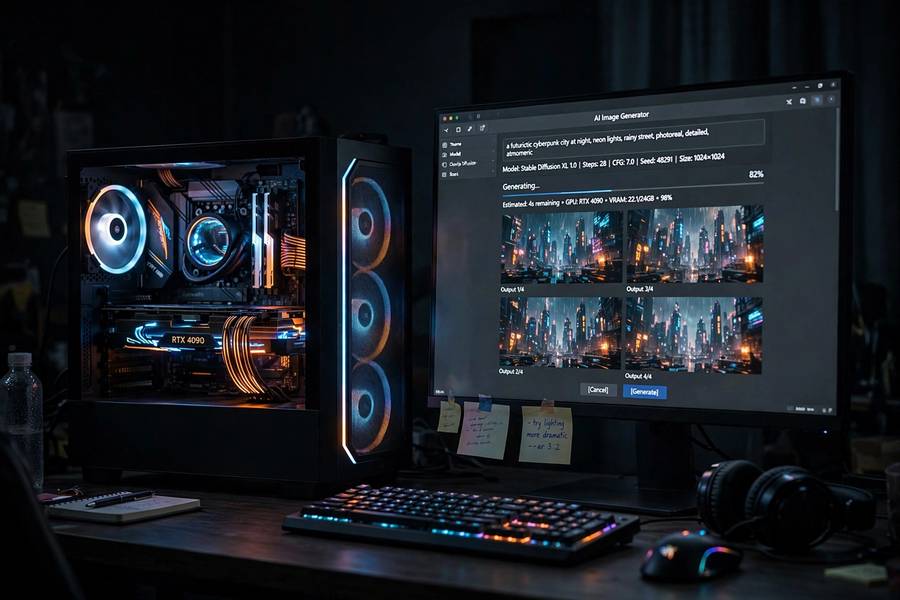
Stable Diffusion runs locally, which means your machine does the work. Practical minimums: 8GB VRAM for comfortable use, more for larger models and higher resolutions. Modern gaming GPUs handle it well; older or integrated graphics struggle. No GPU? Cloud options exist — rented GPU time or hosted interfaces — but then you’re paying per generation like a subscription anyway.
Midjourney needs nothing but a browser and Discord. Chromebook, tablet, phone — anything that runs a chat app generates the same images as a workstation. This is the underrated superpower of the product model: the hardware barrier is zero. For anyone without a gaming PC, this alone decides the debate.
Customization: Where Stable Diffusion Dominates
This is Stable Diffusion’s home turf, and it’s not close. Custom models: thousands of community fine-tunes for specific styles, subjects, and aesthetics — train your own on your own art. LoRAs: lightweight style adapters you can stack and blend. ControlNet: pose, depth, edge, and composition control that makes Midjourney’s parameters look like suggestions. Inpainting/outpainting: mature, precise local editing. Full pipeline control: samplers, steps, seeds, schedulers — every variable exposed.
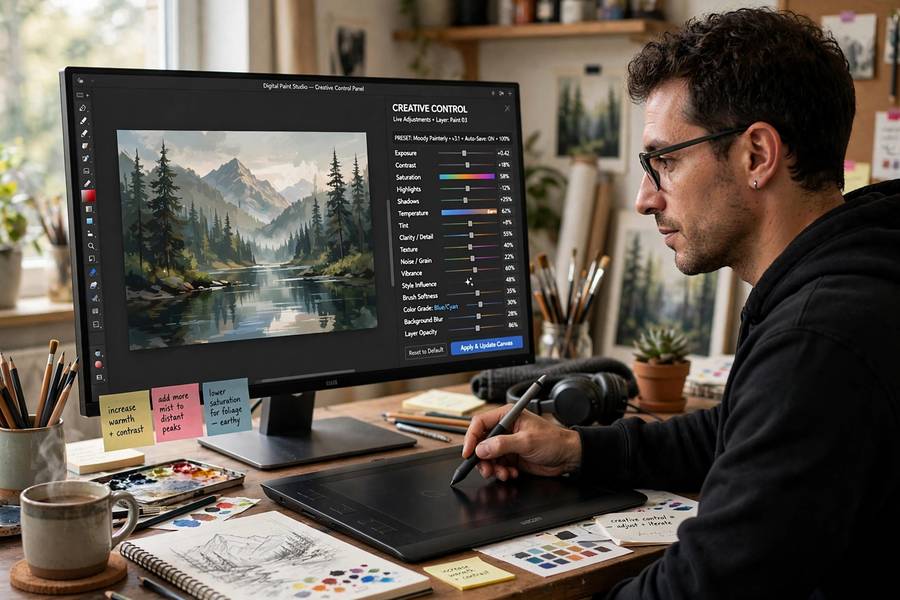
Midjourney offers curated parameters (--stylize, --chaos, region editing) that cover common needs elegantly but can’t match this depth. If your work requires specific, repeatable, fine-grained control — consistent characters across a series, exact poses, brand-specific styles — Stable Diffusion is the only serious choice. How to use Midjourney shows what the product approach covers; everything beyond that lives here.
Ease of Use and Learning Curve
Midjourney: an afternoon to functional, a month to skilled. The Discord interface is odd but learnable, and the skill is prompting — a transferable creative skill. Stable Diffusion: a weekend to installed-and-generating (if technical), months to genuinely skilled. The skills are systems administration plus prompting plus model curation — powerful but narrow.
Be honest about your temperament. If you enjoy tinkering and systems, Stable Diffusion’s learning curve is a feature — you’ll love it. If you want to make images rather than manage infrastructure, it’s pure friction. There’s no virtue in choosing the harder tool; there’s only the question of which friction you’d rather pay.
Privacy and Ownership
Stable Diffusion’s local operation means your prompts and images never leave your machine — significant for sensitive commercial work, unreleased concepts, or personal projects. No gallery, no terms-of-service data usage, no account to be moderated. Midjourney processes everything on their servers; generations appear in public galleries by default (stealth mode costs extra), and you’re subject to their content moderation.
For most casual use this doesn’t matter. For client work under NDA, proprietary concepts, or anyone with strong privacy preferences, it’s a genuine advantage — one of the few that’s absolute rather than situational.
Community and Models
Stable Diffusion’s community is its superpower: model-sharing hubs with hundreds of thousands of variants, tutorials for every niche, and a pace of innovation no single company matches. Need a model trained on isometric game assets? It exists. On 1970s travel posters? Exists. The long tail of creativity lives here.
Midjourney’s community is different: focused on prompting craft within one excellent model. The gallery is a masterclass in what’s achievable with words alone. Less variety of tools, more depth of technique. Both communities are generous and worth joining regardless of which tool you primarily use.
The Verdict: Who Should Pick What
Pick Midjourney if: you want beautiful results immediately, lack a powerful GPU, value simplicity, generate moderately, or do general creative work. It’s the best default choice for most people.
Pick Stable Diffusion if: you’re technical, need unlimited free generation, require custom styles or fine control, care about privacy, or have specific niche needs the mainstream tools don’t serve.
Use both if: you’re serious about the craft — and many professionals do. Midjourney for fast exploration and hero images; Stable Diffusion for precise, customized production work. The philosophical question underneath — can AI make art — doesn’t care which tool you used.
Workflow Integration: Where Each Fits
The tools integrate into creative workflows differently, and this often decides more than quality debates. Midjourney fits the “generate then refine elsewhere” workflow: create options fast in Discord, upscale the winners, finish in Photoshop or Figma. It’s a brilliant ideation engine feeding into standard tools — fast at the fuzzy front end, hands off for precision work.
Stable Diffusion fits the “integrated pipeline” workflow: generate inside your editing environment (there are Photoshop plugins and ComfyUI workflows), iterate with precise control, keep everything in one place. For production pipelines — consistent characters, batch variations, automated workflows — it’s unmatched. The question isn’t just which images are better; it’s where image generation sits in your process. Front-end ideation favors Midjourney’s speed; production integration favors Stable Diffusion’s embeddability.
Where This Rivalry Is Headed
A prediction, offered with appropriate humility: the gap narrows from both sides. Open models keep improving — the quality difference that justified Midjourney’s premium shrinks with every release. Meanwhile Midjourney keeps adding control features that encroach on Stable Diffusion’s territory: better editing, more parameters, API access.
The likely equilibrium: Midjourney remains the best pure product experience — the iPhone of image AI — while open models become the infrastructure everything else builds on. Most professionals will use both without thinking about it, the way photographers use both a phone camera and a DSLR. The rivalry framing will fade; the workflow framing will win. Learn both deeply enough to choose per task, and you’ll be insulated from whichever direction the market moves. That’s the real answer to “which one” — yes.
Training Data and the Ethics Conversation
The elephant in the gallery: both tools trained on vast image collections scraped from the internet, including copyrighted work and living artists’ portfolios. This is the industry’s open wound — lawsuits ongoing, norms unsettled, opinions heated. Neither Midjourney nor Stable Diffusion is clean here by the strictest standards; Adobe Firefly’s licensed-data approach is the notable exception.
What should you do practically? Avoid prompts that mimic living artists by name for commercial work. Add genuine human creative direction — the more transformative your input, the stronger your position. Follow the legal developments in your jurisdiction rather than assuming today’s norms persist. And be honest with clients about AI involvement. The ethics conversation won’t resolve soon, but practitioners who stay informed, avoid the clearest abuses, and add real creativity sleep better than those who treat it as someone else’s problem.
Frequently Asked Questions
Midjourney wins on out-of-the-box beauty and ease of use; Stable Diffusion wins on customization, cost (free software), privacy, and fine-grained control. “Better” depends on whether you value convenience or control.
The software is free and generations are unlimited, but you need a capable GPU (8GB+ VRAM recommended) or pay for cloud GPU time. Factor in hardware costs and learning time for the honest total.
8GB of VRAM is the practical minimum for comfortable use; more VRAM enables larger models and higher resolutions. Modern gaming GPUs work well. Without a discrete GPU, consider cloud options or Midjourney instead.
Yes, with the right community models, settings, and expertise — it can match or exceed Midjourney in specific domains like photorealism or anime. But it requires knowledge to assemble; Midjourney delivers high quality with zero configuration.
Midjourney, clearly. An afternoon gets you generating beautiful images. Stable Diffusion demands technical setup and a longer learning curve before results match — rewarding for tinkerers, frustrating for everyone else.
Keep reading: