In 1779, a Hungarian inventor named Wolfgang von Kempelen built a machine of bellows, reeds, and leather that could say a few recognizable words — “mama,” “papa” — by mechanically imitating the human vocal tract. It was a parlor trick, but it was also the first synthetic speech: the opening chapter of a 250-year quest to make machines talk. Every GPS voice, every audiobook narrator, every “hey” from your smart speaker descends from Kempelen’s bellows.
The history of text to speech technology is really three histories braided together: the mechanical era (imitating the throat), the electronic era (imitating sound with circuits and code), and the AI era (learning from data). Each era thought it had solved the problem; each was wrong in interesting ways. For the modern technology these eras produced, see how text to speech works.
Table of Contents
- The Mechanical Dreamers: 1779 to 1930s
- The Voder: Speech From a Keyboard, 1939
- The Electronic Era: Formants and Rules
- Concatenative Synthesis: The Frankenstein Method
- The 1980s: Speech Comes Home
- Hawking’s Voice and Cultural Moments
- The Statistical Turn: HMMs in the 2000s
- WaveNet 2016: The Neural Big Bang
- The Modern Era: Voices Everywhere
- Frequently Asked Questions
The Mechanical Dreamers: 1779 to 1930s
Von Kempelen’s speaking machine (completed around 1779, described in his 1791 book) used a bellows for lungs, vibrating reeds for vocal cords, and a leather “mouth” the operator shaped by hand. Skilled operators could produce short phrases — contemporary accounts describe audiences gasping. It was extraordinarily limited (a few words, barely intelligible) and extraordinarily visionary: the insight that speech is a physical process that can be mechanically reproduced.
Others followed. Charles Wheatstone built an improved version in the 1830s. Alexander Graham Bell — before the telephone made him famous — built a talking head with his brother as a teenager, a “talking machine” that reportedly said “mama” so convincingly it frightened visitors. Joseph Faber’s Euphonia (1840s) was the most ambitious: a full keyboard-operated talking head that could sing “God Save the Queen,” exhibited to paying audiences.
These machines all shared a ceiling: human operators. Every utterance required a skilled performer working the controls in real time — speech synthesis as puppetry. The dream was a machine that could speak from text automatically. That had to wait for electronics.
The Voder: Speech From a Keyboard, 1939
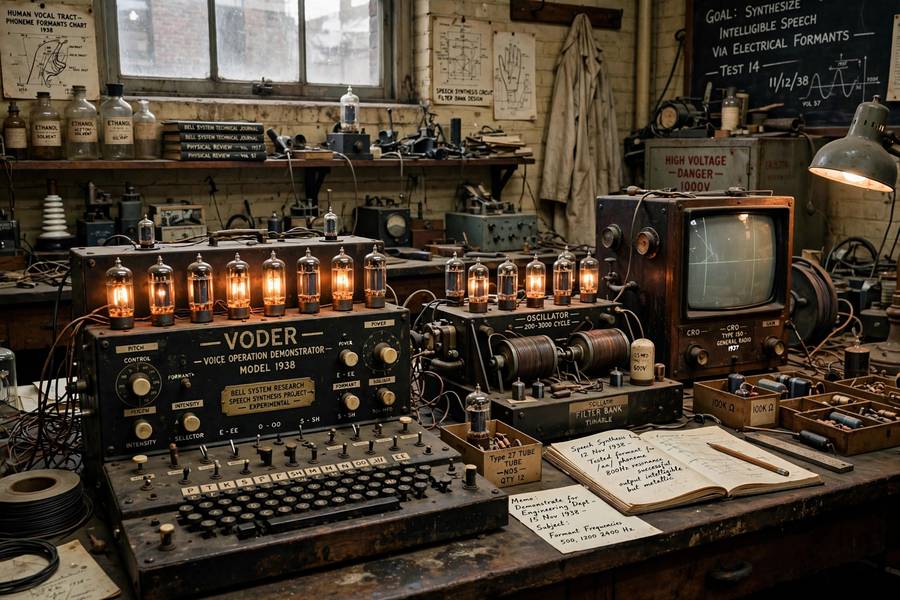
The 1939 New York World’s Fair featured an astonishing exhibit: Bell Labs’ Voder (Voice Operating Demonstrator), a machine that produced continuous speech controlled by a trained operator at a keyboard-like console. The Voder generated sound electronically — buzzers and noise sources shaped by filters — and the operator “played” speech the way an organist plays music, controlling pitch, formants, and articulation with keys, pedals, and a wrist bar.
It took about a year to train a Voder operator. The results, in skilled hands, were remarkably intelligible sentences — the first electronic speech that could say anything, not just prerecorded phrases. The Voder proved that speech could be decomposed into controllable acoustic parameters — the conceptual foundation for everything electronic that followed.
But like the mechanical machines, the Voder needed its human performer. Automatic operation — text in, speech out, no organist — required the computer, which didn’t exist yet. The Voder was a brilliant dead end in one sense and a prophecy in another: it showed what the parameters of speech were, waiting for machines that could set them automatically.
The Electronic Era: Formants and Rules
The postwar decades brought the first truly automatic synthesis. The key insight was the source-filter model: speech = a sound source (buzzing vocal cords or hissing breath) shaped by a filter (the throat, mouth, and nasal cavities). Model the source, model the filter, and you can synthesize any speech sound mathematically.
The Pattern Playback (1950s) at Haskins Laboratories converted painted spectrograms back into sound — researchers literally drew speech and heard it, proving the acoustic theory. By the 1960s-70s, formant synthesizers (like the famous Klatt synthesizer, 1980) generated speech entirely from rules: text → phonemes → acoustic parameters → waveform. No human recordings needed. This was text to speech in the modern sense — fully automatic — and it sounded like a robot. A charming, intelligible, unmistakable robot.
The rule-writing effort was heroic and doomed. Linguists encoded pronunciation rules, coarticulation effects, intonation patterns — thousands of rules interacting in ways no one fully predicted. English’s irregularity fought back at every turn. The voices were intelligible enough for accessibility uses (early screen readers adopted them eagerly) but too unnatural for mainstream applications. The ceiling wasn’t effort; it was the paradigm — speech turned out to be too subtle for rulebooks.
Concatenative Synthesis: The Frankenstein Method
The 1980s-90s took the opposite approach: instead of modeling speech mathematically, record a human saying everything and stitch it together. Concatenative synthesis cut recordings into tiny units (diphones, then smaller) and glued them into new sentences. Unit selection synthesis (1990s) improved this dramatically — recording huge speech databases and algorithmically selecting the best-matching units for each target utterance.
The results were the best yet: genuinely human voice quality in the individual pieces, since they were real recordings. Airline announcements, early GPS systems, and accessibility tools adopted concatenative voices widely. For the first time, synthetic speech could sound pleasant.
But the seams showed. Joining units from different original contexts produced audible discontinuities and intonation quirks — the voice was human in fragments, alien in flow. And each new voice required enormous recording and tuning effort; each new language, years of work. Concatenative TTS was a local maximum — better than formants, but with its own hard ceiling. It dominated commercially for two decades while researchers knew something better was needed.
The 1980s: Speech Comes Home
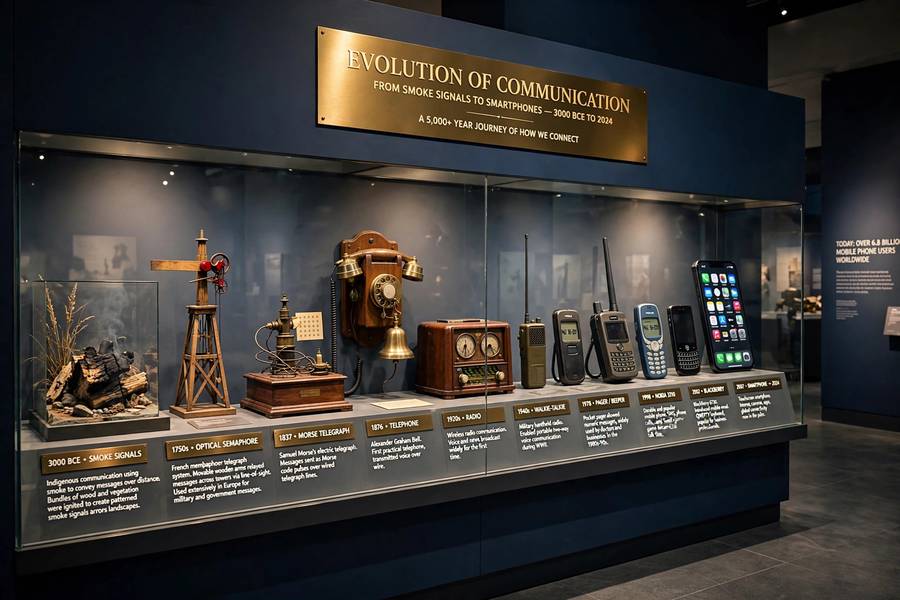
The personal computer era brought speech synthesis to desks and living rooms. The Commodore 64’s Software Automatic Mouth (1982), the Apple Macintosh’s MacinTalk (1984 — “Hello, I am Macintosh,” demoed to gasps), DECtalk (1984, the high-end standard) — suddenly computers could talk, and the novelty was intoxicating.
These were mostly formant/rule-based systems, so they sounded robotic — but that became part of the charm. An entire generation’s idea of “computer voice” was forged here: the deadpan robot that would later be lovingly imitated in movies and music. Accessibility adoption was the serious story — affordable synthesis meant screen readers for personal computers, bringing computing to blind users at unprecedented scale.
The cultural footprint outlasted the technology. Those robotic voices became shorthand for “the future” in films, the aesthetic of early techno music, the voice of countless sci-fi computers. When people of a certain age hear a robot voice, they’re hearing the 1980s — the decade speech synthesis moved from labs to living rooms.
Hawking’s Voice and Cultural Moments
No history of TTS is complete without Stephen Hawking’s voice — a DECtalk-based synthesizer (later software emulations of it) that became one of the most recognizable voices on Earth. When technology offered him more natural voices, he refused: the robotic voice was his identity. It’s a profound reminder that voices aren’t just audio output — they’re personhood, and the “best” voice is the one its owner chooses.
Other cultural moments: the Speak & Spell (1978) teaching a generation of kids with its LPC synthesis; movie computers from HAL to Jarvis shaping expectations; the gradual shift in the 2000s-2010s as GPS voices and phone systems made synthetic speech mundane background infrastructure. Each wave normalized the previous science fiction a little more.
These moments matter because they shaped public understanding — and misunderstanding — of the technology. The sci-fi computer voice set expectations that real TTS chased for decades: conversational, intelligent, natural. We’re only now arriving where fiction pointed.
The Statistical Turn: HMMs in the 2000s
Before neural networks, there was an important intermediate paradigm: hidden Markov model (HMM) synthesis. Instead of hand-written rules, HMM systems learned statistical models from recorded speech — decision trees predicting acoustic parameters from linguistic features. It was machine learning, just not deep learning.
HMM synthesis (dominant in research through the 2000s, commercialized in products like many early-2010s voices) improved naturalness over rule-based systems and, crucially, made voice building a data problem rather than a rules problem — foreshadowing the neural era. New voices got cheaper; quality got smoother.
But HMM speech had a telltale “buzzy,” over-smoothed quality — the statistical averaging washed out the fine detail that makes voices vivid. Researchers called it the “vocoded” sound. It was better than concatenative in consistency, worse in peak naturalness — a tradeoff the field accepted while waiting for something better. That something was already gestating in the neural network research labs.
WaveNet 2016: The Neural Big Bang
DeepMind’s WaveNet paper (September 2016) detonated the field. By predicting raw audio waveforms directly with a deep neural network, WaveNet produced speech dramatically more natural than anything before — listeners preferred it over the best concatenative systems by wide margins. The samples in the paper’s appendix were the “hear for yourself” moment: halting, imperfect, but unmistakably a new regime.
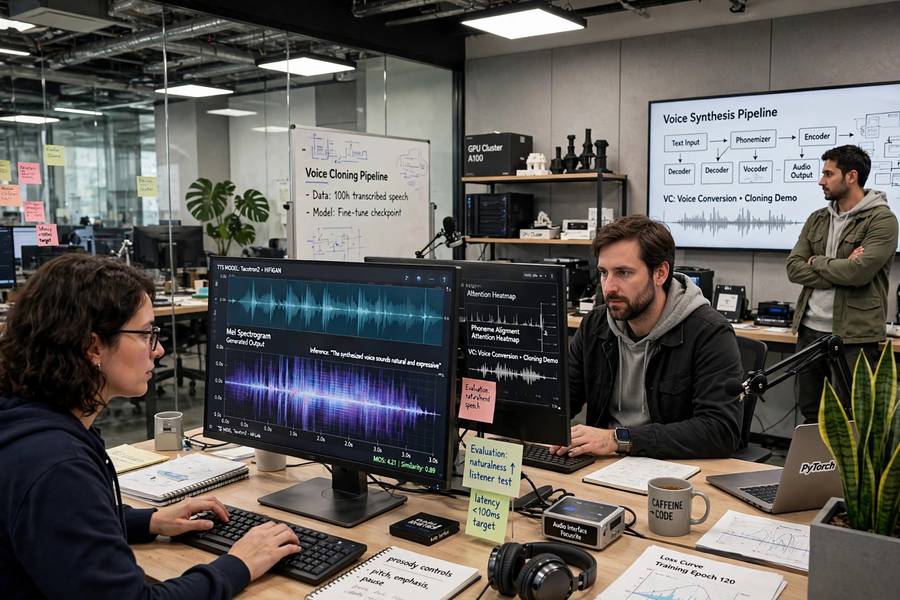
What followed was a Cambrian explosion: Tacotron (2017) for text-to-spectrogram, neural vocoders for spectrogram-to-waveform, then end-to-end models, then diffusion-based systems. Each year brought audible improvements. By 2020, the best AI voices passed casual human detection in many contexts. By 2023-2024, voice cloning from seconds of audio, emotional control, and multilingual models arrived in products.
The deeper story: TTS rode the same deep-learning wave as the rest of AI (see the history of artificial intelligence for the parallel timeline). More data, bigger models, better architectures — the scaling recipe worked for speech exactly as it worked for text and images. The robotic voice wasn’t a hard problem; it was a hard problem for the old paradigms.
The Modern Era: Voices Everywhere
Today, neural TTS is infrastructure — embedded in phones, cars, apps, websites, call centers, and content pipelines worldwide, in hundreds of languages. The technology that took von Kempelen bellows and a skilled operator now runs in milliseconds on a chip, generating any text in voices indistinguishable from human in most contexts.
The frontier has moved from “can machines talk?” to “what should machine speech be?” — questions of consent (voice cloning), identity (what an AI model is now includes voice models trained on real people’s voices), labor (narrators, voice actors), and design (when should AI identify itself as AI?). These are the debates of a mature technology, and they’re the right debates to be having.
Looking back across 250 years, the pattern is humbling: every era’s “solved” was the next era’s “primitive.” The mechanical dreamers proved speech was reproducible. The electronic era proved it was automatable. The AI era proved it was learnable. The throughline is human persistence — two and a half centuries of people who heard machines talk and thought, we can make that better. They were always right.
Frequently Asked Questions
The first speaking machine was Wolfgang von Kempelen’s mechanical device in 1779. Electronic speech synthesis began with Bell Labs’ Voder in 1939. Fully automatic text to speech (text in, speech out, no human operator) arrived with rule-based formant synthesizers in the 1960s-70s.
The Voder (1939) was Bell Labs’ electronic speech machine, demonstrated at the New York World’s Fair. A trained operator “played” speech on a keyboard-like console controlling electronic sound sources and filters. It proved speech could be decomposed into controllable acoustic parameters — the foundation of electronic synthesis.
Old TTS used hand-written rules (formant synthesis) or stitched-together recordings (concatenative synthesis). Rules couldn’t capture speech’s subtlety; stitched recordings had audible seams and flow problems. Both paradigms had hard quality ceilings that only data-driven neural learning broke through.
WaveNet (DeepMind, 2016) was the first neural system to generate raw audio waveforms directly, producing dramatically more natural speech than previous methods. It proved neural approaches could beat decades of traditional TTS and launched the modern AI voice era — every natural AI voice today descends from this breakthrough.
Hawking used a DECtalk-based synthesizer whose robotic voice became globally iconic. When offered more natural voices, he refused — it was his identity. His story reminds us that synthetic voices are personhood, not just audio output, informing today’s debates about voice cloning and consent.