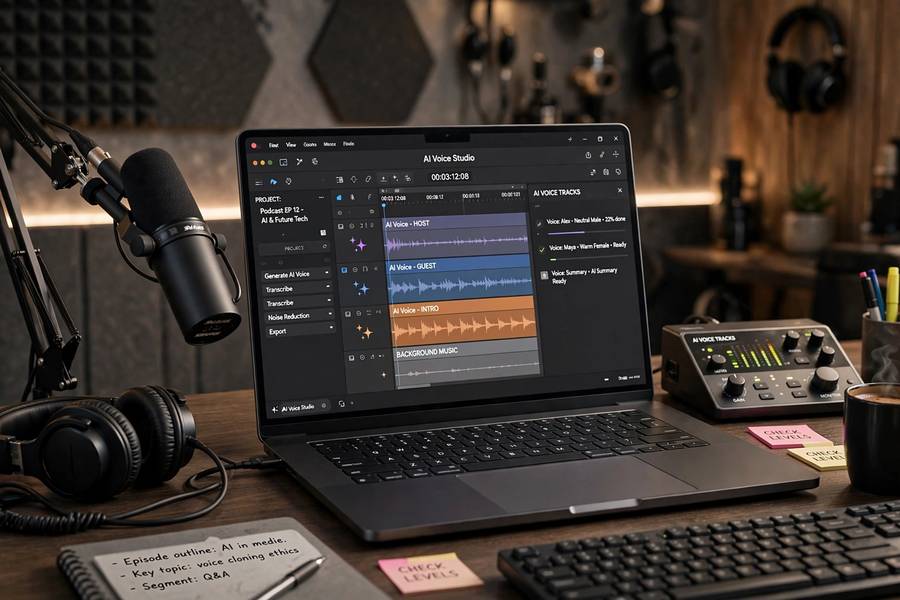
A podcaster friend of mine recently admitted something over coffee: three of his show’s most popular “bonus episodes” were fully AI-narrated, and nobody noticed until he told them. Not because the audience is inattentive — his listeners are sharp — but because for informational content, the voice delivering facts matters less than we assume. That admission captures where text to speech for podcasts stands in 2026: past the novelty phase, into the quiet-utility phase, reshaping how audio content gets made.
This guide covers the full picture: where AI voices fit in podcast production, the workflows that work, the economics, and the honest limits. For the voice technology itself, see how text to speech works; for the business side of podcasting, how podcasts make money.
Table of Contents
- Where AI Voices Fit in Podcasting
- Full AI Narration: When It Works
- The Hybrid Approach: Humans Plus AI
- Multilingual Podcasts Without the Cost
- Production Workflow: Script to Episode
- Voice Selection and Consistency
- The Economics: What AI Changes
- Quality Bar: What Listeners Accept
- Disclosure and Trust
- Frequently Asked Questions

Where AI Voices Fit in Podcasting
AI voices in podcasting occupy several distinct roles, and conflating them causes most of the confused debate. Full narration: the entire episode is AI-voiced, from script to audio. Extra voices: intros, outros, ad reads, transitions, and segment narration around human-hosted content. Translation and localization: the same show in multiple languages with voice-matched AI. Production assistance: draft narration for review, placeholder voices during editing, accessibility versions.
Each role has different quality requirements and audience expectations. Full narration of a news briefing faces low skepticism; full narration of an intimate interview show faces high skepticism. Extra voices are broadly accepted — listeners barely register a polished AI intro. Translation is increasingly celebrated as access-expanding. The debate isn’t really “AI in podcasts yes/no” — it’s which roles, done how well, disclosed how clearly.
My honest assessment of the 2026 landscape: hybrid production (humans for the human parts, AI for everything else) is the dominant winning pattern, full-AI shows thrive in specific informational niches, and the shows pretending AI isn’t involved are making a strategic error we’ll discuss under disclosure.
Full AI Narration: When It Works
Full AI narration works when the content’s value is informational and the audience’s relationship is with the information, not a personality. Daily news briefings, market updates, tech news roundups, niche topic explainers, story narrations, meditation and sleep content — these thrive with AI voices because listeners want the content efficiently, not a parasocial bond.
The production advantages are structural: episodes can be produced daily (or multiple daily) at minimal marginal cost, scripts can be updated until minutes before release (crucial for news), and back-catalog production scales — imagine generating a hundred evergreen explainer episodes in a week. For solo creators, it removes the recording bottleneck entirely: no studio time, no retakes, no “I sound tired today.”
What it demands: excellent scripts (AI narration exposes weak writing mercilessly — there’s no charismatic delivery to hide behind), careful voice selection, and realistic expectations about the ceiling. The best AI-narrated shows are genuinely good listening. They’re not, however, the shows people describe as “my favorite podcast” — that tier still belongs to human voices with human quirks. Know which game you’re playing.
The Hybrid Approach: Humans Plus AI
The hybrid model — human hosts for the human moments, AI for production support — is where most professional podcasting is heading. Concrete patterns: AI voices for cold opens, segment transitions, and ad reads (consistent, quick to produce, easy to update). AI draft narration during production — hear the episode structure before recording, rewrite weak sections, then record the final. AI for the “boring” parts: disclaimers, credits, show notes read-alouds, promo swaps.
A particularly effective hybrid: human interview/conversation as the core, AI narration for the scripted framing around it. The listener gets human authenticity where it matters (the conversation) and polished efficiency where it doesn’t (the setup). Several top shows in informational categories now run this pattern without advertising it — and listeners don’t mind because the experience is good.
The production math is compelling: hybrid cuts production time significantly while preserving the human elements audiences bond with. For teams, it means the host’s time goes to recording great conversations, not re-recording intros for the fifth time. For the economics, this efficiency compounds across episode counts — see how podcasts make money for why production cost is the key variable in podcast profitability.
Multilingual Podcasts Without the Cost
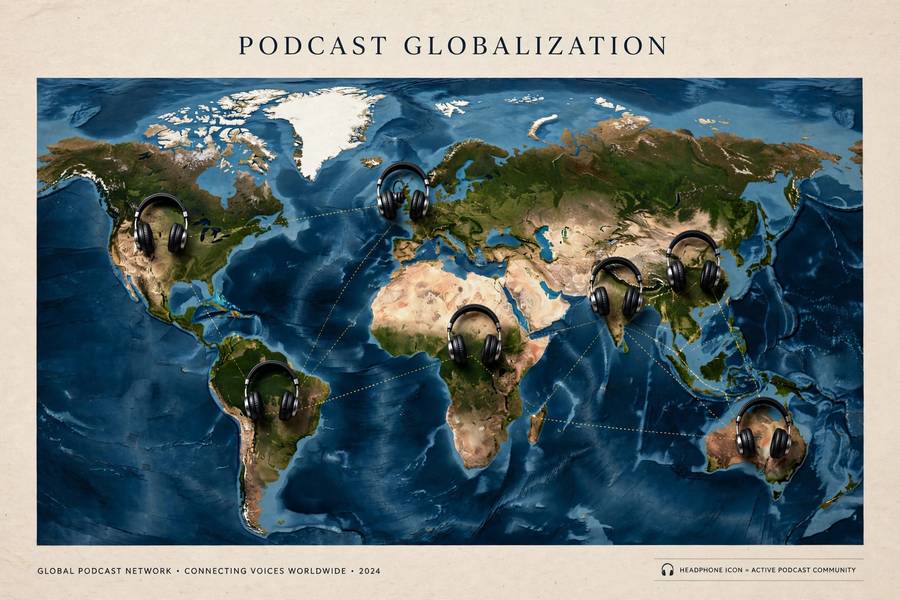
This is the most transformative application and the least discussed. Traditionally, launching a podcast in another language meant hiring native-speaking hosts, re-recording everything, running a parallel production — costs that restricted multilingual podcasting to big networks. AI voice cloning collapses this: record in English, generate natural versions in Spanish, Portuguese, Hindi, German — same show identity, same vocal character, new languages.
The quality has crossed the threshold where it’s genuinely listenable, not a novelty. Voice-matched translation preserves the host’s vocal identity across languages — listeners in each language hear “the same” host. For informational and narrative shows, this works beautifully. For personality-driven comedy or culturally specific content, translation needs more adaptation than voice-swapping — humor and references don’t always travel, and AI can’t fix that (yet).
Strategic implication: podcasters should think about their addressable audience multiplied. A show with 50,000 English listeners might find 200,000 Spanish listeners for the same content with AI localization. The creators moving first on this are building global audiences while competitors stay monolingual. The window won’t stay open forever — eventually everyone localizes, and the advantage normalizes — but right now it’s a genuine edge.
Production Workflow: Script to Episode
The AI-assisted podcast workflow, end to end. One: write the script for the ear (conversational, speakable — the same principles as any TTS script). Two: select and lock the voice — consistency across episodes matters enormously. Three: generate in section-sized chunks, not all at once (better prosody, easier fixes). Four: listen back fully and mark issues — mispronunciations, flat passages, pacing problems. Five: fix and regenerate problem sections. Six: assemble, add music/SFX beds, master to podcast loudness standards (-16 LUFS stereo is the common target).
Seven — the step people skip: the fresh-ears check. Have someone unfamiliar listen to the full episode. They’ll catch what you’ve gone deaf to. Eight: publish with proper metadata, transcripts (accessibility and SEO), and disclosure where appropriate.
The time economics: a 20-minute AI-narrated episode takes roughly 2-4 hours of human work (scripting, voice direction, QA, post-production) versus 6-10+ for human-recorded equivalents. The savings concentrate in recording and re-recording — the most tedious parts. Script quality becomes the binding constraint, which is as it should be: the words matter more than ever when the voice is synthetic.
Voice Selection and Consistency
Voice choice is branding. Your podcast’s voice is as identifying as a logo — listeners recognize it in seconds. Choose deliberately: match the voice’s character to the show’s tone (authoritative for news, warm for storytelling, energetic for tech), test with your actual scripts (not demos), and consider the long listen — a voice that’s exciting for two minutes and tiring for twenty is wrong.
Consistency across episodes is non-negotiable for series. Lock the voice, the settings, even the generation parameters — document them. If the platform updates its models (they do, regularly), test that your voice still sounds like your voice before publishing. Audiences bond with consistency; unexplained voice changes break trust subconsciously.
For shows with multiple voices (narrator plus characters, co-host dynamics), cast them like a production: distinct, complementary, consistent. AI makes multi-voice production trivially easy compared to coordinating human talent — use that advantage, but direct it. Random voice assignment sounds random; directed casting sounds professional.
The Economics: What AI Changes
Podcast economics hinge on production cost per episode versus revenue per episode, and AI attacks the cost side aggressively. Human-narrated episodes cost in studio time, talent fees, editing, and re-recording. AI-narrated episodes cost in scripting, QA, and compute — an order of magnitude less at scale. This changes which shows are viable: daily shows, niche topics with small audiences, extensive back-catalogs — all become economical.
It also changes the risk profile of experimentation. Launching a new show used to require significant upfront investment; AI production lets creators test concepts cheaply — produce ten episodes, measure response, double down or kill. This experimental capacity is arguably AI’s biggest gift to podcasting: more shots on goal, faster learning, lower cost of failure.
The countervailing force: as production gets cheaper, supply explodes, and discovery gets harder. The podcast market is already crowded; AI lowers the barrier further. The winners won’t be those who produce cheapest — they’ll be those who combine AI efficiency with something scarce: original reporting, unique perspective, genuine expertise, distinctive taste. AI commoditizes production; it can’t commoditize having something worth saying. (For inspiration on what great shows sound like, the best self-improvement podcasts roundup shows the human standard AI is chasing.)
Quality Bar: What Listeners Accept
Listener acceptance in 2026 is more nuanced than the discourse suggests. Surveys and behavior show: for informational content, most listeners accept AI narration without complaint — many don’t notice. For narrative storytelling, acceptance is high when the production is good, with a minority preferring human narrators. For comedy, interviews, and intimate/personal shows, human voices are strongly preferred — the parasocial bond doesn’t transfer to synthetic voices.
The acceptance killer isn’t “AI” per se — it’s bad production. Flat delivery, mispronunciations, obvious glitches: these get blamed on AI even when they’re really scripting and QA failures. Well-produced AI narration passes unnoticed; poorly produced human narration gets criticized too. The bar is “good listening experience,” not “human voice.”
Generational note: younger listeners, raised on AI-narrated short-form video, are significantly more accepting than older ones. The acceptance curve slopes upward over time. Producing for where the audience is heading, not where the discourse is, is the smart play.
Disclosure and Trust
Should you disclose AI narration? My position: yes, simply and without fanfare. A line in the show notes (“Narrated with AI voice technology”) costs nothing and preempts the betrayal response if listeners discover it themselves. Discovery-without-disclosure is what damages trust — the content of the disclosure matters less than the honesty of it.
The shows handling this best treat it as production trivia, not a confession: matter-of-fact, unapologetic, focused on the content’s value. The shows handling it worst either hide it (and get caught) or over-apologize (signaling they think they’re doing something wrong, which teaches the audience to think so too).
Looking ahead, platform labeling requirements are likely — some directories are already discussing AI-content labels. Getting ahead of this voluntarily positions you as transparent rather than compliant-under-duress. And for voice cloning specifically (using a real person’s voice, including your own, synthetically), consent and disclosure aren’t just good practice — they’re increasingly legal requirements. Get the paperwork right.
Frequently Asked Questions
Yes — fully AI-narrated podcasts work well for informational content like news briefings, explainers, and story narration. They struggle for personality-driven shows (comedy, interviews) where audiences bond with human hosts. Script quality becomes the binding constraint since there’s no charismatic delivery to hide weak writing.
For informational content, yes — most listeners accept or don’t notice good AI narration. Acceptance is lower for intimate, comedic, and interview shows where the human connection matters. The real acceptance killer is bad production, not AI itself; well-produced AI narration passes unnoticed.
Record in your primary language, then use AI voice cloning to generate natural-sounding versions in other languages with the same vocal identity. This collapses localization costs from hiring full native-speaking teams to running a pipeline — though culturally specific content needs adaptation beyond voice-swapping.
Yes — a simple line in the show notes costs nothing and preempts trust damage if listeners discover it themselves. Treat it as production trivia, not a confession. Platform labeling requirements are likely coming; voluntary transparency now beats forced compliance later.
A 20-minute AI-narrated episode takes roughly 2-4 hours of human work versus 6-10+ for human-recorded equivalents, with compute costs of cents per episode. The savings concentrate in recording and re-recording, making daily shows and niche topics economically viable.
Keep reading: