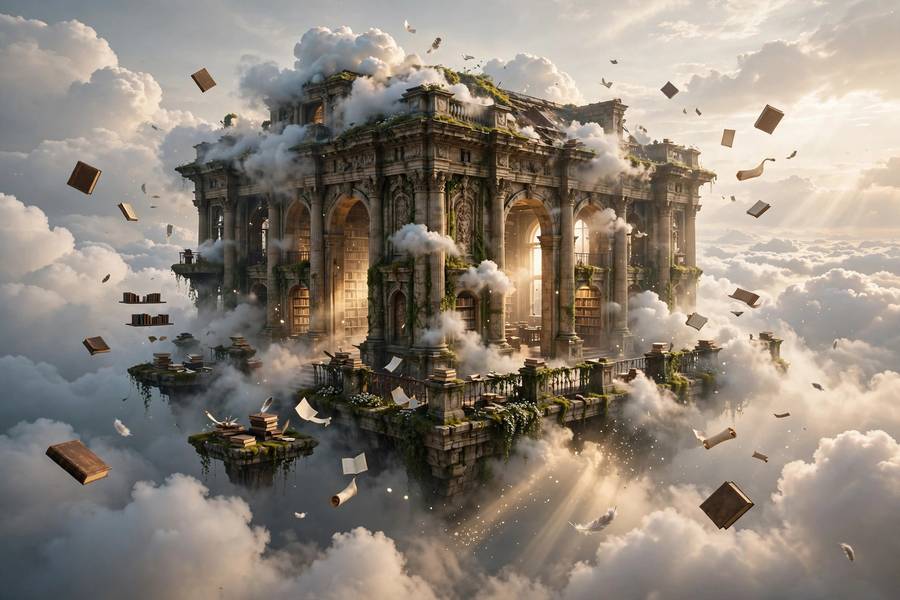
A few months ago I prompted an image generator for “a lighthouse made of books, waves of paper, storm of letters” — and what came back genuinely surprised me. Not because it was beautiful (it was), but because I’d never seen that idea before, and I couldn’t name a human artwork it was copying. It felt original. Then the doubt crept in: was it? Or was it just a combination I’d never personally encountered, assembled from patterns I’d never consciously catalogued? That question — what originality actually is, and whether machines can do it — is deeper than the usual AI art debate. It’s the one underneath it. The broader creative question is at can AI make art; here we go one level deeper.
Table of Contents
- Three Meanings of “Original”
- What AI Actually Does: Recombination at Scale
- The Case That AI Can Be Original
- The Case That It Can’t
- The Novelty Test: Has AI Surprised Us?
- Originality vs. Creativity: An Important Split
- Where the Human Fits In
- My Working Answer
- Frequently Asked Questions
Three Meanings of “Original”
“Original” smuggles three different claims, and the AI question gets a different answer for each:
1. Novel: never seen before. The weakest sense — just “not a copy.” A random splatter pattern is novel. Most AI outputs clear this bar trivially; every generation differs from every training image at the pixel level.
2. Non-derivative: not traceable to a source. Stronger — “doesn’t obviously come from something specific.” AI mostly clears this too, except in memorization cases where it demonstrably reproduces training images. The gray zone is style: clearly “in the style of X” without copying any specific X.
3. Creatively original: a new idea, not just a new arrangement. The strongest sense — the kind we mean when we call an artist “original.” A new way of seeing, a concept nobody had, a break from convention. This is where the real fight lives.
Most people arguing about AI originality slide between these meanings mid-sentence. “It’s just remixing training data” attacks sense 3 while conceding sense 1. “But look, it’s never been seen before” defends sense 1 while ignoring sense 3. Pin down which sense you mean and half the disagreement evaporates.
What AI Actually Does: Recombination at Scale
Mechanically, image models are recombination engines. They learned the statistical structure of visual reality — and visual culture — from billions of images, and they generate by sampling new combinations from that learned structure. How Midjourney works covers the diffusion mechanics; the philosophical upshot is: every output is a novel path through a learned space of possibilities.
Is recombination “original”? Consider the human version: every artist recombines too. Picasso recombined African masks with European portraiture. Hip-hop recombined funk breaks. “Nothing is original” is one of creativity’s oldest clichés — originality, in human practice, usually means unfamiliar recombination, not creation from nothing. Nobody creates from nothing; even the most radical breakthrough stands on predecessors.
So the honest framing isn’t “AI recombines, humans originate.” It’s “both recombine; the question is whether AI’s recombination can reach the unfamiliarity and significance we associate with human originality.” And that turns on what guides the recombination — which is where the two cases diverge.
The Case That AI Can Be Original
Unfamiliar combinations count. When a model blends concepts no human thought to combine — my book-lighthouse, or the genuinely strange outputs from high-chaos generations — the result can be novel in sense 3, not just sense 1. If a human produced that image, we’d call the idea original. Judging the idea differently because of its origin is origin-bias, not analysis.
Latent space contains unexplored territory. A model’s learned space is vastly larger than what any human has explored. Sampling it systematically surfaces combinations outside human habit — not because the model is clever, but because human imagination is constrained by experience in ways the model’s isn’t. AI’s “originality” may come precisely from its alienness: it doesn’t know which combinations are cliché.
Emergence happens. Complex systems produce unexpected behaviors their designers didn’t program. Models occasionally generate coherent details, visual puns, or compositional ideas that surprise even their operators. If originality means producing the genuinely unexpected, emergence qualifies — the surprise is real regardless of mechanism.
The bar for humans is lower than we admit. Much celebrated human art is recombination with good PR. If we credit humans for unfamiliar juxtapositions, consistency demands crediting equivalent machine juxtapositions — or admitting the credit was always about the human, not the novelty.
The Case That It Can’t
Recombination without understanding is shuffling. The model doesn’t know why a book-lighthouse is evocative — it has no concept of books as knowledge, lighthouses as guidance, or why their fusion resonates. Human originality involves grasping why a combination matters. AI produces the combination without the comprehension, which makes its “originality” accidental rather than creative.
No intention, no break from convention. True originality often means deliberately violating expectations — Duchamp’s urinal worked because he understood the convention he was breaking. A model can’t break conventions intentionally because it doesn’t hold them as conventions; it holds them as statistics. Its deviations are noise, not statements.
Originality requires a point of view. What makes an artist’s original work theirs is a consistent vision — obsessions, blind spots, a way of seeing. Models have no obsessions. They’ll generate in any style, on any subject, with equal (in)difference. That versatility is the opposite of the particularity that marks original artistic voices.
Surprise isn’t creativity. A random word generator surprises you too. Creativity, on the strong account, involves recognizing the value in the unexpected — and the recognition, in AI workflows, is done by the human prompter selecting among outputs. The originality, if any, lives in the human’s curation, not the machine’s generation.
Training data bounds the space. The model can only recombine what it absorbed. It cannot originate a genuinely new visual concept from outside its training distribution — no AI invented cubism, because cubism wasn’t in the data. Human originality sometimes means seeing what isn’t there; models only remix what was.
The Novelty Test: Has AI Surprised Us?
Let’s get empirical. Has AI image generation produced anything the art world found genuinely novel — not just pretty, but new?
Candidate surprises: The sheer fluency of early Midjourney outputs surprised everyone — images of a quality nobody expected from text prompts. Specific viral images (the pope in a puffer jacket, for instance) surprised through content — novel juxtapositions with cultural resonance. And practitioners report regular “I never would have thought of that” moments in high-variation exploration.
The skeptic’s reply: Surprise at capability isn’t artistic novelty. The pope image was novel as a prank, not as art — its surprise was sociological. And practitioner surprises are selection effects: generate ten thousand images and some will startle you; that’s statistics, not vision.
My assessment: AI has produced genuine combinatorial novelty — juxtapositions and fusions outside human habit — but not yet genuine conceptual novelty: no AI-originated movement, no new way of seeing, no “cubism moment.” The novelty so far is in the combinations, and the concepts still arrive via human prompts. That’s a meaningful, limited kind of originality — real, but not the full thing.
Originality vs. Creativity: An Important Split
Here’s a distinction that clarifies everything: originality is a property of outputs; creativity is a property of processes.
An output can be original (novel, non-derivative, even conceptually fresh) without its production process being creative in the human sense. A crystal formation is original — that exact crystal never existed — but we don’t call geology creative. Conversely, a process can be deeply creative while producing something unoriginal (every competent cover song).
AI art forces the split into the open: we have outputs that score reasonably on originality produced by processes that lack the markers of creativity (intention, understanding, struggle, vision). The debate persists because people answer different questions — “is the image original?” (often yes, in senses 1-2, sometimes 3) versus “is the system creative?” (probably not, in the full human sense).
Once you separate them, the paradox dissolves: AI can produce original-seeming artifacts through non-creative processes, with the creativity (such as it is) residing in the human’s prompting, selecting, and refining. The originality is distributed across the human-machine system, not located in either part alone.
Where the Human Fits In
This is where I think the honest accounting lands. In current AI art workflows, originality is a joint product:
- The human supplies: the concept, the direction, the taste, the selection, the iteration, the meaning. When a prompter pursues a vision through fifty generations, rejecting and refining, the originality of the pursuit is human.
- The machine supplies: combinatorial range, unexpected juxtapositions, executional fluency, happy accidents. The originality of specific details often genuinely originates in the model’s sampling — the human didn’t imagine that exact texture, that precise fusion.
- The collaboration produces: artifacts neither would make alone. The human couldn’t execute them; the machine couldn’t conceive them.
Calling the result “AI originality” or “human originality” both miss the structure. It’s system originality — and as AI tools proliferate, system originality (human + machine, with the human doing the conceiving and the machine doing the combining) is becoming the normal mode of visual production. The interesting question isn’t whether the machine alone is original; it’s what humans do with a tireless recombination partner.
My Working Answer
Can AI create original art? My answer, after turning this over for longer than is probably healthy:
In senses 1 and 2 (novel, non-derivative): yes, routinely. Every generation is a new artifact, not a copy.
In sense 3 (creatively original — new ideas, new ways of seeing): partially, and only within human-directed systems. The machine contributes genuine combinatorial novelty; the human contributes the conceptual framing that makes the novelty mean something. Apart, neither quite gets there; together, sometimes.
As an autonomous creator: no — not yet, and not by the standards we’d apply to humans. No intentions, no point of view, no deliberate convention-breaking, no understanding of why its novelties matter.
The most defensible position: AI is an originality amplifier, not an originality source. It multiplies the combinatorial reach of human intention. That’s less than the hype claims and more than the skeptics admit — which, in my experience, is usually where the truth parks itself.
Frequently Asked Questions
AI routinely produces novel, non-derivative images (originality in the weak senses). Deeper creative originality — new ideas and new ways of seeing — emerges in human-directed AI workflows, where the machine contributes combinatorial novelty and the human contributes concept and meaning. As an autonomous creator, AI doesn’t yet meet human standards of originality.
AI models recombine learned visual patterns rather than copying specific images (except in rare memorization cases). But human artists also recombine influences — originality in human practice usually means unfamiliar recombination, not creation from nothing. The difference is that humans recombine with understanding and intention.
Originality is a property of outputs (is this new?), while creativity is a property of processes (was this made with intention, understanding, and vision?). AI can produce original-seeming outputs through processes that lack human-like creativity — which is why the debate splits along these lines.
AI has produced genuine combinatorial novelty — surprising juxtapositions outside human habit — but no AI-originated art movement or fundamentally new way of seeing. The conceptual framing still comes from human prompts; the machine contributes unexpected combinations within that framing.
Originality in AI workflows is best understood as a joint product: the human supplies concept, direction, taste, and selection; the machine supplies combinatorial range and unexpected details. Neither part alone fully accounts for the result — it’s system originality, not solo authorship.