Best AI Courses With Certificates: Which Credentials Actually Matter


Let me save you some money: most AI certificates are decoration. Not because the courses are bad — many are good — but because in AI hiring, demonstrated ability crushes credentials every time. I’ve watched hiring managers toss “certified” resumes while fighting over candidates with interesting GitHub profiles. The certificate industry knows this and sells the dream anyway.
But “most” isn’t “all.” Some credentials carry real signal, and understanding which — and why — lets you spend wisely instead of collecting digital wallpaper. This guide covers the certificate landscape honestly: what employers actually value, which types of credentials matter, and how to think about the ROI. For course selection itself, see the best AI courses online.
Table of Contents
- The Uncomfortable Truth About AI Certificates
- What Employers Actually Look For
- The Credential Hierarchy: What Signals What
- University-Affiliated Certificates
- Platform Certificates: Reading the Signal
- Vendor Certificates: The Special Case
- When Certificates DO Matter
- The Portfolio Play: Certificates as Bonus
- The Certificate Mistakes I See People Make
- Frequently Asked Questions

The Uncomfortable Truth About AI Certificates
The AI certificate market exists because of an information asymmetry: learners don’t know what employers want, so they buy what feels like progress. Certificates feel like progress — tangible, shareable, LinkedIn-postable. But the hiring reality in AI is skills-based to an unusual degree, because the work is so demonstrable. You can literally show what you built.
Here’s the hierarchy of what actually influences AI hiring, roughly ordered:
- Demonstrated work — projects, GitHub, deployed applications, writing about technical topics
- Relevant experience — even adjacent experience with AI components
- Technical interview performance — can you actually do the thing
- Education — degrees still matter, especially for research roles
- Certificates — a distant fifth, and mostly as a tiebreaker
A certificate without projects is an empty claim. Projects without certificates get hired constantly. Internalize this before spending a dollar — it reframes every certificate decision from “which looks best” to “does this help me build demonstrable skill.”
What Employers Actually Look For
Talking to hiring managers and watching hiring play out, the pattern is consistent. For applied AI roles, they want: can you build things with AI that work? For ML roles: do you understand modeling deeply enough to be trusted with real problems? For both: evidence, not claims.
Certificates help at exactly one stage: getting past initial resume screening, and only when the screener doesn’t know the field well. A non-technical recruiter sees “AI certificate” and it checks a box. A technical hiring manager skips straight to your projects. So certificates have screening value inversely proportional to the screener’s expertise — useful, but narrow.
The AI skills worth learning this year matter more than any credential: skills get you through interviews; certificates get you to interviews. Both have a role, but don’t confuse their weights.
The Credential Hierarchy: What Signals What
Not all certificates are equal. Roughly, from strongest signal to weakest:
Tier 1 — University programs with real assessment. For-credit or professional programs from known universities with proctored exams and substantial projects. Expensive, time-consuming, and genuinely respected — because they’re hard to fake.
Tier 2 — Rigorous platform specializations. Multi-course sequences with peer-reviewed or auto-graded substantial projects, from providers with quality control. The projects are the real credential; the certificate just packages them.
Tier 3 — Vendor certifications with exams. Proctored exams from major cloud/AI vendors. Signals specific platform competence. Valued in enterprise contexts where those platforms dominate.
Tier 4 — Single-course completion certificates. “You watched the videos.” Minimal signal — everyone knows completion doesn’t imply competence. Fine as learning milestones, weak as credentials.
Tier 5 — Participation badges. Digital confetti. No hiring value whatsoever, though they may motivate the learner (which has its own value — just don’t pay for it).
The pattern: signal correlates with assessment rigor and effort required. Anything easy to get is easy to dismiss. This is a feature, not a bug — it means the valuable credentials are valuable precisely because they’re hard.
University-Affiliated Certificates
University-branded AI certificates (professional certificates, MicroMasters-style programs) sit at the top of the online credential hierarchy for good reasons: admissions standards (mild), real assessment, substantial time investment (hundreds of hours), and institutional reputation that non-technical screeners recognize.
The trade-offs: cost (hundreds to thousands), time (months), and sometimes academic pacing that frustrates practitioners. They’re best for career changers who need the strongest possible signal and can invest accordingly — or for those who genuinely want the deepest education and view the credential as a bonus.
One caution: “university-affiliated” varies enormously. A certificate actually run by the university’s faculty differs from a platform course that licenses a university’s name. Check who’s really teaching and assessing before paying the premium.

Platform Certificates: Reading the Signal
The major learning platforms offer AI certificates at various depths. How to read them:
Specialization certificates (multi-course sequences): moderate signal, primarily as evidence of structured learning. The real value is the projects you complete — put those on GitHub and in your portfolio, and the certificate becomes packaging for real evidence.
Professional certificates (career-oriented programs): often include career services and are designed with employer input. Better screening value, especially for career changers. Still secondary to projects.
Single-course certificates: minimal hiring signal. Take the courses for learning; don’t pay extra for the certificate unless you need it for a specific requirement.
The meta-advice: never pay for a certificate tier before completing the course content. Finish first, evaluate whether the credential serves a specific purpose (a job application, a requirement, a LinkedIn signal for recruiters), then decide. Most platforms let you upgrade to the certificate track after completing — use that option.
Vendor Certificates: The Special Case
Cloud and AI vendor certifications (AWS, Google Cloud, Azure AI, etc.) are a different animal: they certify platform-specific competence through proctored exams, and in enterprise environments running those platforms, they carry real weight.
They’re worth it when: you’re targeting enterprise roles on specific clouds, your employer values or requires them, or you want structured proof of platform skills. They’re less valuable for startups, research, or roles where platform is incidental.
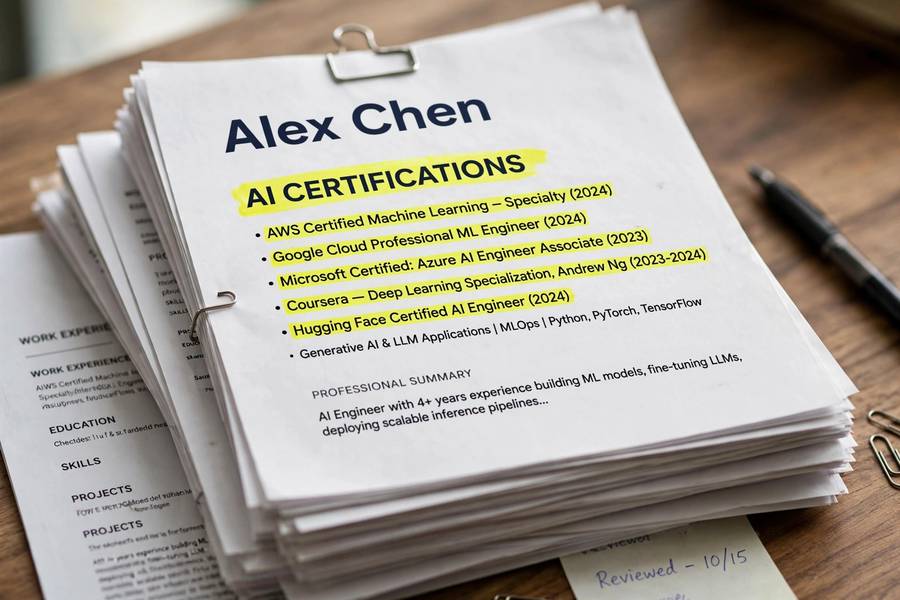
The trap: collecting vendor certs instead of building skill. A wall of badges with no projects is a known anti-pattern that experienced hiring managers recognize instantly. One relevant vendor cert plus projects beats five certs and no work.
When Certificates DO Matter
Certificates punch above their weight in specific situations:
Career changers with no track record in the field — certificates plus projects tell a coherent story of deliberate transition.
Regulated or credential-conscious industries — finance, healthcare, government contracting — where checkboxes matter structurally.
Internal advancement — current employers often value certificates for promotion cases more than external hiring does.
Visa and immigration — some points-based systems credit formal credentials.
Personal motivation — if a certificate gets you to finish, that’s real value. Just don’t overpay for the motivation; cheaper commitment devices exist.
Recruiter-driven markets — when non-technical recruiters do first-pass screening, recognizable credentials help you survive the filter.
In each case, the certificate serves a specific function. Identify the function before buying — “it might help” is how money gets wasted.
The Portfolio Play: Certificates as Bonus
The winning strategy, used by everyone who navigates this well:
- Take courses for skill, choosing based on educational quality, not certificate prestige.
- Build projects during and after — 2–3 substantial ones, public, documented.
- Write about what you learn — the strongest signal of understanding there is.
- Add certificates as the cherry on top — nice packaging for the real evidence.
In this framing, certificates cost little (you’re taking the course anyway) and add marginal screening value. The portfolio does the heavy lifting; the certificate just makes the LinkedIn profile look complete.
And critically: this ordering means you never buy a certificate hoping it substitutes for skill. It doesn’t, it can’t, and everyone who matters knows it. The credential is the receipt, not the purchase — the learning is the purchase.
The Certificate Mistakes I See People Make
Watching people navigate AI credentials, the same expensive errors recur:
Buying the certificate before finishing. Paying for the verified track on day one, then abandoning the course in week three. You’ve now paid for a credential you’ll never earn. Finish first, pay later — the option to upgrade almost always exists.
Collecting instead of building. Five certificates, zero projects. Hiring managers read this instantly as “avoids hard things.” One certificate plus two substantial projects beats five certificates every time, in every hiring process I’ve observed.
Chasing prestige over fit. Paying 10x for a brand-name certificate in a topic you don’t need, while skipping the unglamorous course that teaches the skill you actually lack. The certificate serves your resume; the skill serves your career. Optimize for the career.
Listing everything. A LinkedIn profile with fourteen AI certificates doesn’t signal expertise — it signals credential anxiety. List the two or three strongest; let the rest live quietly in your learning history.
Treating the certificate as the goal. The day you pass is the day the learning should accelerate, not stop. Certificates document past learning; they don’t substitute for current capability. The people who keep getting hired are the ones still building after the certificate arrives.
Frequently Asked Questions
As learning milestones, sometimes; as hiring credentials, usually less than hoped. Employers hire for demonstrated ability — projects and interview performance outweigh certificates decisively. Certificates help most with non-technical resume screening and in credential-conscious industries.
University-affiliated programs with real assessment carry the strongest signal, followed by rigorous multi-course specializations with substantial projects and proctored vendor exams. Single-course completion certificates carry minimal hiring weight.
Technical hiring managers care far more about projects and demonstrated skill. Non-technical recruiters doing initial screening may use certificates as a filter. The certificate’s value is inversely proportional to the screener’s technical expertise.
Finish the course first, then decide based on a specific purpose — a job application, an employer requirement, or recruiter visibility. Most platforms let you upgrade after completing. Don’t pay upfront hoping the certificate substitutes for skill.
A portfolio of 2–3 substantial projects, relevant experience, technical interview performance, and writing about what you’ve learned. These demonstrate ability directly; certificates only claim it. Build the evidence first, add credentials as packaging.
Keep reading: