How to Build an AI Portfolio as a Beginner (That Gets You Hired)

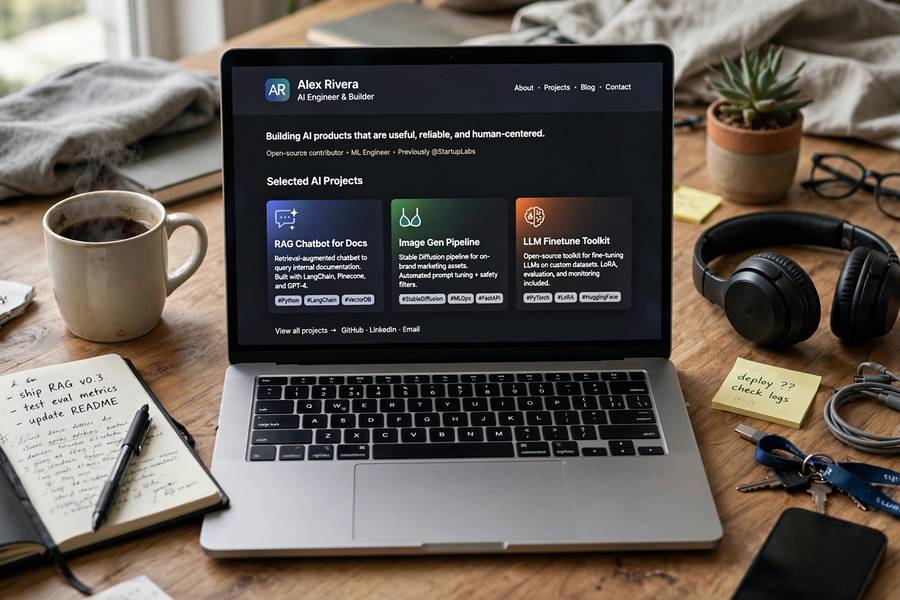
Here’s the uncomfortable truth about breaking into AI: nobody hires you for what you know. They hire you for what you’ve built. Certificates, courses, and tutorial completions are nearly worthless as signals — every hiring manager has seen a hundred candidates with the same ones. A portfolio of real projects, honestly presented, is the only credential that reliably opens doors.
The good news: you don’t need impressive credentials to build an impressive portfolio. You need three to five genuine projects, documented well, showing a trajectory of growth. Let me show you exactly how — what to build, how to present it, and the mistakes that make beginners’ portfolios invisible. For the learning path this fits into, see my guide on how to learn artificial intelligence.
Why Portfolios Beat Certificates
Hiring managers for AI roles face a specific problem: it’s easy to claim AI skills and hard to verify them. Certificates don’t solve this — anyone can click through a course. Portfolios do, because they show:
What you can actually build. Not what you watched, not what you read — what you shipped. A working project is proof that survives scrutiny.
How you think. Your write-ups reveal problem framing, trade-off reasoning, and debugging ability — the things interviews try (and often fail) to assess.
That you finish things. Most beginners have ten half-finished tutorials. Three finished projects put you ahead of 90% of applicants. Completion is a superpower.
Growth trajectory. A portfolio showing project 1 (simple) → project 3 (ambitious) tells a story of learning velocity. Employers hire trajectories, not snapshots.
The math is simple: one hiring manager told me she spends 30 seconds on resumes and five minutes on portfolios. Guess which one gets you the interview.
The 3-Project Starter Portfolio
You need three projects. Not ten — three, done well. Each serves a different purpose:
- Something that uses AI — proves you can work with AI tools/APIs practically
- Something that shows judgment — proves you can evaluate, analyze, and think critically
- Something ambitious — proves you can scope, persist, and ship something hard
Build them in order. Each should take 2–4 weeks. Total: 2–3 months alongside your other learning. Browse AI projects for beginners for concrete ideas at each level.
Project 1: Something That Uses AI
Goal: Prove practical fluency with AI tools and APIs.
Good options: – A specialized AI assistant for a real use case (study helper, writing coach, meeting summarizer) built on an LLM API – An automation that solves a genuine annoyance in your work or life (email triage, report generation, data entry) – A content pipeline: research → draft → refine, orchestrated with AI at each stage
What makes it portfolio-worthy: It must work and be used. “I built a meeting summarizer my team uses weekly” beats “I built a chatbot demo” every time. Real users (even three of them) transform a toy into evidence.
Document: the problem, your approach, the key technical decisions (why this model? why this architecture?), and honest metrics (how well does it work? where does it fail?).
Project 2: Something That Shows Judgment
Goal: Prove you can think critically about AI — not just use it.
Good options: – A model comparison study: take 3–4 AI models, test them on a task you define, and publish rigorous results with methodology. This shows evaluation skill — one of the most in-demand AI skills to learn in 2026. – A failure analysis: pick an AI system, systematically find where it breaks, and document the failure modes with examples. Shows the skeptical thinking employers crave. – A cost/quality analysis: compare approaches (API vs. open models vs. no-code) for a real task, with actual numbers. Shows business thinking.
What makes it portfolio-worthy: Rigor and honesty. A comparison that admits “model X won on quality but costs 10x more, so the answer depends on your constraints” shows mature judgment. Cherry-picked results show the opposite.
Document: methodology (so others could reproduce it), raw results, your interpretation, and what you’d do differently. This project often impresses more than the “ambitious” one — judgment is rarer than effort.
Project 3: Something Ambitious
Goal: Prove you can handle scope, complexity, and sustained effort.
Good options: – A multi-component AI application (frontend + API + data processing + evaluation) – A fine-tuned model for a specific domain or task – A RAG system over a real document collection (company docs, a book corpus, research papers) – An AI agent that completes multi-step tasks autonomously
What makes it portfolio-worthy: That you finished it. Ambitious projects are where beginners usually fail — not from lack of skill but from lack of scoping. The portfolio win isn’t the sophistication; it’s the shipped complexity.
Scope ruthlessly. Define the minimum version that counts as “done,” build that first, then add one stretch feature if time allows. Write the scope down before starting — future you, drowning in feature creep, will need past you’s clarity.
Document: the architecture (a simple diagram), the hard problems you solved, what you cut and why, and an honest retrospective.
How to Document Projects Like a Professional
Each project needs a write-up with five sections:
- The problem (2–3 sentences). What real need does this address? “I built X” is weak; “Customer support teams waste hours on Y, so I built X” is strong.
- My approach (a paragraph). What you built and the key decisions. Link the demo and code.
- How it works (technical summary). Architecture, tools, the interesting implementation details. A diagram helps enormously.
- Results (honest numbers). Accuracy, usage, feedback — whatever’s relevant. Include the bad news: “fails on Z, which I’d fix by…”
- What I learned (the retrospective). What surprised you, what you’d do differently, what you’d build next. This section is what separates beginners who’ll grow from those who won’t.
Tone: confident but honest. “This works well for X but struggles with Y” beats both false modesty and hype. Hiring managers have excellent hype detectors — they’ve been burned before.
Length: one page per project. If it needs more, link to details. Respect the reader’s time.
Where to Host Your Portfolio
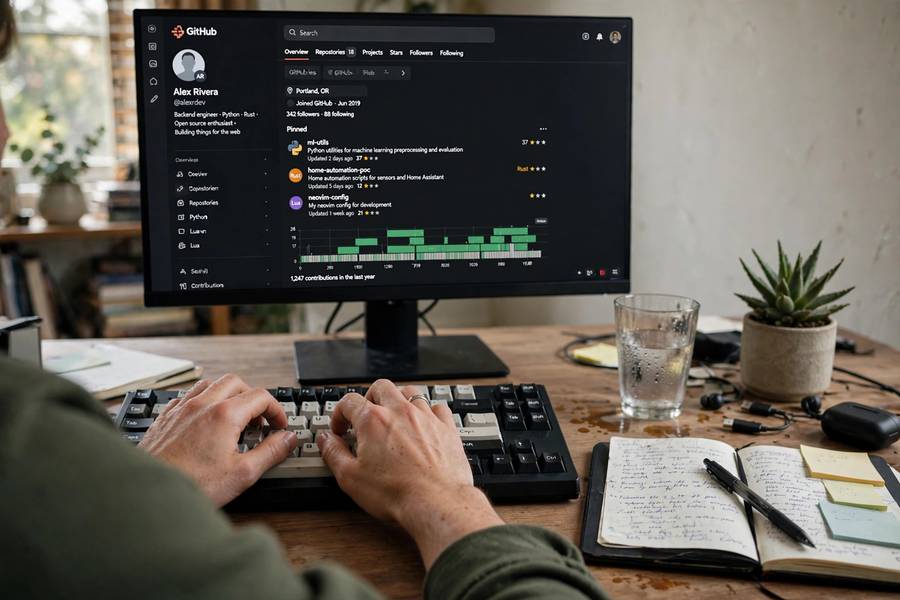
GitHub — non-negotiable for code. Clean repos, good READMEs, meaningful commit history (not one giant “final” commit). Pin your three portfolio projects.
A simple personal site — GitHub Pages, a Notion page, or a minimal static site. One page: who you are, your three projects with links and one-paragraph summaries, contact info. Design matters less than clarity.
Write-ups — put the detailed project documentation where it’s readable: the site, a blog, or thorough READMEs. Assume the hiring manager reads on a phone between meetings.
What you don’t need: a fancy custom domain (nice but optional), video production (a simple screen recording of the demo is plenty), or social media presence (helpful, not required).
Portfolio Mistakes That Kill Your Chances
Tutorial clones. “I built the exact project from the course” signals you can follow instructions. Change it, extend it, apply it to a new domain — make it yours.
No live demo. Code nobody can run is a promise, not proof. Deploy it, record it, or at minimum include clear run instructions with screenshots.
Hype without evidence. “Revolutionary AI that transforms…” — no. Show, don’t tell. Numbers beat adjectives.
Hiding failures. A portfolio with no mention of what didn’t work looks fake. Honest retrospectives build more trust than perfect records.
Ten mediocre projects. Three excellent beats ten okay. Depth signals; breadth dilutes.
No narrative. Three random projects are forgettable. Three projects showing growth — user → analyst → builder — tell a story. Stories get remembered.
Your portfolio is a machine for turning learning into opportunity. Three real projects, documented honestly, hosted accessibly — that’s the entire formula. It’s not easy, but it’s simple, and it’s the highest-leverage thing a beginner can do. Start project one this week.

Frequently Asked Questions
Three excellent projects beat ten mediocre ones. Aim for: one showing practical AI use, one showing analytical judgment, and one ambitious build — each documented with problem, approach, results, and honest retrospective.
For applied AI roles, yes — a strong portfolio of real projects is the most persuasive credential for career switchers. It proves you can build, think, and finish. Pair it with networking and it beats certificates decisively.
Only if you’ve significantly extended or transformed them. Exact tutorial clones signal you can follow instructions, not solve problems. Change the domain, add features, or apply the techniques to your own data to make them yours.
GitHub for code (non-negotiable), plus a simple personal site or page linking your three best projects with one-paragraph summaries and demos. Clarity beats design — one clean page with working links outperforms a fancy site with broken ones.
Finished projects (not tutorials), honest documentation including failures, evidence of real users or real data, clear communication, and a visible growth trajectory. They hire for demonstrated ability and learning velocity, not credentials.