How to Study With Flashcards Effectively: The Science-Backed Method


Flashcards are the most-used and most-misused study tool in existence. Used badly — flipping through a stack while half-watching TV, re-reading cards you already know — they are barely better than doing nothing. Used well, they exploit two of the most powerful findings in learning science: active retrieval and spaced repetition. The difference between those two outcomes is method, and this guide is the method.
You will learn how to study with flashcards effectively: the Leitner 3-box system that automates your review schedule, the card-design rules that separate good cards from useless ones (one concept per card, question-style fronts), how to run a session for maximum retention, and an honest paper-versus-Anki comparison so you can pick your weapon.
Why Flashcards Work: Retrieval and Spacing
Two mechanisms do all the heavy lifting. Active retrieval: the act of pulling an answer from memory strengthens the memory far more than re-reading the same information. When you look at a card’s front and struggle to produce the back, that struggle is the learning — the effort of recall builds the neural pathway. Flipping the card over to ‘check’ without genuinely attempting recall skips the entire benefit.
Spaced repetition: memories decay on a predictable curve, and reviewing just as you are about to forget resets the curve at a shallower angle — each successful retrieval makes the memory last longer. Review a card after one day, then three days, then a week, then two weeks, and it migrates toward long-term memory. Cramming ignores this entirely, which is why crammed knowledge evaporates within days.
The practical implication: flashcards are not for first learning, they are for consolidation. Make cards after you understand the material — from lectures, readings, or notes — then use the cards to lock it in. Students who try to learn cold material from flashcards alone end up memorizing answers they do not understand, which collaps differs from knowing. Understand first, drill second.
The Leitner 3-Box System: Your Review Schedule on Autopilot
The Leitner system, invented by German science journalist Sebastian Leitner in the 1970s, is beautifully simple: sort cards into boxes by how well you know them, and review each box on a different schedule. Box 1 — new and shaky cards, reviewed every session. Box 2 — cards you got right once, reviewed every 2-3 sessions. Box 3 — cards you know cold, reviewed weekly.
The movement rules: get a Box 1 card right, and it promotes to Box 2. Get a Box 2 card right, and it promotes to Box 3. Get any card wrong, and it demotes all the way back to Box 1 — no matter where it was. This is the genius of the system: your study time automatically concentrates on what you do not know, while known material gets just enough review to prevent decay.
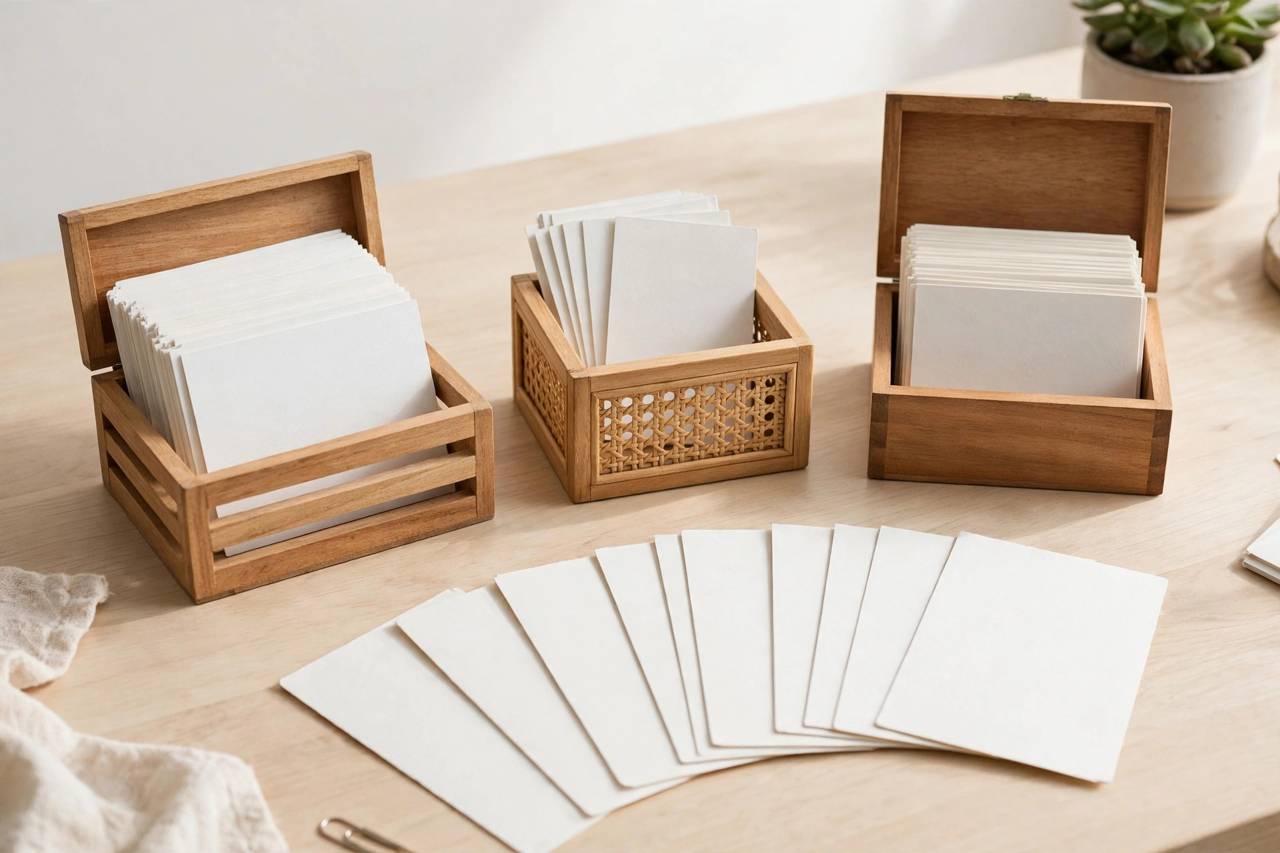
With physical cards, use actual boxes, envelopes, or rubber-banded piles. With apps like Anki, the algorithm does this automatically — and more precisely, scheduling each card at its optimal interval. Either way, the principle is identical: frequency follows difficulty. A common failure mode is reviewing all cards equally every session — comfortable, and a waste of the time you spend on cards you already know.
Card-Design Rules: One Concept, Question Fronts
Most bad flashcards are bad before the first review — they were designed wrong. Rule one: one concept per card. ‘What were the causes of the French Revolution?’ is an essay prompt, not a flashcard — it has five answers and tests nothing cleanly. Split it: ‘Name one economic cause of the French Revolution’ with ‘regressive taxation / bread prices’ on the back. Atomic cards produce clean right/wrong judgments, which is what the Leitner system needs.
Rule two: question-style fronts. ‘Mitochondria’ as a front invites vague staring; ‘What organelle produces most of the cell’s ATP?’ demands a specific retrieval. Phrase fronts as questions, fill-in-the-blanks, or ‘define X’ prompts. The front should make the desired answer unambiguous — if two different answers could both be ‘right,’ the card is broken.
Rule three: keep backs short. A back with a paragraph gets skimmed, not learned. Aim for a phrase, a short list, or a single sentence. If the answer needs a paragraph, the card covers too much — split it. Rule four: include memory hooks where natural — a tiny mnemonic, an image, or a connection to something known. ‘Never Eat Soggy Waffles’ for compass points is silly and unforgettable, which is the point.
Rule five: make cards in your own words. The act of distilling a textbook paragraph into a sharp question-and-answer pair is itself powerful studying — many students report that making the cards taught them more than reviewing them. Copy-pasting definitions skips this benefit entirely.
How to Study With Flashcards Effectively: Running the Session
A good session has a structure. Step one: shuffle. Always shuffle — reviewing in the same order lets you memorize the sequence instead of the content, a classic illusion of competence. Step two: for each card, read the front, genuinely attempt the answer (say it aloud — speaking engages more memory channels than thinking), then flip and judge honestly.
Honest judging is a discipline. ‘Kind of knew it’ is wrong — mark it wrong. The system only works on accurate data; inflating your score just schedules reviews too far apart and guarantees forgetting. Be strict now, grateful later.
Step three: for every card you miss, do not just move on — pause for ten seconds and re-encode. Read the back, connect it to something you know, say it aloud twice. This immediate repair is where missed cards get fixed rather than just rescheduled. Step four: end the session by re-quizzing the misses once more. Sessions of 20-30 minutes beat hour-long slogs — attention degrades, and honest judging degrades with it. Two focused sessions beat one marathon.
Frequency: daily short sessions during the learning phase, tapering to the Leitner schedule as cards promote. The night-before-exam mega-session has its place for familiarization, but the real retention was built in the weeks of short sessions before it. There are no shortcuts around the spacing — only systems that manage it for you.
Paper vs. Anki: An Honest Comparison
Paper cards: free, tactile, no screen, and the physical sorting of the Leitner boxes is satisfyingly concrete. Downsides: no automatic scheduling (you manage the boxes), bulky for large decks, no multimedia, and statistics are manual. Best for: small decks (under 200 cards), kinesthetic learners, and anyone who wants a screen-free study option.
Anki (free, open-source): implements a sophisticated spaced-repetition algorithm (SM-2 based) that schedules each card individually at its optimal interval, syncs across devices, supports images and audio, and tracks detailed statistics. Downsides: a learning curve for the interface, card-creation can feel fiddly, and the algorithm’s scheduling only works if you review daily — it punishes inconsistency with card avalanches. Best for: large decks (language vocabulary, anatomy, board exams), long-term retention goals, and daily reviewers.
The verdict: the system matters more than the medium. A disciplined student with paper boxes outperforms a sporadic student with Anki, because consistency beats algorithm. Choose the medium you will actually use daily. Many students hybridize — Anki for the big long-term deck, paper for the quick chapter quiz. If your broader study system needs work beyond memorization, studying for final exams covers the full preparation arc, and the Cornell notes method is the ideal front-end for generating card material from lectures.
Flashcard Mistakes That Waste Your Time
Mistake one: making cards but never reviewing them. The deck on your desk is not studying; the daily session is. Schedule it like a class — same time, non-negotiable, even fifteen minutes counts.
Mistake two: recognition instead of recall. Looking at the front, thinking ‘yeah, I know that,’ and flipping — that is recognition, and it feels like learning while being nearly useless. Always produce the answer before checking. Cover-and-recite, never skim-and-nod.
Mistake three: bloated decks. A 1,000-card deck for one exam is not thoroughness, it is avoidance — you cannot review it, so you will not. Ruthlessly prioritize: cards for what you must recall cold under exam pressure. Understanding-level material belongs in notes, not cards.
Mistake four: never deleting cards. Once a card is truly permanent knowledge — you have nailed it across weeks — retire it. A deck that only grows becomes unmaintainable. Prune monthly; your future self has enough to review.
Frequently Asked Questions
How many flashcards should I make per chapter?
Fewer than you think — typically 20-40 well-designed cards per chapter. If you are making 100+, your cards are not atomic enough or you are carding material better left in notes. Prioritize: definitions, key facts, formulas, dates, and anything you must produce from memory under pressure.
Is Anki really better than paper flashcards?
For large decks and long-term retention, yes — its scheduling algorithm is genuinely superior to manual boxes. For small decks and short timelines, the difference is negligible and paper’s simplicity wins. The decisive factor is always consistency: the best system is the one you use daily.
When should I start using flashcards before an exam?
As early as possible — ideally making cards as you learn each topic, then reviewing on the Leitner schedule. Starting two weeks out still helps significantly. Starting the night before gives familiarization, not retention. Spacing needs time to work.
Can flashcards work for essay subjects like history?
Yes, with good card design. Do not card essays — card the building blocks: dates, definitions, causes, key figures, quotations, and historiographical positions. ‘Give two historians’ views on X’ with two named positions on the back is an excellent history card. The essay skill itself is practiced by writing, not flashing.
How do I avoid just memorizing the card order?
Shuffle every session without exception. Also periodically reverse cards (answer on front, term on back) for two-way knowledge, and interleave decks from different chapters — mixed practice builds flexible recall that survives exam conditions.
The Bottom Line: Retrieve, Space, and Be Honest
Effective flashcard study is three habits: design atomic, question-style cards after you understand the material; run them through the Leitner boxes so difficult cards get the most attention; and judge yourself honestly, producing every answer before you peek.
Do that daily in short sessions, and flashcards transform from the most misused study tool into the most powerful one you own.