How Do F1 Pit Stops Work? Inside the Two-Second Choreography

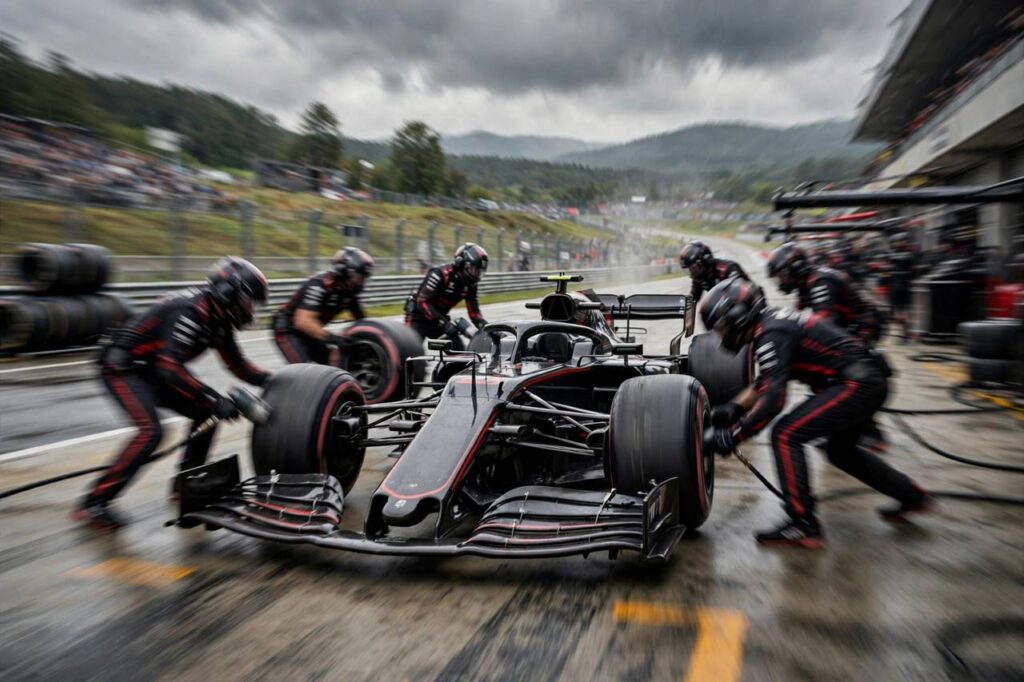
Twenty-two people. Two seconds. Zero margin for error. How do F1 pit stops work? A Formula 1 pit stop is the most choreographed two seconds in sports: a crew of over twenty specialists changes all four wheels of a 200-mph race car in less time than it takes to read this sentence. I have watched pit crews train, and it looks less like auto racing than like a special forces operation — every movement rehearsed thousands of times, every role defined to the half-second. This is the anatomy of the stop.
The numbers first, because they are absurd. A competitive F1 pit stop takes between 1.8 and 2.5 seconds from the car stopping to the car leaving. The all-time record — McLaren’s 1.80-second stop in 2023 — is faster than a human eyeblink sequence. During those two seconds, four wheels come off, four wheels go on, adjustments are made, and the car is released into traffic at racing speed. A slow stop — anything over 3 seconds — can cost a driver positions they spent twenty laps earning. In a sport decided by tenths, the pit lane is a battlefield.
How Do F1 Pit Stops Work? The 2-Second Choreography
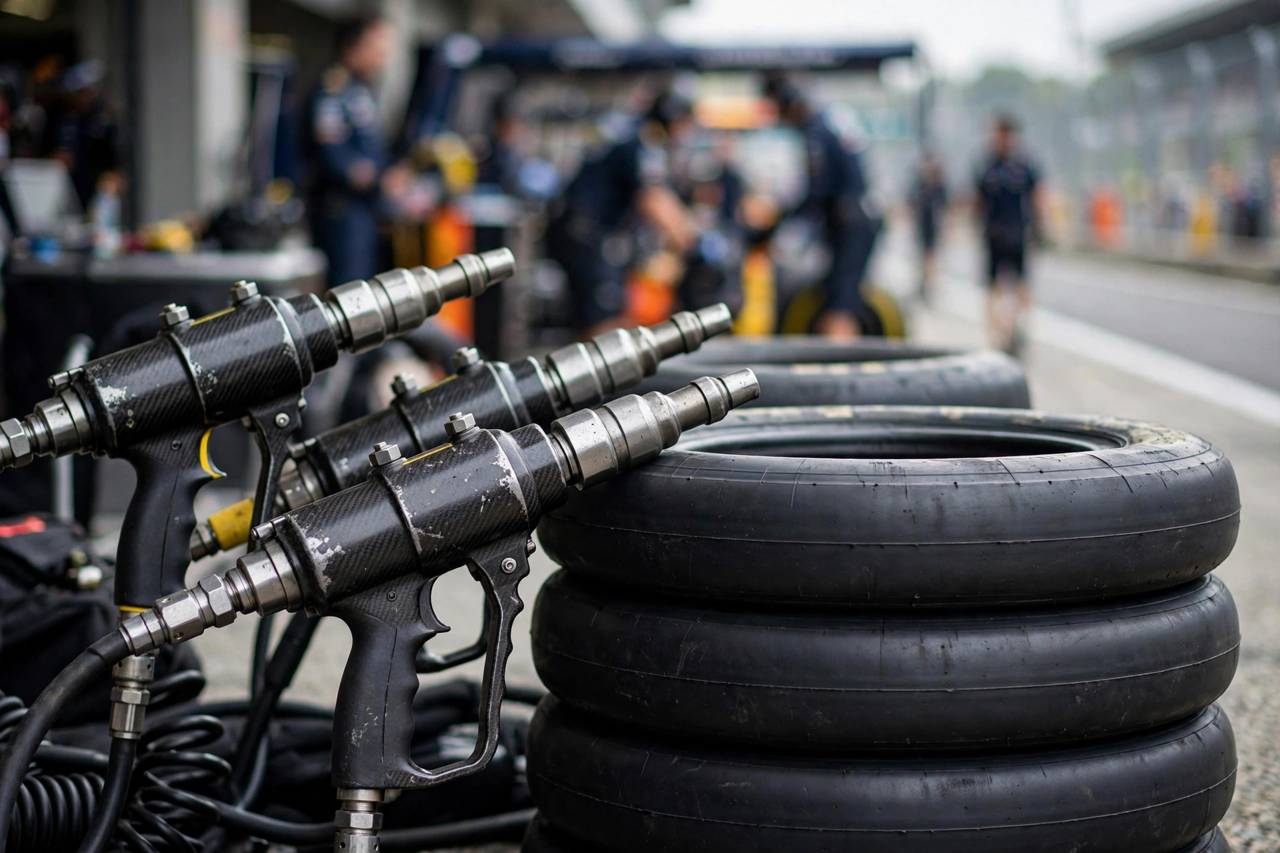
A pit crew is typically 22 to 24 people, and every one of them has exactly one job. Four tyre changers (one per wheel) operate the wheel guns — single-nut guns spinning at up to 15,000 rpm that remove and fasten the wheel’s central nut in a fraction of a second. Four tyre carriers (one per wheel) bring the fresh tyre in and take the old one away. Two jack operators lift the car — front jack and rear jack, raised in perfect sync. Stabilizers hold the car steady. And at the front, crew members with front wing adjusters can tweak the wing angle in the second or so they have, while others clear the pit box of equipment.
The sequence runs like this. The car hits its marks — painted lines in the pit box that the driver must hit within centimeters, at pit-lane speed (limited to 80 km/h in most races). The jacks go up. The guns come off the old nuts and the old wheels come away as the carriers arrive with fresh rubber. New wheels go on, guns fasten the nuts, the car drops, and the driver is released. Each sub-task takes roughly half a second. The whole thing is practiced until it is muscle memory — crews drill hundreds of practice stops per season, and the best crews treat a 2.1-second stop as a failure to analyze.
The release is its own discipline. The driver cannot simply floor it — releasing into the path of another car earns a penalty and can cause a collision. A crew member (or an automated light system, which most teams now use) gives the release signal only when the pit lane is clear. The dreaded unsafe release — sending the car into traffic — is one of the most penalized errors in the sport, because at pit-lane speeds a collision can injure crew members from multiple teams.
Crew Roles: Specialists, Not Generalists
What surprises people is that the pit crew are not mechanics who happen to do stops. They are athletes hired and trained specifically for the pit lane. The tyre gunners — the highest-pressure role — train like sprinters: reaction time, core strength, and the ability to operate a heavy gun with millimeter precision while kneeling inches from a hot car. Many teams recruit former athletes; the physical demands (explosive movement, heat, noise, stress) select for a specific kind of performer.
Each role has its failure modes, and crews drill the recoveries. A cross-threaded nut — the gun catching wrong — can turn a 2-second stop into an 8-second disaster. A stuck wheel that will not come off the hub. A dropped tyre rolling into the pit lane. The difference between a good crew and a great one is not the perfect stop; it is the recovery from the imperfect one. Championship pit crews are defined by their bad days, not their good ones.
There is also the lollipop man legacy — the crew member who once held the “lollipop” sign telling the driver when to go. Most teams replaced him with automated traffic-light systems, but the human backup remains. The release decision, human or automated, carries the same weight it always has: go now, or wait, and live with the consequence for the rest of the race.
Tyre Compounds: The Strategy Inside the Stop
The pit stop is not just maintenance — it is strategy made physical. F1’s tyre supplier provides multiple compounds per race weekend, color-coded: soft (red, fastest, shortest-lived), medium (yellow, the compromise), and hard (white, slowest, longest-lived), plus intermediates and wets for rain. Teams must use at least two different dry compounds during a dry race, which means at least one pit stop is mandatory. The choice of which tyres to bolt on, and when, is the strategic heart of the race.
This creates the undercut and overcut — the chess moves of pit strategy. The undercut: pit early for fresh tyres, use their pace advantage to pass a rival when they pit later. The overcut: stay out on old tyres, run fast laps in clean air while the rival is stuck in traffic after their stop, then pit and emerge ahead. Every stop’s timing is a bet on tyre degradation, track position, and traffic — calculated by strategists watching live data and decided in seconds.
Tyre degradation — the cliff where a tyre’s performance falls off — is the variable that makes it all work. A soft tyre might be two seconds a lap faster than a hard for ten laps, then collapse. The strategist’s job is predicting the collapse before it happens. Pit too early and you waste tyre life; pit too late and you hemorrhage lap time. The two-second stop is the execution. The twenty-lap calculation behind it is the strategy.
When Stops Go Wrong
Pit-lane disasters are part of the sport’s lore because the margin is so thin. Wheels not properly attached — the loose wheel retirements that end races instantly. The car dropped before all four wheels are on. Equipment failures, gun malfunctions, a mechanic’s mistimed movement. Each incident gets analyzed frame by frame, because at this level a tenth of a second is a place on the grid of blame.
The regulations keep tightening the safety envelope: pit-lane speed limits, equipment standards, minimum crew safety gear, and penalties for unsafe releases. The pit lane is the most dangerous workplace in motorsport — crew members working inches from cars arriving at 80 km/h — and the sport treats it that way. The choreography is beautiful. The reason for the choreography is survival.
And that is the real answer to how F1 pit stops work: they are not car maintenance. They are a timed athletic event, a strategic weapon, and a safety-critical operation happening simultaneously, in two seconds, twenty times a season, in front of millions. The driver gets the glory. The crew gets the stopwatch. Both are racing.
How the Rules Shaped the Modern Stop
The two-second stop is a product of regulation as much as athleticism. Until 2010, F1 allowed refueling during races — stops took 6 to 10 seconds while fuel hoses were attached, and strategy revolved around fuel loads. When refueling was banned, stops collapsed to tyre-only changes, and the choreography compressed to today’s two seconds. The wheel guns got faster, the crews got more specialized, and the pit stop became a pure speed event.
The regulations also standardize the equipment to keep competition about execution rather than engineering. Wheel guns must meet specifications, the single central wheel nut (replacing the old multi-lug designs) was mandated to speed changes, and pit-lane speed limits (usually 80 km/h, 60 in tighter pit lanes like Monaco) are enforced with heavy penalties for violations. Even the pit box dimensions are regulated. The sport wants the stop decided by the crew’s perfection, not by a technical loophole.
Safety rules continue to tighten after incidents: minimum pit-crew protective gear, restrictions on personnel in the pit lane during sessions, and the automated release lights (which replaced the error-prone human “lollipop” for most teams). Every rule in the pit lane was written for a reason, and most of those reasons were accidents. The two-second ballet exists inside a cage of regulation — which is precisely why it works.
Practice: The Hundreds of Reps Behind Two Seconds
Teams practice pit stops relentlessly — hundreds of reps per season, often with the race drivers, often filmed and timed to the hundredth. Practice covers the perfect stop, but more importantly the imperfect ones: the stuck nut, the fumbled tyre, the jack that will not drop. Crews drill recoveries until they are automatic, because in a real stop there is no time to think.
Drivers practice too. Hitting the pit-box marks at exactly the speed limit, stopping within centimeters, holding position while the crew swarms, and launching on the release light without jumping it — the driver’s contribution is precision under pressure. A driver who overshoots the marks by half a meter costs the crew a second repositioning. In a two-second stop, the driver is the 23rd crew member, and the best ones treat the pit entry with the same focus as a qualifying lap.
Frequently Asked Questions
How long does an F1 pit stop take?
A competitive stop takes 1.8 to 2.5 seconds from the car stopping to release. The record is 1.80 seconds (McLaren, 2023). Anything over 3 seconds is considered slow and can cost track positions.
How many people are in an F1 pit crew?
Typically 22 to 24, each with a single specialized role: tyre changers, tyre carriers, jack operators, stabilizers, wing adjusters, and the release crew. They are trained athletes, not general mechanics.
Why do F1 cars have to pit?
Regulations require using at least two different dry tyre compounds in a dry race, mandating at least one stop. Teams also pit for fresh rubber as tyres degrade — the pace advantage of new tyres usually outweighs the time lost stopping.
What is the undercut in F1?
A strategy where a driver pits early for fresh tyres and uses their pace advantage to pass a rival when that rival pits later. The overcut is the reverse: staying out on old tyres to gain time in clean air before stopping.
What are the F1 tyre compounds?
Soft (red — fastest, least durable), medium (yellow — balanced), and hard (white — slowest, most durable), plus intermediate (green) and wet (blue) tyres for rain. Teams choose compounds and stop timing as their core race strategy.
What happens in an unsafe release?
Releasing a car into the path of another vehicle in the pit lane. It is heavily penalized (time penalties or worse) because of the danger to crew members. Most teams now use automated light systems with human backup for the release decision.