What Is the Largest Desert in the World? (Not the Sahara)

Ask what is the largest desert in the world and most people picture endless sand dunes under a blazing sun. That image leads to the Sahara — a reasonable guess, and the right answer to a slightly different question. The actual largest desert on Earth is not hot at all. It is Antarctica, a frozen polar desert nearly twice the size of the Sahara, where it barely ever rains or snows. The confusion comes from the definition of “desert” itself, which has nothing to do with heat and everything to do with dryness. Once you understand that, the rankings reshuffle in surprising ways, and the Sahara drops to third place. Here is how deserts are actually defined, which ones top the list, and why the biggest desert on the planet is covered in ice.
What Counts as a Desert? The Real Definition
A desert is defined by precipitation, not temperature. The standard threshold used by geographers is simple: a region receiving less than 250 millimeters (about 10 inches) of precipitation per year qualifies as a desert. Some definitions add high evaporation rates, but the rainfall line is the core test. By that measure, Antarctica is unambiguously a desert. Its interior receives less than 50 millimeters of precipitation a year — drier than the Sahara — and some valleys in Antarctica are among the driest places on Earth, having gone without meaningful precipitation for millions of years. The Arctic polar desert, covering much of the far north, qualifies too. This surprises people because we associate deserts with heat, but heat is incidental. What makes a desert is the absence of water, and cold air holds very little moisture, so polar regions can be extraordinarily dry. Deserts actually come in four main types: hot and dry like the Sahara, cold like the Gobi, coastal like the Atacama, and polar like Antarctica. The polar variety covers more of Earth’s surface than all the hot deserts combined.
The Largest Desert in the World: Antarctica
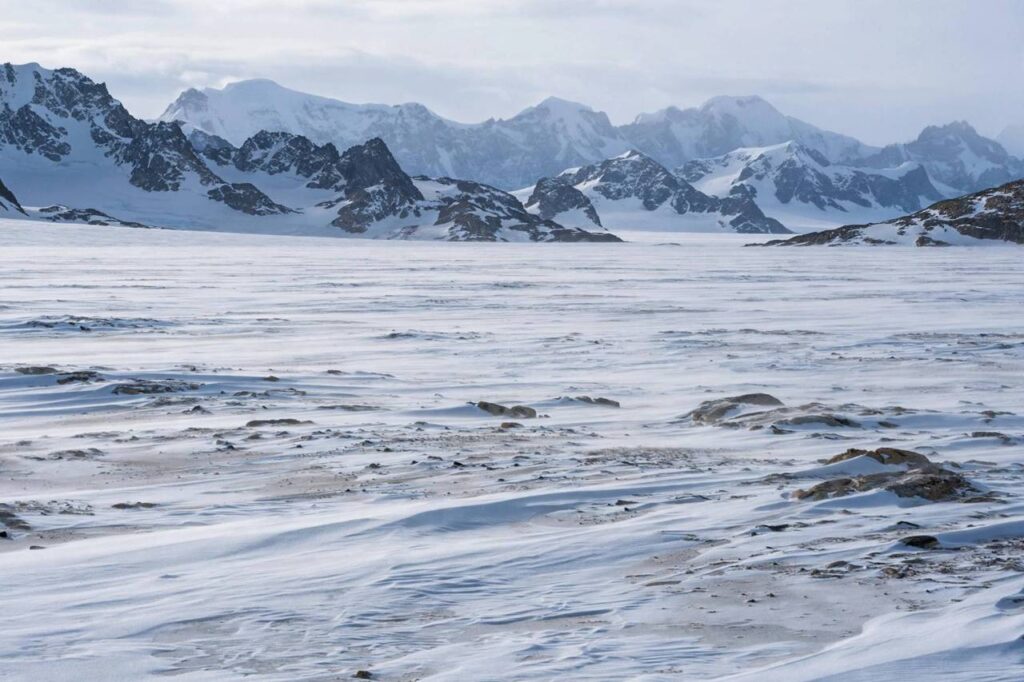
The Antarctic Desert spans roughly 14 million square kilometers — about 5.5 million square miles — covering nearly the entire continent of Antarctica. To put that in perspective, it is larger than the whole of Europe, and almost double the Sahara. It meets every criterion for desert classification: extreme aridity, sparse vegetation, and a landscape shaped more by wind than by water. What falls there falls as snow, and so little of it accumulates in the interior that the continent is technically the driest on Earth. Life exists at the margins — penguins and seals along the coasts, mosses and lichens in rare ice-free valleys — but the vast interior plateau is one of the most lifeless places on the planet, a white desert of ice and wind. The katabatic winds, dense cold air rushing down from the high interior toward the coast, can exceed hurricane force and sculpt the snow into strange formations called sastrugi. Temperatures on the plateau regularly drop below minus 60 degrees Celsius in winter. It is a desert not of dunes but of ice, and it holds about 70 percent of the world’s fresh water locked in its ice sheet — water that is there but almost entirely unavailable to life, which is precisely the desert paradox.
The Runners-Up: Arctic, Sahara, and the Rest
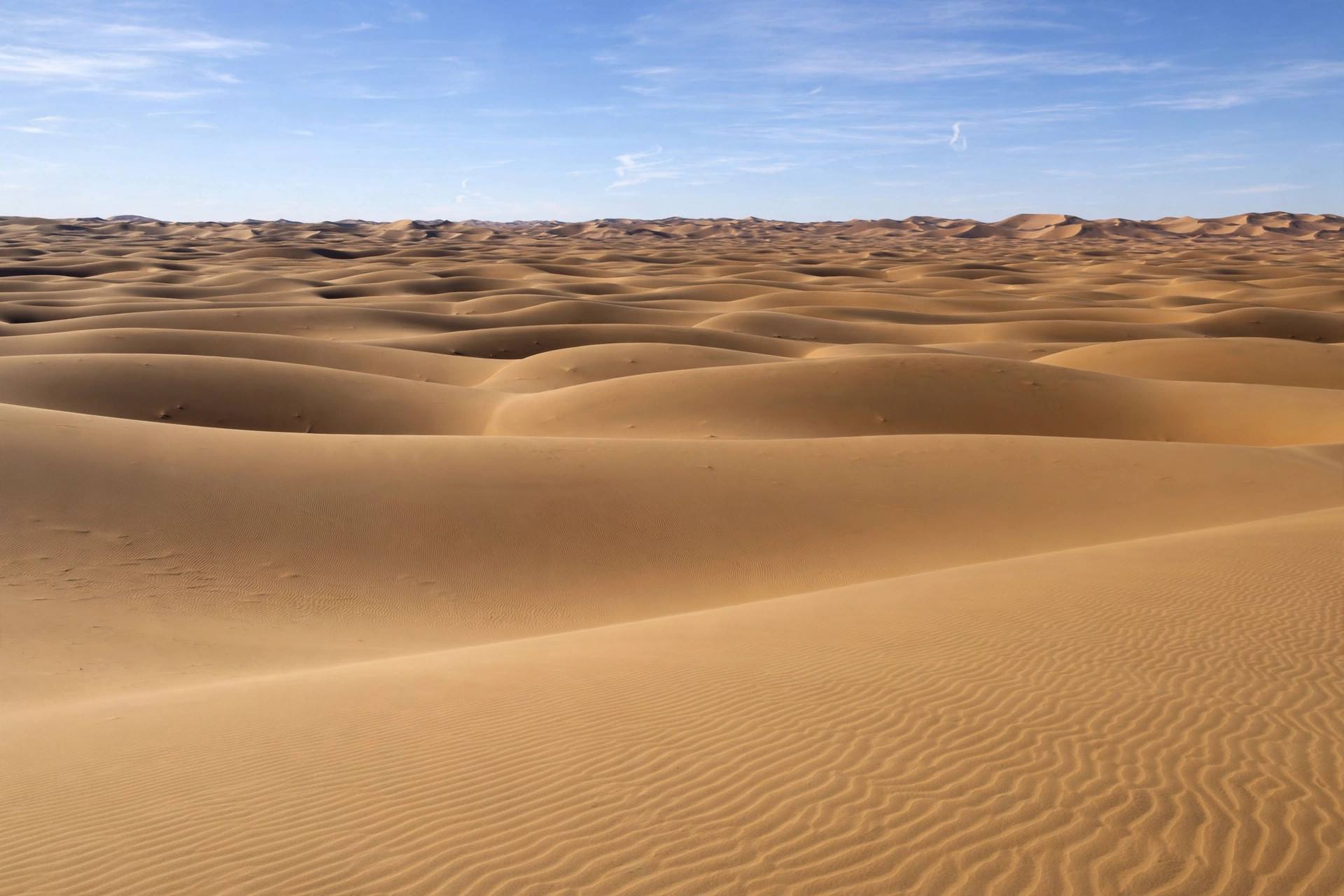
Second place belongs to the Arctic Desert, covering roughly 13.9 million square kilometers across the northern polar regions — northern Canada, Greenland, Russia, and the Arctic Ocean’s fringes. Like Antarctica, it is a cold desert of ice and tundra, defined by minimal precipitation and long frozen winters. Then comes the answer most people expect: the Sahara, at about 9.2 million square kilometers, making it the largest hot desert in the world. The Sahara spans eleven countries across North Africa, and it is the desert of popular imagination — the great sand seas, the dunes of the Erg, temperatures that can top 50 degrees Celsius. Yet only a fraction of the Sahara is actually sand dunes; most of it is gravel plains, rock plateaus, and dry mountains. Fourth is the Arabian Desert at roughly 2.3 million square kilometers, covering most of the Arabian Peninsula with its own vast sand seas. Fifth, the Gobi in Mongolia and northern China at about 1.3 million square kilometers — a cold desert of gravel and rock where temperatures swing from scorching summers to brutal winters. Below them come the Patagonian, Great Victoria, Kalahari, and Great Basin deserts, each under a million square kilometers. Notice the pattern: the two largest are polar, and the famous hot deserts, while enormous, are much smaller.
Why the Sahara Gets All the Fame
If Antarctica is nearly twice the Sahara’s size, why does nobody picture ice when they hear “desert”? Partly it is history and storytelling. The Sahara sits at the crossroads of civilizations — ancient trade routes, caravan cities like Timbuktu, explorers’ tales — so it entered the cultural imagination centuries before anyone set foot on Antarctica’s interior. Partly it is the visual drama: dunes photograph better than flat ice, and films have cemented the sand-and-sun image. And partly it is a quirk of language. In everyday speech, “desert” evokes heat, so the scientific definition feels like a technicality even though it is the actual definition. The Sahara also deserves respect on its own terms: it is growing, with desertification pushing its boundaries southward; it influences weather across the Atlantic, with Saharan dust fertilizing the Amazon rainforest; and it contains some of the most extreme inhabited environments on Earth, with communities that have adapted to its harshness for millennia. Fame is not the same as size, and the Sahara’s cultural footprint is genuinely enormous. It is simply not the largest — it is the largest hot desert, a title that is impressive enough without the exaggeration.
Deserts Are Not Wastelands
The word “desert” comes from a Latin root meaning “abandoned,” and it shows in how we talk about these places — as empty, useless, barren. That framing misses most of what deserts are. Hot deserts host extraordinary specialized life: the fennec fox’s oversized ears radiating heat, desert plants that bloom spectacularly after rare rains, nocturnal animals that avoid the day’s furnace entirely. Cold deserts preserve some of Earth’s most pristine environments and most important climate records — Antarctic ice cores contain hundreds of thousands of years of atmospheric history, the closest thing we have to a time machine for studying past climates. Deserts are also expanding in many regions as the climate warms, a process with serious consequences for the hundreds of millions of people living at desert margins. Understanding what deserts really are — defined by dryness, spanning from ice to sand — matters beyond trivia. It shapes how we think about water, habitability, and the surprising diversity of life on a planet where even the driest places find a way to be interesting.
Quick Comparison: The Five Largest Deserts
For easy reference, here are the five largest deserts ranked by area, with their type and location. The Antarctic Desert leads at about 14 million square kilometers — a polar desert covering Antarctica. The Arctic Desert follows at roughly 13.9 million square kilometers — a polar desert spanning the far north. The Sahara comes third at about 9.2 million square kilometers — a hot desert across North Africa, and the largest hot desert on Earth. The Arabian Desert is fourth at around 2.3 million square kilometers — a hot desert covering the Arabian Peninsula. The Gobi Desert rounds out the top five at roughly 1.3 million square kilometers — a cold desert in Mongolia and northern China. Two things stand out from this list. First, polar deserts dominate the top of the ranking, which is why the textbook answer surprises almost everyone. Second, the gap between the top three and everything else is enormous — the Sahara alone is four times the size of the Arabian Desert. Desert rankings shift slightly depending on where geographers draw boundaries, so you will see small variations in published figures, but the order of the top five is consistent across sources.
What Is the Largest Desert in the World: The Trick Behind the Question
This question is a favorite of quiz masters precisely because it punishes the obvious answer. Say “Sahara” and you are wrong; say “Antarctica” and you sound like you are showing off — but you are right. The trick works because everyday language and scientific language split on the word “desert.” In conversation, desert means hot, sandy, cactus-and-camel territory. In geography, it means a place where almost no precipitation falls, full stop. Once you apply the scientific definition consistently, the polar regions qualify, and because they are enormous, they take the top two spots by a wide margin. Teachers love this question because it exposes how much of what we “know” is really just association — sand equals desert — rather than definition. It is the same family of trick as “what is the largest living organism” (a fungus, not a whale) or “which animal kills the most humans” (the mosquito, not the shark). The lesson is not really about deserts at all. It is about checking definitions before answering, because the words we use casually often have precise technical meanings that change the answer completely. So the next time someone asks what is the largest desert in the world, you can smile, say Antarctica, and explain exactly why — which is considerably more fun than just being right.
Frequently Asked Questions
Is Antarctica really a desert?
Yes. A desert is defined by low precipitation — generally under 250 millimeters per year — not by heat. Antarctica’s interior receives far less than that, making it the largest desert in the world at roughly 14 million square kilometers. It is a polar desert, a category that also includes the Arctic.
What is the largest hot desert in the world?
The Sahara, at about 9.2 million square kilometers across North Africa. It is the third-largest desert overall, after the Antarctic and Arctic polar deserts, but it is by far the largest desert with a hot climate.
How big is the Sahara compared to the United States?
The Sahara is slightly smaller than the entire United States — about 9.2 million square kilometers versus roughly 9.8 million. It spans eleven African countries, making it nearly the size of a continent-sized nation.
Why is Antarctica so dry if it is covered in ice?
Cold air holds very little moisture, so little precipitation falls in Antarctica’s interior. The ice sheet is ancient accumulated snowfall, not evidence of current wetness — some interior regions receive less precipitation than the Sahara. The water is there, but it is locked up as ice.
Are deserts getting bigger?
In many regions, yes. Desertification — the expansion of desert-like conditions — is advancing in parts of Africa, Asia, and the Americas, driven by climate change, overgrazing, and unsustainable land use. The Sahara itself has grown measurably over the past century.