How to Study Effectively for Exams: Science-Backed Methods

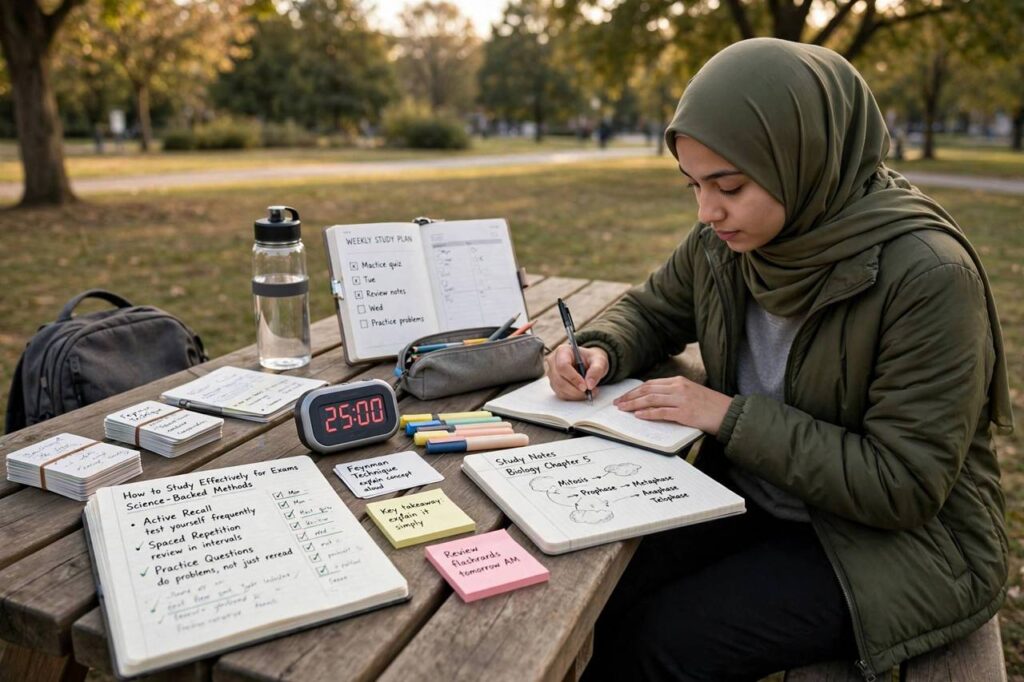
Most students do not have a motivation problem — they have a method problem. If you have ever wondered how to study effectively for exams, the research answer is surprisingly clear: the techniques that feel easiest, like rereading chapters and highlighting pages, are among the least effective, while the techniques that feel harder — testing yourself, spacing sessions out, mixing topics — build far stronger memories. I have watched students double their retention without adding a single study hour, simply by changing how they use the hours they already had. This guide collects the methods that cognitive science actually supports, shows you how to build them into a realistic schedule, and flags the common traps that waste entire evenings.
How to Study Effectively for Exams: What the Science Says
Your brain strengthens a memory every time it works to retrieve it. That single principle explains why self-testing beats rereading so dramatically. When you reread a highlighted chapter, your brain coasts — the words look familiar, so it mistakes recognition for knowledge. When you close the book and try to recall the material from scratch, the effort of retrieval forges a stronger path to that memory. Psychologists call this the testing effect, and it is one of the most replicated findings in learning research. The practical version is simple: after reading a section, hide it and write down everything you remember. Use flashcards for definitions, but write real questions for concepts — “why does this happen?” beats “what is the term for this?” Every blank you hit is useful information, because it shows you exactly what to restudy. Students preparing for cumulative tests get particular mileage from this, which is why guides on how to study for final exams emphasize practice questions over passive review. A blank page is uncomfortable, and that discomfort is precisely the signal that learning is happening.
Space It Out: The Spacing Effect
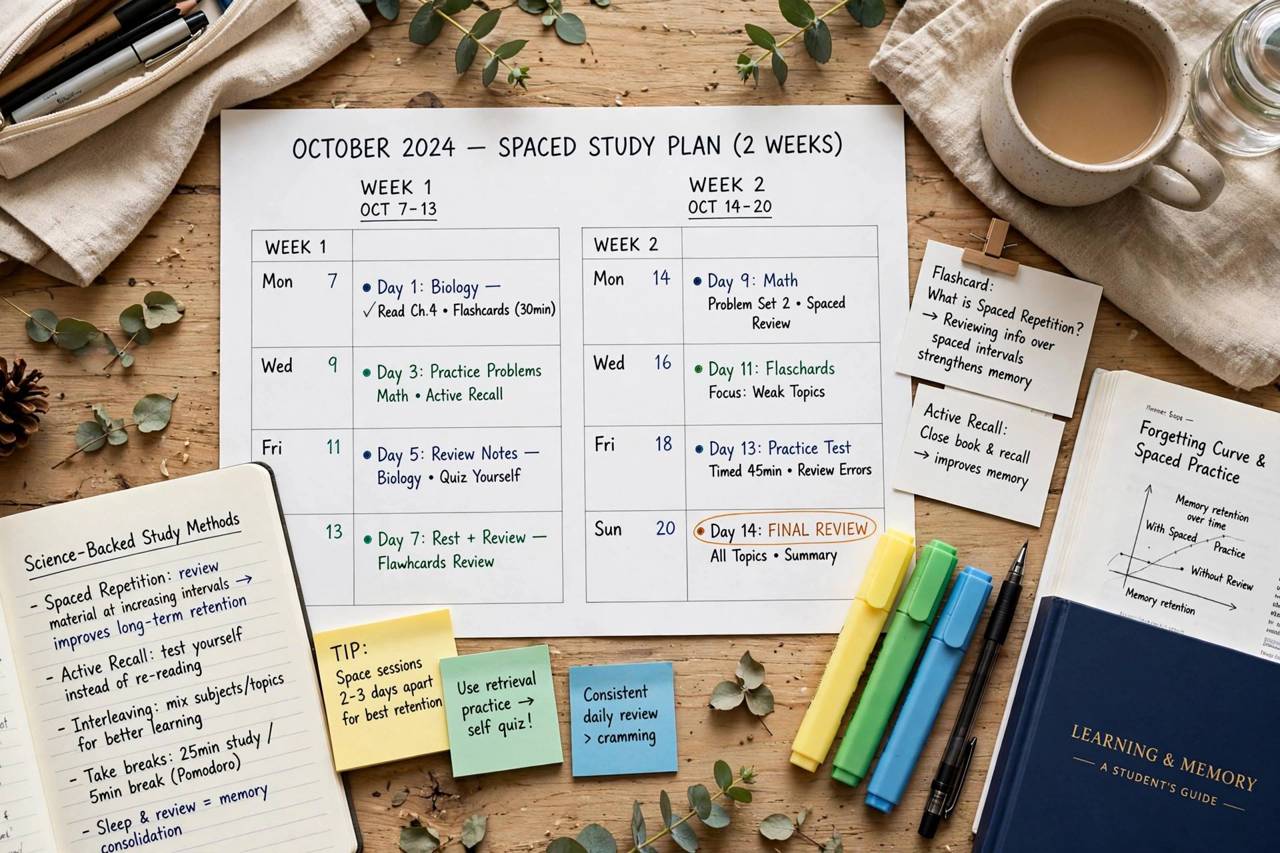
Cramming feels productive because the material is fresh in your head during the session. Two days later, most of it is gone. Spreading the same total study time across several days produces dramatically better long-term retention — this is the spacing effect, and it works because each session forces your brain to re-retrieve a slightly faded memory, strengthening it further. For a test one week away, study a topic on three separate days rather than in one marathon. For a test a month away, revisit each topic weekly. The first review should come a day or two after you learn something, when forgetting has just begun. This is why last-minute all-nighters are such a bad trade: you sacrifice sleep, which your brain needs to consolidate memories, in exchange for short-term familiarity that evaporates by exam morning. A spaced schedule does not require more hours — it requires starting earlier. Even three days of spaced review beats one heroic cram session of equal length, and you will walk into the exam rested instead of wired.
Mix It Up: Interleaving Topics
When you study one topic exhaustively before moving to the next, you are practicing in “blocks” — all of chapter 4, then all of chapter 5. Interleaving means mixing: a few problems from chapter 4, then some from chapter 2, then back to 5. It feels messier and slower, which is exactly why students resist it. But exams do not announce which chapter each question comes from. Interleaved practice trains the skill exams actually test: recognizing what kind of problem you are facing and choosing the right approach. This matters most in subjects like math, physics, and chemistry, where identifying the problem type is half the battle. A practical way to interleave: when you sit down for a session, pull practice questions from at least two different topics or weeks of class. End each session with a short mixed quiz covering everything so far. Your scores will dip at first compared to blocked practice — that dip is the feeling of genuine learning replacing the illusion of it. Within a week, the mixed practice pays off in flexibility that blocked studying never builds.
Take Notes That Actually Help
Notes are a tool, not a trophy. Copying slides word for word keeps your hand busy while your brain idles, and you end up with beautiful pages you never reread. Effective notes are short, selective, and written in your own words. The Cornell method is a classic for a reason: divide the page into a narrow cue column and a wide notes column. During class, capture main ideas and examples in the wide column. Afterward, write questions and key terms in the cue column — those become your self-testing prompts later. Summarize each page in two or three sentences at the bottom; if you cannot summarize it, you did not understand it. Digital or paper both work, but the research leans slightly toward handwriting for conceptual subjects because it forces you to paraphrase rather than transcribe. Whichever you choose, good organization multiplies the value of everything else you do, and the right note-taking apps can keep your system searchable and synced across devices. One more rule: review and condense your notes within 24 hours of taking them. That single pass, done while the lecture is still fresh, is worth more than three rereads the night before the test.
Build a Study Schedule You Will Actually Follow
The best method in the world fails if you never sit down to use it. Work backward from the exam date and assign topics to days, leaving the final two days for mixed review and practice tests — not new material. Study in focused blocks of 25 to 50 minutes with real breaks between them; your concentration has a natural ceiling, and pushing past it produces diminishing returns. Put the hardest subject in your sharpest time slot — for most people, that is morning or early afternoon, not midnight. Protect your sleep ruthlessly in exam week: memory consolidation happens during deep sleep, and an all-nighter trades the very process that makes studying stick. Exercise helps too, even a twenty-minute walk, because it improves focus and reduces the anxiety that sabotages recall. If you study with others, use group time for quizzing each other and explaining concepts aloud — teaching a topic is one of the strongest ways to learn it — but do your first pass of the material alone so the group session is review, not discovery. Students juggling multiple subjects should rotate which one gets the prime slot each day so nothing gets neglected.
Exam Day: Performing Under Pressure
All that preparation needs a delivery plan. The night before, pack everything, set two alarms, and stop studying at a reasonable hour — late-night cramming now only feeds anxiety. Eat a normal meal before the exam; your brain runs on glucose, and hunger is a distraction you can prevent. Arrive early enough that a slow bus or a locked building cannot rattle you. When the paper lands, spend the first few minutes reading everything and planning your time: mark the questions you can answer confidently, note the heavy-mark ones, and decide your order. Answer what you know first. This builds momentum and banks marks before the clock pressures you. For essays, spend five minutes outlining — a short plan prevents the rambling that loses marks. If you blank on a question, skip it and return later; related questions often jog the memory. Watch the clock but do not obsess — check it at planned intervals, not every minute. And when time is called, stop. Second-guessing after the fact helps nothing. Walk out knowing you executed a plan, and let the preparation do its work.
How to Study Effectively for Exams With Only Three Days Left
Sometimes the ideal schedule is a fantasy and you have seventy-two hours. Do not panic and do not pull all-nighters — a compressed plan using the right methods still beats a week of rereading. Day one is triage. List every topic on the exam and rate each one honestly: solid, shaky, or unknown. Spend today on the shaky pile, because that is where points are won cheapest — solid topics need only a quick review, and unknown topics get whatever time remains. For each shaky topic, read your condensed notes once, then close them and write out everything you remember. Check what you missed, restudy only the gaps, and test yourself again. This is retrieval practice under time pressure, and it is brutally efficient. Day two is interleaved practice questions. Work through past papers or problem sets mixing topics together, under timed conditions if the exam is timed. Mark every question you got wrong or guessed on — that error list becomes your day-three hit list. Sleep a full night between day two and day three; the consolidation matters more than extra hours. Day three is the error list plus one full mixed review. Test yourself on every missed item until you can answer it cold, then do a final pass over your cue cards or summary sheets. Stop studying two hours before the exam. Eat, hydrate, and walk in. A three-day plan cannot cover everything, so it deliberately sacrifices perfection on unknown topics to lock down the shaky ones — and that trade wins more marks than any amount of frantic highlighting ever will.
Frequently Asked Questions
Is highlighting textbooks a waste of time?
Largely, yes — at least on its own. Research consistently ranks highlighting and rereading among the least effective study techniques because they create familiarity without building recall. If you highlight, do it sparingly to mark material you will turn into self-test questions later, not as the study session itself.
How many hours a day should I study for exams?
Quality beats quantity. Three to four focused hours using active techniques outperform eight distracted hours of rereading. In exam week, most students do well with focused blocks totaling four to six hours, with breaks, exercise, and a full night’s sleep. More than that usually means the method needs fixing, not the schedule.
Does listening to music while studying help?
For most people, music with lyrics hurts concentration on language-heavy tasks like reading and writing. Instrumental or ambient music is less harmful and some students find it helps them settle in. The honest test: try a practice quiz with and without music and compare your scores.
What should I do the night before an exam?
Light review only — skim your condensed notes or cue cards, then stop early. Pack your bag, lay out clothes, set alarms, and get a full night’s sleep. Cramming new material the night before increases anxiety and interferes with the sleep your brain needs to consolidate what you already learned.
How do I study for subjects I find boring?
Connect the material to something you care about, even loosely — boring statistics become interesting when they explain a sport you follow. Break sessions shorter, reward yourself after each block, and study the boring subject in your peak-energy slot. Self-testing also helps because the challenge of recall makes dull material more engaging than passive reading.