4 Days in Paris Itinerary: The Perfect Long Weekend (2026)

Four days is the sweet spot for Paris — enough for the icons without the sprint, enough for the neighborhoods without the FOMO, and (crucially) enough for the long lunches that are the actual point. I’ve done Paris in 2, 3, 4, and 7 days, and 4 is the trip I’d recommend to anyone: it’s the long weekend that feels like a real visit.
This itinerary builds on the essentials (Eiffel Tower, Louvre, Montmartre) and adds what shorter trips miss: the second museum, the real neighborhoods, the day-trip option (Versailles or Giverny), and the breathing room to just be in Paris. It’s structured but not scheduled to the minute.
Shorter trips: our 2-day itinerary and 3-day itinerary (the pillar). This is the 4-day expansion.
The 4-Day Strategy: Structure + Serendipity
Days 1–2: the icons (Eiffel Tower, Louvre, Notre-Dame area, Montmartre) — the non-negotiables, done with the advance-booking discipline. Day 3: the choice — Versailles (the palace day trip) or the deeper Paris (Musée d’Orsay + Le Marais + Saint-Germain, the local’s day). Day 4: the neighborhoods (the Paris you’ll miss most — the markets, the parks, the café mornings, the picnic). how to plan a Europe trip
The pacing rule: one major sight per half-day, one long meal per day, one unplanned hour per day. The unplanned hour is load-bearing — it’s when you find the bookstore, the garden, the viewpoint that becomes the trip’s story. The over-scheduled Paris trip sees more and remembers less.
Book in advance: Eiffel Tower summit (2–4 weeks ahead), Louvre timed entry (1–2 weeks), Versailles (1 week — the timed palace entry), and the restaurants you care about (the good bistros book out). Everything else can breathe.
Day 1: The Icons — Eiffel Tower + Seine
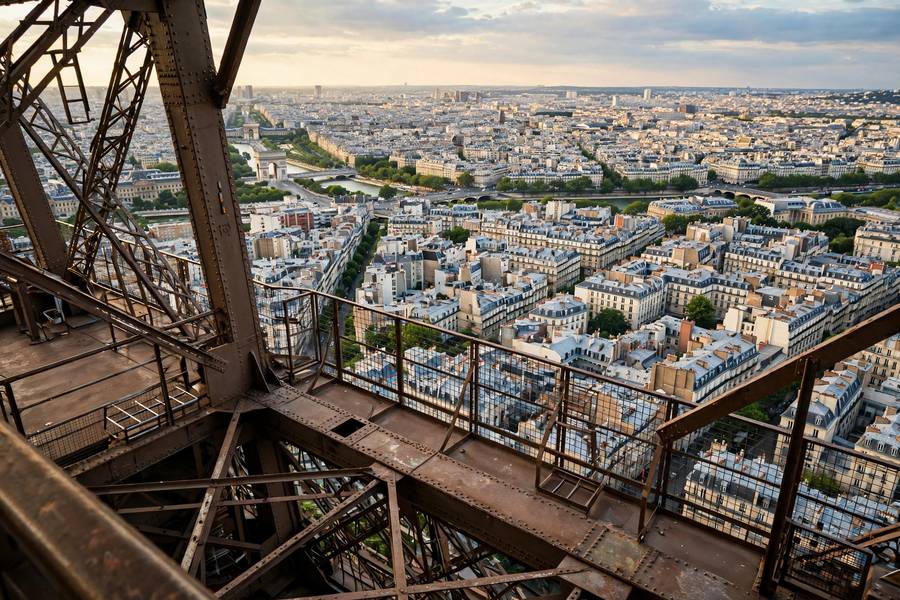
Morning: Eiffel Tower summit, first slot (9:00 a.m. — book ahead, €29.40). 90 minutes at the top and second floor, then the Champ de Mars walk and the boulangerie jambon-beurre on a bench. This is the arrival ritual — do it first, get the icon out of the way, and spend the rest of the trip knowing you’ve stood on top of Paris.
Afternoon: the Seine walk — from the Eiffel Tower east along the Left Bank (the houseboats, the bouquinistes’ book stalls, the bridges), crossing at Pont des Arts to the Louvre courtyard. The Tuileries gardens, the Place de la Concorde, and the stroll up to the Arc de Triomphe (the rooftop view, €16 — the best panorama in Paris, better than the Tower for photos of the Tower).
Evening: dinner in the 7th or 8th arrondissement (the neighborhoods near the Tower have excellent bistros once you’re 5 minutes from the tourist strip), then the Eiffel Tower sparkle (on the hour after dark — the 10 p.m. from the Champ de Mars or the Pont de l’Alma). The first day ends with the icon lit up — the trip’s thesis statement.
Day 2: The Louvre + Île de la Cité
Morning: the Louvre, 9 a.m. timed entry via the Carrousel (underground) entrance — no pyramid line. The strategy: icons first (Mona Lisa, Winged Victory, Venus — 45 minutes), one wing of choice (90 minutes — Egyptian, Napoleon III, or Italian masters), wandering (45 minutes). Out by 1 p.m. — museum fatigue is the enemy, and the afternoon is for the island.
Afternoon: lunch in the Marais (falafel on Rue des Rosiers or the bistro), then the Île de la Cité — Notre-Dame’s exterior and the restoration, Sainte-Chapelle (the 15 meters of stained glass — the most beautiful room in Paris, €13, 45 minutes), and the Conciergerie (the Revolution’s prison — Marie Antoinette’s cell). The island is the medieval heart; give it the slow afternoon.
Evening: Saint-Germain — dinner in the 6th (book ahead), then the Seine walk at night (Pont Neuf to Pont des Arts, Notre-Dame ahead). The Left Bank at night, with no agenda, is the hour that justifies the whole trip. The bouquinistes are closing, the bridges are lit, and Paris is showing off.
Day 3: The Choice — Versailles or Deeper Paris
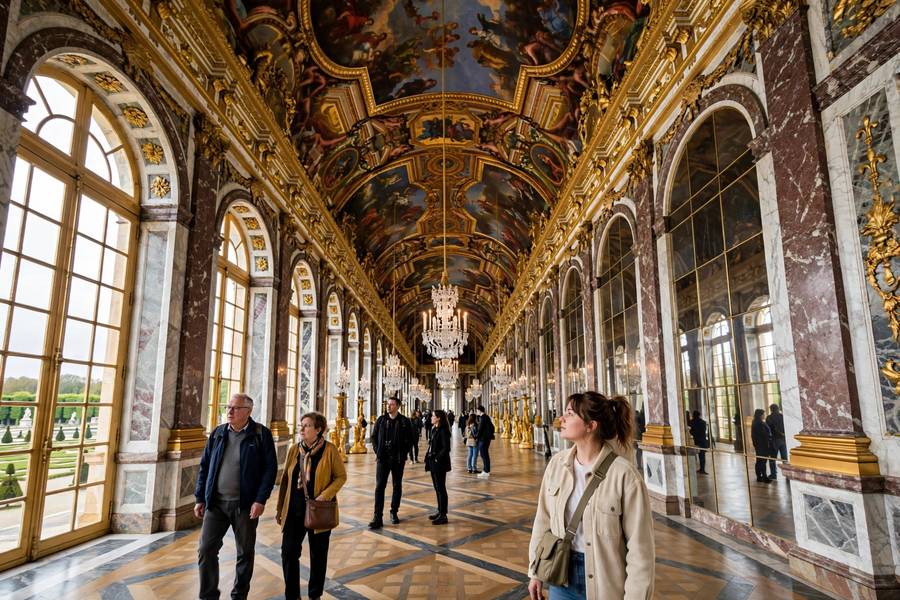
Option A: Versailles — RER C train (40 minutes, €7), palace timed entry (book the 9 a.m. slot, €21.50 palace or €32 passport). The strategy: palace first (the Hall of Mirrors before the crowds — 90 minutes), then the gardens (the 800 hectares — rent the golf cart or the bikes, the scale demands it), Trianon palaces if energy allows. Back by 4 p.m. It’s a full day, it’s magnificent, and it’s the one day trip worth the time.
Option B: deeper Paris — Musée d’Orsay (9:30 a.m., the Impressionists in the Beaux-Arts station — 2.5 hours, the more lovable museum), lunch in Saint-Germain, the Luxembourg Gardens (the afternoon — the pond, the chairs, the petanque), the Panthéon (the crypt — Voltaire, Curie, Hugo), and the Mouffetard market street (the evening — the oldest street market in Paris, dinner from the stalls).
The honest advice: Versailles if it’s your first Paris trip and palaces move you; deeper Paris if you’d rather know the city than see the palace. There’s no wrong answer — but don’t try both. The day-trip-every-day itinerary is how 4-day trips become exhausting.
Day 4: The Neighborhoods (The Day You’ll Miss Most)
Morning: the market — Marché d’Aligre (the 12th’s food market — the produce, the cheese, the North African stalls) or the Bastille market (Thursday/Sunday — the bigger one). Buy the picnic: cheese, charcuterie, bread, fruit, the $5 bottle of wine. This is the Parisian morning — the shopping is the sightseeing.
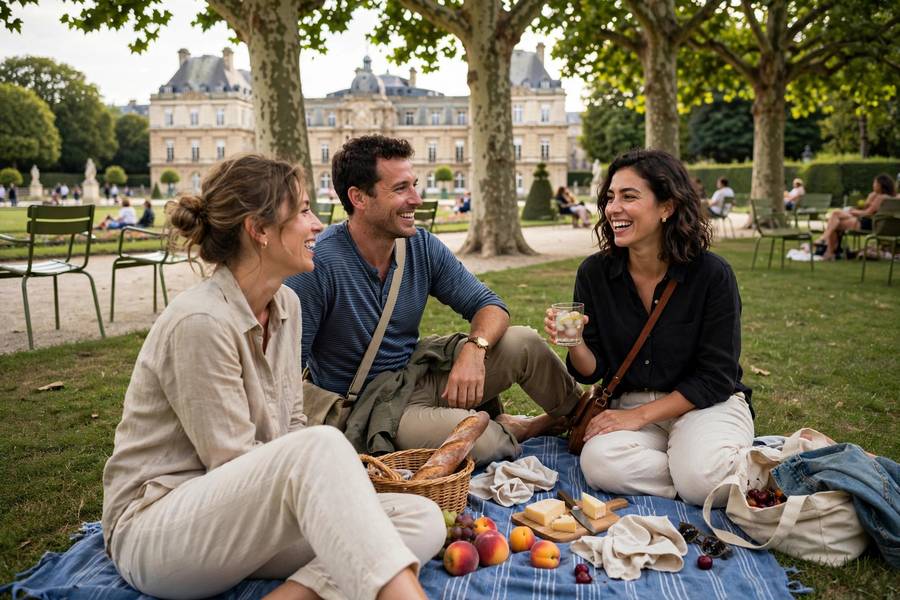
Midday: the picnic — Luxembourg Gardens, Champ de Mars (the Tower view), or the Canal Saint-Martin (the local’s choice — the iron footbridges, the bobos, the vibe). Two hours, no agenda, the best meal of the trip (the $20 picnic beats the $80 restaurant — the setting is the ingredient). Then the neighborhood walk: the Marais’s hidden squares (Place des Vosges), the galleries, the shops.
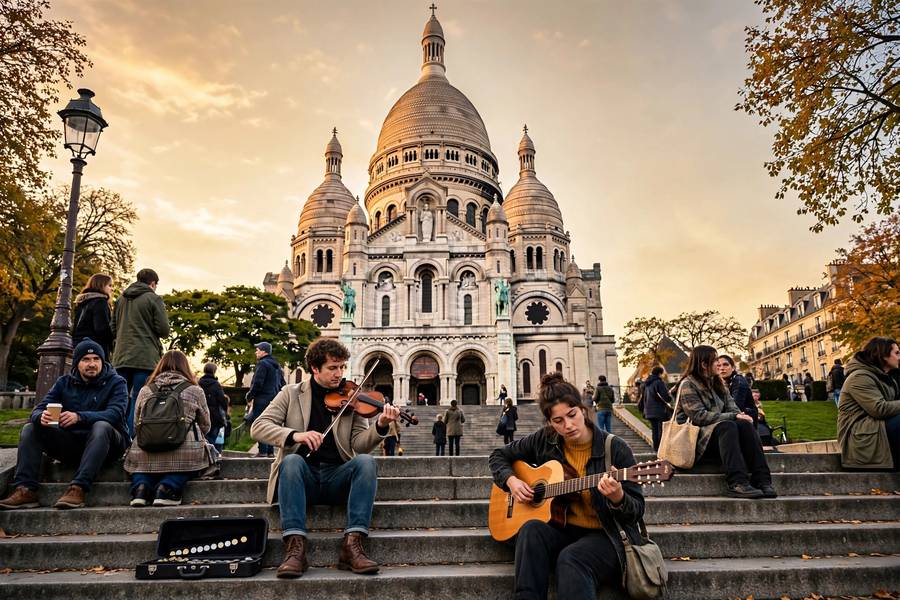
Afternoon/evening: Montmartre — the climb (not the funicular), Sacré-Cœur at golden hour (the steps, the buskers, the city below), the vineyard, Place du Tertre, dinner on Rue des Abbesses (the local street — book the bistro). The trip ends where Paris is most itself — on the hill, at sunset, with the city spread out. Stay for the sparkle hour if you can.
Food: The Eating Strategy for 4 Days
The meal architecture: breakfast (the boulangerie — croissant + coffee, €5, standing at the counter like a local), lunch (the long one — the menu du jour, 2 courses €20–25, the day’s main event), dinner (the bistro — book 2–3 in advance, wing 1–2). The picnic (day 4) replaces one lunch. Total food budget: €60–90/day for excellent eating.
The reservations: book the 2–3 dinners you care about (the bistros with reputations — they fill up). Lunch can be spontaneous (the menu du jour is everywhere). The one splurge (if any): the Eiffel Tower’s Le Jules Verne (the lunch menu, €140 — the room, the view, the occasion) or the classic (Le Train Bleu at Gare de Lyon — the Belle Époque dining room, the most beautiful restaurant interior in Paris).
The rules: never eat on the Rue de Rivoli tourist strip (walk 5 minutes, quality doubles), the crêpe stands are for the Nutella emergency only (the real crêperies are in Montparnasse — the Breton quarter), and the wine (the house red at the bistro is always the right choice — €6–8/glass, always good).
Logistics: Staying, Moving, Budgeting
Stay: the Marais (3rd/4th), Saint-Germain (6th), or the 7th near the Tower — central, metro-connected, walkable. 4 nights at €150–200/night (the mid-range sweet spot — the Hôtel Jeanne d’Arc, the Grand Hôtel Lévêque, the genre). Airbnb for the apartment experience (the kitchen for the market breakfasts — the local life). Book 2–3 months ahead for the good ones.
Move: the Navigo Easy (the rechargeable card — €2, load 10-ride carnets at €2.15/ride) or the Paris Visite (the tourist pass — only worth it for 5+ rides/day). Walk the centers (the 1st–7th are compact), metro the distances. CDG: RER B (€11.80, 45 min — never the taxi). The flight timing guide for the fare strategy.
Budget (per person, mid-range): hotel €600–800 (4 nights), food €240–360, attractions €80–100 (Tower + Louvre + Versailles + Sainte-Chapelle + Arc), transport €40–60, total €1,000–1,300. The splurge version (+€400): the nice dinners, the Le Jules Verne lunch, the taxi when tired. Paris rewards the mid-range — the expensive version isn’t proportionally better.
Yes — it’s the sweet spot. Enough for the icons (Eiffel Tower, Louvre, Montmartre, Notre-Dame area), a second museum or Versailles day trip, real neighborhood time, and the long meals. Shorter is a sprint; longer is a luxury. Four days is the trip.
If palaces move you and it’s your first trip — yes, it’s worth one day. If you’d rather know Paris deeply, skip it for the Musée d’Orsay + neighborhoods day. Don’t try to do both — the day is either Versailles or Paris, not both.
€1,000–1,300 per person mid-range (hotel €600–800, food €240–360, attractions ~€90, transport ~€50). Budget travelers can do €700–800 (hostels, picnics, free sights); the splurge version runs €1,700+.
The Marais (3rd/4th), Saint-Germain (6th), or the 7th near the Eiffel Tower — central, walkable, metro-connected. Four nights justifies the apartment (Airbnb) — the kitchen for market breakfasts, the local life. Book 2–3 months ahead.
Eiffel Tower summit (2–4 weeks ahead), Louvre timed entry (1–2 weeks), Versailles palace entry (1 week), and 2–3 restaurant dinners (the good bistros). Everything else — museums aside — can be spontaneous.