Squash Doubles Rules: How the Two-on-Two Game Actually Works


The first time I played squash doubles, I spent the opening rally apologizing to three people simultaneously — my partner, whom I’d nearly hit, and both opponents, whom I’d blocked. Doubles squash is faster, more crowded, and more chaotic than singles, and it has its own rulebook to match. It’s also, once you survive the learning curve, some of the most fun you can have on a court.
This guide covers the squash doubles rules: the bigger court, scoring to 15, serving order, the alternating-shots rule, and how interference works when four bodies share one box. If you’re new to squash generally, read our basic squash rules first — doubles builds on the singles foundation.
In this guide:
- How Doubles Differs From Singles
- The Doubles Court
- Scoring in Doubles
- Serving Order and Rotation
- The Alternating Shots Rule
- Interference: The Big Doubles Headache
- Doubles Strategy Basics
- Hardball Doubles: The North American Cousin
- Getting Started in Doubles
How Doubles Differs From Singles
Doubles is played two-on-two on a wider court, with modified scoring and strict rules about who hits the ball when. The game is quicker — more players means less court to cover each, so rallies feature harder hitting and faster exchanges — and positioning becomes a genuine tactical discipline rather than an afterthought. Communication is constant: “mine,” “yours,” “leave it” are the soundtrack of every doubles rally.
The Doubles Court
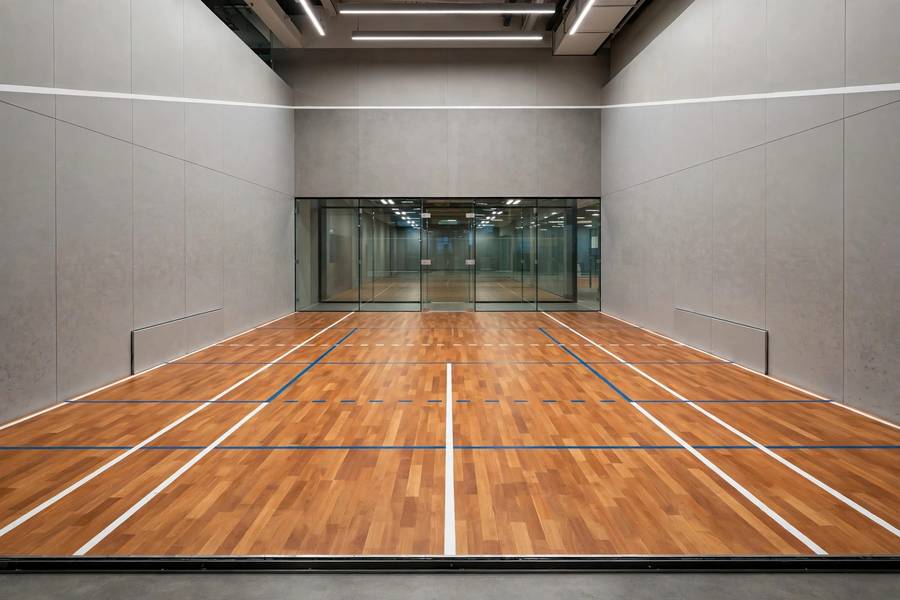
The doubles court is the same length as a singles court (32 feet) but wider — 25 feet instead of 21. The extra four feet matter enormously; they create the space four players need to coexist without constant collision. The tin is slightly lower in doubles (17 inches vs 19), which opens up attacking options and keeps rallies from becoming pure defensive grinding.
Service boxes are the same concept as singles, and the service line sits at the same height. If you want exact measurements for both versions of the court, our guide to squash court dimensions lays them side by side.
Scoring in Doubles
Doubles uses point-a-rally scoring like singles, but games go to 15 points instead of 11 (still win by two). Matches are typically best of five games. The longer games suit doubles: with four players covering the court, rallies last longer and points are harder to finish, so 15 gives the game room to breathe. Some social leagues play to 11 or best-of-three for time — always confirm before you start.

Serving Order and Rotation
Each team nominates a serving order at the start of the match, and it stays fixed. The first server serves until their team loses a rally; then the serve passes to the opponents, who use their own order. Within a team, partners alternate serving turns as the serve comes back to them — you can’t have your stronger server take every turn.
Which box you serve from follows the same even/odd convention as singles: serve from the right box when your team’s score is even, left when odd. The receiver must stand in the opposite quarter court, and the partner of the receiver has to stay out of the way — loitering in the server’s line of sight or the ball’s path can draw interference calls.
The Alternating Shots Rule
This is the rule that defines doubles: partners must alternate hitting the ball. If you hit the last shot for your team, your partner must hit the next one. Hit two in a row and you lose the rally. It sounds simple and it completely rewires your instincts — in singles you’d happily take two balls in a row; in doubles that’s a fault.
The practical consequences are big. You can’t poach your partner’s ball, even if you’re better placed — well, you can, but you’ll lose the point. Positioning becomes about setting up your partner, not just yourself. The classic beginner doubles error is both players chasing the same ball while the other half of the court stands empty. Call it early, commit, and trust your partner.
Interference: The Big Doubles Headache
With four players in a box built for two, interference calls multiply. The principles match singles — a player blocked from the ball or from swinging can appeal for a let, and serious obstruction can be a stroke — but the traffic is constant. Two rules keep it manageable:
- Clear for everyone, not just your opponent. After hitting, move to a spot that doesn’t block either opponent or your partner’s next shot. The corners are usually safe; the middle of the court is never safe.
- The striker has right of way. If you’re about to hit and someone — anyone, including your partner — is in your swing path, stop. Safety lets are always granted; playing through is how rackets meet faces.
In casual doubles, most groups play generous lets and get on with it. In competitive doubles, referees are strict about deliberate blocking, and teams that master legal screening — standing where they obstruct without technically interfering — gain a real edge. It’s a dark art; learn the legal version first.

Doubles Strategy Basics
- One up, one back. The classic formation: one player near the T/front, one covering the back. It divides the court cleanly and keeps partners out of each other’s way.
- Hit to the weaker opponent — through the stronger one. Target the opponent who’s struggling, and use the stronger opponent’s positioning against them.
- Communicate constantly. Call every ball. Silence causes collisions; over-communication just causes laughter.
- Attack the middle. Shots down the middle create confusion about whose ball it is. In doubles, confusion is a weapon.
- Keep the ball tight. Loose balls in the middle get punished by two opponents instead of one. Width and depth are safety.
Doubles rewards players who think in pairs. The best doubles teams I’ve played against weren’t the four best athletes — they were the two best partnerships, moving like they’d rehearsed it. Which, the good ones had.
Hardball Doubles: The North American Cousin
If you play squash in the US or Canada, you’ll encounter hardball doubles — a distinct variant with its own traditions. It’s played on a much bigger court (45 feet long, 25 feet wide) with a harder, faster ball and a lower tin, and the rules differ meaningfully: scoring is to 15 but without the win-by-two requirement in some formats, only one serve is allowed per side (no second chances at all), and the game is famously aggressive — hardball doubles rallies are short, violent, and spectacular.
The strategy shifts too. On the big court, the “two box” system dominates: each team defends its own half, with one player typically taking forehand-side balls and the other backhands. Poaching is more common and more accepted than in the international softball game. If a club invites you to hardball doubles night, say yes — it’s the most fun variation of squash that exists, and the post-match stories are half the point. Just know the rules differ enough that you should ask for the local conventions before your first game.
Getting Started in Doubles
The easiest entry into doubles is a club social night or a friendly four with players you trust. A few practical tips for your first outings:
- Play with a regular partner. Doubles chemistry is real and it compounds. A steady partnership beats rotating partners every week.
- Start at the back. If you’re new, take the back-court role — fewer split-second decisions, more time, and your partner handles the frantic front-court exchanges.
- Talk more than feels natural. “Mine!” “Yours!” “Leave!” “Switch!” Say it loud, say it early. The embarrassment of over-communicating lasts one rally; the bruise from a collision lasts a week.
- Wear eyewear. Four players, fast ball, crowded court — this is the format where eye protection matters most. Non-negotiable in my book.
- Learn the local conventions. Every club’s doubles group has unwritten rules about lets, scoring quirks, and rotation. Ask before your first game, not during it.
And when you’re ready to work on the movement and sharpness doubles demands, general athletic conditioning pays off fast — the leg strength and change-of-direction work in our strength training for runners guide transfers to court coverage better than most players expect.
Doubles is played two-on-two on a wider court (25ft vs 21ft). Partners must alternate hitting the ball — hitting twice in a row loses the rally. Games go to 15 points (win by 2), serving order is fixed per team, and interference rules are stricter because four players share the court.
The doubles court is 4 feet wider (25ft vs 21ft) with the same length, and the tin is slightly lower at 17 inches instead of 19. The extra width gives four players room to move safely.
Yes. Partners must alternate — if you hit your team’s last shot, your partner must hit the next one. Touching the ball twice in a row (across two shots) is a fault and loses the rally.
Point-a-rally scoring to 15 points, win by 2, usually best of five games. The longer game length (vs 11 in singles) accounts for longer doubles rallies.
It’s different rather than harder. Doubles demands more communication, positioning discipline, and awareness of three other bodies, but each player covers less court. Most players find it more social and, once learned, more fun.