Offside Rule in Soccer Explained (2026 Guide)


The offside rule in soccer explained properly is simpler than its reputation — but it has one twist that breaks most beginners’ brains, and one modern complication that changed everything. I played competitively through college, I still watch an unhealthy amount of football, and I can tell you from experience: almost everyone who thinks offside is about “being past the last defender” has it slightly wrong. The actual rule is about timing, not position alone. Once that clicks, the whole thing opens up — including why VAR has turned offside into the most argued-about call in the sport.
This guide is written with the 2026 World Cup’s new viewers in mind. We will start with the basic law, walk through the exact moment that matters, cover the famous exceptions, and then get into how VAR and semi-automated technology have rewritten what offside looks like in the modern game. By the end, you will be able to call offside from your couch before the flag goes up.
The Basic Law: What Offside Actually Is
Here is the rule in its simplest accurate form: a player is in an offside position if they are nearer to the opponent’s goal line than both the ball and the second-to-last opponent at the moment the ball is played to them by a teammate. Being in an offside position is not, by itself, an offense. It only becomes an offense if the player then becomes involved in active play — by touching the ball, interfering with an opponent, or gaining an advantage from the position.
Three things to unpack there. First, “second-to-last opponent” — in practice this is almost always the last outfield defender, because the goalkeeper is usually the last opponent. But if the goalkeeper rushes out, the “second-to-last” might be a defender, and attackers have been caught out by exactly this scenario. Second, “the moment the ball is played” — this is the twist. Offside is judged when the ball is kicked by the teammate, not when the attacker receives it. A striker can be ten yards behind the defense when the pass is struck, sprint past everyone, and collect the ball legally — because at the moment of the pass, they were onside. Third, “involved in active play” — standing in an offside position while the ball goes elsewhere is fine. The flag only comes when it matters.
Why does this rule exist at all? Without offside, attackers would just camp by the opponent’s goal waiting for long balls — the game would devolve into a kicking contest and lose everything that makes it beautiful. Offside forces attacking play to be constructed, timed, and earned. It is the rule that makes through-balls an art form.
The Moment That Matters: Timing Over Position
Let me hammer this home with the classic scenario, because it is where 90 percent of confusion lives. Your team’s midfielder has the ball. Your striker is level with the last defender — onside. The midfielder plays the through-ball. At the exact instant of the kick, the striker takes two explosive steps and is now a yard beyond the defender. The striker runs onto the ball and scores.
Goal. Legal. The striker was onside when the ball was played, and everything after that moment is just running.
Now reverse it. The striker, eager, drifts a half-step beyond the last defender just before the midfielder kicks the pass. The ball is played. The striker was in an offside position at the moment of the pass — even though by the time they touch the ball, a defender has recovered and they look level. Offside. Flag up.
This is why you see strikers constantly glancing across the defensive line and timing their runs, and why you see defenders stepping up in unison to “play the offside trap” — pushing forward just as the pass is struck to strand the attacker beyond them. The entire attacking-defensive battle in the final third is fought in fractions of a second around that single moment.
The Big Exceptions: When Offside Does Not Apply
The law has several explicit exceptions, and they produce some of the most exciting plays in football:
- Goal kicks, throw-ins, and corner kicks. You cannot be offside directly from any of these restarts. This is why you see attackers lurking near the goal on corners without a care — and why long throw-ins into the box are a legitimate weapon.
- Level is onside. If the attacker is level with the second-to-last opponent — even by a toenail — they are onside. The benefit of the doubt goes to the attacker. (This is also why VAR’s millimeter decisions drive everyone mad: the law says level is fine, but technology now measures “level” to the centimeter.)
- Your own half. You cannot be offside in your own half of the field, no matter where the defenders are.
- Receiving the ball directly from an opponent. If a defender deliberately plays the ball — a back-pass, a clearance, an attempted interception that they control — an attacker in an offside position who collects it is not offside. The exception is a deflection or rebound: if the ball ricochets off a defender to an offside attacker, the flag still goes up. The distinction between a “deliberate play” and a deflection is genuinely one of the hardest judgment calls in officiating.
- Not interfering. Standing in an offside position while a teammate scores from distance, without touching the ball or blocking anyone’s view, is not an offense. But “interfering with an opponent” includes blocking the goalkeeper’s line of sight or making an obvious action that impacts a defender’s ability to play the ball — and officials judge this strictly.
Offside Rule in Soccer Explained for the VAR Era
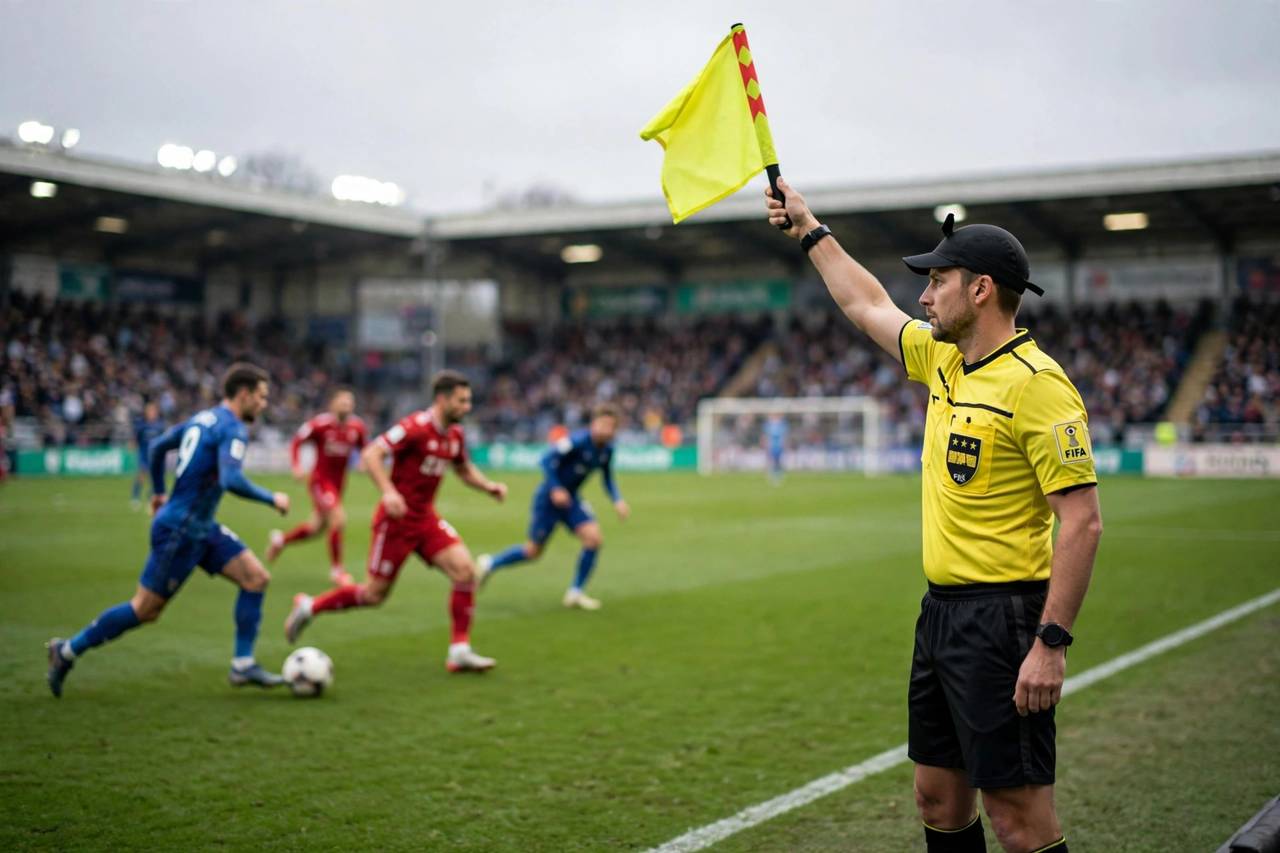
Here is where the modern game changed. For most of football history, offside was called by a human assistant referee sprinting sideways along the touchline, judging a moving ball and moving players in real time. Close calls went to the attacker by convention — “level is onside” was interpreted generously, because the human eye cannot split millimeters at full sprint.
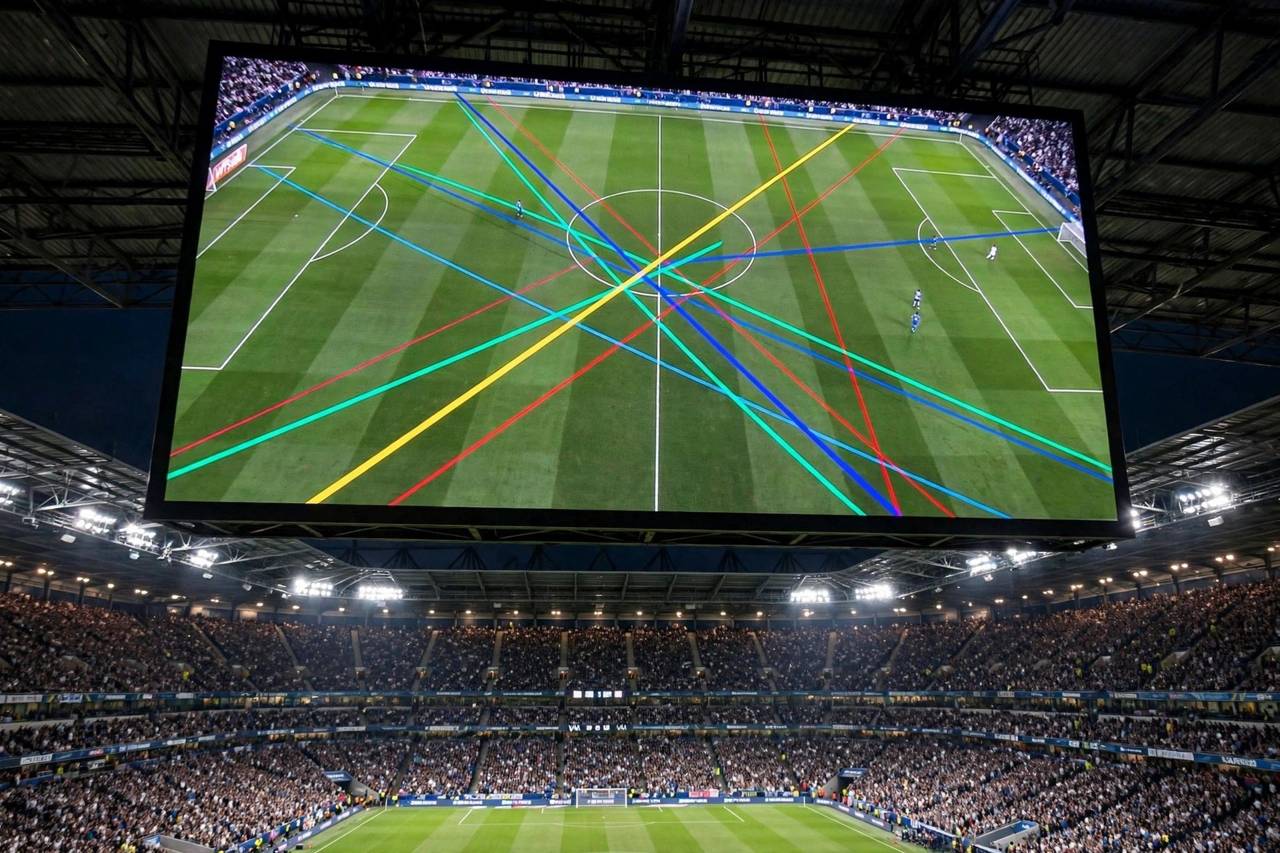
VAR — the video assistant referee — changed the evidentiary standard. Now, tight calls are reviewed frame by frame, with lines drawn to determine exactly where the attacker’s most forward playable body part was relative to the defender’s at the moment the ball was played. (Note: hands and arms do not count for offside — only parts you can legally score with.) Goals get disallowed because a shoulder, a knee, or a toe was centimeters beyond the line. Fans hate it. Pundits argue about it weekly. And it has measurably changed how the game is played: defenders hold higher lines knowing technology will bail them out, and attackers have had to recalibrate runs that used to be safely onside.
The latest evolution is semi-automated offside technology, which uses tracking cameras and sensors to determine offside positions almost instantly, with a 3D visualization shown to fans. It has been used at recent World Cups and in top leagues, and it speeds up decisions dramatically — though it does not end the arguments, because the underlying question of exactly when the ball was played still involves judgment. If you are watching the 2026 World Cup, expect to see these animations regularly, and expect them to spark debates in every group chat you are in.
My take, for what it is worth: the technology is more accurate and less fair-feeling at the same time. It enforces the letter of a law that was written for human eyes. Whether future law changes introduce a “daylight” tolerance — requiring clear separation between attacker and defender — is one of the liveliest debates in the sport right now.
How to Spot Offside While Watching: A Fan’s Checklist
Want to read the game like an analyst? Train your eye on these things:
- Watch the passer’s foot, not the runner. The moment of the kick is everything. Pause your instinct to watch the striker and check where they were when the ball left the boot.
- Find the second-to-last defender. Usually the deepest outfield defender. Ignore the goalkeeper unless they have come out.
- Check the exceptions first. Was it a throw-in, corner, or goal kick? Then stop — no offside possible.
- Ask “were they involved?” A player standing offside who never touches the ball and never interferes has committed no offense.
- On VAR reviews, watch for the kick-point frame. Disputes usually hinge on which frame was chosen as “the moment the ball was played” — a frame or two of difference can flip the call.
Do this for a few matches and it becomes second nature. You will start calling offside a half-second before the flag, and your friends will think you have developed mystical powers. You have not. You just learned where to look.
For a deeper dive into the specific wording and edge cases, our companion piece on the soccer offside rule breaks down additional scenarios with diagrams.
Frequently Asked Questions
Can you be offside from a throw-in?
No. The laws of the game explicitly state there is no offside offense when a player receives the ball directly from a throw-in, goal kick, or corner kick. This is why teams use long throw-ins as an attacking weapon — attackers can position themselves beyond the defense without penalty.
Is it offside if the player is level with the last defender?
No — level is onside. The law requires the attacker to be nearer to the goal line than the second-to-last opponent; being exactly level does not meet that test. In the VAR era this gets measured to tiny margins, but the principle remains: the benefit goes to the attacker.
Do arms count for offside?
No. Only body parts with which a player can legally score a goal count — so head, torso, legs, and feet, but not hands or arms. This is why VAR offside graphics sometimes show a player “onside” despite an outstretched arm beyond the line.
What is the offside trap?
A defensive tactic where the back line steps forward in unison just as an opponent plays a pass, stranding attackers in offside positions. It requires perfect coordination and timing — if one defender is slow to step up, they play everyone onside. High defensive lines in the VAR era have made a version of this the default for many top teams.
Why do offside VAR checks take so long?
The officials must determine two precise things: the exact frame when the ball was played, and the exact positions of the relevant body parts in that frame. Drawing calibrated lines and selecting the kick point takes time, especially on tight calls. Semi-automated offside technology has shortened this considerably where it is deployed.
Has the offside law changed recently?
The core law has been stable, but its application has been transformed by VAR and semi-automated technology, and lawmakers continue to discuss reforms — including proposals for a tolerance margin so that marginal, millimeter-level offsides are not penalized. Any change would come through the International Football Association Board, which governs the laws of the game.
Now Watch a Match
Theory only takes you so far. Put on a match this weekend and do the exercise: watch the passer’s foot, find the second-to-last defender, and make the call before the flag. You will get some wrong — everyone does, including the professionals — but you will understand the game at a deeper level than most of the people shouting at the screen. And when the 2026 World Cup rolls around, you will be the one in the room who actually knows what just happened.