What Is March Madness Format? The Complete Bracket Explainer


Every March, America collectively loses its mind over a basketball tournament — offices run pools, strangers argue about 12-seeds, and people who have not watched a minute of college basketball all season suddenly have very strong opinions about mid-majors. If you have ever nodded along while secretly wondering what is March Madness format, this is your no-judgment explainer. I will walk you through the 68 teams, the rounds, how selection actually works, and how to watch your first tournament like someone who knows what is going on — because by the end of this, you will.
The one-sentence version: March Madness is the NCAA Division I men’s (and separately, women’s) college basketball championship — a single-elimination tournament where 68 teams play win-or-go-home basketball over three weeks until one team is left standing. Single elimination is the whole magic: there are no second chances, no best-of-seven series to fall back on. One bad night ends a season. That fragility is why a 15-seed beating a 2-seed feels like an earthquake — and why it happens just often enough to keep everyone watching.
What Is March Madness Format? The 68 Teams
The field has two doors. Automatic bids (32): every Division I conference holds its own postseason tournament, and the winner of each gets an automatic ticket to the Big Dance. Win your conference tournament and you are in — no matter how bad your regular season was. This is how tiny schools no one has heard of end up playing blue bloods on national television, and it is glorious.
At-large bids (36): the rest of the field is chosen by the NCAA selection committee — ten people who spend the season evaluating teams and then lock themselves in a room on Selection Sunday to argue it out. They weigh records, strength of schedule, quality wins, bad losses, injuries and about a dozen metrics with acronyms (NET, KenPom, KPI). The at-large process is where the annual outrage comes from: every year, a handful of power-conference teams with gaudy records get left out while mid-majors with better resumes get in, and the debate consumes sports media for a week. The committee’s decisions are subjective by design — and the subjectivity is part of the show.
Seeding: The 1-to-16 Ladder
The 68 teams are sorted into four regions of 16ish teams each, seeded 1 through 16 by perceived strength. The 1-seeds are the best teams; the 16-seeds are the longest shots. The bracket is engineered so that, in theory, the best teams do not meet until late: 1 plays 16, 2 plays 15, and so on, with the winners advancing through a structure designed to protect the top seeds deep into the tournament.
In practice, the bracket is a beautiful lie — which is exactly why we watch. 12-seeds beat 5-seeds with suspicious regularity (it happens nearly every tournament). 15 over 2 has happened multiple times. And in 2018, UMBC became the first 16-seed to beat a 1-seed, breaking the one “impossible” result in tournament history. The seeds tell you what should happen; the games tell you what actually does. That gap is March Madness.
The Rounds: From First Four to One Shining Moment
First Four (Tuesday–Wednesday): the tournament technically starts with four play-in games in Dayton, Ohio — the four lowest-seeded automatic qualifiers and the last four at-large teams fighting for four spots in the main bracket. Casual fans skip this; diehards know some of the best drama lives here.
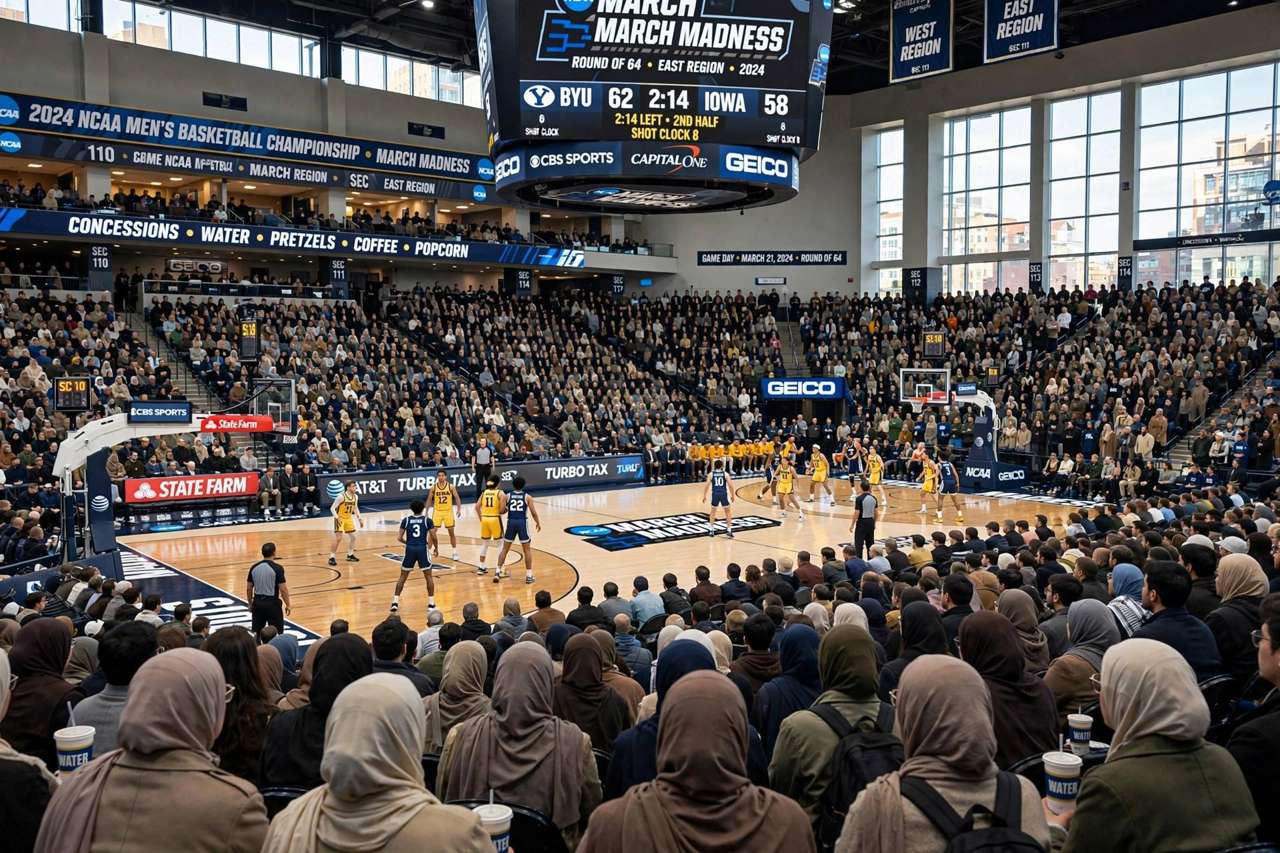
First Round / Round of 64 (Thursday–Friday): the greatest four days in American sports television. Thirty-two games in two days, wall-to-wall coverage, buzzer-beaters stacked on buzzer-beaters. If you watch one round, make it this one — the chaos density is unmatched.
Second Round / Round of 32 (Saturday–Sunday): the field halves again. Upset survivors try to prove the first win was not a fluke; favorites try to avoid becoming the next cautionary tale. The quality of basketball rises as the Cinderella count falls.
Sweet 16 (next Thursday–Friday): sixteen teams, and from here on every game is an event. This is where the tournament shifts from delightful chaos to heavyweight basketball — the remaining teams are almost all genuinely excellent.
Elite Eight (weekend): eight teams, four games, four tickets to the Final Four. The regional finals. Losing here is its own special heartbreak — one win from immortality, and done.
Final Four (Saturday): the semifinals, played in a football stadium before 70,000+ fans. The scale is absurd and wonderful. Two games, two winners, one step from the title.
National Championship (Monday): one game, winner takes all, confetti, “One Shining Moment,” and a highlight montage that will make you emotional about eighteen-year-olds you met three weeks ago. That is the tournament. That is March Madness.
How Selection Sunday Works
The bracket reveal is itself a television event. On Selection Sunday, the committee unveils the full bracket region by region, and the country reacts in real time: cheers, groans, and the instant filling-out of millions of brackets. The committee also sets the seed lines and matchups with an eye toward competitive balance, geographic considerations and avoiding early rematches of regular-season games. Conspiracy theories about favorable placements for TV ratings surface annually; the committee insists the process is pure. Believe what you want — arguing about it is tradition.
One detail that surprises newcomers: the committee seeds the entire field 1 through 68 (the “S-curve”), then places teams into regions following bracketing principles. So a 2-seed is not just “a good team” — it is specifically the 5th-through-8th best team as the committee judged them. The precision is part of what makes bracket debates so heated: everyone can see exactly where the committee ranked their team, and everyone disagrees.

The Beginner’s Viewing Guide
Fill out a bracket. Even a random one. Having picks transforms every game from background noise into personal drama — you will find yourself screaming for a school you could not locate on a map. Bracket pools with friends, family or coworkers are the social engine of the tournament.
Learn the vocabulary: a Cinderella is a low seed making an improbable run. A buzzer-beater is a game-winning shot at the clock’s expiration. Bracket buster is the upset that ruins everyone’s picks. One-and-done describes star freshmen expected to leave for the NBA after a single college season — the tournament is their showcase.
Watch the first weekend. Thursday through Sunday of the opening rounds is the essential experience — maximum games, maximum upsets, minimum commitment. If you get hooked (you will), the Sweet 16 onward is appointment television.
Pick a Cinderella. Everyone needs a team to irrationally love. Find a double-digit seed with a fun style, a charismatic coach or a great story, and ride with them. When your Cinderella wins, it is the best feeling in sports. When they lose, you barely knew them a week ago — low risk, high reward fandom.
Understand the clock: college games are two 20-minute halves (not four quarters like the NBA) — if the timing feels unfamiliar, here is how long a basketball game actually lasts across levels. Knowing the structure helps you read the late-game drama: fouls, timeouts and clock management decide more tournament games than talent does.
The Other Tournament: Women’s March Madness
Everything above describes the men’s tournament, but the women’s NCAA tournament runs on the same 68-team, single-elimination format — and in recent years it has become essential viewing in its own right. Selection works the same way (automatic bids plus at-large selections), the rounds mirror the men’s event, and the Final Four carries the same win-or-go-home electricity. The women’s game has its own stars, dynasties and Cinderella stories, and the championship game has drawn record audiences as the sport’s popularity has surged. If you are learning the format, learn both brackets — the men’s tournament gets the historical hype, but the women’s tournament is where some of the best basketball of March is being played right now. Fill out both brackets. Thank me later.
A note on the name: “March Madness” was long used primarily for the men’s event while the women’s tournament fought for the same branding — a disparity the NCAA formally ended by extending full March Madness branding to the women’s tournament. It matters because language shapes attention: calling both tournaments by the sport’s biggest name tells new fans that both are the main event. They are. And the upsets hit just as hard when you have no idea who is “supposed” to win — arguably harder, because every Cinderella feels brand new.
Frequently Asked Questions
How many teams are in March Madness?
68 teams: 32 automatic qualifiers (conference tournament champions) and 36 at-large selections chosen by the NCAA selection committee. Four teams play in the First Four play-in games, leaving 64 for the main bracket.
How does the March Madness bracket work?
It is single elimination: lose once and you are out. Teams are seeded 1–16 in four regions, with 1 playing 16, 2 playing 15, and so on. Winners advance through six rounds — from the Round of 64 to the national championship game.
What is the difference between March Madness and the Final Four?
March Madness is the entire tournament; the Final Four is just the semifinal round — the last four teams standing, playing two games to decide the championship matchup. People use the terms interchangeably, but the Final Four is one weekend inside the three-week tournament.
Has a 16 seed ever beaten a 1 seed?
Yes — once. In 2018, UMBC (University of Maryland, Baltimore County) beat top overall seed Virginia 74–54, the first and only time a 16-seed has beaten a 1-seed in the men’s tournament. It remains the most famous upset in the event’s history.
When is March Madness played?
The tournament runs from mid-March to early April each year: the First Four in mid-March, the opening rounds the following Thursday–Sunday, and the Final Four and championship game in early April.
The Bottom Line
What is March Madness format: 68 teams, single elimination, six rounds from the First Four to one national champion — with Selection Sunday seeding the chaos and Cinderella stories supplying the magic. Fill out a bracket, pick an underdog, clear your first weekend, and enjoy the most gloriously unpredictable three weeks in American sports.