What Is the Offside Rule in Soccer? Clear Explanation


Few things enrage a football crowd like an offside flag. One moment your striker is clean through on goal, the next a linesman’s flag goes up and the stadium erupts. So what is the offside rule in soccer? In short: an attacking player is offside if, when the ball is played to them, they are nearer to the opponent’s goal line than both the ball and the second-to-last defender, with a few important exceptions.
I have watched fans argue about this law for years, and most arguments come from the same misunderstanding. Offside is not about where you receive the ball. It is about where you were when it was played. Get that one distinction and the whole law starts making sense.
What Is the Offside Rule in Soccer? The Law in Plain English
Here is the rule broken into its working parts. A player is in an offside position if they are in the opponent’s half, ahead of the ball, and ahead of the second-to-last opponent (usually the last outfield defender, since the goalkeeper is typically the last). Being in that position alone is not an offense.
The offense happens when a player in an offside position becomes actively involved in play: receiving the ball, interfering with an opponent’s ability to play it, or gaining an advantage from a rebound off the post or a defender. Standing in an offside position while the ball goes elsewhere is perfectly legal.
The critical timing detail: offside is judged at the moment the ball is played by a teammate, not when it is received. A striker can sprint past the entire defense after the pass is struck and still be onside, because they were level when the ball left their teammate’s foot. This is why through-balls timed to a runner’s movement are football’s most thrilling weapon.
The Exceptions Everyone Forgets
You cannot be offside from a goal kick, a throw-in, or a corner kick. These three restarts are explicitly exempt, which is why you will see strikers camped on the goal line at corners without a flag in sight.
You also cannot be offside in your own half. No matter how far forward the defense pushes, an attacker standing in their own half when the ball is played is onside. And there is no offside offense if the ball comes directly from an opponent, a defender’s deliberate play resets everything.
Being level is onside. The law gives the benefit of the doubt to the attacker: if any part of the attacker’s body that can legally play the ball is level with the second-to-last defender, they are onside. With VAR drawing lines to the millimeter, “level” has become one of the most scrutinized inches in sport.
Why the Rule Exists at All
Without offside, the game would break. Strikers would simply stand next to the opposing goalkeeper waiting for long balls, and football would devolve into a kicking contest. The law forces attacking play to build through the midfield and rewards defensive organization.
It also creates the sport’s tactical chess match. Defenses push high to compress space and trap attackers offside; attackers time runs to beat the trap. The high defensive line, the perfectly timed run, the flag that stays down: these are among football’s finest dramatic moments, and they all exist because of this one law.
For context on how the sport’s biggest stage works, how the World Cup works is worth a read, and how World Cup groups are decided explains the tournament format where these offside dramas play out most memorably.
VAR and the Modern Offside Controversy
Video review changed offside forever. Before VAR, linesmen made split-second calls and the benefit of the doubt went to the attacker in spirit. Now, VAR draws calibrated lines and disallows goals for armpits and toes straying millimeters beyond the defender.
Fans hate it, and the data suggests the frustration is understandable: goals get chalked off for margins no human could perceive in real time, after celebrations have already happened. The precision is technically correct and emotionally deflating in equal measure.
The lawmakers have noticed. Trials of semi-automated offside technology, using tracking cameras and sensors, aim to make decisions faster, and there are serious proposals to rewrite the law so that daylight between attacker and defender is required. The debate is really about what the law is for: perfect geometric fairness, or the spirit of preventing goal-hanging?
How to Spot Offside Like a Linesman
Want to impress your friends? Watch the second-to-last defender, not the ball. Linesmen are trained to keep the defensive line and the ball in view simultaneously, a skill that takes years. The moment a teammate plays the ball forward, freeze the picture in your mind: is the attacker beyond that line?
Ignore the arms and hands; only body parts you can legally score with count. And remember that a player running back from an offside position to collect the ball is still offside: the judgment was made when the ball was played.
The more you watch for it, the more you will appreciate the craft. A well-executed offside trap is defensive artistry, and a run timed to perfection is attacking genius. The flag, annoying as it is, is what makes both possible.

Famous Offside Controversies
Every fan has a scar. England supporters still debate goals disallowed by the finest of margins in major tournaments. Frank Lampard’s “goal” against Germany in 2010 was not offside but a goal-line error, yet it lives in the same family of officiating heartbreak that fuels the debate.
The VAR era produced its own hall of fame. Goals have been disallowed for armpits, heels, and even a player’s sleeve straying beyond the line. Each one was technically correct and each one felt wrong to millions watching. The controversy is not about accuracy; it is about whether the law was meant to police millimeters.
Perhaps the most instructive case is how the game adapted before technology. The 1990 change, making level with the defender onside, and the 2005 clarification about interfering with play, both tilted the law toward attackers. Football’s lawmakers have repeatedly decided that goals are the product, and the law should serve the spectacle, not strangle it.
Teaching Offside to a New Fan
Here is the thirty-second version I give newcomers: the attacker has to stay behind the last defender (not counting the goalkeeper) until the ball is kicked. That is it. Everything else is refinement.
Then add the three things that confuse people most. One: it is judged when the ball is played, not received. Two: you cannot be offside in your own half, or from throw-ins, corners, and goal kicks. Three: being in an offside position is only an offense if you get involved.
Watch one match with these rules in mind, focusing on the defensive line when passes go forward, and it will click. Offside is one of those laws that sounds complicated in words and looks obvious in motion.
The Art of the Offside Trap
The trap is the defense’s weapon: the back line steps up in unison just as the pass is played, stranding the attacker beyond them. Done well, it is beautiful, four defenders moving as one, arms raised in synchronized appeal. Done badly, it gifts the striker a clear run at goal.
It requires extraordinary coordination and trust. One defender a half-step slow ruins it. This is why the trap is a hallmark of well-drilled teams and a rarity in chaotic ones. Managers who master it, from Arrigo Sacchi’s Milan to modern high-line specialists, build entire defensive identities around the law.
Forwards counter with the delayed run: holding their sprint until the last instant, or starting from deep and arriving at pace. The duel between trap-setters and run-timers is football tactics in miniature, and it never gets old.
Offside in Other Sports: A Quick Tour
Football is not alone in policing goal-hanging. Ice hockey has its own offside: attacking players cannot cross the blue line before the puck. It serves the same purpose, preventing cherry-picking, and produces the same controversies on video review.
Rugby’s offside law is stricter and more continuous: players must stay behind the ball or behind a moving offside line throughout open play. It shapes the entire sport, forcing the distinctive lateral passing game.
Basketball has the three-second rule and defensive three-seconds instead, limiting how long big players can camp near the basket. American football uses formation and motion rules to similar effect. Every invasion sport invents some version of this law, because without it, the optimal strategy is always to loiter by the goal.
Soccer’s version is the most debated precisely because it is the most consequential: goals are rare, so each disallowed one matters enormously. The law’s drama is proportional to the sport’s scoring scarcity.
Frequently Asked Questions
What is the offside rule in soccer in simple terms?
An attacker cannot be ahead of the second-to-last defender (and the ball) in the opponent’s half when the ball is played to them by a teammate, unless an exception applies.
Can you be offside from a throw-in or corner?
No. Goal kicks, throw-ins, and corner kicks are all explicitly exempt from the offside law.
Is it offside if you are level with the defender?
No. Being level with the second-to-last opponent counts as onside; the benefit of the doubt goes to the attacker.
Why was VAR introduced for offside?
To correct clear mistakes on game-changing decisions. It has succeeded at accuracy but sparked debate over millimeter-level calls that feel against the spirit of the law.
Can a goalkeeper be the one who plays you offside?
The law counts the second-to-last opponent, which is usually an outfield defender with the goalkeeper last. If the goalkeeper rushes out, an outfield player near the goal line can become the relevant defender.
What does the assistant referee actually watch for on offside calls?
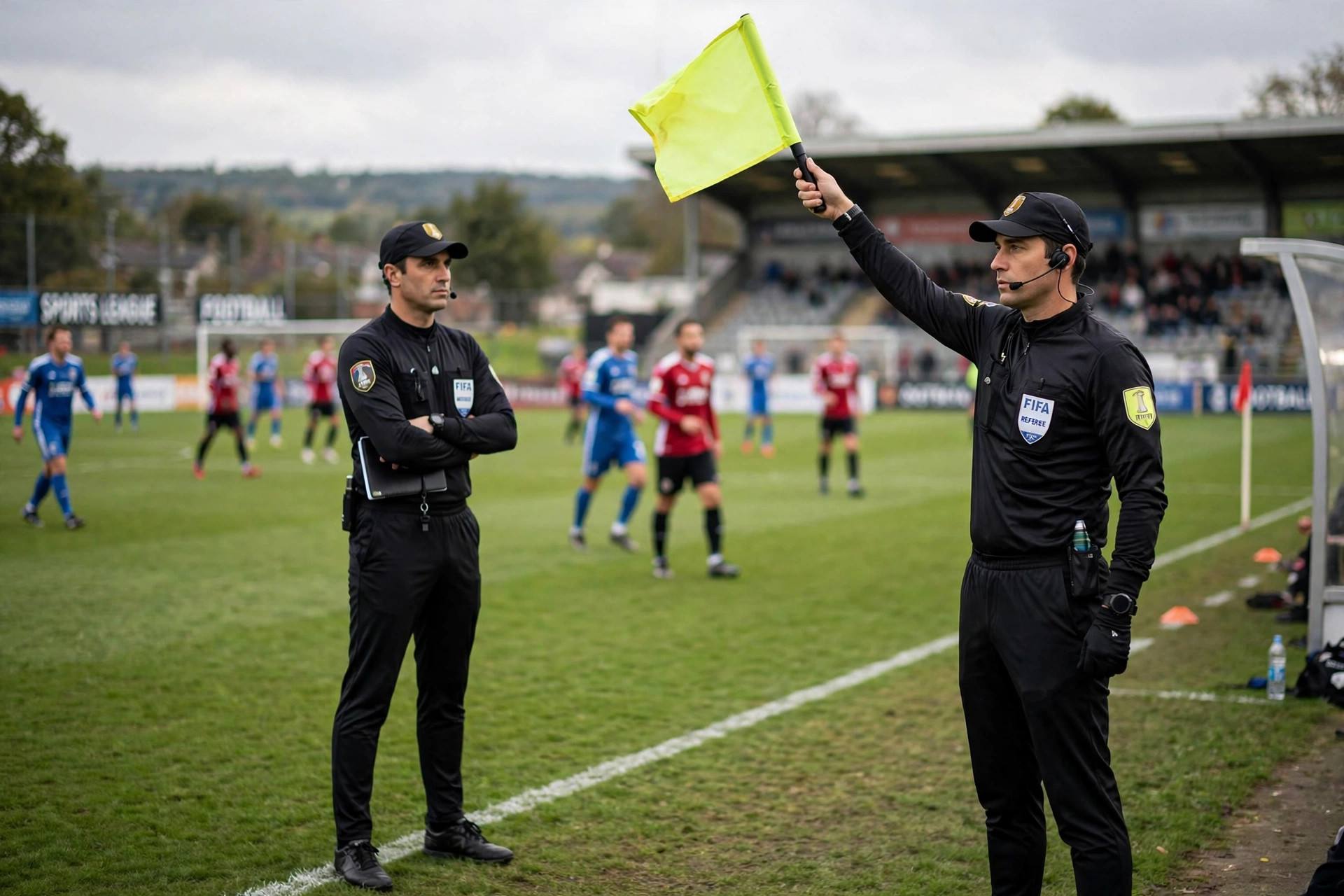
The assistant referee, the official with the flag on the touchline, tries to stay level with the second-to-last defender and watches two things at once: the moment a teammate plays the ball and the position of the attackers. It is one of the hardest jobs in officiating, which is why VAR now assists with the tightest calls.