Why Do We Get Goosebumps? The Science Behind the Shivers


The answer fits in one sentence, but the story behind it is worth the longer version. Why do we get goosebumps? Because tiny muscles at the base of each body hair contract — usually in response to cold, fear, or strong emotion — pulling the hairs upright and dimpling the skin around them. It is a reflex inherited from far hairier ancestors, and it fires whether you want it to or not. Here is what is actually happening under your skin, why music can trigger it, and what those bumps were originally for.
The Tiny Muscles Behind the Bumps
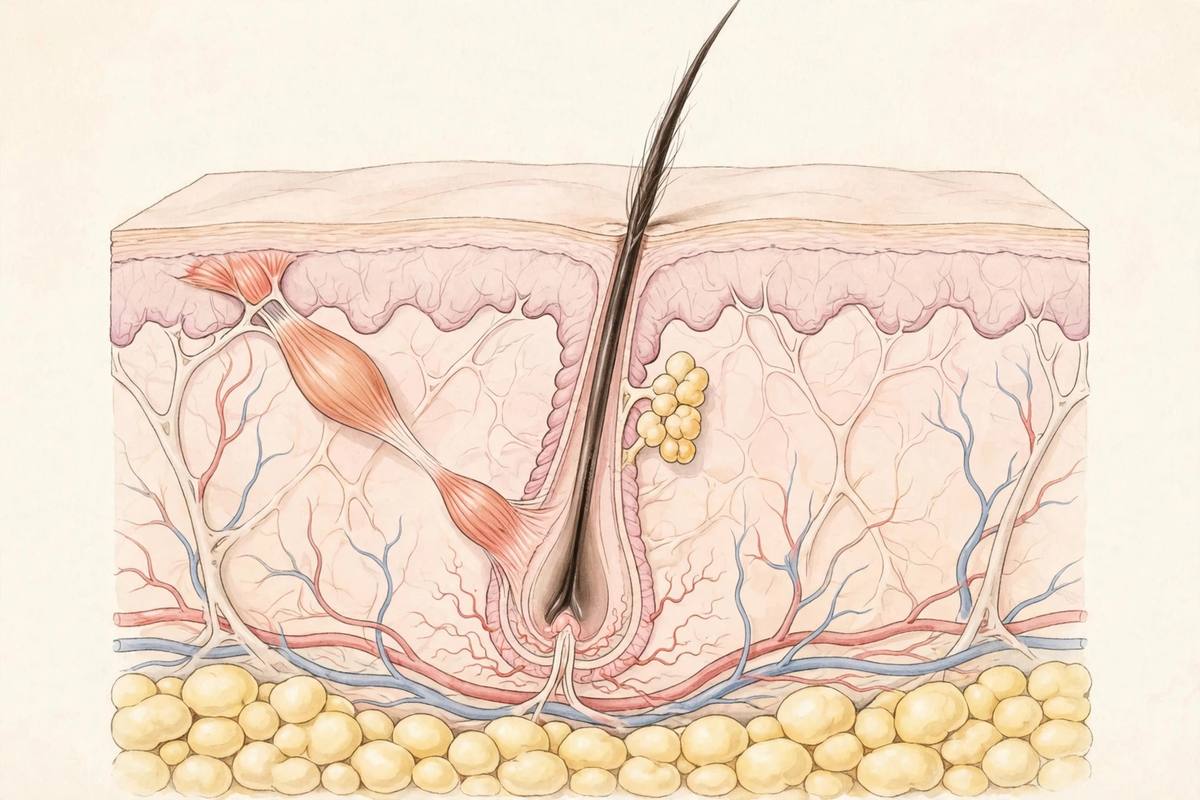
Every hair on your body — all roughly five million of them — has its own miniature muscle attached to it. The name is a mouthful: the arrector pili muscle. Each one is only a millimeter or two long, far too small to see, but when thousands of them contract at once, the effect is unmistakable. The muscle yanks the hair follicle upright, the hair stands on end, and the skin around the follicle gets tugged into a small bump. That bump is the goosebump. For perspective, the same basic mechanism raises a cat’s fur when it is startled and puffs up a dog’s hackles during a confrontation — you are watching your own version of the exact same hardware.
The signal to contract comes from the sympathetic nervous system, the branch of your nervous system that handles fight-or-flight responses. It does not ask your permission. When your brain detects a sudden drop in temperature, a threat, or something emotionally overwhelming, the sympathetic nervous system releases a surge of adrenaline, and the arrector pili muscles are among the first responders. The whole chain — trigger, adrenaline, contraction, bumps — can complete in under a second.
Here is the part most people miss: the cold response and the emotion response travel through the same wiring. That is why a freezing wind and a spine-tingling piece of music can produce identical-looking goosebumps. Your body is running one ancient program, and it accepts several different inputs.
Why Do We Get Goosebumps When We Are Cold?
Cold is the original trigger — the one the reflex was actually built for. When your skin temperature drops, receptors in the skin alert the hypothalamus, the brain’s thermostat. The hypothalamus responds the way it always does to cold: it tries to warm you up. Shivering is the famous part of that response, but goosebumps are the quieter partner.
In a furry mammal, raised hair is genuinely useful insulation. Each upright hair traps a thin layer of still air against the skin, and still air is an excellent insulator — the same principle behind down jackets and double-glazed windows. A cold dog with raised fur is measurably warmer than the same dog with flat fur. For our ancestors, who were covered in far more hair than we are, the difference mattered.
For modern humans, it mostly does not. We kept the reflex but lost most of the fur, so the insulation effect is negligible — a few hundredths of a degree at best. The bumps remain as a kind of physiological souvenir: the body faithfully running a program whose main benefit expired roughly a million years ago, when we started shedding our heavy coat of hair. The shivering that usually accompanies cold-triggered goosebumps does the real warming work; the bumps are just along for the ride.
The Other Trigger: Fear, Awe, and That Song
Cold explains maybe half of all goosebumps. The rest come from the emotional trigger, and this is where it gets interesting. Fear is the obvious one — the hair-raising moment in a horror film, the jolt of nearly stepping into traffic. That is the fight-or-flight system doing exactly what it evolved to do: in a furry ancestor, raised hair made the animal look bigger and more intimidating to a predator or rival. A startled cat demonstrating the effect is not showing off; it is trying to look like a worse idea to attack.
But goosebumps also show up in moments with no threat at all: a powerful piece of music, a moving speech, a stunning view, a reunion at an airport arrivals gate. Researchers call these “aesthetic chills,” and they are surprisingly common — studies suggest roughly half of people experience them regularly, and some people experience them far more intensely than others. The leading explanation is that strong emotion of almost any kind — awe, admiration, tenderness, even nostalgia — can spill over into the same sympathetic arousal system that handles fear. Your brain registers something as deeply moving, the adrenaline system fires as a side effect, and the arrector pili muscles contract.
There is a personality angle, too. People who score high on “openness to experience” — curiosity, imagination, appreciation of art — report aesthetic chills more often. Brain imaging studies have found that people prone to music-triggered goosebumps tend to have denser connections between the auditory cortex and the brain’s emotion-processing regions. In other words, some brains are simply wired so that sound reaches the feeling centers faster and harder, and the skin announces it.

It is worth pausing on how strange this is, biologically speaking. A reflex built to fluff up fur in the cold has been co-opted — entirely by accident — into a visible signal of being moved by art. No other mammal gets goosebumps from a symphony. The hardware is ancient; the input is brand new, a product of human culture plugging into wiring that predates culture by millions of years. When the hairs on your arms rise during a piece of music, you are watching evolution’s leftovers get repurposed in real time.
What Goosebumps Were Originally For
Put the two triggers together and the evolutionary logic snaps into focus. Goosebumps are a leftover from a time when humans — and the mammals before them — were furry enough for raised hair to matter. The reflex served two jobs, and it served them with the same muscles:
Job one: insulation. Fluffed-up fur traps warm air. Every mammal from mice to bears still uses a version of this, and birds do something similar when they puff up their feathers in winter. The colder it got, the more valuable the reflex.
Job two: intimidation. Bigger-looking animals win more confrontations without fighting. Porcupines, cats, dogs, and countless other species raise their hair or quills when threatened, and the visual effect is immediate. Our ancestors presumably benefited the same way — a rival deciding you look larger than expected might decide the fight is not worth it.
Both jobs depended on having substantial body hair, which is why the reflex has faded into near-uselessness for us while remaining fully functional in our pets. Evolution rarely bothers to delete a harmless reflex, so it persists — triggered by cold we can no longer insulate against and threats we can no longer look bigger for, plus the emotional spillover that neither our ancestors nor evolution particularly planned for.
Goosebumps, Gooseflesh, and Piloerection: Same Thing?
Yes — three names for one phenomenon. “Goosebumps” and “gooseflesh” are the everyday English terms, named for the resemblance to the bumpy skin of a plucked goose. “Piloerection” (from the Latin pilus, hair, and erectio, raising) is the technical term you will see in physiology textbooks. “Horripilation” is another formal synonym, from the Latin for “bristling hair” — it shares a root with “horror,” which tells you which trigger the Romans noticed first.
One related term worth knowing: the bumps themselves are sometimes confused with “chicken skin,” but that usually refers to keratosis pilaris, a harmless and unrelated condition where dead skin cells clog hair follicles permanently. Goosebumps come and go in seconds or minutes; keratosis pilaris is always there. Different mechanism, different story.
Can You Give Yourself Goosebumps on Purpose?
Some people can — and it is a genuine, documented ability, not a party trick. A small number of people can voluntarily trigger piloerection, usually by concentrating on the sensation or recalling an emotional memory. Researchers who have studied these individuals found that the voluntary control seems to run through the same sympathetic pathways as the involuntary version; they have simply learned to activate them deliberately.
For everyone else, the reliable methods are the classic triggers: cold exposure, startling yourself, or seeking out the music and films that give you chills. There is no health benefit to collecting goosebumps the way you might collect steps — the reflex itself does nothing useful for you anymore. But the emotional version is at least a decent signal: if a piece of music consistently raises the hairs on your arms, your brain is telling you something about what moves you, and that is worth paying attention to for its own sake.
When Goosebumps Mean Something Is Wrong
Ordinary goosebumps need no treatment and warrant no worry. But the same machinery can misfire in a few medical situations worth knowing about. Persistent, unexplained piloerection on one side of the body can occasionally signal a neurological issue affecting the sympathetic nerves. Goosebumps accompanied by fever and chills are simply the body fighting an infection — the “chills” of the flu are goosebumps plus shivering working as a team to raise your core temperature. And in rare cases, recurrent episodes of goosebumps with no trigger have been associated with certain types of seizures, where abnormal brain activity stimulates the autonomic nervous system.
None of this applies to the normal, everyday version. If your goosebumps show up with cold, fear, excitement, or a great song — and then fade within minutes — that is the reflex working exactly as designed, a million years after its design stopped mattering.
Frequently Asked Questions
Why do we get goosebumps when we listen to music?
Strong emotion — including awe and pleasure from music — can spill over into the sympathetic nervous system, which triggers the same arrector pili muscles that respond to cold and fear. People with stronger connections between auditory and emotion-processing brain regions experience this more intensely.
Do goosebumps actually keep you warm?
Not meaningfully, not anymore. In furry mammals, raised hair traps insulating air against the skin. Humans lost most of our body hair, so the warming effect is negligible — the shivering that usually comes with cold-triggered goosebumps does the real work.
Why are they called goosebumps?
Because bumpy human skin resembles the skin of a plucked goose. The technical term is piloerection, from Latin words meaning “hair raising.”
Can animals get goosebumps?
Mammals with fur experience the same reflex — it is what makes a startled cat’s fur stand on end or a cold dog look puffy. In furry animals the response still serves its original purposes of insulation and looking larger to threats.
Is it normal to never get goosebumps from music?
Completely normal. Only about half of people regularly experience aesthetic chills from music or art, and sensitivity varies widely. It is linked to personality traits like openness to experience and to individual differences in brain wiring — not to emotional depth.