What Is a Swing State? How Battlegrounds Decide Elections

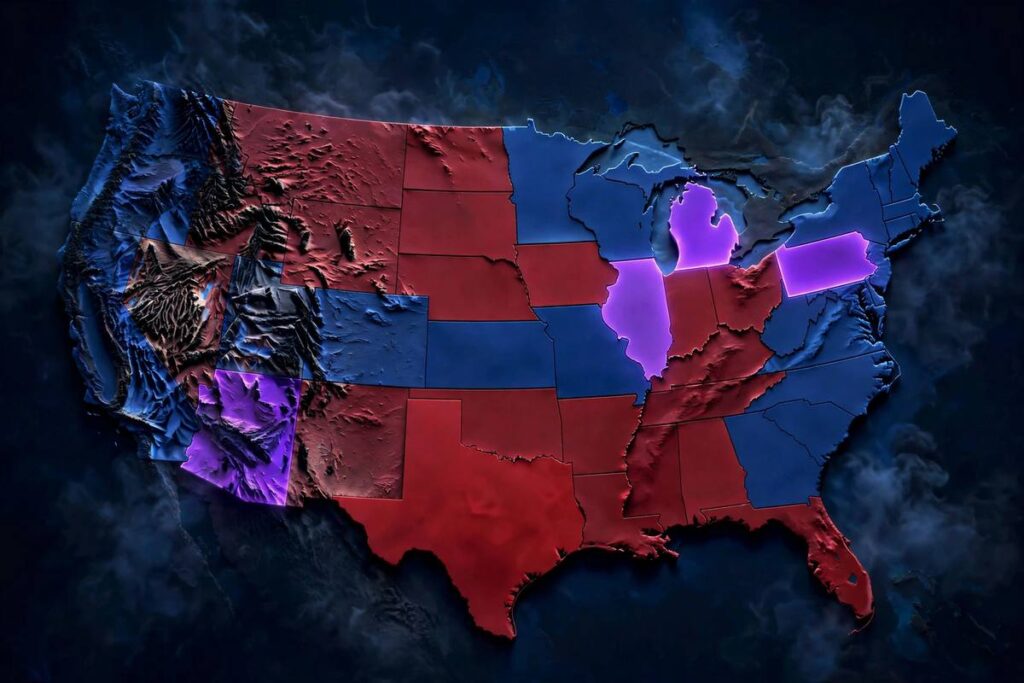
Every four years, presidential candidates spend a wildly disproportionate share of their time and money in the same handful of states — Pennsylvania, Michigan, Wisconsin, Georgia, Arizona, Nevada, North Carolina — while largely ignoring the country’s two biggest states. What is a swing state, and why does it command that kind of attention? A swing state (also called a battleground state) is a state where neither major party can count on winning, so its electoral votes are genuinely up for grabs. This guide explains how swing states work, which states currently qualify, and why a few thousand voters in the right places can decide a national election.
What Is a Swing State vs. a Safe State?
The distinction starts with the Electoral College, the system the United States uses to elect its president. Voters do not directly choose the president; they choose electors, and each state gets electors equal to its congressional delegation. There are 538 electors in total, and 270 are needed to win. In 48 states, the winner of the statewide popular vote takes all of that state’s electors — the winner-takes-all rule.
That rule creates the two categories. A safe state (often called a red state or blue state) is one where the outcome is effectively predetermined — California for Democrats, Wyoming for Republicans — because the margin is so wide that campaigning there would be wasted effort. A swing state is one where recent elections were close enough that either party could plausibly win next time. The label is not permanent; it is a description of recent competitiveness, and states move in and out of the category as their politics shift.
The practical consequence is stark. A candidate who leads comfortably in safe states still needs 270 electoral votes, and the swing states hold the balance. In a close national race, the entire election can come down to a few tens of thousands of votes spread across three or four battlegrounds — which is exactly what happened in both 2016 and 2020.
Why Swing States Matter So Much
The winner-takes-all rule is what gives swing states their outsized power. Consider the arithmetic: winning California by 5 million votes earns a Democrat the same 54 electoral votes as winning it by 5,000 votes. Surplus votes in a safe state are, electorally speaking, wasted. But flipping a swing state by a few thousand votes swings its entire electoral haul from one column to the other.
This is why campaigns allocate resources the way they do. In a typical presidential cycle, the two campaigns will hold the overwhelming majority of their rallies, buy the overwhelming majority of their television advertising, and deploy the overwhelming majority of their field organizers in just six to eight states. Voters in swing states see dramatically more campaign contact — more ads, more visits, more polling — than voters anywhere else. Political scientists have a term for the flip side: safe-state neglect, the reality that tens of millions of voters in non-competitive states are effectively spectators in the presidential contest.
The influence extends beyond campaigns. Presidents have strong incentives to keep swing-state voters happy once in office, because those are the voters who will decide their reelection. Analysts have found patterns in federal spending, disaster declarations, and policy attention that tilt toward battleground states — a phenomenon sometimes called the battleground premium. Whether or not any individual decision is motivated by electoral math, the structural incentive is real.
The Current Swing States
The roster changes from cycle to cycle, but heading into the 2026 midterms and looking toward 2028, the states most analysts classify as genuine battlegrounds are:
Pennsylvania (19 electoral votes). The largest swing state and the single most contested piece of electoral real estate in the country. It has voted for the winning candidate in most recent cycles, decided by razor-thin margins, and combines big-city Democratic strength (Philadelphia, Pittsburgh) with deep-red rural counties and genuinely competitive suburbs.
Michigan (15) and Wisconsin (10). The other two legs of the “Blue Wall” that cracked in 2016 and partially rebuilt in 2020. All three were decided by less than a percentage point in at least one recent election — margins of a few tens of thousands of votes out of millions cast.
Georgia (16) and Arizona (11). The Sun Belt battlegrounds. Both were reliably Republican for a generation before flipping Democratic in 2020, driven by fast-growing and diversifying suburbs around Atlanta and Phoenix. Both have since hosted some of the closest Senate and gubernatorial races in the country.
North Carolina (16) and Nevada (6). North Carolina has been the Republicans’ narrowest win in multiple cycles — close enough to contest, just out of Democrats’ reach so far. Nevada, with its service-worker-heavy economy and growing Latino population, has been drifting toward competitiveness for a decade.
Former swing states tell the other half of the story. Ohio and Iowa were the quintessential battlegrounds of the 2000s and early 2010s; both have since shifted firmly Republican. Florida, once the ultimate swing state, has moved toward the GOP column. Virginia and Colorado moved the opposite direction, from Republican-leaning to Democratic-leaning. The map is not fixed — it is a snapshot of a moving electorate.
How Campaigns Fight Over Battlegrounds
Winning a swing state is a ground game as much as an air war. The playbook has several layers. Advertising saturation is the most visible: in the final months of a presidential race, voters in markets like Philadelphia, Detroit, Milwaukee, and Phoenix can see thousands of campaign ads — often several per commercial break. The spending is staggering; the two campaigns and their allies routinely pour well over a billion dollars combined into battleground advertising in a single cycle.
Beneath the ads sits the field operation: offices in every competitive county, staff whose full-time job is recruiting volunteers, and data-driven voter targeting that identifies persuadable voters down to the household. Modern campaigns maintain detailed models of every voter — likelihood to vote, likelihood to support, which issues move them — and the field program exists to turn those models into actual ballots through door-knocking, phone calls, and text campaigns.
Then there is the candidate calendar. A presidential candidate might visit Pennsylvania a dozen times in the final two months while never setting foot in New York or Texas. Running mates and surrogates fill the gaps, fanning out across the battleground map. The logic is pure efficiency: an hour of a candidate’s time moves more votes in Erie, Pennsylvania, than in any safe state in the country.
Can a State Stop Being a Swing State?
Constantly — and the reasons are usually demographic or economic rather than mysterious. States drift out of battleground status when their underlying coalitions change. Ohio’s rightward drift, for example, tracks the decline of unionized manufacturing employment and the national realignment of white working-class voters. Georgia’s emergence as a battleground tracks the explosive growth of the Atlanta suburbs and their increasing diversity. Migration is the engine: people move for jobs and housing, and they bring their politics with them.
Redistricting does not directly change a state’s presidential battleground status — electoral votes are statewide — but it shapes the House battlegrounds within states and can influence which states feel competitive down-ballot. Generational turnover matters too: younger voters lean Democratic and older voters lean Republican on average, so states with younger populations tend to drift left over time while aging states drift right, all else being equal.
The deeper point is that “swing state” is a verdict on the recent past, not a permanent identity. Analysts typically require at least two consecutive close cycles before applying the label, and they retire it just as readily when margins widen. Today’s battleground is often yesterday’s safe state — and tomorrow’s, too.
Criticisms of the Swing-State System
The concentration of campaign attention on a few states is one of the most criticized features of the Electoral College. Defenders of the current system argue that it forces candidates to build geographically broad coalitions rather than simply running up margins in big cities — that without it, rural and small-state concerns would be ignored entirely. They note that the battleground map itself shifts, so no region is permanently privileged.
Critics answer that the system does not protect small states so much as it privileges competitive states, whatever their size — tiny New Hampshire gets lavished with attention while giant California and Texas are ignored. They point to safe-state neglect, the battleground premium in federal spending, and the recurring scenario in which the national popular-vote winner loses the presidency, as evidence that the system distorts democratic representation. Reform proposals range from the National Popular Vote Interstate Compact — an agreement among states to award their electors to the national popular-vote winner once enough states join — to a constitutional amendment for direct election, which would make every vote count equally and effectively end the swing-state era.

Frequently Asked Questions
What is a swing state in simple terms?
A swing state is a U.S. state where presidential elections are consistently close enough that either the Democratic or Republican candidate could win. Because of the winner-takes-all Electoral College rule, these states receive the vast majority of campaign attention and spending.
Which states are swing states right now?
The most commonly cited current swing states are Pennsylvania, Michigan, Wisconsin, Georgia, Arizona, North Carolina, and Nevada. The exact list shifts from cycle to cycle as state politics evolve.
Why do candidates ignore safe states?
Under winner-takes-all rules, winning a safe state by a huge margin earns no more electoral votes than winning it narrowly, so campaigns get far more return on investment from contesting close states. An hour of campaigning in a battleground moves more electoral votes than anywhere else.
Has a swing state ever decided an election?
Repeatedly. Florida’s 537-vote margin decided the 2000 election, and in 2016 and 2020 the outcomes hinged on tens of thousands of votes across a handful of battlegrounds — Pennsylvania, Michigan, Wisconsin, Georgia, and Arizona.
Can a swing state become a safe state?
Yes, and it happens regularly. Ohio and Iowa were premier swing states a decade ago and are now reliably Republican; Virginia and Colorado moved the other way. Demographic change, migration, and economic shifts constantly redraw the battleground map.