How to Start Minimalism Without Throwing Everything Away

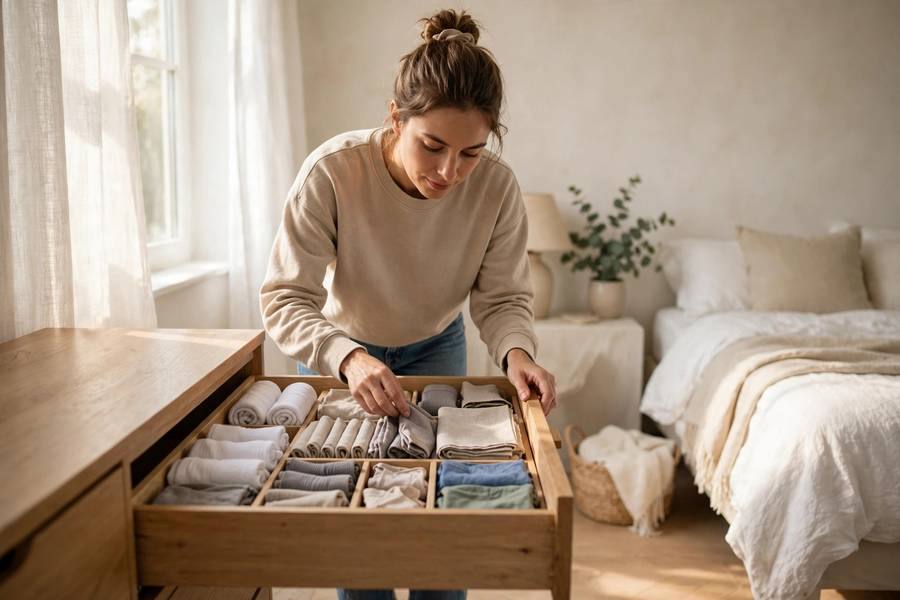
Here’s what nobody tells you about starting minimalism: the dramatic version — trash bags, empty rooms, before-and-after photos — is the worst way to begin. I know because I tried it. I filled six bags in a weekend, felt amazing for three days, then spent the next month rebuying things I’d tossed in a frenzy and feeling like a failure. The second time, I started so small it felt almost silly: one junk drawer, fifteen minutes. That version stuck, and three years later I’m still here.
Starting minimalism isn’t an event; it’s a direction. This guide is the gentle on-ramp: how to begin without overwhelm, without regret, and without turning your home into a construction zone. No trash-bag montages required.
In this guide:
- Start With Mindset, Not Trash Bags
- Week 1: Observe and Prepare
- Weeks 2-3: Easy Wins Only
- Week 4 and Beyond: The Deeper Work
- 5 Rules That Make It Sustainable
- Mistakes Beginners Make
- Your 30-Day Starter Plan
Start With Mindset, Not Trash Bags
Before touching a single object, get clear on your “why.” Minimalism without a reason becomes either a short-lived purge or an aesthetic competition. My why was specific: I wanted mornings that didn’t start with clutter-stress and weekends that weren’t eaten by tidying. Yours might be saving money, reducing anxiety, preparing for a move, or just being tired of managing stuff. Write it down — one sentence — and put it where you’ll see it when motivation dips.
Next, define what minimalism means for you. (If you are unsure, read what minimalism actually means first.) It’s not a number of possessions or a color scheme. For a parent of three, minimalism might mean “every toy has a home and cleanup takes 15 minutes.” For a hobbyist photographer, it means “gear I use, not gear I admire.” Your version is the only version that matters, and defining it upfront protects you from chasing someone else’s Instagram version.
Finally, give yourself permission to go slow. The stuff accumulated over years; it doesn’t have to leave in a weekend. Slow decluttering has a massive hidden advantage: you learn your actual patterns. When you declutter gradually, you notice what you reach for, what you miss, and what you never think about — data that makes every later decision easier and regret-free.
Week 1: Observe and Prepare
Don’t declutter anything yet. Seriously. Week one is reconnaissance. Notice which areas stress you out (that closet you avoid opening), which surfaces collect clutter (the kitchen counter, the entryway), and what you actually use daily. Keep a simple note on your phone: “used today” items versus “haven’t touched in weeks” items. This awareness does half the work before you lift a finger.
Prepare your exit routes: find your nearest donation drop-off and its hours, bookmark the local buy-nothing group, check if any charities do pickups. Set up four bags or boxes: Donate, Sell, Relocate, Trash. Preparation removes the friction that kills momentum — when you decide something goes, it should leave within days, not sit in a “donation corner” for two months.
Do one tiny thing this week to build the muscle: clear a single surface completely — one nightstand, one bathroom counter, one desk corner. Clean it, leave only what belongs there, and live with it for a few days. Notice how it feels. That feeling — calm, clear, easy — is your preview of the whole project. Most people find it addictive.
Weeks 2-3: Easy Wins Only
Now start, but only with the easy stuff. Our how to declutter your house room by room guide has the full room order. Trash and expired items first: old magazines, dead batteries, expired food and medicine, dried-out pens, takeout menus. Zero emotional difficulty, immediate visible progress. Then duplicates: the extra water bottles, the mug army, the tangle of phone chargers for phones you no longer own.
Work in 15-30 minute sessions, one small zone at a time — a drawer, a shelf, half a closet — and how to be more organized has systems for keeping it that way. Set a timer. When it rings, you stop, even if you’re mid-drawer. This sounds overly cautious until you’ve experienced the alternative: the 4-hour marathon that ends with you surrounded by chaos and putting it all back. Small sessions, consistently, beat heroic weekends every time.
After each session, take the Donate bag to your car immediately (next stop: drop-off) and trash the trash. The stuff must leave the building. Clutter in bags by the door is still clutter, and it has a magnetic pull back into closets. Momentum is everything in the early weeks — protect it by finishing each session completely.

Week 4 and Beyond: The Deeper Work
Once the easy wins are done and your decision muscle is warmed up, tackle the medium-hard categories: clothes (the 90/90 rule — unworn in 90 days, unlikely in the next 90, it goes), books and media, kitchen gadgets, and hobby supplies for hobbies you’ve actually quit. Still save sentimental items and the truly hard calls for last.
This is also when you start addressing inflow, not just outflow. Unsubscribe from marketing emails. Delete shopping apps. Institute the 30-day rule for non-essential purchases (write it down; revisit in 30 days; you’ll forget 90% of them). Decluttering without fixing inflow is bailing water with a hole in the boat — you’ll be doing this again next year.
Expect an emotional wave somewhere in here. Letting go of things tied to identities you’re shedding (the career clothes, the “someday” gear) can feel like grief, and that’s normal — you’re not just clearing a closet, you’re updating your self-concept. Be kind to yourself. Keep the truly meaningful representatives. Release the rest with gratitude, not guilt.
5 Rules That Make It Sustainable
1. One in, one out. New item enters, old item leaves. Non-negotiable. This single rule prevents 90% of re-cluttering. 2. The 30-day list. Want something non-essential? Write it down with the date. Revisit in 30 days. Most wants evaporate. 3. The maybe box. Can’t decide? Box it, date it six months out, store it away. Unopened at the deadline? Donate the whole box. 4. The 20/20 rule. If you can replace it for under $20 in under 20 minutes, let it go without agonizing. 5. The container rule. Every category gets a container (one shelf for books, one drawer for gadgets); when it’s full, something must leave before anything enters. Containers make limits physical instead of theoretical.
Mistakes Beginners Make
The purge-and-regret cycle: decluttering in a frenzy, tossing things you actually use, then rebuying them and concluding “minimalism doesn’t work.” The fix is speed limits — slow enough that every decision is deliberate. Decluttering other people’s stuff without permission: your partner’s things, your kids’ things, the shared spaces. Minimalism is a personal practice; evangelizing it at others is how you become the villain of your own home. Lead by example with your own zones.
Buying organizing products before decluttering: bins and baskets for stuff you haven’t decided about yet is just expensive procrastination. Declutter first, then contain what’s left. And chasing the aesthetic: if your minimalism journey involves buying all-new matching beige everything, you’ve been marketed to, not liberated. The goal is less stuff serving your life, not prettier stuff serving your feed.
The comparison trap
Unfollow the extreme minimalists during your first months. Comparing your lived-in family home to someone’s 200-square-foot white box with a single chair is demoralizing and irrelevant. Your minimalism should serve your actual life — kids, hobbies, pets, and all. The only valid comparison is your home last month versus your home today.

Your 30-Day Starter Plan
Here’s the whole thing on one timeline. Days 1-7: observe, define your why, set up donation routes and boxes, clear one surface. Days 8-14: trash and expired items throughout the house, 20 minutes a day. Days 15-21: duplicates and easy categories — mugs, water bottles, chargers, old magazines. Days 22-30: one medium category (clothes or books or kitchen gadgets), plus start the inflow rules (unsubscribe, 30-day list, delete shopping apps).
That’s it. Thirty days, maybe 10 total hours, and you’ll have visible results, working systems, and — most importantly — proof that you can do this without drama. From there, continue one category at a time at whatever pace feels sustainable. There’s no finish line and no deadline. There’s just the direction: less, but better.
You don’t need to throw everything away. You don’t need to count your possessions or paint your walls white. You just need to start — one drawer, fifteen minutes, today. The calm on the other side is worth every small step it takes to get there. Tight on space? Start with how to organize a small apartment.
Start with mindset: define your personal ‘why’ and what minimalism means for your life. Then spend week one observing and preparing (donation routes, boxes). Begin decluttering with easy wins only — trash, expired items, duplicates — in short 15-30 minute sessions. Save hard categories and sentimental items for later when your decision muscle is stronger.
Clear a single surface completely (one nightstand or counter) and live with it for a few days — the calm feeling motivates everything else. Then work through trash/expired items, then duplicates, in short timed sessions. Always remove donations and trash from the house the same day so momentum doesn’t stall.
There’s no finish line — it’s a direction, not a destination. A noticeable shift takes about 30 days of consistent small sessions (roughly 10 total hours). Deeper decluttering of a whole home typically takes 2-6 months at a sustainable pace. Anyone promising a weekend transformation is selling something.
No — that’s the fastest path to regret and rebuying. Minimalism isn’t about owning as little as possible; it’s about everything you own earning its place. Keep what you use, love, or genuinely need. The goal is intentional ownership, not empty rooms.
The essentials: one-in-one-out for purchases, a 30-day waiting list for non-essential wants, the maybe box for hard decisions (unopened in 6 months = donate), the 20/20 rule (replaceable cheaply and quickly = let it go), and fixing inflow (unsubscribe, delete shopping apps) alongside outflow.