How to Play Go Fish Card Game: Rules for Kids & Adults

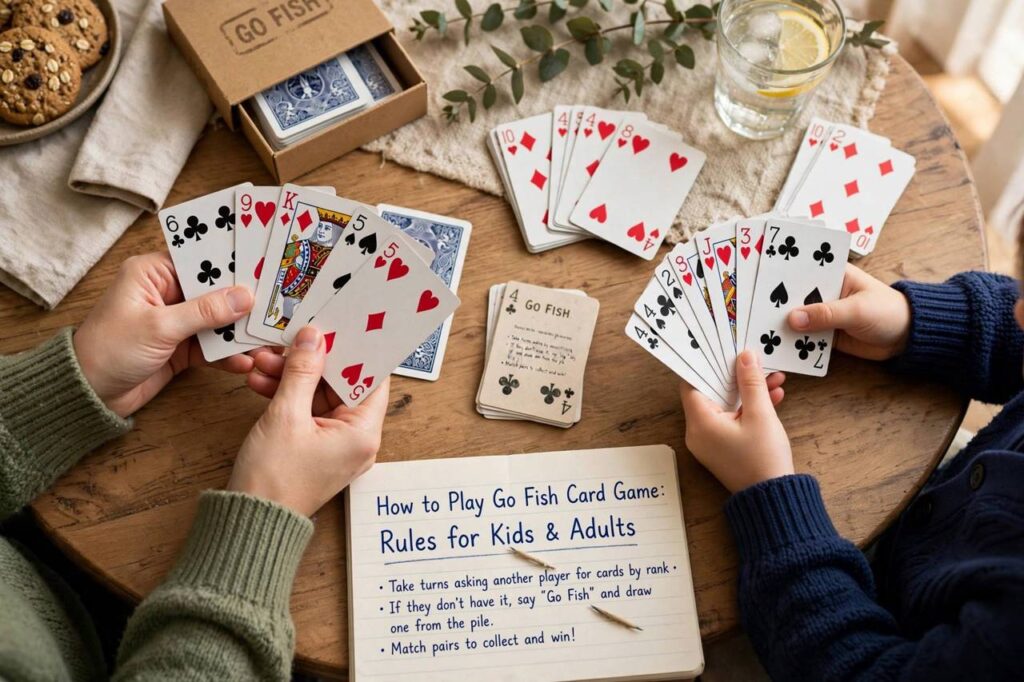
Go Fish might be the first card game most of us ever learned — and there is a reason it survives every generation of new games. It takes two minutes to teach, needs nothing but a standard deck, and works for a five-year-old and a grandparent at the same table. If you need a refresher on how to play go fish card game rules, whether for family game night, a classroom, or a rainy afternoon with the kids, this guide covers the official setup, turn structure, winning conditions, and the little strategy that separates casual players from sharks. Plus a few fun variations to try once the classic gets comfortable.
What You Need to Play
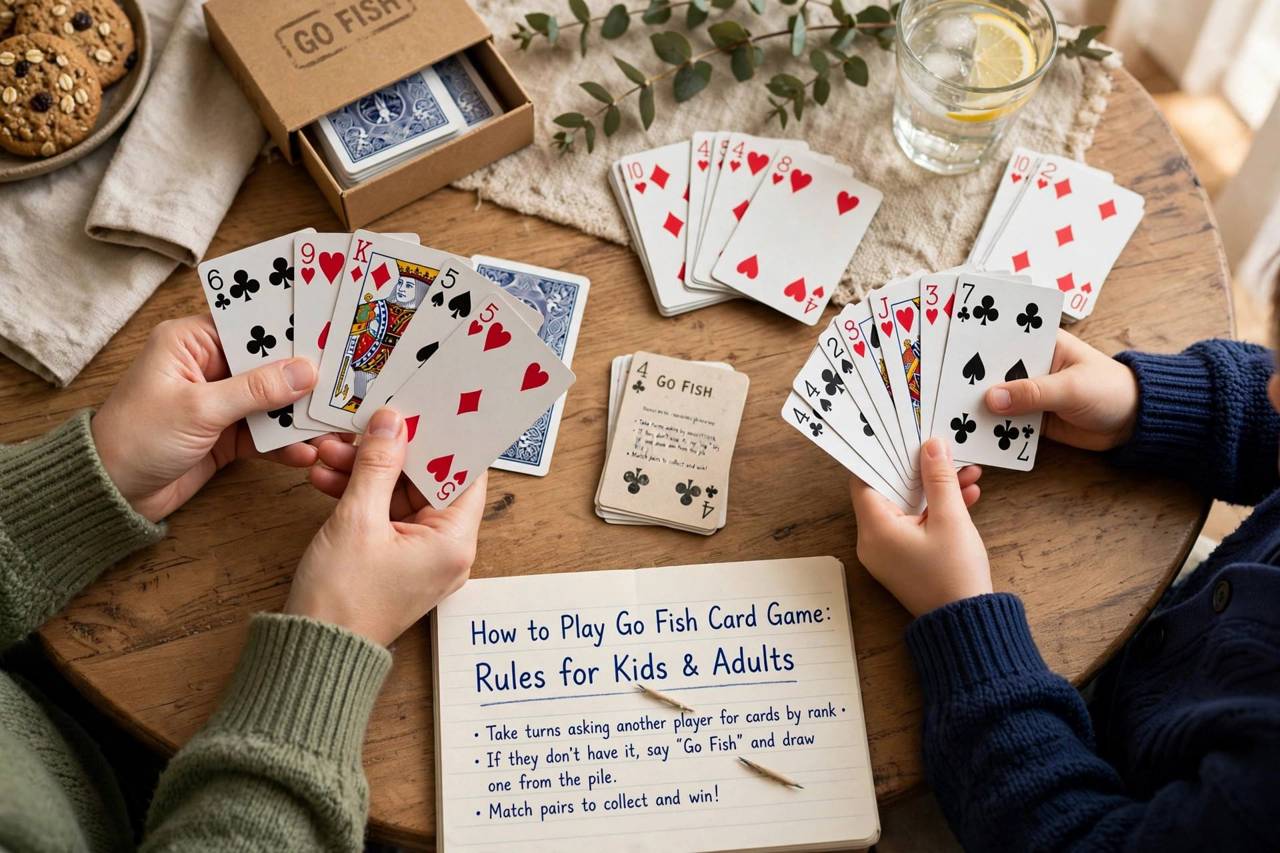
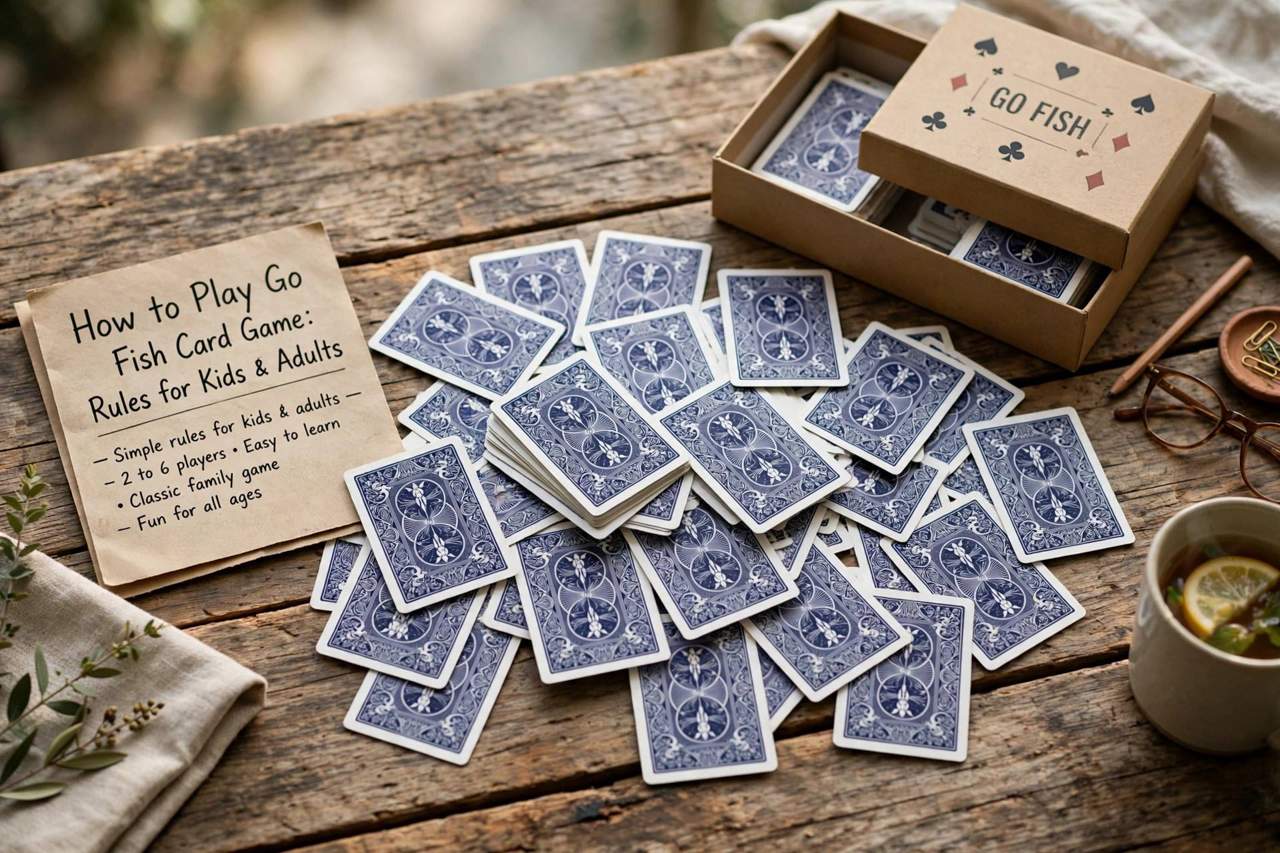
One standard 52-card deck — jokers removed — and two to six players. That is the entire equipment list, which is half the game’s charm. For very young children, you can play with a stripped deck (just a few ranks) to keep things manageable, but the full deck works fine from about age five upward. Seating does not matter much, though with six players the game moves fast and turns come around quickly. No chips, no scorepads, no batteries. Shuffle well, because a poorly shuffled deck clusters ranks together and makes the opening hands swingy.
Setup and Dealing
Choose a dealer — youngest player is the traditional pick. For two or three players, deal seven cards to each; for four or more players, deal five cards each. The undealt cards form a face-down pile in the center: the pond, or as generations of kids call it, the “fish pile.” Players look at their own cards and keep them hidden. Before play begins, check your hand for any complete sets of four cards of the same rank — four kings, four sevens, whatever you hold. Lay any completed sets, called books, face-up in front of you. They are safe and already count toward your final score.
How a Turn Works
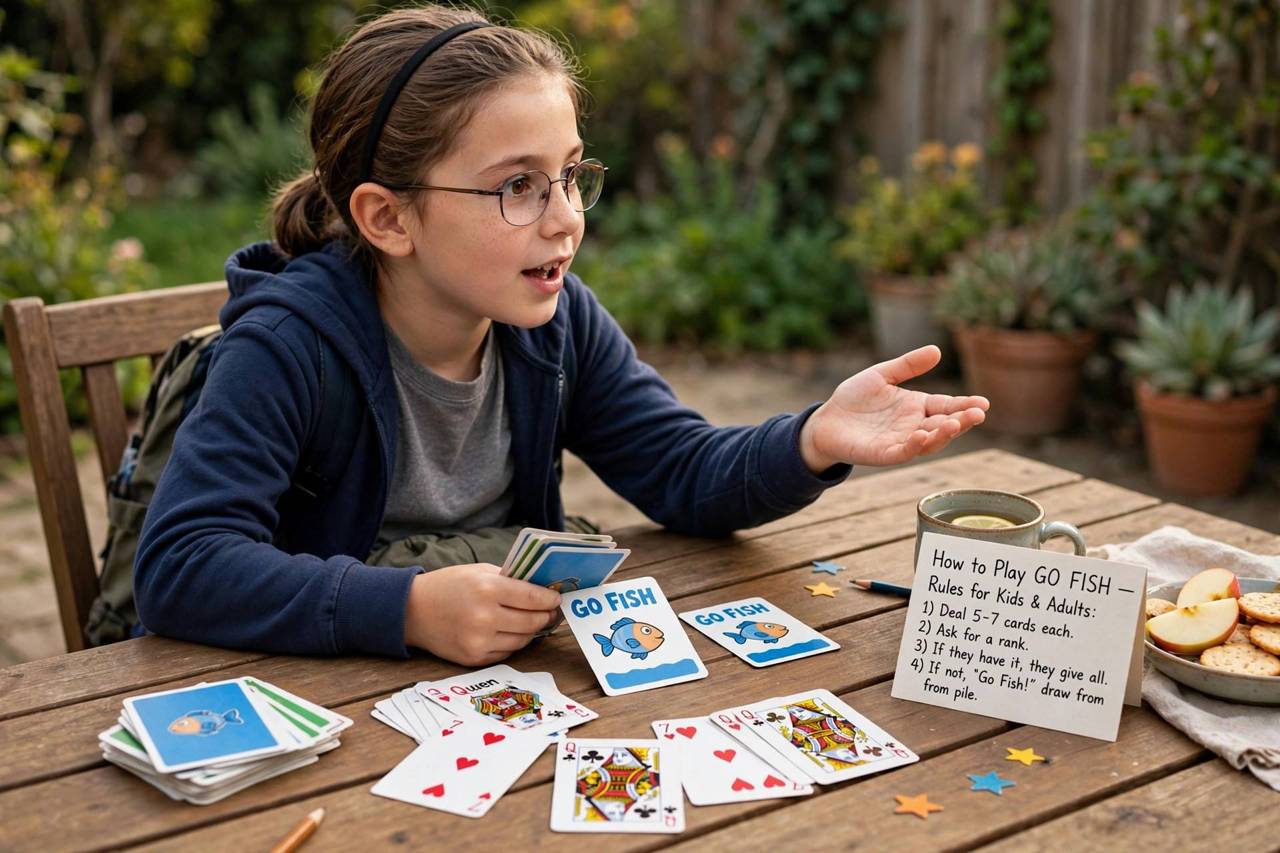
Play moves clockwise from the dealer’s left. On your turn, pick any other player and ask them for all their cards of one specific rank — but only a rank you already hold at least one of. The classic phrasing is “Do you have any queens?” If they do, they must hand over every card of that rank, and you get another turn. Keep asking as long as your requests succeed. If they have none, they say “Go fish!” and you draw the top card from the pond. If the drawn card matches the rank you asked for, tradition says you announce your luck and take another turn; otherwise play passes to the next player. When you collect all four of a rank at any point, lay the book down immediately. The round ends when all thirteen books are claimed or the pond runs out.
Winning the Game
Count your books when play ends. The player with the most complete sets of four wins — simple as that. Ties are common and perfectly fine; shared victory beats a rematch argument at the kids’ table. Note the pond-exhaustion rule carefully: if the pond runs out of cards, players keep taking turns asking each other until someone cannot ask (holding no cards means you are out of asking, though your books still count). Some house rules end the game the moment the pond empties; agree on your version before dealing to avoid the traditional end-of-game debate.
Actual Strategy (Yes, Really)
Go Fish looks like pure luck, but attentive players win more. First, memory is everything: track which ranks each player asked for, because a failed request tells you what they hold. If Maya asked for kings twice, she has at least one king — ask her for kings when it is your turn. Second, ask for ranks you hold multiples of, since each successful request can cascade into a book. Third, pay attention to the pond: cards drawn from it are unknown to everyone, so late-game pond draws are lottery tickets. Fourth, with two players, the game becomes a genuine memory duel — concentrate. None of this guarantees victory, but it turns a kids’ pastime into a respectably sharp little game.
Rules for Young Kids
For players under six, simplify without losing the fun. Deal five cards regardless of player count, and consider playing with pairs instead of books of four — completing a pair feels achievable and keeps the game moving. Let kids hold their cards openly or use a card holder; the secrecy matters less than the asking. Be generous with reminders about whose turn it is and what they can ask for. Most importantly, model good sportsmanship: say “go fish” cheerfully when you miss, and congratulate the winner. The goal at this age is not mastery but the social ritual — taking turns, asking politely, handling disappointment. Go Fish teaches all of it beautifully.
Fun Variations to Try
Once the classic is second nature, mix it up. In Happy Families, use the same asking mechanic with themed quartets from a dedicated deck. In Authors, a traditional variant, books are sets of four related cards like famous writers. For a faster game, play to a fixed number of books instead of all thirteen. For a spicier game, add a rule: when you complete a book from pond draws alone, it counts double — this makes late-game fishing genuinely exciting. Some families play that a successful “go fish” draw matching your request earns a bonus turn even mid-cascade, extending lucky streaks. House rules are part of the tradition; just agree on them before the first deal.
Go Fish Etiquette and Table Manners
A few unwritten rules keep the game pleasant. Ask clearly and give the other player a moment — no rapid-fire interrogations. Do not lie about what you hold; the game depends on honest answers. Keep your books visible so everyone can track the score. And when a young player struggles, offer a hint rather than exploiting their confusion — the sharks can wait for the adults’ table. Knowing how to play go fish card game properly means knowing both the rules and the spirit: it is a social game first, a competition second. Play it that way and it earns its place at every family gathering for the next fifty years.
How to Play Go Fish Card Game: The 60-Second Rules Card
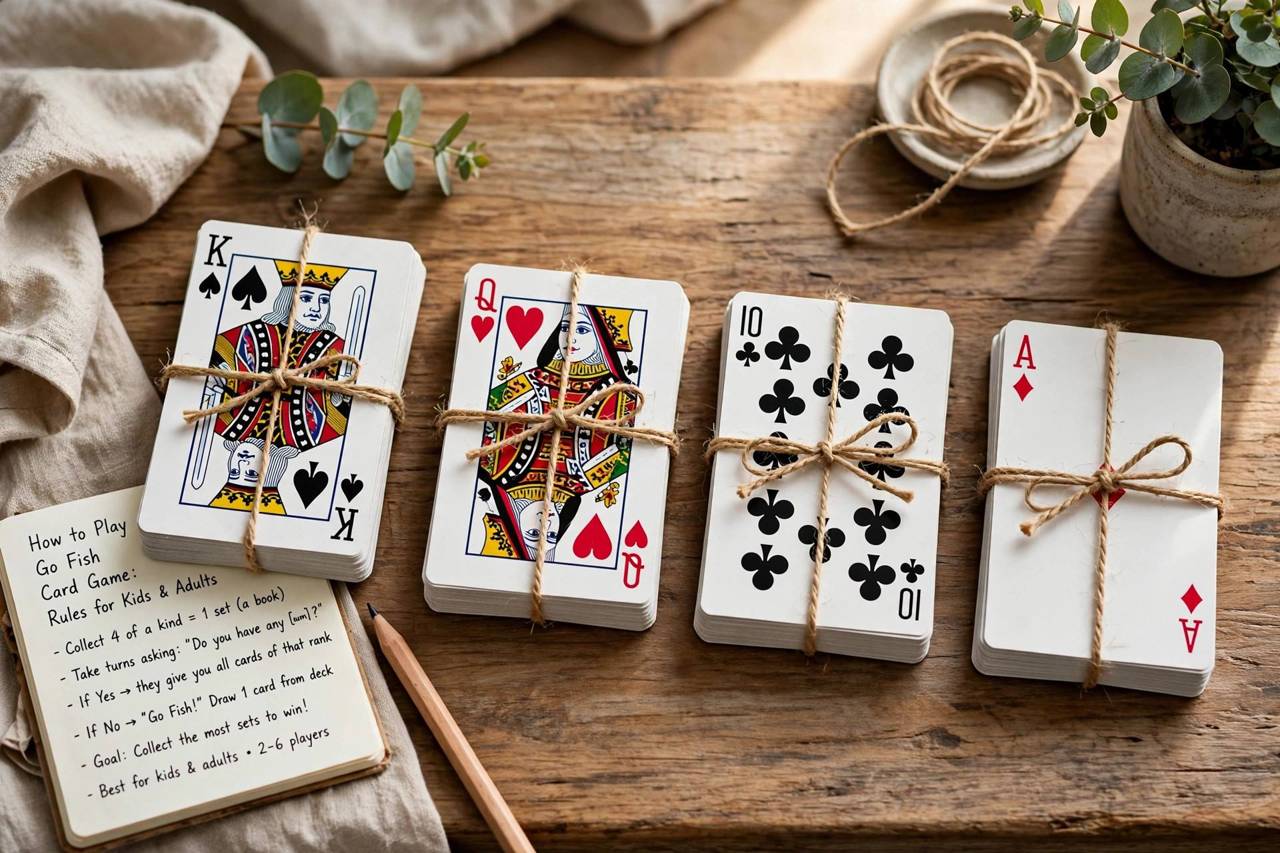
New players? Read this aloud and start dealing. Goal: collect the most sets of four matching cards (books). Deal: seven cards each for 2 to 3 players, five each for 4 to 6 players; rest is the pond. On your turn: ask one player for all their cards of a rank you hold (“Any sevens?”). If they have them, they hand them over and you ask again. If not, they say “Go fish” — draw from the pond; a matching draw earns another turn. Lay down completed fours immediately. The game ends when all thirteen books are claimed or the pond is empty; most books wins. That is the entire game. Everything else — strategy, variants, etiquette — is refinement. Tape this to the inside of the card box and you will never need to look up the rules again.
Go Fish Variants From Around the World
The asking mechanic is older and more widespread than most players realize. Happy Families, the classic British children’s game, uses the same ask-and-collect structure with illustrated family quartets instead of standard ranks — many British adults learned card play through it. Authors, popular in nineteenth-century America, asked for books by famous writers, doubling as a literature lesson. In some European traditions the game is played with pairs instead of fours for speed. Modern commercial versions add special-action cards that let you peek at hands or steal books. The mechanic even appears in digital card games for children. Whatever the dressing, the core loop — ask, remember, collect — is one of the oldest and most durable in all of card gaming.
Teaching Go Fish: A Parent’s Playbook
Go Fish is many children’s first strategy game, and how you teach it shapes their relationship with games. Start by playing open-handed for the first round or two — everyone sees everyone’s cards — so the child learns the asking mechanic without the memory burden. Narrate your own thinking aloud: “I’m asking Dad for threes because I have two threes and want a book.” Celebrate good asks, not just wins. When they lose — and they will — model graceful losing explicitly: “Good game! You almost had me with those kings.” Keep sessions short; twenty minutes of fun beats forty minutes ending in tears. As they improve, add the memory layer gradually: “Remember, Grandma asked for queens earlier…” Within a few sessions you will have a genuine opponent, and the pride on their face when they beat you fairly is worth every thrown game along the way.
Go Fish in the Classroom
Teachers have used Go Fish as a learning tool for generations, and it works beautifully. The game drills number and rank recognition for young learners without feeling like a worksheet. Memory and attention get a real workout as children track who asked for what. Turn-taking and graceful losing are social skills the classroom needs daily. Language teachers adapt it brilliantly: asking “Do you have…?” practices question formation, and themed decks can drill vocabulary — animals, colors, numbers in a second language. The game scales from kindergarten to adult ESL classes with simple adjustments. Few teaching tools cost nothing, take two minutes to explain, and hold attention like this one does.
Frequently Asked Questions
How many cards do you deal in Go Fish?
Deal seven cards each for two or three players, and five cards each for four to six players. The remaining cards form the face-down pond in the center.
What do you say when someone asks for a card you don’t have?
Say “Go fish!” The asking player then draws the top card from the pond. If it matches the rank they asked for, they typically get another turn.
How do you win Go Fish?
The player with the most completed books — sets of four cards of the same rank — wins when all thirteen books are claimed or the pond runs out.
Can you ask for a rank you don’t have?
No. Standard rules require you to hold at least one card of the rank you are asking for. This is the rule most often forgotten by beginners.
What age is Go Fish good for?
Around age five and up for the standard game. Younger children can play simplified versions with fewer cards or pairs instead of four-of-a-kind books.