How to Declutter Your Home Room by Room: The Order-of-Attack Plan


Learning how to declutter your home room by room sounds straightforward until you are standing in the middle of a chaotic living room with no idea where to start — so you start everywhere, finish nowhere, and end the day more overwhelmed than you began. I have been there, and I have guided many households out of it. The secret is not motivation or better storage bins. It is sequence: which room first, what decision framework to use in each room, and a ruthless rule for what leaves the house. This plan gives you all three.
We will cover the order-of-attack framework (the single most important decision), a practical walkthrough of each room, the 2-week sell/donate rule that prevents the dreaded “donate pile in the hallway for six months,” and how to keep it from creeping back.
How to Declutter Your Home Room by Room: The Order of Attack
Where you start determines whether you finish. The framework: start with the room that bothers you most when you walk in the door — usually the living room or kitchen — because early visible wins fuel the rest of the project. Then proceed in order of daily impact: kitchen, bedroom, bathroom, home office, closets, storage areas last. Save sentimental spaces (attics, memory boxes, kids’ keepsakes) for the very end, when your decision muscles are strongest.
There are two schools of thought on sequencing — visible-first (momentum) versus easiest-first (confidence). I recommend visible-first for most people, because decluttering runs on emotional fuel and a transformed living room refuels you daily. The exception: if you are deeply overwhelmed, start with one small easy win (a single drawer, the bathroom cabinet) to prove to yourself the system works, then move to the high-impact rooms.
Time-box each room: one room per session, 2–3 hours maximum. Marathon decluttering sessions produce worse decisions as fatigue sets in — the “keep everything” impulse grows with tiredness. Better three sharp sessions than one exhausted weekend.

The 4-Box Method: Your Decision Framework
Every item in every room gets one of four verdicts. Set out four containers (bags, boxes, laundry baskets — whatever you have) labeled: Keep (stays, and gets a designated home), Donate/Sell (leaves the house via charity or sale), Relocate (belongs in a different room — no wandering the house putting things away mid-session), and Trash/Recycle (broken, expired, genuinely useless).
The decision questions, in order: Have I used this in the past year? Would I buy it again today? Does it work, and do I have the parts? Am I keeping it from guilt or obligation? (Gifts you hate are the classic guilt-keep — the giver’s feelings were honored when you received it; keeping it in a drawer honors no one.) If an item survives all four questions, it earns its place. Everything else leaves.
One hard rule: the Keep box must fit the storage you actually have. If the keeps overflow the closet, the closet is telling you the truth about how much you can keep — edit further. Decluttering without addressing storage capacity just rearranges the clutter.
Room-by-Room Walkthrough
Kitchen: Start with duplicates — the third spatula, the novelty mugs, the plastic containers without lids (match lids to bases ruthlessly; lidless orphans go). Expired pantry items and fossilized spices next. Small appliances you have not used in a year are prime donate candidates; they are bulky and someone else will actually use them.
Bedroom: The closet is its own project (see below). Beyond clothes: nightstand archaeology (chargers for dead phones, dried-up pens), under-bed storage (be honest about what lives there), and books — keep the ones you will reread or reference, release the rest. Bathroom: Expired medications (return to pharmacy take-back programs), ancient cosmetics, the product graveyard under the sink. Bathrooms declutter fast and the win feels great.
Living room: Media you will never revisit, decor that no longer suits you, the cable-and-remote tangle (label what remains), magazines and catalogs. Home office: Paper is the enemy — which leads directly to the documents question. (If paperwork is your mountain, this guide to getting organized pairs well with this room.) Closets: clothes follow the same 4-box logic — and if your wardrobe needs a full rebuild afterward, a dedicated closet declutter goes deeper. Garage/storage: last, because it is where deferred decisions go to live. Apply the same framework; “I might need it someday” is not a decision, it is a postponement.

The 2-Week Sell/Donate Rule
Here is where most decluttering projects die: the bags sit by the door for months, slowly migrating back into closets. The rule is simple and non-negotiable: everything designated to leave must leave within two weeks. Donations go to the charity shop on a scheduled day (put it in your calendar during the decluttering session). Sale items get listed within 48 hours with a 2-week deadline — whatever has not sold in two weeks gets donated. No extensions.
For selling, be realistic about value versus effort. High-value items (electronics, designer goods, furniture) justify listing individually. The box of miscellaneous kitchen gadgets does not — donate it and reclaim the hours. Price to move: the goal is the item gone, not maximum extraction. Every week a sale item sits in your hallway, it is still clutter — just clutter with a price tag.
Photograph donations for tax records if your jurisdiction allows deductions, get receipts, and enjoy the empty space. The first time you open a closet and see air instead of avalanche-risk, you will understand what the whole project was for.
Keeping It That Way: Maintenance Systems
Decluttering is an event; staying decluttered is a system. One-in-one-out: a new item enters only when an old one leaves — the single most effective maintenance rule ever devised. The 10-minute reset: every evening, return things to their designated homes. Clutter is just delayed decisions; the reset prevents the delay from compounding. Seasonal sweeps: twice a year, walk each room with fresh eyes and a donation bag. The shopping pause: before buying non-essentials, wait 48 hours. Most “wants” evaporate; the ones that survive are worth having.
And designate homes for everything you kept. “Where does this live?” must have an answer for every kept item — items without homes become clutter regardless of how much you love them. The goal was never minimalism for its own sake; it is a home where everything you own has a place and everything in its place earns its keep.
Decluttering With Other People in the House
The system works beautifully solo; with family or roommates, it needs diplomacy. The cardinal rule: never declutter someone else’s belongings without permission. Not your partner’s, not your teenager’s, not your roommate’s. It breeds resentment and it does not stick — people reclaim or rebuy what was taken. Instead, declutter your own things visibly and thoroughly; the example is more persuasive than any argument, and shared spaces (kitchen, living room, bathroom) are fair game for joint sessions.
For kids, make it collaborative and age-appropriate: the 4-box method works for children too, and letting them choose what to donate builds generosity rather than resentment. Frame it positively — “let’s make room for the things you love most” beats “we’re getting rid of your stuff.” For reluctant partners, start with your own spaces and the shared areas, and let the results do the talking. Most converts are made by living in a decluttered home, not by being lectured about one.
The Psychology: Why Clutter Stresses Us Out
This is not just aesthetics. Research consistently links cluttered environments to higher cortisol levels, reduced focus, and a persistent low-grade sense of overwhelm — your brain processes every visible item as unfinished business. Decluttering works because it reduces the number of micro-decisions your environment demands: fewer things to navigate, clean around, and mentally track.
Understanding this helps on the hard days. When you are stuck on whether to keep something, ask not “might I need this?” but “is this worth the mental rent it charges?” Everything you own occupies a small piece of your attention. A decluttered home is not empty — it is a home where everything present has paid its rent. That reframe turns the 4-box method from a chore into an act of self-respect.
What to Do With the Hardest Category: Papers and Memorabilia
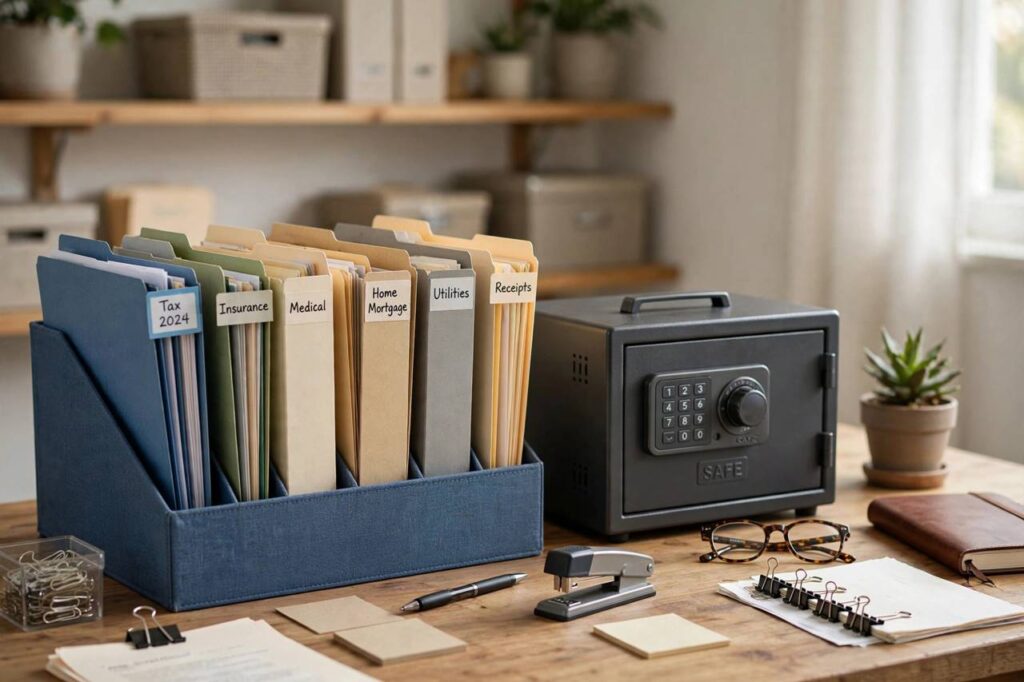
Two categories defeat more declutterers than any other. Papers: the mail pile, the old bills, the warranties for dead appliances. Rule: if it is available online (bank statements, bills, manuals), shred the paper. If it is tax-related, scan and file digitally. What remains is usually one small box — manageable. Memorabilia: do it last, do it once, and curate rather than keep: one memory box per person, best items only, photographed rest. The goal is a collection you actually open, not storage you pay rent on.
FAQ
Which room should I declutter first?
The room that bothers you most when you walk in — usually the living room or kitchen. Visible wins build momentum for the rest of the project. Save sentimental areas for last.
How long does it take to declutter a whole house?
Most households need 4–8 weekends at 2–3 hours per session. Time-box sessions to avoid decision fatigue; marathon sessions produce worse keep-or-toss decisions.
What is the 2-week sell/donate rule?
Everything designated to leave must exit within two weeks — donations dropped off on a scheduled day, sale items listed within 48 hours and donated if unsold after two weeks. No extensions.
How do I declutter sentimental items?
Do them last, when your decision skills are sharpest. Keep the best representative pieces (not every item), photograph the rest before letting go, and remember that the memory lives in you, not the object.
Should I sell or donate decluttered items?
Sell high-value items individually; donate everything else. Price sale items to move with a 2-week deadline — the goal is the item gone, not maximum profit.
How do I stop clutter from coming back?
One-in-one-out for new purchases, a 10-minute nightly reset, seasonal sweeps, and a 48-hour pause before non-essential buying. Maintenance is a system, not willpower.
Conclusion
Declutter room by room in order of impact, decide with the 4-box method, and enforce the 2-week exit rule without mercy. The project is finite — a few focused weekends — but the result compounds daily: less cleaning, less searching, less mental noise. Start with the room that bothers you most, and do not stop until every kept item has a home.