How to Stop Procrastinating on Chores: The Systems Approach

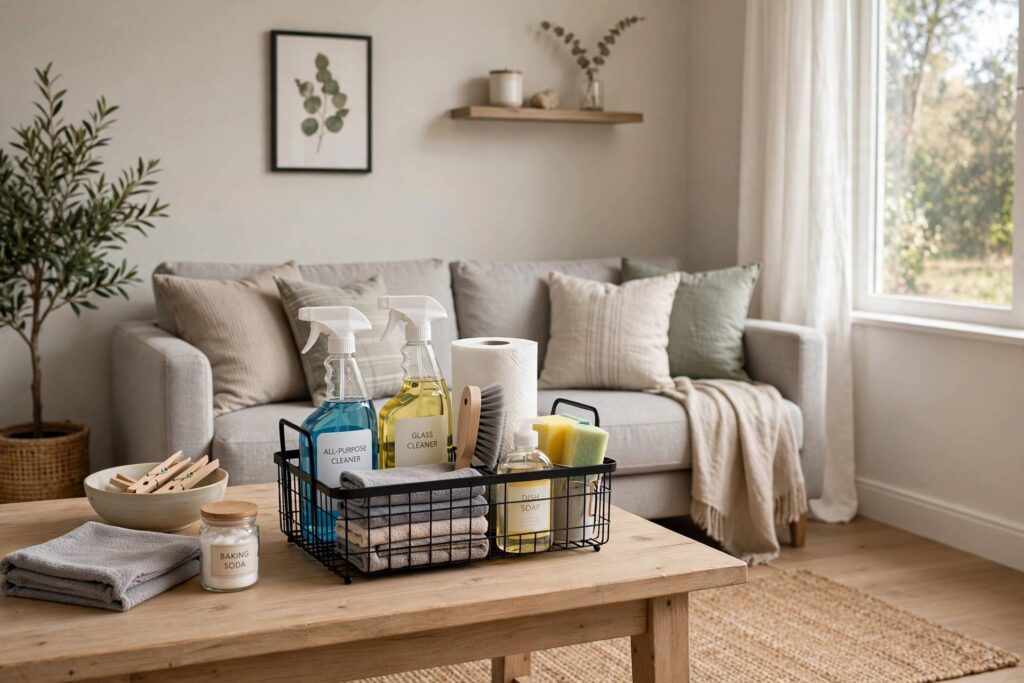
Here is what I finally accepted after years of staring at laundry piles: how to stop procrastinating on chores is not a motivation problem. It is a systems problem. I tried motivation — the pep talks, the guilt, the Sunday-night panic — and the chores always won. What actually worked was embarrassingly unglamorous: I stopped trying to feel like doing housework and built a setup where the chores mostly did themselves, or at least stopped requiring a heroic act of will. If your house is messy because your brain will not cooperate, this is the systems approach that fixed mine.
The core insight: procrastination is not laziness. It is your brain doing cost-benefit math and finding the chore expensive — in effort, in time, in unpleasantness — with the reward too distant to matter. Willpower tries to override that math. Systems change the math. Every strategy below either shrinks the perceived cost of starting, makes the reward immediate, or removes the decision entirely. That is the whole game.
How to Stop Procrastinating on Chores: The 10-Minute Rule
The hardest part of any chore is the first ninety seconds. Your brain looks at “clean the kitchen” and sees an unbounded, miserable project — so it vetoes the whole thing. The 10-minute rule hacks this: commit to just ten minutes. Set a timer. You can stop when it rings.
Here is why it works: starting is the expensive part, continuing is cheap. Once you are wiping counters with momentum, stopping at ten minutes feels sillier than finishing. I would estimate I continue past the timer eight times out of ten — and on the days I stop at ten, the kitchen is still ten minutes cleaner, which compounds. The rule also reframes the chore honestly: “ten minutes of dishes” is a true statement in a way “do the dishes” somehow is not. Your brain trusts specific, bounded commitments and distrusts vague, infinite ones.
Variations that work the same way: the one-song rule (clean for the length of one song — music also makes the time feel shorter), the commercial-break sprint (one chore per ad break, if you still watch live TV), and the single-surface rule (just the stove, just the bathroom mirror — small wins that snowball).

Task Batching: Stop Paying the Switching Tax
Every time you switch tasks, your brain pays a restart cost — gathering supplies, remembering where you left off, rebuilding momentum. Doing laundry, then dishes, then vacuuming, then back to laundry folds three restart costs into one afternoon. Batching groups similar chores so you pay the setup cost once.
In practice: do all the laundry start-to-finish in one block (sort, wash, dry, fold, put away — the put-away is where laundry actually dies, so do not separate it). Clean all the bathrooms in one pass, carrying the caddy room to room. Do all the floors at once. The principle: one setup, one teardown, one mental context. I batch laundry on one morning and bathrooms on another, and each takes roughly half the wall-clock time it used to take scattered across the week — because scattered chores were mostly restart costs wearing a chore costume.
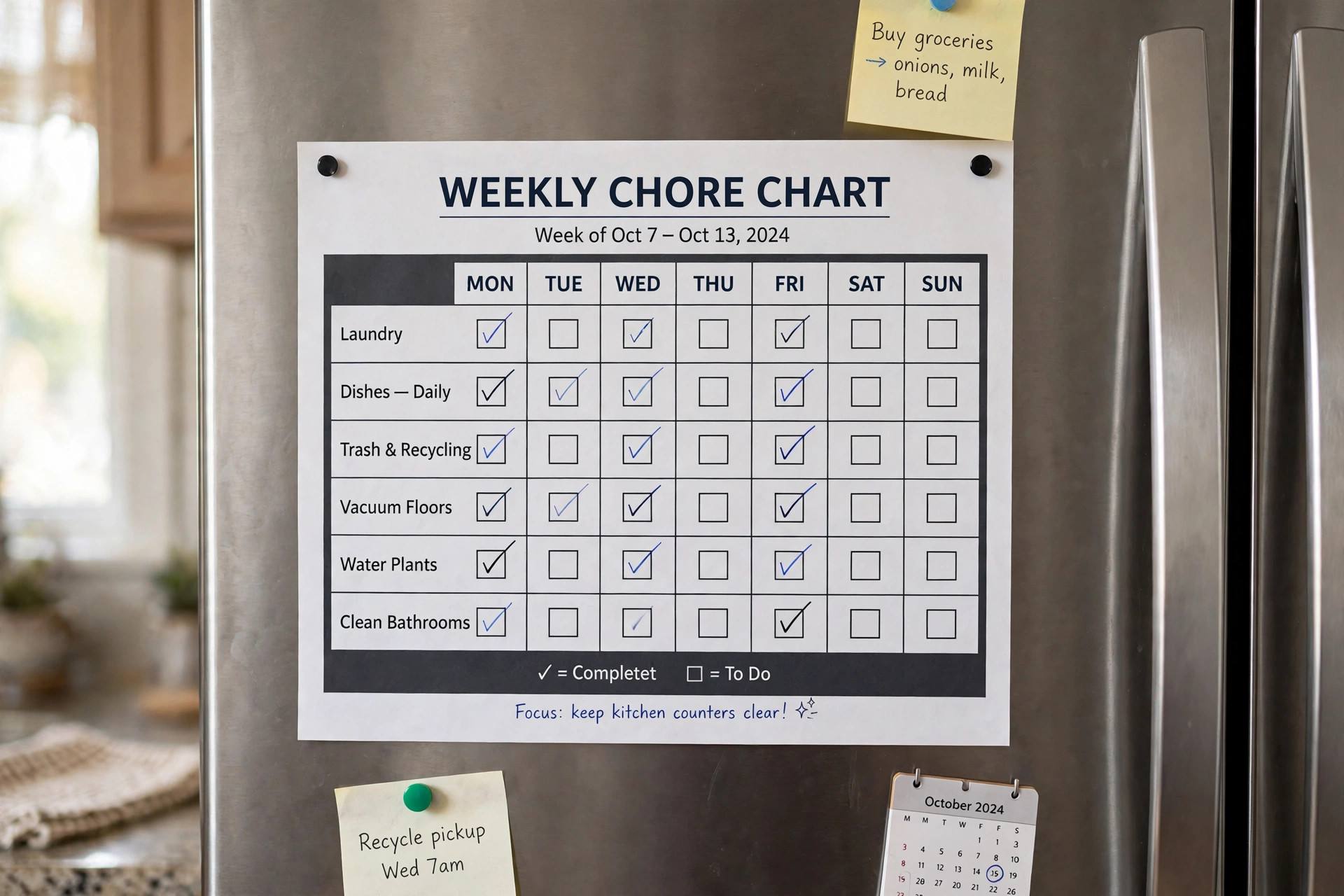
Batching also enables theme days, which sound rigid but feel freeing: Monday is laundry, Wednesday is bathrooms and floors, Friday is the kitchen deep-clean. The magic of theme days is not efficiency — it is the elimination of the daily decision. You never stand around wondering what needs doing. It is Wednesday. It is bathrooms. The decision was made once, months ago, and now you just execute.
Habit Stacking: Attach Chores to Things You Already Do
Willpower is unreliable; existing habits are not. Habit stacking attaches a small chore to a habit you never skip, using the formula: “After [existing habit], I will [tiny chore].”
My stack, built over months: after I start the coffee maker, I unload the dishwasher (the timing matches almost exactly). After I brush my teeth at night, I wipe the bathroom sink. While dinner reheats in the microwave, I clear the table. After I get into bed, I set out tomorrow’s clothes — which makes mornings smoother, which makes everything smoother. None of these required motivation. They required association: the coffee maker became the dishwasher cue, and now unloading happens on autopilot.
The rules for stacks that stick: keep the chore tiny (under two minutes — stacks fail when the attached chore is secretly a project), stack onto rock-solid habits (not aspirational ones), and add one stack at a time (let it become automatic over two to three weeks before adding the next). Five tiny stacked chores quietly handle a shocking percentage of daily housework.
Lower the Bar Until Starting Is Easy
Perfectionism is procrastination in a fancy coat. “I can’t just wipe the counters, I need to deep-clean the whole kitchen” is how counters stay dirty for a week. Give yourself explicit permission for good-enough versions: the bed made sloppily still beats unmade. Dishes in the dishwasher still beat dishes in the sink, even if the counters are not wiped. Laundry folded into rough piles still beats the clean-clothes chair.
Related: reduce the chore’s existence. Fewer decorative pillows to arrange. Fewer gadgets on the counter to wipe around. A laundry basket in every room where clothes actually get dropped. Every object you own is a tiny future chore — curating ruthlessly is procrastination prevention at the source. I am not a minimalist, but every item I removed from my counters made wiping them down ten seconds faster, and ten seconds is the difference between “I’ll do it now” and “later.”
And make supplies stupidly accessible. Cleaning supplies live where the cleaning happens — bathroom cleaner in the bathroom, not under the kitchen sink. A vacuum on each floor if you have stairs. Friction is the enemy: every thirty-second supply hunt is a chance for your brain to renegotiate the whole chore.
The Weekly Reset: Your Safety Net
Even with systems, life happens. The weekly reset — one focused hour, same time each week — catches everything the daily systems missed and prevents the slow slide into overwhelming mess. Mine is Sunday morning: laundry folded and put away, fridge cleared of science experiments, surfaces reset, floors vacuumed, bathrooms speed-cleaned. One hour, timer on, music up.
The reset works because it caps the downside. Knowing Sunday exists takes the pressure off the weekdays — a missed day is not a failure, it is just something Sunday handles. And an hour of reset prevents the five-hour disaster-clean that procrastination eventually demands. It is the cheapest insurance in housekeeping. If you are building broader structure around this, creating a daily routine that the reset plugs into makes the whole system nearly self-running.
Getting the Whole Household on Board
Systems work best when they are not a solo project. The mistake is presenting the system as rules; the move is presenting it as relief. Nobody resists “I figured out how we can all do less housework arguing” — they resist chore charts that feel like management. Assign ownership, not tasks: one person owns laundry end-to-end, another owns the kitchen — ownership creates pride where task lists create resentment. Rotate the hated jobs quarterly so nobody feels stuck. Make the standard visible: “clean enough that the Sunday reset takes an hour” is a concrete bar everyone can aim at; “keep it tidy” is a fight waiting to happen. Kids and chores: start earlier than feels necessary with tiny, real contributions (a four-year-old can sort socks; a seven-year-old can own a bathroom mirror), and tie the habit to the routine, not to rewards — allowance-for-chores teaches that housework is optional paid labor, when the actual lesson is that everyone contributes to the shared home. The goal is a household where the system runs on shared habit, not on one person’s nagging — because the nagging is the part that actually burns people out, not the dishes.
The weekly family reset: twenty minutes, everyone, same time — set a timer, put on music, and blitz the house together. It is faster than one person’s hour, it teaches kids the systems by immersion, and it ends with the shared satisfaction of a reset house. Some families make it genuinely fun; all of them make it faster. The timer is the secret — finite effort, visible finish line, no martyrdom.
Frequently Asked Questions
Why do I procrastinate on chores even when I know I should do them?
Because your brain weighs immediate effort against distant reward and the effort wins. It is not a character flaw — it is cost-benefit math. Systems (10-minute rule, batching, habit stacking) change the math instead of fighting it with willpower.
What is the 10-minute rule for chores?
Commit to just ten minutes of a chore with a timer, giving yourself full permission to stop when it rings. Starting is the hardest part; once you begin, continuing is usually easier than stopping. Even when you stop, you are ten minutes ahead.
How do I motivate myself to clean when I am tired?
Do not rely on motivation — lower the bar instead. Permit good-enough versions (dishes in the dishwasher counts), use habit stacks that run on autopilot, and save demanding chores for your higher-energy hours. Tired brains need smaller commitments, not bigger pep talks.
Should I do chores daily or batch them weekly?
Both: tiny daily maintenance via habit stacking (dishes, surfaces, tidying) plus batched weekly sessions for bigger jobs (laundry, bathrooms, floors) plus a weekly reset hour as your safety net. Daily-only burns you out; weekly-only lets mess accumulate past the painful point.
How do I stop chores from piling up?
Attack the pile-up mechanisms: put-away steps (finish laundry completely), accessible supplies (no friction), fewer objects (less to maintain), and a weekly reset that caps how far things can slide. Piles are a systems failure, not a motivation failure.
The Bottom Line
How to stop procrastinating on chores: quit negotiating with motivation and build systems instead — the 10-minute rule to start, batching to avoid restart costs, habit stacking for autopilot maintenance, lower bars for tired days, and a weekly reset as your safety net. The goal was never a perfect house. It was a house that stays livable without heroics. That is entirely achievable — I am the proof, and my laundry pile used to have its own weather system.