How to Get Blog Traffic Without Social Media: 4 Channels That Work


I quit posting on social media for my blog two years ago, and my traffic went up. That sounds like a contrarian headline, but it is simply what happened when I stopped spending ten hours a week on platforms I didn’t own and redirected that time into channels that compound. If you want to know how to get blog traffic without social media, the answer is not one secret tactic. It is four unglamorous channels, worked consistently for ninety days.
Social media traffic is rented. An algorithm change can cut it in half overnight, and I have watched it happen to friends. The channels below are owned or durable: search traffic, Pinterest, email, and other people’s audiences. None of them require you to dance on camera or post daily. Let’s go through each one honestly, including what it costs in time.
How to Get Blog Traffic Without Social Media: SEO Content Clusters
Search engine optimization is the closest thing blogging has to a flywheel. You publish an article targeting a specific question, it ranks, and it sends you traffic every day for years with no further effort. My oldest SEO articles still bring in thousands of visits a month from work I did once.
The beginner-friendly version of SEO is simple: find questions people actually search for, answer them better than the current results, and publish consistently. Use free tools to check search volume and look at what ranks. Your advantage as a small blogger is specificity. Big sites target broad keywords; you can own narrow questions they ignore.
Start with informational content in your niche, ten to twenty articles answering specific questions. Make each one genuinely the best answer available: clear structure, real examples, no fluff. Internal linking between your articles helps search engines understand your site. This is slow for the first two months and then it bends upward. If you are starting from zero, read how to start a blog first to get the technical foundation right, because SEO on a broken setup is wasted effort.
Channel 2: Pinterest (A Search Engine, Not Social Media)
Pinterest looks like social media but behaves like a search engine, which is why it belongs on this list. Pins rank in Pinterest search for months and years, and each pin links directly to your article. I treat Pinterest as visual SEO, not as a social platform: no commenting, no following strategies, just searchable pins pointing at good content.
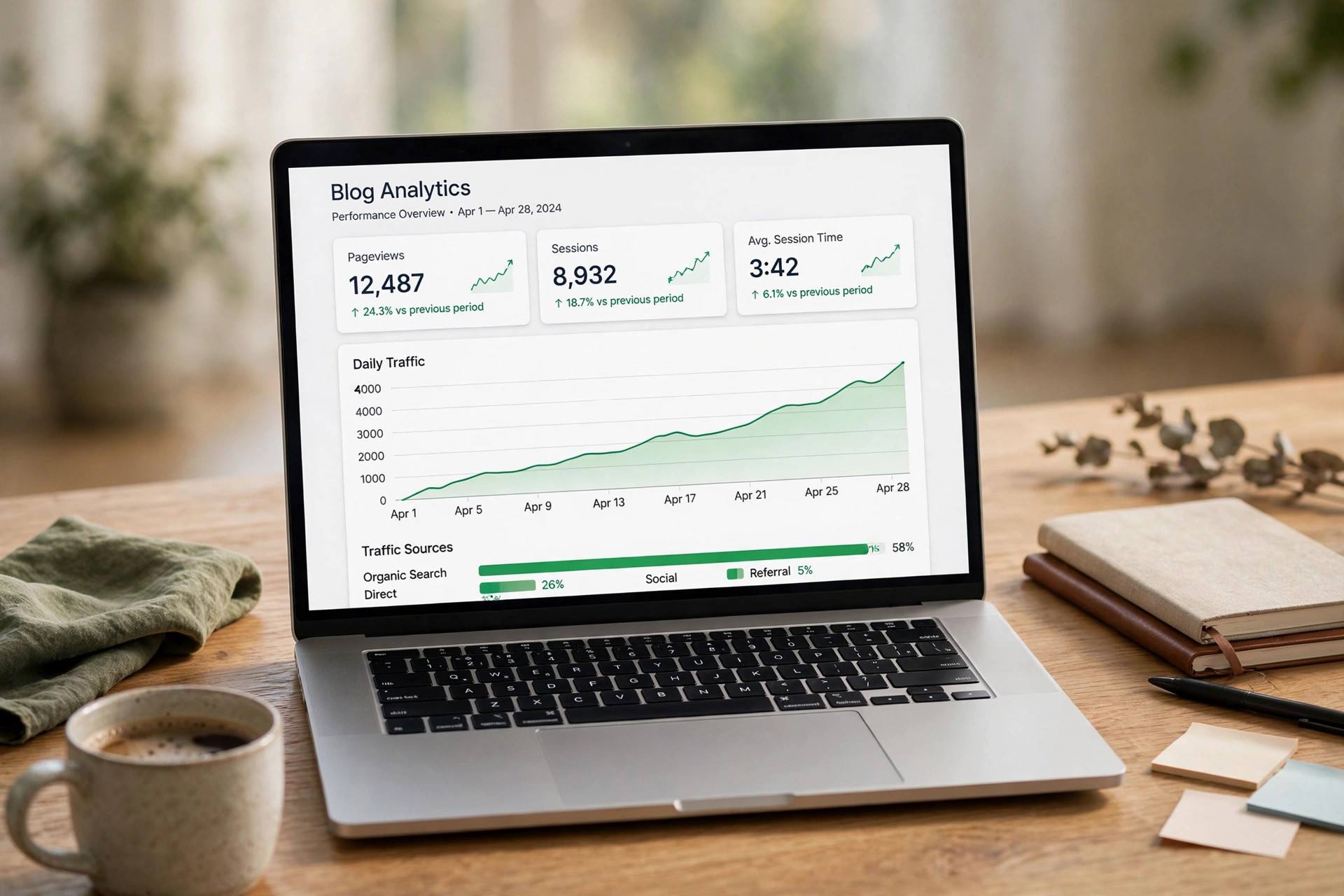
The workflow that works: create two to three pins per article using a simple template, write keyword-rich titles and descriptions (think like search, not like captions), and pin consistently, five to ten pins a day via a scheduler. Fresh pins to the same article every few months keep it circulating. My Pinterest traffic took about eight weeks to start and now delivers a steady third of my total visits.
The key insight is that Pinterest rewards the same thing Google does: content that answers a query. Design matters less than relevance. A plain, readable pin for the right keyword beats a beautiful pin for the wrong one.
Channel 3: Email Newsletter (The Channel You Own)
Your email list is the only audience no algorithm can take from you. Every other channel should feed it. I put a simple signup form at the end of my best articles offering something specific, a checklist, a template, a resource list, and my list grows every week without me promoting it anywhere.
The newsletter itself does double duty. Each issue sends a spike of traffic to whatever you feature, and over time the list becomes a launch audience: new articles get immediate readers, which generates early engagement signals. I email once a week, keep it short, and always include one useful thing that isn’t just “read my post.” Open rates stay healthy because subscribers know what they’re getting.
Start embarrassingly small. Ten subscribers is a fine beginning. The list compounds just like search traffic, and a year from now you’ll wish you’d started today.
Channel 4: Guest Posts and Borrowed Audiences
Guest posting is the fastest way to get in front of readers who already trust someone else. One guest post on an established blog in your niche can send more qualified traffic than a month of social posting, plus you get a backlink that helps your SEO permanently.
The approach that works: pitch specific article ideas, not “I’d love to write for you.” Read the blog, find a gap, and propose the exact headline. Write the best piece you’re capable of, because this is an audition. Include one natural link back to your most relevant article, and make your author bio promise something worth clicking for.
Beyond blogs, the same principle applies to podcasts, newsletters, and communities. Anywhere your ideal readers already gather, a genuinely helpful contribution with a link back outperforms months of shouting into the social void.
Your 90-Day Traffic Plan
Here is how to sequence the four channels so they reinforce each other.
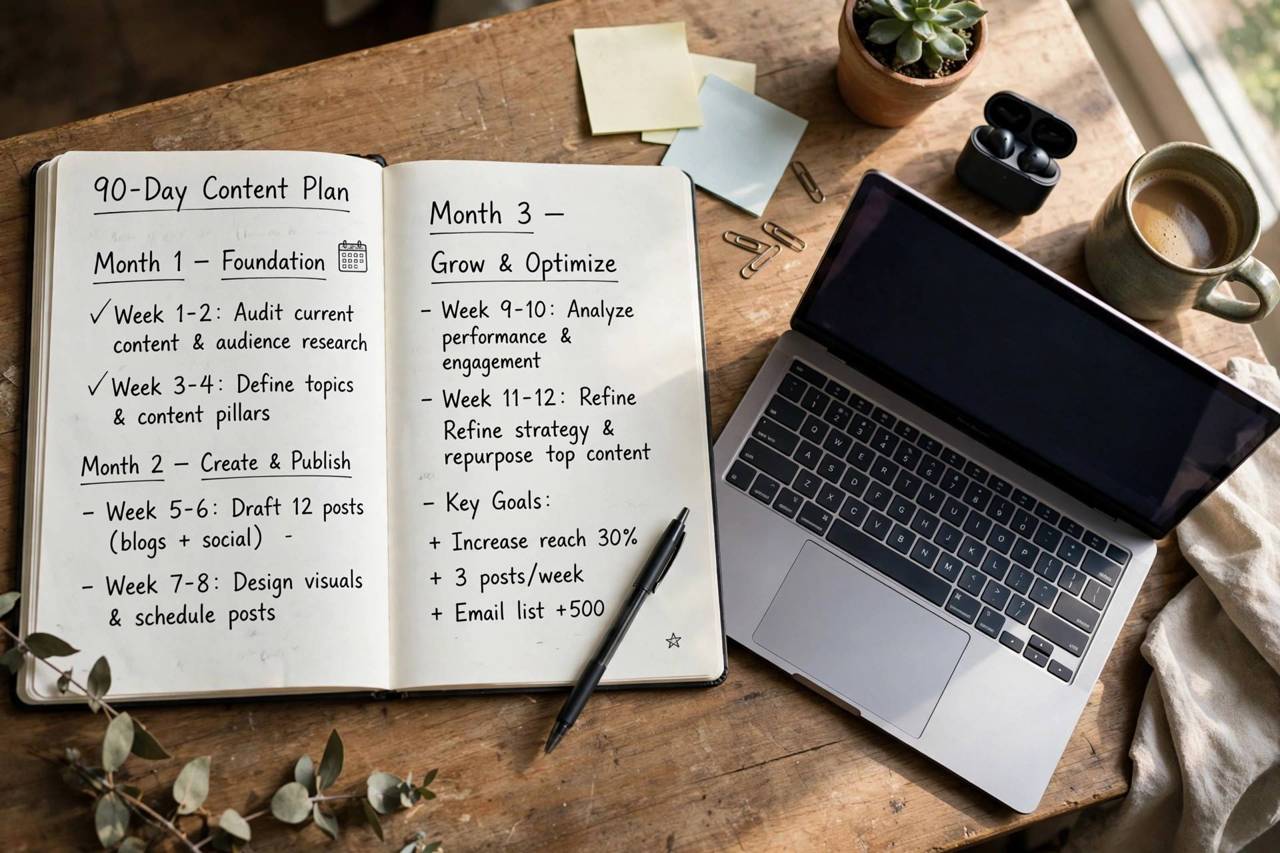
Days 1-30: Foundation. Publish eight to twelve SEO-targeted articles. Set up your email capture with one good lead magnet. Create Pinterest templates and start pinning your new articles. Pitch five guest post ideas.
Days 31-60: Acceleration. Publish eight more articles, interlinking with the first batch. Write and place two guest posts. Increase Pinterest to a daily schedule. Send your first four newsletter issues featuring your best content.
Days 61-90: Compounding. Your earliest articles start ranking. Double down on what’s working: more content in the topics gaining traction, more pins for ranking articles, guest posts on bigger sites now that you have a portfolio. Review analytics weekly and cut anything producing nothing.
By day ninety, you should see the curve bending: search impressions climbing, Pinterest delivering daily clicks, and a small but growing email list. None of it required a single social media post.
Measuring What Works (and Cutting What Doesn’t)
Without social media vanity metrics, you need a simple analytics routine. Once a week, check three numbers: organic search clicks (is SEO climbing?), Pinterest outbound clicks (which pins drive traffic?), and email open and click rates (is the list engaged?). That’s it. Ten minutes, three numbers, one decision: do more of what’s working.
The metric that matters most in months one through three is search impressions, not clicks. Impressions climbing means Google is testing your content with searchers; clicks follow once rankings stabilize. If impressions are flat after sixty days, the problem is usually targeting: you’re answering questions nobody searches for, or competing for keywords dominated by giants. Adjust the keyword strategy before blaming the writing.
Kill channels that produce nothing after ninety days of honest effort. I dropped two tactics from my original plan in month three because the data said they weren’t working. That’s not failure; it’s the system functioning. Your time is the scarcest resource in this plan, and data tells you where to spend it.
Avoiding the Biggest No-Social-Media Mistake
The mistake I see most: bloggers who quit social media but keep creating content for social media. Short, shallow posts optimized for shares don’t rank in search and don’t get pinned. The no-social-media strategy requires a format shift toward comprehensive, search-friendly articles: longer, structured, genuinely useful.
Every article should target one clear search query and answer it better than anything currently ranking. That means real depth: examples, specifics, honest trade-offs. The bloggers winning without social media aren’t writing less; they’re writing differently. Depth is the distribution strategy.
Repurposing: One Article, Four Channels
The efficiency unlock of the no-social-media strategy is repurposing. Every article you publish should feed all four channels with minimal extra work. The article itself serves SEO. Two to three pins made from its key points serve Pinterest. The article becomes the featured link in your newsletter with a short intro written for subscribers. And the article’s core insight becomes your guest-post pitch angle or a condensed version for someone else’s audience.
This means each article does quadruple duty, which is how small bloggers compete with teams. I spend roughly four hours per article including the repurposing, and each piece works across every channel for months. Compare that to social media, where a post’s lifespan is measured in hours. The math isn’t close.
Frequently Asked Questions
Can a blog really succeed without social media in 2026?
Yes. Social media is one distribution channel among many, and for informational blogs it was never the best one. Search, Pinterest, email, and borrowed audiences are all more durable and more convertible than social followers.
How long until SEO traffic starts?
Expect the first meaningful search traffic at two to four months for a new blog, with real momentum at six to twelve months. This is why the 90-day plan layers faster channels like Pinterest and guest posts alongside SEO.
Is Pinterest still worth it for bloggers?
For niches with visual or instructional content, absolutely. Pinterest functions as a search engine with long-lived results, which makes it structurally similar to SEO. It is less useful for purely opinion or news content.
How often should I publish for SEO?
Consistency beats volume. Two quality articles a week sustained for a year beats fifty rushed posts. Each article should target one clear query and answer it thoroughly.
Do I need paid tools for any of this?
No. Free tiers cover everything at the start: search volume research, Pinterest scheduling, email up to a few hundred subscribers, and analytics. Spend money only when a channel is already working and you want to scale it.
Should I delete my social media accounts entirely?
Not necessarily. Keeping dormant profiles with a link to your blog costs nothing and captures the occasional visitor. The key change is stopping the time investment: no more daily posting, engaging, or algorithm-chasing. Let the accounts exist passively while your real channels do the work.
How do I get my first 100 email subscribers?
Put a specific, useful lead magnet on your five best articles (a checklist, template, or resource list related to the article’s topic), and mention the newsletter naturally within the content. Your first hundred subscribers come from your existing readers; you don’t need traffic to build a list, you need an offer worth signing up for.
The Bottom Line
Social media is optional for blog traffic. SEO compounds, Pinterest behaves like search, email is the audience you own, and guest posts borrow trust at scale. Work all four for ninety days and you’ll have traffic no algorithm can take away.