How to Write Blog Headlines That Get Clicks (Without Clickbait)


Learning how to write blog headlines that get clicks is the highest-leverage skill in blogging. You can write the best article in the world, but if the headline does not earn the click, nobody will ever know. I have written thousands of headlines over the years — some that flopped embarrassingly, some that outperformed everything else on the site — and the difference was never talent. It was process. This guide gives you the formula swipe file I actually use, the SEO rules that keep headlines ranking, and a testing framework that removes the guesswork.
One important distinction up front: getting clicks and using clickbait are not the same thing. Clickbait promises what the article does not deliver; a great headline promises exactly what the article delivers, as compellingly as possible. The first burns trust. The second builds an audience. Everything below is about the second kind.
How to Write Blog Headlines That Get Clicks: The Core Formula
Every high-performing headline does four jobs: it names a specific benefit, it signals who it is for (or what it is about), it creates curiosity or urgency, and it stays honest. “How to Start a Vegetable Garden” names a benefit. “How to Start a Vegetable Garden in a Small Apartment” adds the who. “How to Start a Vegetable Garden in a Small Apartment (in One Weekend)” adds urgency. Each layer costs a few words and buys a real increase in clicks.
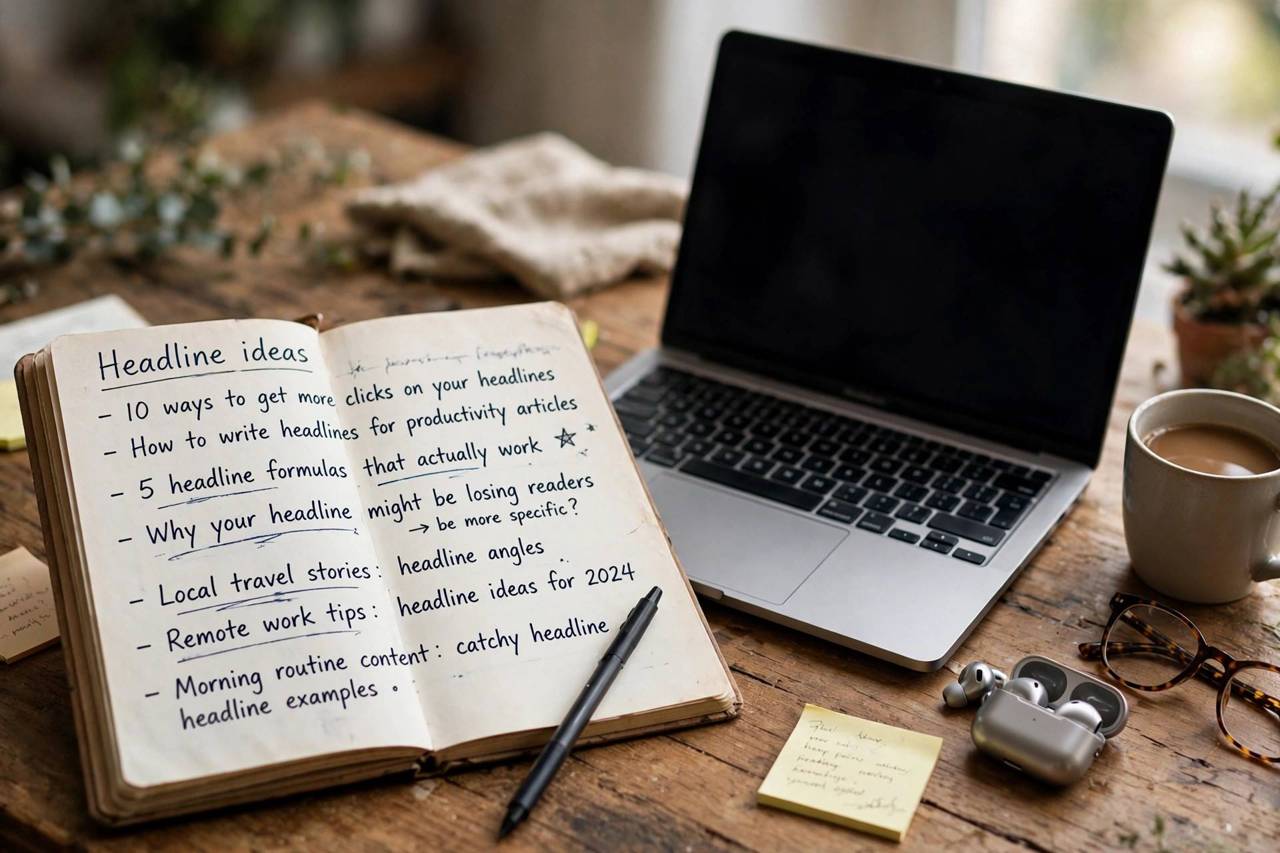
The practical habit: write 10 headlines for every post. The first three will be obvious, the next four will be variations, and somewhere around number eight you will find the one that actually works. Professional headline writers do this as a matter of routine — the best headline is rarely the first one you think of. If you are just getting your blog off the ground, this guide to starting a blog covers the foundations this skill builds on.

The Formula Swipe File: 12 Headline Templates
Steal these structures shamelessly — formulas are tools, and every working blogger has a swipe file:
1. The number + benefit: “7 Email Templates That Book More Client Calls.” Numbers promise scannable structure. 2. The how-to + timeframe: “How to Learn Basic Spanish in 30 Days.” 3. The mistake reversal: “5 Houseplant Mistakes That Are Killing Your Plants.” Loss aversion is powerful. 4. The comparison: “Freelancing vs. Full-Time: An Honest Breakdown.” 5. The insider secret: “What Real Estate Agents Won’t Tell First-Time Buyers.” 6. The ultimate guide: “The Ultimate Guide to Sourdough for Beginners” — use sparingly; it must actually be ultimate. 7. The question: “Is a Standing Desk Worth It?” Matches how people search. 8. The case study: “How I Doubled My Newsletter in 90 Days.” 9. The listicle with a twist: “11 Kitchen Gadgets Chefs Actually Use.” Specificity beats generic. 10. The contrarian: “Why Morning Routines Are Overrated.” 11. The beginner promise: “Budget Travel: A Complete Beginner’s Guide.” 12. The versus + verdict: “iPhone vs. Android for Photography: Which Wins?”
Notice that every formula can be honest or clickbaity depending on delivery. “What X Won’t Tell You” is fine if the article genuinely reveals insider knowledge; it is clickbait if the article contains nothing new. The formula is neutral — your integrity decides what it becomes.
SEO Constraints: Headlines That Rank Too
A headline has two audiences: humans and search engines. For SEO, put your target keyword as close to the front of the headline as natural — “How to Write Blog Headlines That Get Clicks” beats “That Get Clicks: How to Write Blog Headlines.” Keep titles under 60 characters so they do not get truncated in search results, and write a distinct meta title if your on-page H1 runs long.
Match search intent with the headline’s promise. If the keyword is “how to,” the headline should promise instructions, not opinions. If it is “best,” promise a comparison or ranking. Mismatched intent is the quiet killer of rankings: the click happens, the reader bounces, and Google notices. And resist stuffing extra keywords into headlines — one clear keyword, written for humans, outperforms a keyword salad every time.
The A/B Testing Framework (Simple Enough to Actually Do)
Here is a testing process that works for blogs without enterprise tools. Step 1: Publish with your best-guess headline. Step 2: After 2–4 weeks (or ~1,000 impressions in Search Console, whichever comes first), note the click-through rate. Step 3: Change exactly one variable — the number, the benefit, the specificity — and wait another 2–4 weeks. Step 4: Keep the winner. That is the whole framework: one variable, measured periods, keep records.
What to test first, in order of impact: specificity (“7” vs. “several”), the benefit statement, emotional words, and length. Do not test more than one headline change at a time or you will not know what worked. And keep a simple log — date, old headline, new headline, CTR before and after. After a year of this, you will have a personal dataset that beats any generic advice, because it reflects your audience.
For social traffic, you can test faster: share the same post with different headlines a week apart and compare engagement. Email subject lines are headlines too — your newsletter open rates are a free headline laboratory. (The headline that wins in email often wins in search as well.)
Mistakes That Kill Clicks
Clever over clear. “The Silence of the Yams” is a great pun and a terrible headline — nobody searching for sweet potato recipes will find it or click it. Clarity first, cleverness second. Vague promises: “You Won’t Believe What Happened Next” tells the reader nothing; specific curiosity (“The $12 Tool That Fixed My Back Pain”) tells them everything. ALL CAPS and excessive punctuation!!! — reads as spam in every context. Burying the keyword at the end of a long title. Headline-article mismatch: the fastest way to train readers never to click you again. And never testing — publishing on instinct alone when the data is sitting in Search Console waiting to be used.
Headline Power Words: A Curated Bank
Certain words consistently lift click-through rates because they trigger specific psychological responses. Curiosity: secret, little-known, surprising, hidden, truth about. Specificity: exact, step-by-step, proven, complete. Urgency: now, today, before you, stop. Authority: guide, ultimate, definitive, expert. Ease: simple, easy, quick, beginner-friendly. Value: free, save, best, top.
The key is restraint: one or two power words per headline. “The Ultimate Step-by-Step Proven Secret Guide to…” collapses under its own weight and reads as spam. Pick the single power word that best matches your article’s genuine strength — if your guide really is step-by-step, say so; if it is not, do not borrow the word. Readers can smell unearned power words, and the disappointment poisons the click you worked for.
Also mind the words that cost clicks: vague adjectives (nice, good, interesting), insider jargon your audience does not share, and superlatives you cannot defend (“best ever,” “amazing”). Specificity is the real power word — it just does not look like one.
Writing Headlines for Different Platforms
Your headline does not live in one place, and each platform rewards a different flavor. Search: keyword-first, clear, under 60 characters — the searcher has intent, so match it plainly. Social media: curiosity-forward and conversational; social scrollers have no intent, so you must create it. It is normal (and smart) for the social headline to differ from the SEO title. Email subject lines: short (under 50 characters for mobile), personal, with one clear hook — and never misleading, because unsubscribes are forever.
Pinterest: keyword-rich and descriptive, since it functions as a visual search engine; put the benefit in the pin title. YouTube/video: curiosity plus clarity, front-loaded, since titles truncate aggressively. The underlying article is the same; the packaging adapts to the room it is entering. Professional bloggers routinely maintain 2–3 headline variants per post for exactly this reason.
When to Break the Rules
Every guideline above has exceptions, and knowing them is what separates competent headline writers from great ones. Break the 60-character rule when the keyword demands specificity that will not fit — a slightly truncated title that matches intent beats a short one that does not. Skip the number when the article is genuinely narrative; “How I Rebuilt My Life After Bankruptcy” needs no digit. Use cleverness when your audience is already loyal — newsletter subject lines to engaged subscribers can be playful in ways cold search traffic cannot.
The meta-rule: guidelines optimize for the average case, and your post may not be average. Test, measure, and let your own data overrule any advice — including mine.
FAQ
How long should a blog headline be?
Aim for under 60 characters so it displays fully in search results, and under 70 for social sharing. Longer headlines can work if the key information comes first.
Do numbers in headlines really increase clicks?
Consistently, yes — odd numbers tend to outperform even ones, and specific numbers (“7”) beat vague ones (“several”). But the effect is modest; a great non-numbered headline beats a mediocre numbered one.
What is the difference between a headline and a title tag?
The headline (H1) is what readers see on the page; the title tag is what appears in search results and browser tabs. They can be identical, but many bloggers write a punchier H1 and a keyword-optimized title tag.
How many headlines should I write per post?
At least 10. The exercise forces you past the obvious options to the interesting ones. Professional copywriters routinely write 25+ for important pieces.
Is clickbait ever okay?
Curiosity-gap headlines are fine when the article genuinely delivers on the promise. It becomes clickbait when the content does not match the headline’s implied promise. When in doubt, make the headline more specific, not more sensational.
Conclusion
Headlines are a craft, not a gift: specific benefit, clear audience, honest curiosity, SEO keyword up front — then write ten versions and test the winner. Keep your swipe file growing, log every test, and let your own data sharpen your instincts over time. Do that consistently and your click-through rates will compound like interest. The articles deserve readers; now they will finally get them all.