“When should I change my spark plugs?” sounds like it should have a simple answer. It doesn’t — or rather, it has four different answers depending on what’s screwed into your engine. I’ve seen owner’s manuals say 30,000 miles and others say 120,000. Both were right, for their cars. The interval depends entirely on the plug’s electrode material, and using the wrong number for your plug type is how people either waste money changing plugs too early or damage engines changing them too late.
Here’s the no-nonsense version: the material of the center electrode determines everything. Let me walk through each type, the real-world intervals I’ve seen hold up, the signs yours are done, and what actually happens if you push them too far.
Contents
- The Short Answer: Intervals by Plug Type
- Copper Plugs: 20k to 30k Miles
- Platinum Plugs: 60k to 100k Miles
- Iridium Plugs: 80k to 120k Miles
- Why the Manual Sometimes Lies (a Little)
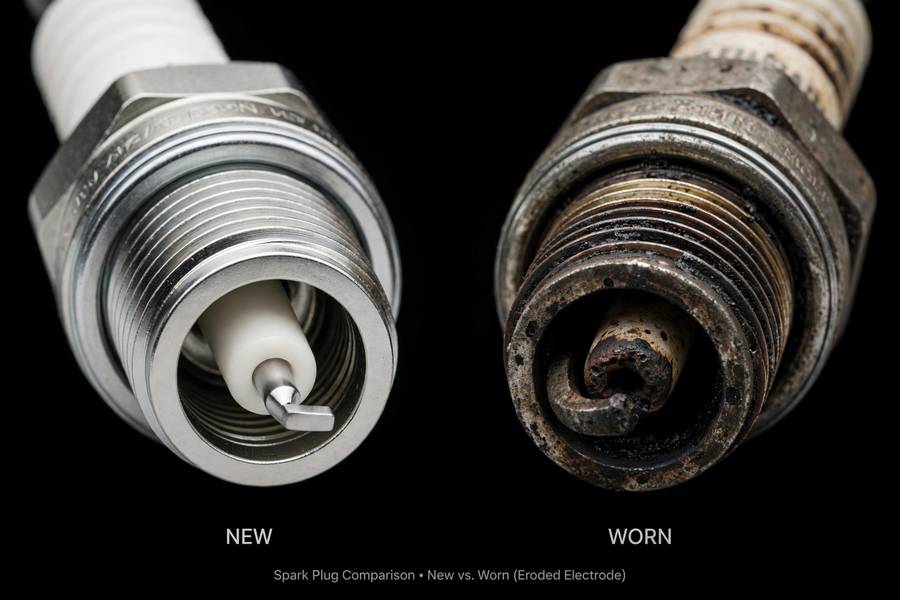
- Signs Your Plugs Are Worn (Regardless of Mileage)
- What Happens If You Wait Too Long
- My Practical Replacement Advice
The Short Answer: Intervals by Plug Type
| Plug type | Typical interval | Common in |
|---|---|---|
| Copper/nickel | 20,000–30,000 miles | Older cars, some performance applications |
| Single platinum | 60,000–100,000 miles | 2000s–2010s mainstream cars |
| Double platinum | 60,000–100,000 miles | Waste-spark ignition systems |
| Iridium | 80,000–120,000 miles | Most modern cars (2010s–today) |
| Ruthenium | 100,000+ miles | Newest applications, high-performance |
If you don’t know what type you have: check the owner’s manual under scheduled maintenance, or pull one plug and read the part number. Don’t guess — the wrong interval for the wrong plug type is the whole problem we’re solving here. And if you’re due, the actual job is straightforward — I cover it step by step in my guide on how to change spark plugs.
Copper Plugs: 20k to 30k Miles
Copper (technically nickel-alloy with a copper core) plugs are the old standard — soft electrodes that erode relatively quickly under the violence of combustion. Every spark blasts a microscopic amount of electrode material away, and soft metal goes faster.
Why does anyone still use them? Two reasons: they’re cheap ($2–$4 each), and copper conducts electricity and heat better than the precious metals. Some performance builders prefer copper for high-boost or nitrous applications because the superior heat transfer resists pre-ignition — they just accept changing them every oil-change-season as the cost of doing business. A few older vehicles spec them from the factory, and in those cases, use what the manual says.
The 30,000-mile ceiling is real with copper. Past that, the electrode gap grows, the spark weakens, and misfires start. On a modern car that came with iridium, never “downgrade” to copper to save money — you’ll be changing them four times as often and the engine’s ignition system was calibrated for the other type.
Platinum Plugs: 60k to 100k Miles
Platinum’s hardness resists electrode erosion far better than nickel alloy, which is why platinum plugs tripled or quadrupled service intervals when they arrived. A tiny platinum disc welded to the electrode takes the brunt of the spark erosion and barely wears.
Single platinum (platinum on the center electrode only) suits conventional coil-on-plug ignitions — the spark always jumps the same direction, so only one side needs the hard metal. Double platinum (platinum on both center and ground electrodes) is for waste-spark systems where the spark jumps in alternating directions, wearing both sides.
Real-world note: platinum plugs often look okay at 100,000 miles but perform worse than you’d think. The gap grows slowly, the engine computer compensates by adjusting timing and fuel, and you lose a little efficiency so gradually you never notice. When customers finally changed 110,000-mile platinum plugs, the most common reaction was “it feels like a different car” — they’d been driving a degraded car for 30,000 miles without realizing.
Iridium Plugs: 80k to 120k Miles
Iridium is harder than platinum and melts at a higher temperature, which lets manufacturers use a much finer center electrode — down to 0.4mm versus ~2.0mm for conventional plugs. That fine wire focuses the electric field, producing a more concentrated, reliable spark with less voltage required. Less voltage demand means less stress on the coils, too.
This is what most cars built in the last 15 years came with from the factory, and the 100,000-mile interval is legitimate — I’ve pulled iridium plugs at 100k that still looked and measured fine. But “up to 120,000” assumes normal driving. Severe service — lots of short trips, extended idling, dusty conditions, or oil consumption issues — shortens it. And turbocharged direct-injection engines are harder on plugs than the old port-injection ones; I tend to recommend the earlier end of the range for those.
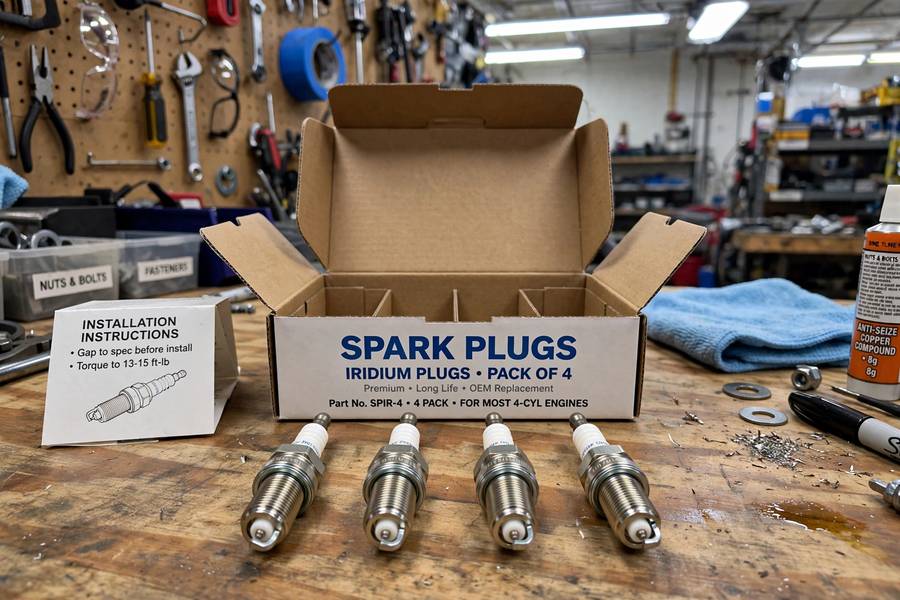
One critical handling note: never re-gap iridium (or platinum) plugs with a traditional gapping tool. The fine-wire electrodes are brittle — prying on them can crack the precious metal tip. Buy them pre-gapped for your application and install as-is. If the gap’s wrong out of the box, you bought the wrong plugs.
Why the Manual Sometimes Lies (a Little)
Owner’s manual intervals assume “normal” driving, and almost nobody drives “normal” by the manual’s definition. The fine print usually defines severe service as: mostly short trips, stop-and-go traffic, extreme temperatures, dusty conditions, towing, or extended idling. Read that list again — that’s most people’s actual driving.
My rule of thumb from the shop: if your driving matches the severe list (and it probably does), use the earlier end of the interval range, or knock 20% off the manual’s number. A 100,000-mile iridium interval becomes 80,000 for a city-driven turbo car. It’s cheap insurance — plugs cost $8–$15 each, and the labor (or your Saturday) is the same whether you do it at 80k or 100k.
Also: time matters, not just miles. A 12-year-old car with 60,000 miles on original iridium plugs should get fresh ones — electrodes corrode, and more importantly, plugs can seize in the aluminum cylinder head over long periods. I’ve extracted seized plugs that turned a $60 maintenance item into a $600 thread-repair job. Don’t let plugs become permanent residents.
Signs Your Plugs Are Worn (Regardless of Mileage)
Mileage is a guide; symptoms are the truth. Watch for:
- Rough idle. The engine shudders or stumbles at stoplights. Worn plugs misfire most at idle, where combustion conditions are least favorable.
- Hesitation or stumbling under acceleration. The engine stutters when you ask for power — classic weak-spark behavior under load.
- Hard starting, especially cold. Weak spark + cold dense air + cold fuel = extended cranking.
- Dropping fuel economy. The computer compensates for weak combustion by adding fuel. A sudden 10–15% drop in MPG with no other explanation points at ignition.
- Check engine light with misfire codes (P0300–P0312). By the time the computer flags it, the plugs are well past done.
- Lack of power. Gradual, so you adapt to it — until new plugs remind you what the car felt like new.
Any of these on a car near (or past) its plug interval? Start with the plugs. They’re the cheapest suspect in the ignition chain — coils cost far more, so rule out plugs first.
What Happens If You Wait Too Long
Mild neglect costs you drivability and fuel economy. Serious neglect costs real money:
- Catalytic converter damage. Persistent misfires dump unburned fuel into the exhaust, where it ignites in the catalytic converter. Converters run hot by design; raw fuel makes them run hot enough to melt internally. A $60 plug job deferred can become a $1,200 converter replacement. This is the big one — the most expensive common consequence.
- Ignition coil failure. Worn plugs with wide gaps demand higher firing voltage. Coils working overtime overheat and fail — and coils cost $50–$150 each, versus $10 for a plug.
- Seized plugs. As mentioned: plugs left in aluminum heads for a decade can weld themselves in place. Extraction risks damaging the threads, which means thread inserts or head work.
- Engine damage (rare but real). In extreme cases — electrode pieces breaking off into the cylinder — you get scored cylinder walls. I’ve seen it twice in fifteen years. It’s rare, but it’s catastrophic when it happens.
None of this is meant to scare you — it’s meant to calibrate the economics. Spark plugs are among the cheapest maintenance items on the car. Deferring them to “save money” is one of the worst trades in car ownership.
My Practical Replacement Advice
- Know your plug type and use its interval, not a generic number. The manual’s maintenance schedule lists it.
- Use the severe-service adjustment if your driving matches (it probably does): earlier end of the range.
- Replace them as a set. Always. Mixing old and new plugs gives you uneven combustion across cylinders.
- Use the exact plug specified — same part number, same heat range, same gap. “Equivalent” plugs from reputable brands are fine; random no-name plugs are not worth the gamble.
- Consider related maintenance while you’re in there: ignition coils on high-mileage cars (if original at 120k+, they’re on borrowed time), and it’s a natural pairing with how often to change engine oil thinking — batch your maintenance so you’re not constantly under the hood. A quick how to check your oil level while you’re at it costs nothing.
- Anti-seize and torque specs matter. Too loose and plugs work loose; too tight and you damage the threads. Follow the spec — and on modern coated plugs, check whether the manufacturer wants anti-seize at all (many pre-coated plugs say no).
Spark plugs are small, cheap, and profoundly important — each one fires millions of times between changes, and your engine’s health rides on every spark. Treat the interval with respect and they’ll never give you trouble.
Frequently Asked Questions
It depends on plug type: copper every 20,000–30,000 miles, platinum every 60,000–100,000 miles, and iridium every 80,000–120,000 miles. Severe driving conditions (short trips, stop-and-go, extreme temperatures) call for the earlier end of each range.
Rough idle, hesitation under acceleration, hard cold starts, dropping fuel economy, misfire check-engine codes (P0300–P0312), and gradual power loss. Any of these near the replacement interval points to worn plugs.
Worn plugs cause misfires that can destroy the catalytic converter ($1,000+ repair), overwork and kill ignition coils, and seize in the cylinder head over time. A $60 plug job deferred can easily become a four-figure repair.
Yes — always replace them as a complete set. Mixing old and new plugs causes uneven combustion across cylinders, and if one plug is worn out, the rest are right behind it. The labor is the same either way.
No — don’t re-gap iridium or platinum plugs with traditional gapping tools. The fine-wire precious metal electrodes are brittle and can crack. Buy plugs pre-gapped for your specific application and install them as they come.