How Long Do Car Tires Last? Miles and Years Explained

Ask five drivers how long tires last and you’ll get five different answers — because two clocks run on every tire: the miles you drive, and the years the rubber spends quietly aging.
Here’s the shop answer: most car tires last 50,000–60,000 miles or 3–5 years of normal driving. That number swings with tire type, driving style, and — the part most people miss — the tire’s age, even when the tread looks fine.
This guide gives you both clocks, a lifespan table by tire type, how to read the age stamped on your own sidewalls, the five signs it’s time to replace, and the maintenance habits that stretch tire life.
How Long Do Car Tires Last? (The Short Answer)
For a typical set of all-season tires on a daily driver: 50,000–60,000 miles, or about 3–5 years. Some tires die younger — soft performance rubber can be done in 25,000–40,000 miles — and some die of old age before the tread is half gone.
There’s one number in the tire world that sounds like a promise but isn’t. Premium all-season tires have been tested out to 95,000–100,000 miles under ideal conditions — gentle driving, perfect inflation, mild climate. Your commute is not a lab test.
One more thing: ten years is the hard stop. A tire with deep tread that’s been sitting for a decade is not a good tire. Rubber degrades, and degraded rubber fails without much warning.
Tire Lifespan by Type: Miles and Years Table
The rubber compound is a trade-off: softer compounds grip better but wear faster. Here’s what to expect by type:
| Tire type | Typical mileage | Age cap |
|---|---|---|
| All-season | 50,000–60,000 miles | 6–10 years |
| SUV | 40,000–60,000 miles | 6–10 years |
| Truck | 50,000–70,000 miles | 6–10 years |
| Winter | 20,000–30,000 miles | 6–10 years |
| Off-road | 20,000–40,000 miles | 6–10 years |
| Performance | 25,000–40,000 miles | 6–10 years |
A few notes. All-season tires are the commuter standard — the 50,000–60,000 figure from the short answer is theirs. SUV tires land lower at 40,000–60,000 miles because heavier vehicles chew through rubber faster. Truck tires can stretch to 50,000–70,000 on the highway, though heavy towing pulls that down.
Winter tires wear fast — 20,000–30,000 miles — because their soft cold-weather compound can’t survive summer heat. Off-road tires live at 20,000–40,000 miles; knobby tread on hard surfaces wears fast. Performance tires trade lifespan for grip at 25,000–40,000 miles — by design, not defect.
The age cap column is identical for every row on purpose. Mileage is how you wear a tire out; age is how a tire wears out on you. Rubber degrades from heat, ozone, and sunlight whether the tire rolls or sits parked, so the 6–10 year replacement rule applies to every type.
Mileage vs Age: The Two Clocks on Your Tires
Mileage is the clock everyone watches. Age is the clock everyone forgets.
Why Tires “Age Out Before They Wear Out”
Rubber is a chemical compound, and it breaks down over time — heat, ozone, and sunlight all attack it. The tread can look deep and healthy while the rubber has gone brittle inside. That’s why a low-mileage car can still need new tires: the odometer says young, the calendar says otherwise.
This is the classic trap with spare tires, garage-kept second cars, and vehicles that sit for months. The tread looks great, but ten-year-old rubber is ten-year-old rubber. It develops cracks in the sidewall and between tread blocks, and old tires are far more likely to fail suddenly — a blowout at highway speed, with no warning from the tread depth.
The 6–10 Year Rule, Regardless of Tread
- After 5 years: have your tires professionally inspected at least once a year, even if the tread looks fine. A tech will spot age cracking and internal issues you won’t catch in the driveway.
- Between 6 and 10 years: replace them, regardless of how much tread is left. Where you land in that range depends on climate — hot, sunny regions age tires faster — and on what the inspection shows.
- At 10 years: done. No exceptions. A tire older than ten years is a safety risk, not a tire.
How to Check Your Tire’s Age (Reading the DOT Code)
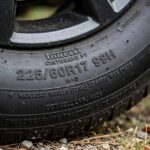
Every tire sold in the US carries its birth date stamped on the sidewall, in a code that starts with “DOT.” The part you want is the last four digits of that code.
The first two digits are the week of manufacture. The last two are the year. For example, a code ending in 2319 means the tire was made in the 23rd week of 2019. A code ending in 0523 means the fifth week of 2023.
Finding it: look on the sidewall for the letters DOT followed by a string of characters. The four-digit date sits at the end, sometimes inside a small oval, and it may only be stamped on one side — check the inner sidewall with a flashlight if you don’t see it.
Past six years goes on the inspection list; past ten goes on the replacement list. For the full breakdown of every sidewall marking, this companion guide to reading tire sidewall numbers walks through all of them.
5 Signs It’s Time to Replace Your Tires
Tread depth gets all the attention, but it’s only one of five checks. Run through all of them:
1. The tread is at or below 2/32 of an inch. The legal minimum in most US states, and genuinely unsafe — stopping distances grow fast on worn tread, especially in the wet.
2. Cracks in the sidewall or between tread blocks. Fine cracking — dry rot — is the signature of aged rubber. A network of small cracks means the compound is breaking down.
3. Bulges or blisters on the sidewall. A bulge means the internal structure has failed there. Urgent: a bulging tire can blow out without further warning. Don’t drive on it longer than you must to get it replaced.
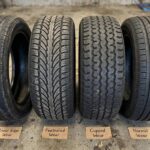
4. Uneven or cupped wear. Tread worn in patches, on one edge, or in a scalloped “cupping” pattern usually means something else is wrong — alignment, balance, or worn suspension. The tire is often a casualty, not the cause. This guide to tire wear patterns and misalignment shows what each pattern means.
5. The tire is simply old. Six to ten years from the DOT date means replacement, no matter how good the tread looks. This catches the tires the other four checks miss.
Tread Depth: The Penny Test, Quarter Test, and the 2/32″ Legal Minimum
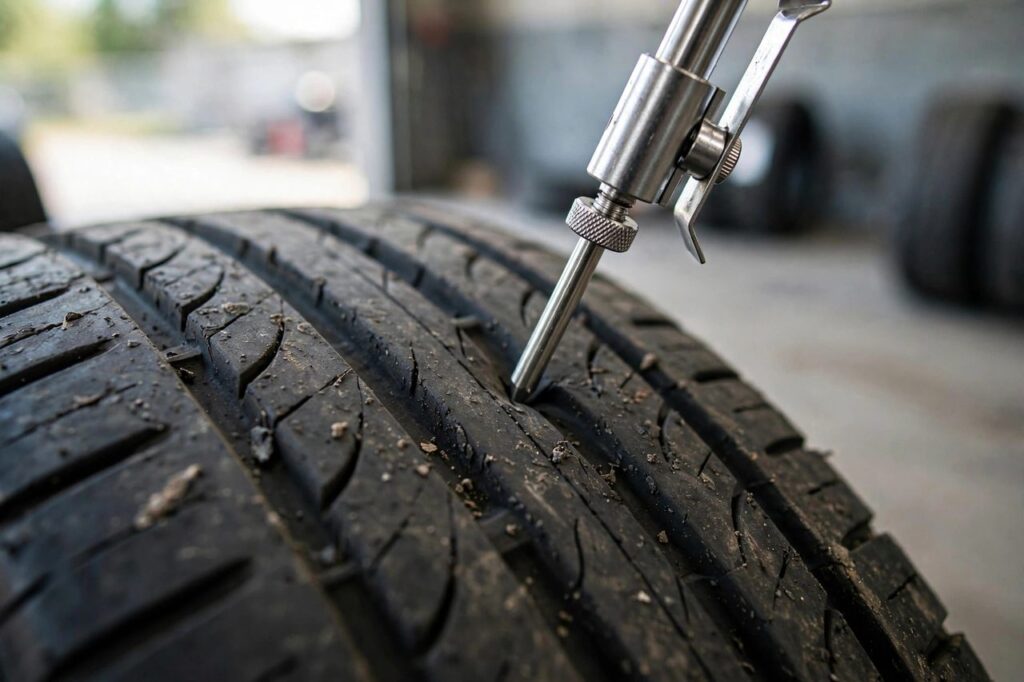
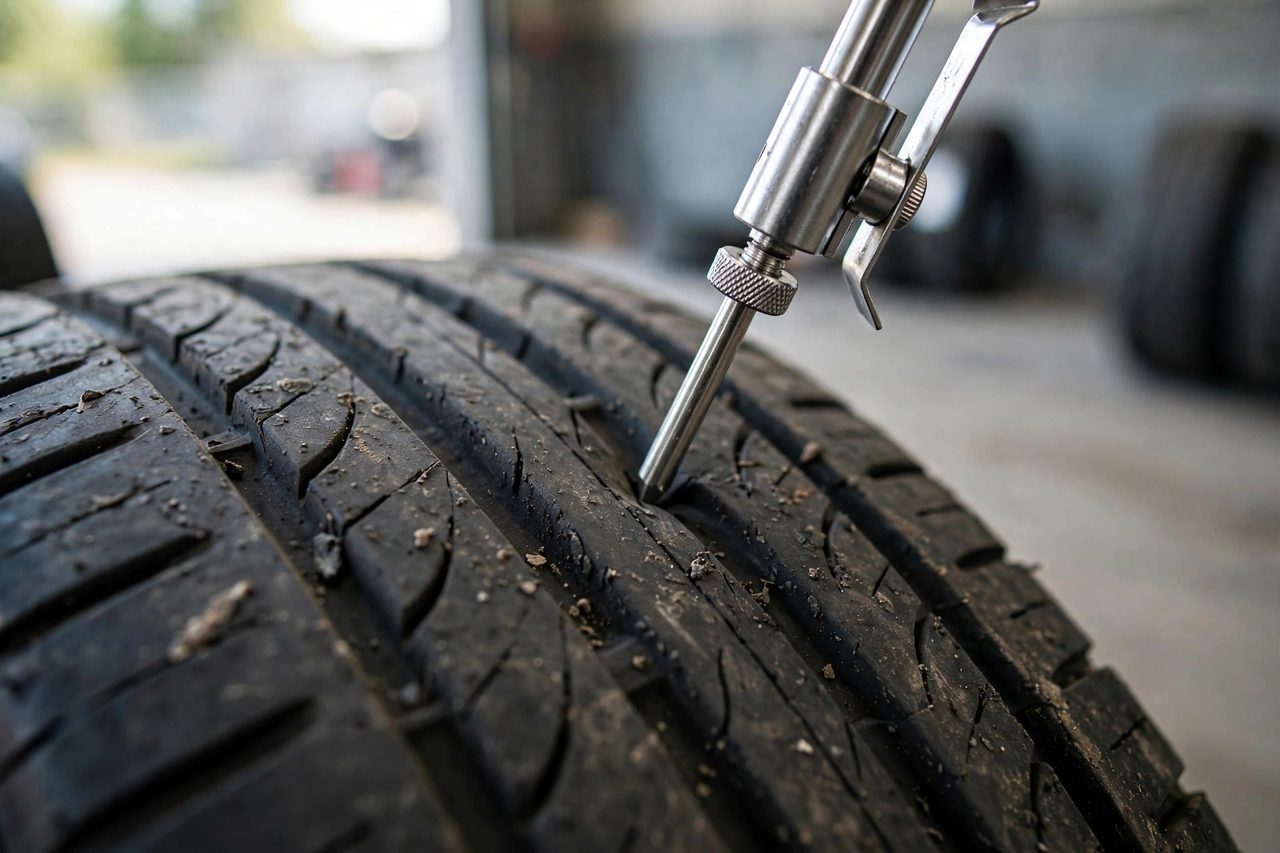
You don’t need a gauge to check tread, though a gauge is cheap and more precise. Two coins do the job:
The penny test. Hold a penny with Lincoln’s head upside down and push it into the tread groove. If you can see the top of Lincoln’s head, the tread is at or below 2/32 of an inch — the legal minimum in most US states.
The quarter test. Same idea with a quarter, Washington’s head upside down. If the top of his head shows, you’re at about 4/32 of an inch. That’s not the legal minimum — it’s the earlier warning. At 4/32″, wet-weather performance has already dropped off noticeably, and replacing now buys you real safety margin in the rain.
Check at least three spots around each tire — inner, middle, and outer grooves — because tires rarely wear evenly. If any spot fails the penny test, the tire is done.
What Affects How Long Tires Last (Driving, Roads, Climate, Load)
Two identical tires can live very different lives. Here’s what moves the number:
Driving style. Hard acceleration, late braking, and fast cornering scrub rubber off the tread. Smooth, steady driving is the single biggest thing in your control — it’s free, and it works on every tire you will ever own.
Roads. Rough, potholed roads and gravel beat tires up faster than smooth highway miles. Constant highway cruising at steady speed is the easiest life a tire can have.
Climate. Heat is the enemy. Hot climates and strong sun age rubber faster — a tire in Arizona ages quicker than the same tire in Minnesota.
Load. Overloading — hauling or towing beyond the vehicle’s ratings — overheats tires and wears them fast. Check the load rating on your sidewall if you tow regularly.
Vehicle weight and type. Heavier vehicles wear tires faster, full stop. That’s why SUV tires sit at 40,000–60,000 miles while the same compound on a lighter sedan goes further. Electric vehicles deserve a mention too: heavier than gas equivalents with instant torque, both of which wear tires faster. Drive an EV, expect the low end of every range on this page.
How to Make Your Tires Last Longer (Rotation, Pressure, Alignment)
Tires die early from neglect far more often than from bad luck. Three habits cover almost all of it:
Rotate every 5,000–7,500 miles. Front tires wear differently than rears — steering and engine weight concentrate wear up front. Rotation evens it out so all four finish together instead of two dying early. Here’s what tire rotation actually does.
Check pressure monthly. Underinflation overheats the tire, wears the edges, and wastes fuel. Overinflation wears the center and shrinks your contact patch. Check cold — before driving — with a gauge, and inflate to the door-jamb sticker number, not the sidewall max. This step-by-step pressure check walkthrough covers the routine.
Get alignments checked. Hitting potholes and curbs knocks alignment out, and bad alignment eats tires in patterns no rotation can fix. If the car pulls, the steering wheel sits crooked, or you see uneven wear, get it checked. An alignment costs far less than a set of tires.
Skip them and you’ll land at the bottom. There’s no secret beyond that.
Replace One Tire or All Four? (The AWD Caveat)
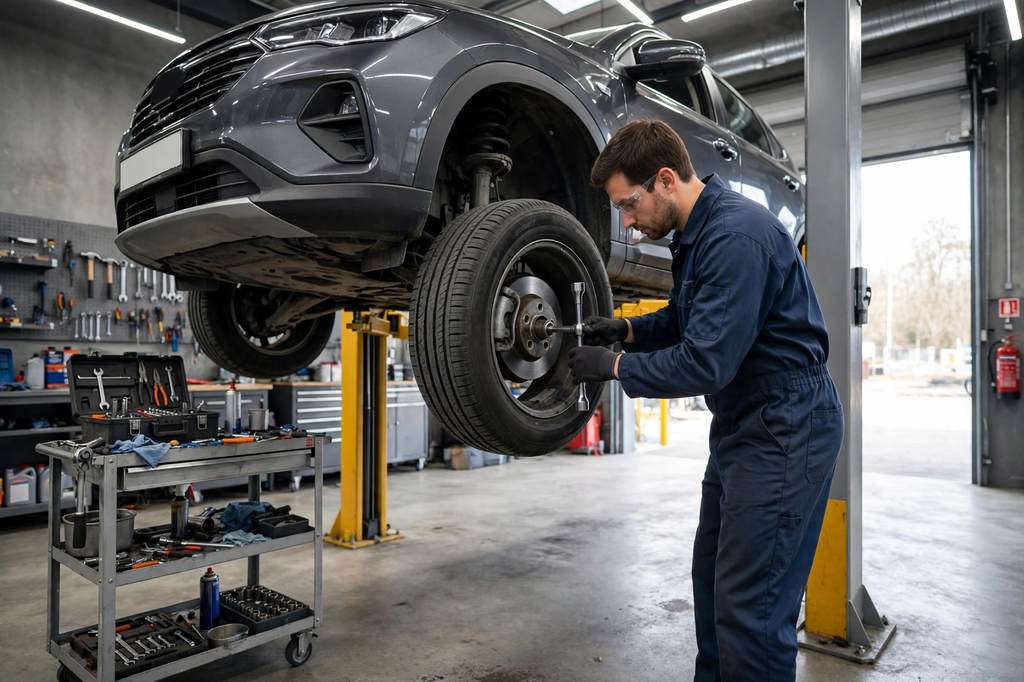
All-wheel drive: replace all four. AWD systems assume all four tires are the same diameter. A new tire is taller than a worn one, and even a small circumference difference makes the system fight itself — overheating and damaging the transfer case or differentials. One new tire among three worn ones is a drivetrain repair waiting to happen.
Two-wheel drive: replace in pairs. Put the new pair on the rear axle — yes, even on front-wheel-drive. Worn rear tires are what let the back end swing out in the wet; new rubber goes on the back, the better old ones move forward.
Just one tire only makes sense when the others are nearly new. Otherwise you’re creating the same mismatch on a smaller scale. When in doubt, match the set — tires are cheaper than transmissions.
The Bottom Line on Lifespan
Two clocks: 50,000–60,000 miles or 3–5 years for a typical set — and a hard age ceiling of 6–10 years no matter what the tread says. Read your DOT codes, run the penny test a few times a year, rotate every 5,000–7,500 miles, keep the pressure right. Do that and no tire will ever surprise you.
Frequently Asked Questions
How long do car tires last in miles?
Most car tires last 50,000–60,000 miles of normal driving. By type: performance 25,000–40,000, winter 20,000–30,000, off-road 20,000–40,000, SUV 40,000–60,000, truck 50,000–70,000. Premium all-season tires have been tested to 95,000–100,000 miles under ideal conditions — the exception, not the rule.
How many years do tires last regardless of mileage?
Replace tires between 6 and 10 years from their manufacture date, regardless of tread depth — rubber degrades over time. Inspect annually after 5 years. Ten years is the hard limit.
Can tires last 10 years?
Ten years is the absolute maximum, not a target. Most tires should be replaced between 6 and 10 years depending on climate and condition, with annual inspections starting at year 5. Rubber breaks down from heat, ozone, and sunlight whether the tire is driven or not.
How do I check how old my tires are?
Find the DOT code on the sidewall and read the last four digits: the first two are the week of manufacture and the last two are the year. For example, a code ending in 2319 means the tire was made in the 23rd week of 2019. Check all four tires plus the spare, since the date stamp may only appear on one sidewall.
Is it OK to replace just one or two tires?
On all-wheel-drive vehicles, replace all four at once — mismatched tire diameters can damage the drivetrain. On two-wheel-drive cars, replacing in pairs is fine, with the new pair mounted on the rear axle for stability. Replacing a single tire only makes sense when the remaining tires are nearly new.
Do tires wear out faster on SUVs?
Yes, somewhat. SUV tires typically last 40,000–60,000 miles compared with 50,000–60,000 for standard all-season tires on lighter cars, because heavier vehicles put more stress on the rubber. Electric SUVs wear tires faster still, thanks to extra battery weight and instant torque.