When you ask ChatGPT a question and watch the answer stream out word by word, it feels like talking to a mind. It’s not. What’s actually happening is both simpler and stranger than most people imagine: the system is predicting the next word, over and over, with no understanding of what it’s saying — and yet producing answers that often sound deeply knowledgeable.
I explain this to everyone who’ll listen, because this single insight — prediction, not thinking — unlocks almost every mystery about ChatGPT’s behavior: why it’s brilliant, why it hallucinates, why phrasing matters so much. For the complete picture of the system, see my guide on how does ChatGPT work.
In This Guide
- The One-Sentence Answer
- Prediction, Not Retrieval
- Tokens: The Units of Prediction
- How One Word Leads to the Next
- Where the “Knowledge” Comes From
- The Role of Temperature: Creativity vs. Predictability
- Why This Explains Hallucinations
- What ChatGPT Is Actually Good At
- Frequently Asked Questions
The One-Sentence Answer
ChatGPT generates responses by predicting the most likely next word (technically, “token”) given everything written so far — then appending it and repeating, hundreds of times, until the response is complete.
That’s it. There’s no database of answers being searched, no reasoning engine deliberating, no moment where the system “decides” what to say. Just next-word prediction, iterated at astonishing speed by a model trained on vast amounts of text. Everything else — the fluency, the apparent knowledge, the occasional nonsense — emerges from this single mechanism.
If you want the deeper technical context, my explainer on what a large language model is covers the architecture behind the prediction.
Prediction, Not Retrieval
Most people’s mental model is wrong in a specific way: they imagine ChatGPT looking up answers, like a super-fast librarian searching a vast library. It’s not doing that. There’s no library, no search, no retrieval of stored responses.
Instead, imagine an autocomplete system of godlike sophistication. When you type “The capital of France is,” your phone suggests “Paris” — that’s tiny-scale prediction. ChatGPT does the same thing, but with a model of language so rich that its predictions capture grammar, facts, reasoning patterns, writing styles, and more.
The training process baked statistical patterns of human text into billions of numerical parameters. When generating, the model consults those patterns — not any stored text — to decide what comes next. It’s reconstructing plausible language from learned patterns, not recalling memorized passages. (Mostly — we’ll get to the exceptions.)
This is why ChatGPT can answer questions about things phrased in ways it never saw in training: it’s not matching your question to a stored answer, it’s generating an answer from patterns. Generation generalizes; retrieval doesn’t.
Tokens: The Units of Prediction
ChatGPT doesn’t actually predict words — it predicts tokens, which are chunks of text the model was trained to work with. A token might be a whole common word (” the”), part of a word (“ing”), or even a single character for unusual text.
“The capital of France is Paris” might tokenize as [“The”, ” capital”, ” of”, ” France”, ” is”, ” Paris”] — or with different splits depending on the tokenizer. This matters because:
- Costs are counted in tokens, not words (roughly 4 characters per token in English)
- Context limits are token limits — the model’s “memory” is measured in tokens
- Weird tokenization explains weird errors — the model sometimes struggles with tasks like counting letters because it doesn’t see individual letters, only tokens
When you watch text stream out, you’re watching tokens being sampled one at a time, each choice informed by all previous tokens.
How One Word Leads to the Next
Here’s the generation loop in detail:
-
You send your prompt. It gets tokenized and fed into the model along with the conversation history.
-
The model computes probabilities. For the next position, the model outputs a probability distribution over its entire vocabulary (~100,000+ tokens). “Paris” might get 92%, “Lyon” 3%, “Marseille” 2%, everything else tiny fractions.
-
A token is sampled. Usually the model picks a high-probability token (with some randomness controlled by “temperature” — more on that below). Say it picks “Paris.”
-
Repeat. “Paris” is appended to the context, and the model predicts the next token given everything including “Paris.” Then the next. Then the next.
-
Stop. Generation continues until the model produces a special end-of-response token or hits a length limit.
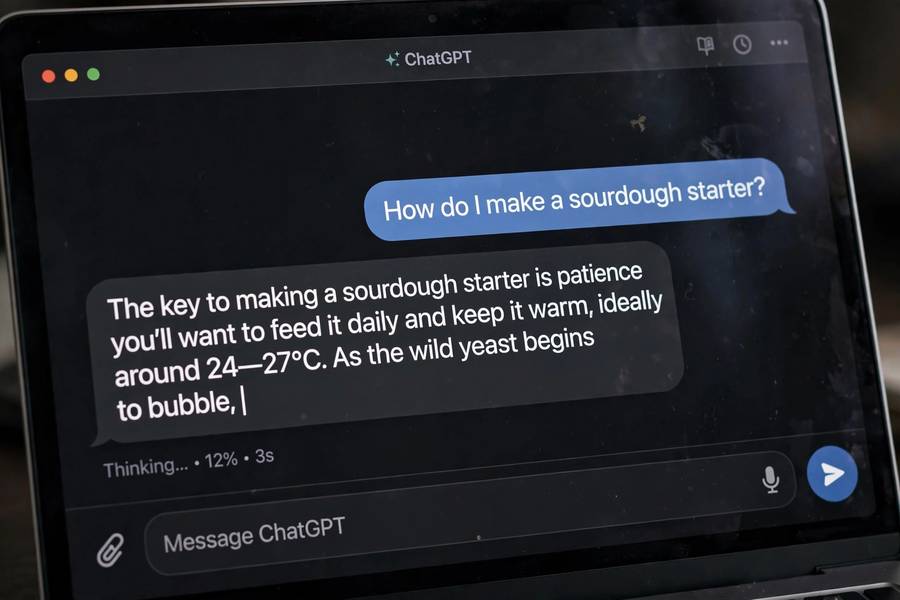
A typical response involves hundreds of these prediction steps, each taking milliseconds. The streaming effect you see — words appearing one by one — is literally the generation loop made visible.
Notice what’s not in this loop: planning, revision, or self-correction. ChatGPT can’t go back and fix an earlier sentence (it can only continue forward). This is why it sometimes paints itself into corners — it’s committed to every token it already produced.
Where the “Knowledge” Comes From
If there’s no database, where do facts come from? From training — the model was exposed to enormous amounts of text (books, websites, articles) and adjusted its billions of parameters to predict that text well. In doing so, it absorbed statistical patterns that encode factual knowledge.
Think of it like this: after reading thousands of texts saying “Paris is the capital of France,” the model’s parameters strongly associate those concepts. When you ask, the prediction machinery surfaces “Paris” with high probability. The knowledge isn’t stored as facts — it’s distributed across the parameters as patterns that produce factual-sounding text.
This explains both the brilliance and the brittleness: – Brilliant because the patterns capture genuine regularities of the world as reflected in text – Brittle because the model has no separate mechanism for verifying truth — plausibility and truth feel identical from inside the prediction loop
The Role of Temperature: Creativity vs. Predictability
Every generation involves randomness, controlled by a setting called temperature:
- Low temperature (~0): the model almost always picks the most likely token. Responses are predictable, consistent, and safe — but potentially boring and repetitive.
- High temperature (~1): the model samples more adventurously from lower-probability tokens. Responses are more creative and varied — but more likely to go off the rails.
- Default (ChatGPT): a middle value balancing coherence and natural variation.
This is why asking the same question twice gives different answers: the sampling randomness means different tokens get picked at decision points, and those small divergences cascade into different responses. It’s also why “regenerate” sometimes fixes a bad answer — you’re just rolling the dice again.
Why This Explains Hallucinations
Hallucinations — confident falsehoods — aren’t a bug in the prediction machinery. They’re the expected output of it. When the model lacks strong patterns for your question, it still must predict something — and it predicts the most plausible-sounding continuation, which may be entirely fabricated.
The model has no “I don’t know” instinct because training rewarded fluent completion, not epistemic humility. (Later fine-tuning added some refusal behaviors, but the underlying drive to produce plausible text remains.)
Understanding this changes how you use ChatGPT: you stop treating it as an oracle and start treating it as a brilliant-but-unreliable assistant whose outputs need verification. That shift — from trust to supervised collaboration — is the single most important skill in using AI well. My guide on how to get better answers from ChatGPT builds on exactly this understanding.
What ChatGPT Is Actually Good At
Given the prediction mechanism, the strengths make sense:
- Language tasks — writing, editing, summarizing, translating, explaining. Prediction is language; this is home turf.
- Brainstorming and variation — generating many plausible options quickly. Sampling randomness becomes a feature.
- Pattern completion — code, templates, structured formats. If it looks like patterns in training data, the model nails it.
- Role-play and style — adopting voices, formats, and personas. Style is pure statistical pattern.
And the weaknesses follow equally: – Novel reasoning — multi-step logic it hasn’t seen patterned before – Precise facts — dates, numbers, citations (plausibility ≠ accuracy) – Real-time information — unless browsing is enabled, it’s frozen at training time – Consistency — it can’t check its own work against reality
ChatGPT generates responses the way a master improviser performs: no script, just an exquisite sense of what comes next, built from absorbing more language than any human ever will. It’s not thinking — but prediction at this scale produces something that rhymes with thought closely enough to be extraordinarily useful, as long as you remember what it actually is.
Frequently Asked Questions
By predicting the next token (word piece) over and over — each prediction informed by all previous text. It samples from probability distributions learned during training, appending one token at a time until the response is complete. There’s no database lookup or deliberation involved.
By default, no — it generates from patterns learned during training, not by searching. Some versions have optional browsing/search features that can fetch current information, but the core response generation is pure prediction from trained parameters.
Because generation involves randomness (controlled by “temperature”). Each run samples tokens probabilistically, so different tokens get picked at decision points and responses diverge. Lower temperature = more consistent; higher = more varied.
A setting controlling randomness in token sampling. Low temperature makes the model pick the most likely tokens (predictable, safe); high temperature allows more surprising choices (creative, but riskier). ChatGPT’s default balances the two.
Not in the human sense. It manipulates statistical patterns of language with extraordinary sophistication, producing text that demonstrates understanding-like behavior. Whether that counts as “understanding” is debated — but mechanically, it’s prediction, not comprehension.