The first time I drove a CVT, I thought the transmission was broken. The engine revved to 4,000 RPM and just… stayed there while the car kept accelerating. No shifts, no drama. My brain was waiting for a gear change that never came. That weird sensation is exactly what makes a CVT different — and once you understand the mechanism, it’s genuinely clever engineering.
If you want the big-picture overview first, my guide to what a CVT transmission is covers the basics. Here, we’re going inside the case to see how it actually works.
Table of Contents
- The Core Idea: Infinite Ratios, No Gears
- The Two Pulleys: Input and Output
- The Belt: The Hardest-Working Part
- Hydraulics: The Muscle Behind the Magic
- The Torque Converter and Start Clutch
- The Brain: Sensors and the Transmission Control Module
- Why the Engine Holds One RPM
- Simulated Gears: Why Some CVTs Fake Shifts
- Frequently Asked Questions
The Core Idea: Infinite Ratios, No Gears
A conventional automatic has, say, 8 gears — 8 fixed ratios between the engine and the wheels. A CVT has no fixed gears at all. Instead, it can vary the ratio continuously between its highest and lowest extremes — effectively infinite ratios.
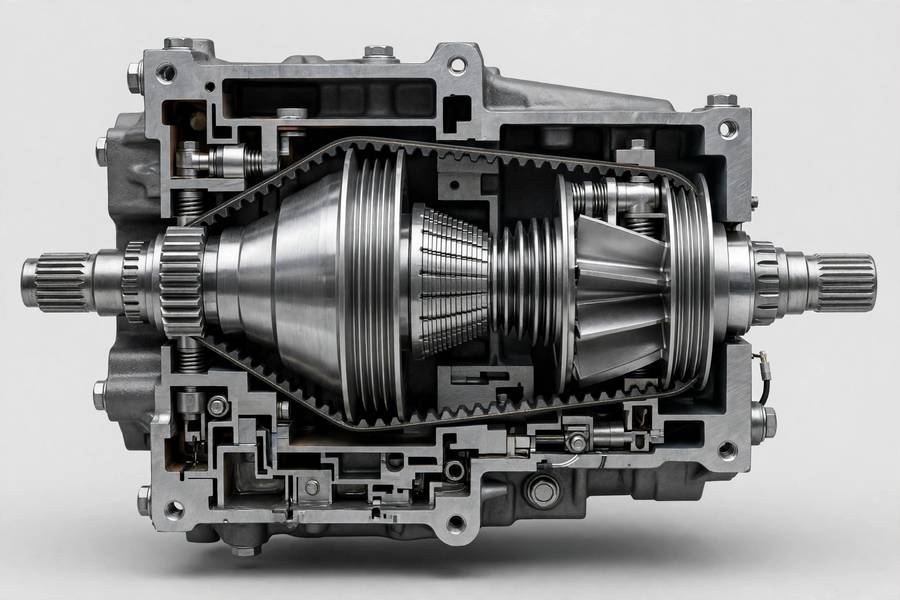
Think of it like this: imagine two cones pointing at each other, with a belt looped between them. Slide the belt toward the fat end of one cone and the skinny end of the other, and you’ve got a tall gear. Slide it the opposite way and you’ve got a low gear. Stop anywhere in between and you’ve got a ratio no conventional gearbox could ever offer — because they can only pick from their fixed set.
That’s the entire magic trick. The CVT is always in exactly the right ratio for the moment — accelerating, cruising, climbing — instead of being close to the right ratio like a geared transmission. This is why CVTs are so efficient: the engine can sit at its most efficient RPM while the transmission handles the speed variation.
The Two Pulleys: Input and Output
The “cones” in my analogy are actually pairs of conical discs — variator pulleys — and there are two sets:
- The primary (input) pulley connects to the engine via the torque converter or start clutch. It takes power in.
- The secondary (output) pulley connects to the final drive and wheels. It sends power out.
Each pulley is split into two halves that can slide toward or apart from each other on their shaft. When the halves squeeze together, the belt is forced to ride higher — on a larger effective diameter. When they spread apart, the belt drops lower — a smaller effective diameter.
Low gear: primary pulley halves spread (belt rides low, small diameter), secondary halves squeezed (belt rides high, large diameter). High gear: the reverse. And every ratio in between is just a different position of those four sliding halves. It’s beautifully simple in concept.
The Belt: The Hardest-Working Part
The belt connecting the two pulleys is the most stressed component in the whole transmission. Modern CVTs use one of two designs:
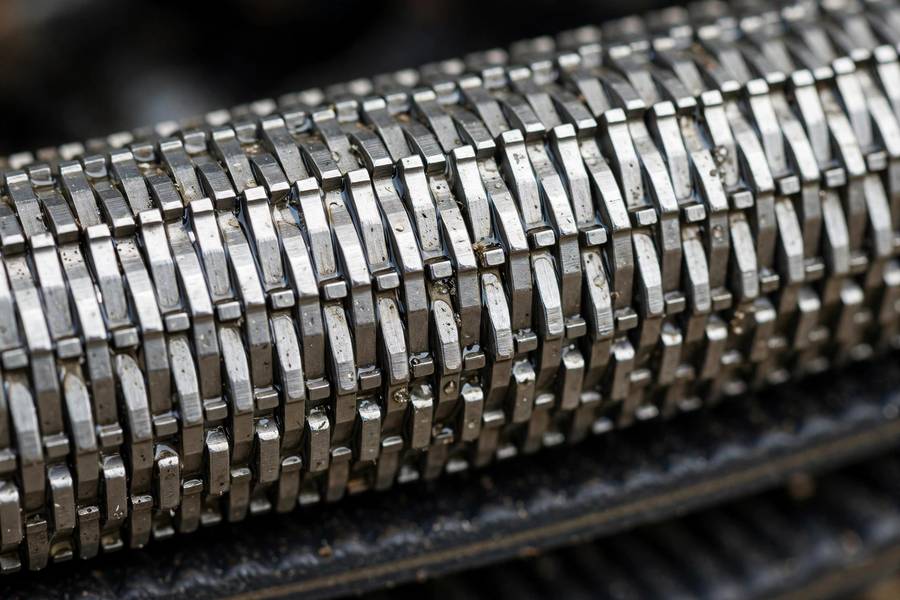
Steel push belts (most common in passenger cars) are made of hundreds of thin metal segments — called elements — held together by layered steel bands. The “push” part matters: unlike a rubber belt that pulls, the elements push against each other to transmit force. These belts handle enormous compression loads and are why a CVT can move a two-ton SUV.
Chains (Subaru’s Lineartronic, some others) use a link-style chain that functions similarly. Chains handle high torque a bit better, which is why you see them in vehicles with more grunt.
Either way, the belt depends on one thing above all: friction. The steel belt doesn’t have teeth engaging gears — it grips the pulley faces through friction alone, maintained by tremendous clamping force. This is exactly why CVT fluid is so specialized and why degraded fluid causes slipping. No grip, no drive.
Hydraulics: The Muscle Behind the Magic
Moving those pulley halves against belt tension takes serious force — far more than any electronic actuator could deliver cheaply. So CVTs use hydraulic pressure generated by a pump driven off the input shaft.
The transmission control module (TCM) commands solenoid valves that direct this pressure to the back sides of the pulley halves, squeezing or releasing them to hit the target ratio. We’re talking about precision control: the system adjusts clamping force in milliseconds based on throttle position, engine torque, vehicle speed, and temperature.
This hydraulic dependency is why CVT problems so often trace back to fluid. Low fluid, degraded fluid, or a failing pump means the pulleys can’t clamp hard enough — and that shows up as slipping, shuddering, or ratio faults. The hydraulics are the transmission’s circulatory system; when the blood goes bad, everything suffers.

The Torque Converter and Start Clutch
Here’s a question I get a lot: if a CVT has no gears, what connects the engine to the pulleys when you’re stopped at a light? You need something that lets the engine idle while the car isn’t moving.
Most CVTs use one of two solutions:
- A torque converter, just like a conventional automatic. It’s a fluid coupling that multiplies torque at launch and then locks up for efficiency. Many modern CVTs lock the converter early to save fuel.
- A start clutch (Honda used these in some designs, others too). It’s a wet clutch pack that slips progressively as you pull away, then fully engages.
Either way, once you’re rolling, the connection is solid and the pulleys take over ratio duties. If you’ve ever felt a shudder right off the line in a CVT, the start device is a prime suspect — especially the torque converter lockup clutch.
The Brain: Sensors and the Transmission Control Module
A CVT is only as smart as its control system. The TCM constantly reads:
- Input and output speed sensors — these tell it the actual ratio at any moment
- Throttle position — how hard you’re asking for power
- Engine torque and load — how much force the belt must handle
- Fluid temperature — heat changes everything in a CVT
- Brake and vehicle speed signals — for coast-down and launch logic
From these, the TCM decides the ideal ratio every few milliseconds. Want maximum acceleration? It drops the ratio low and holds the engine at peak power RPM. Cruising on flat highway? It stretches the ratio tall and lets the engine loaf at 1,800 RPM. Climbing a grade? Somewhere in between.
This is also how the transmission protects itself. If the TCM sees the belt slipping (commanded ratio vs. actual ratio mismatch), it can cut engine torque, raise line pressure, or trigger limp mode. That’s the computer saving the hardware from you — or from itself.
Why the Engine Holds One RPM
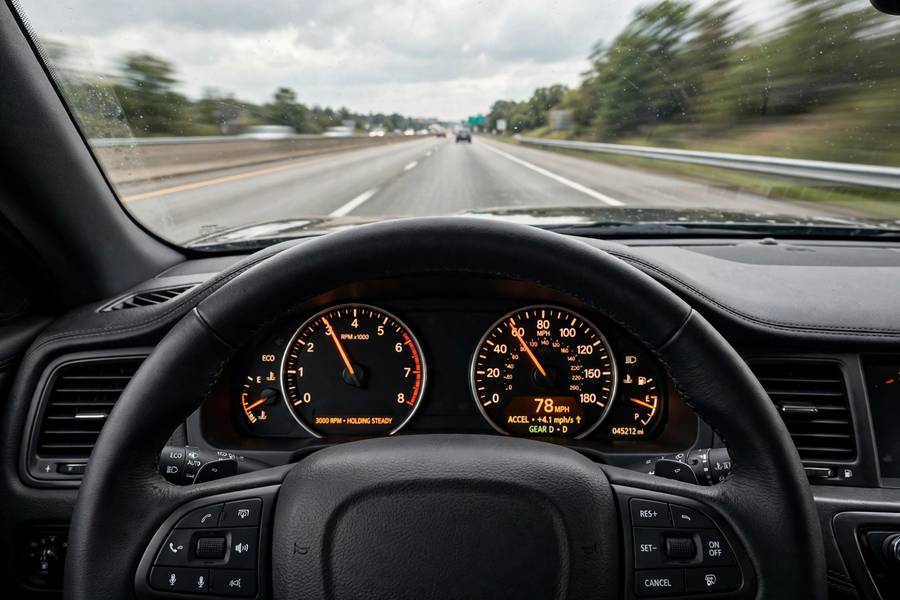
Back to that weird first-drive experience. In a conventional car, acceleration means the engine revs up through a gear, shifts, drops, revs again. In a CVT under hard acceleration, the TCM picks the engine’s peak-power RPM — say 5,500 — and holds it there while the pulleys continuously change ratio to accelerate the car.
Engineers call this the “rubber band” effect, and it’s the single most efficient way to accelerate: the engine never leaves its sweet spot. Your brain finds it strange because decades of driving have trained you to associate acceleration with rising and falling RPM. But the flat-RPM acceleration is the CVT doing its job perfectly.
Some drivers hate the sensation — it feels disconnected, like the car is slipping. Others don’t notice after a week. If it bothers you, that’s exactly why many manufacturers added simulated shift points (see below). The efficiency payoff is real, though: by keeping the engine at its best fuel-consumption point during acceleration, a CVT can beat a conventional automatic’s economy by a meaningful margin in mixed driving. The rubber band isn’t just a sensation — it’s the whole point of the design.
Simulated Gears: Why Some CVTs Fake Shifts
Here’s the funny part: after engineering a transmission that eliminates shifts, manufacturers spent years adding fake ones back in. Most modern CVTs include programmed “step” points where the TCM briefly holds fixed ratios to mimic a conventional automatic’s shifting.
Why? Purely for driver feel. Focus groups consistently said the droning, shiftless acceleration felt wrong — even though it’s more efficient. So the software pretends. Sport modes often make the fake shifts more pronounced; eco modes let the CVT do its stepless thing.
I have mixed feelings about this. On one hand, it’s dishonest engineering theater. On the other, if fake shift points make drivers comfortable with an efficient transmission, everybody wins. Just know that when your CVT “shifts,” it’s the computer playing pretend — the belt never left its smooth glide.
For the full head-to-head with conventional gearboxes, see my comparison of CVT vs a conventional automatic transmission (publishing soon in this series).
Frequently Asked Questions
It uses two variable-width pulleys connected by a steel belt or chain. Hydraulic pressure squeezes or spreads the pulley halves, changing the belt’s riding diameter and creating an infinite range of ratios instead of fixed gears.
Hydraulic pressure. A pump generates pressure, and the transmission control module directs it through solenoids to the pulley halves, adjusting them in milliseconds to hit the ideal ratio.
The transmission computer picks the engine’s most efficient or most powerful RPM and holds it there while the pulleys continuously change ratio. This “rubber band” effect is the most efficient way to accelerate.
Most do — a torque converter or start clutch connects the engine to the pulleys at launch, just like in a conventional automatic. It locks up once you’re rolling for efficiency.
Manufacturers program simulated shift points into the software because drivers found the shiftless drone unsettling. The “shifts” are fake — the belt keeps gliding smoothly while the computer briefly holds fixed ratios.