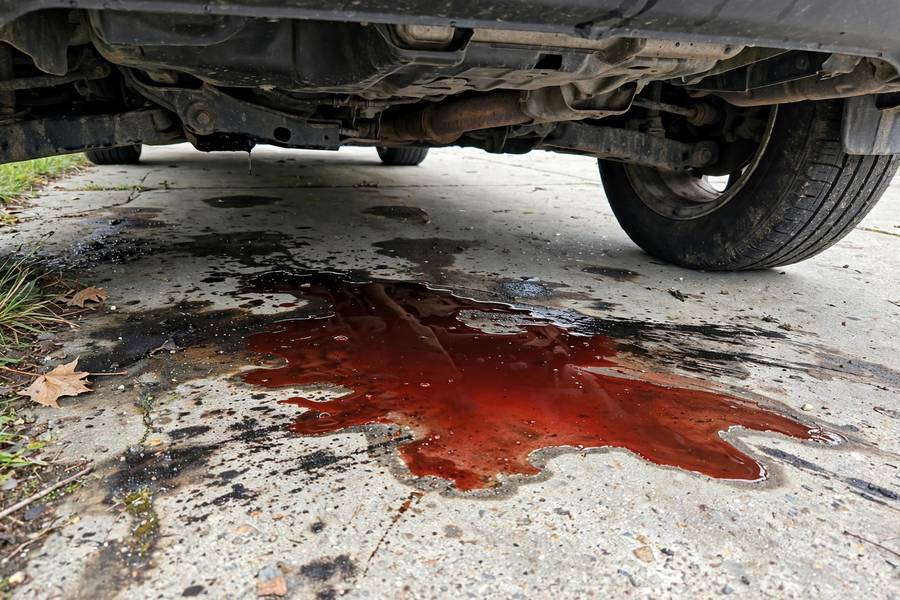
Short answer: you can, but every mile is a gamble, and the house always wins eventually. Low transmission fluid is one of those problems that starts as an inconvenience — a little slip here, a hard shift there — and ends as a four-figure repair bill. The transmission doesn’t send you a polite letter asking for fluid. It just starts eating itself.
I’ve had people ask me “how far can I drive it like this?” and I always give the same answer: as far as the nearest place you can add fluid, and not one mile more than necessary. Here’s why, what the damage looks like, and what to do right now.
Table of Contents
- Why Low Fluid Is So Damaging
- What You’ll Feel: The Warning Signs
- How Far Can You Actually Drive?
- What to Do Right Now
- The Damage Timeline: What Low Fluid Does Over Time
- Why Is It Low? Find the Leak
- The $40 Decision: Top Off Now or Tow It
- Frequently Asked Questions
Why Low Fluid Is So Damaging
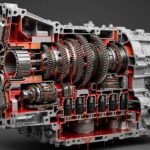
Transmission fluid does three jobs at once: it’s the hydraulic medium that applies the clutches, the lubricant for gears and bearings, and the coolant that carries heat away. Low fluid compromises all three simultaneously. That’s what makes it so destructive — it’s not one system failing, it’s everything at once.
Loss of hydraulic pressure. Clutches and bands engage via fluid pressure. Low fluid means low pressure, which means clutches slip instead of gripping firmly. Slipping generates enormous heat — and heat is the number one killer of transmissions.
Loss of lubrication. Gears, bearings, bushings — they all depend on a constant bath of fluid. Run low and metal starts touching metal. That’s not a metaphor; that’s actual metal-on-metal contact inside a precision machine with tolerances measured in thousandths of an inch.
Loss of cooling. The fluid carries heat to the cooler. Less fluid, less cooling capacity, more heat. And heat breaks down the remaining fluid faster, which makes everything worse. It’s a death spiral: low fluid → heat → degraded fluid → more wear → more heat.
Air in the system. When the fluid level drops low enough, the pump starts sucking air. Aerated fluid can’t build pressure and can’t lubricate. The transmission starts behaving erratically — slipping, banging into gear, refusing to engage — because it’s literally trying to work on foam.
What You’ll Feel: The Warning Signs
Your car will tell you the fluid is low before it dies. Listen to it:
- Delayed engagement. You shift into Drive or Reverse and… nothing… then a clunk as it finally grabs. That’s low pressure struggling to apply the clutches.
- Slipping. The engine revs but the car doesn’t accelerate proportionally, especially under load or going uphill. The tachometer climbs, the speedometer doesn’t.
- Harsh or erratic shifting. Bangs into gear, shifts at weird times, hunts between gears. Inconsistent hydraulic pressure means inconsistent shifts.
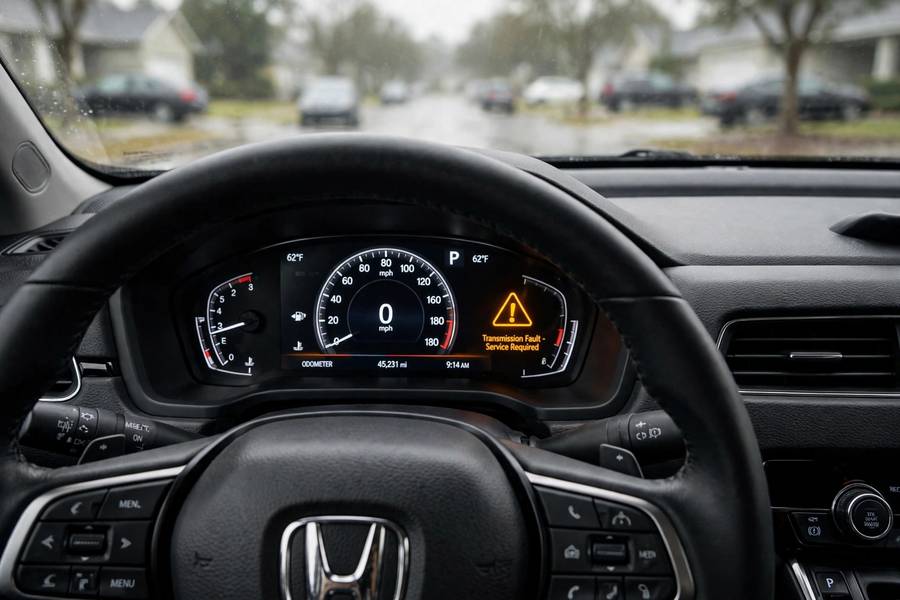
- Overheating warnings. Some cars have a transmission temperature warning. If it lights up, stop. Now.
- Whining or buzzing noises. The pump cavitating — sucking air — makes a distinctive whine that changes with engine speed.
- No movement at all. In the worst case, the transmission won’t engage any gear. At that point, you’re done driving.
If you’re feeling any of these, check your transmission fluid level immediately — before you drive it again.
How Far Can You Actually Drive?
I get asked for a number. Here’s my honest, unsatisfying answer: it depends on how low, and there’s no safe number.
- Slightly low (just below the mark), no symptoms: you can drive to the parts store, buy fluid, and top it off. Tens of miles, gently. This is the “add fluid today” zone.
- Noticeably low with mild symptoms (slight slip, delayed engagement): drive only as far as absolutely necessary — the nearest safe place to add fluid or the nearest shop. A few miles, easy driving, no highway, no hills, no towing.
- Severely low with major symptoms (heavy slipping, won’t stay in gear, overheating): do not drive it. Call a tow. Every revolution of those slipping clutches is shaving material off them, and clutch material doesn’t grow back.
The thing people don’t understand: the damage isn’t linear. A transmission can tolerate being a little low for a while, then cross a threshold where the pump sucks air and the damage accelerates dramatically. You don’t get a warning at the threshold — you just go from “driving with a problem” to “needing a rebuild.”
My rule: if it’s low enough to cause symptoms, it’s low enough to tow.
What to Do Right Now
Okay, practical steps, in order:
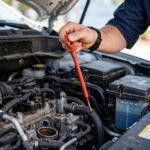
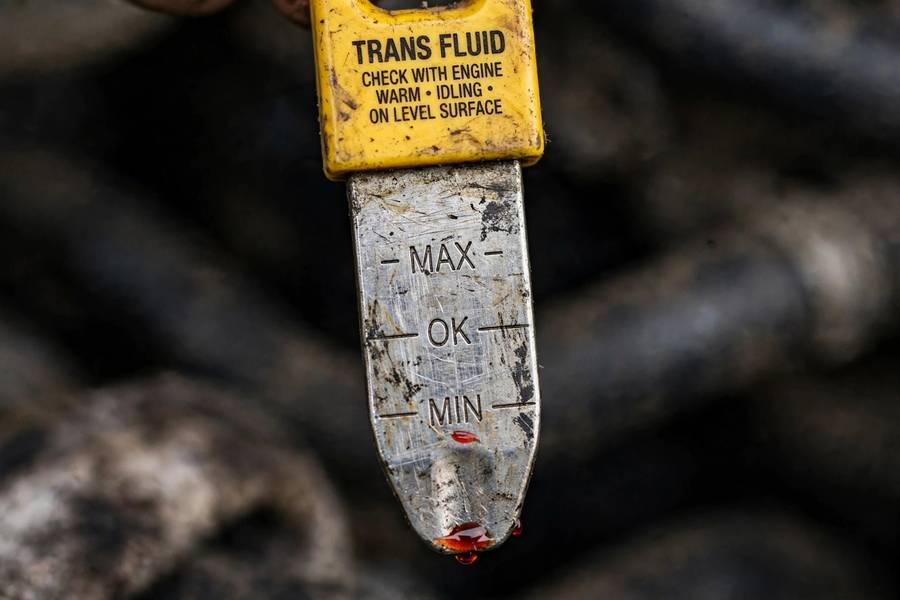
- Check the level properly. Engine running, in Park, on level ground, fluid at operating temperature. Confirm it’s actually low and note how low.
- Look under the car. Red or pink puddle? That’s your answer for why it’s low — and also a sign of how urgent this is. Fresh, active dripping means don’t drive it.
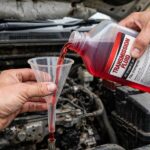
- Add the correct fluid. If you have the right spec on hand, top it off following the proper procedure — I cover it step by step in my guide on how to add transmission fluid. Add slowly, recheck at temperature.
- Drive gently to get it diagnosed. Even topped off, a transmission that was run low needs attention. The leak needs fixing, and the unit should be checked for damage.
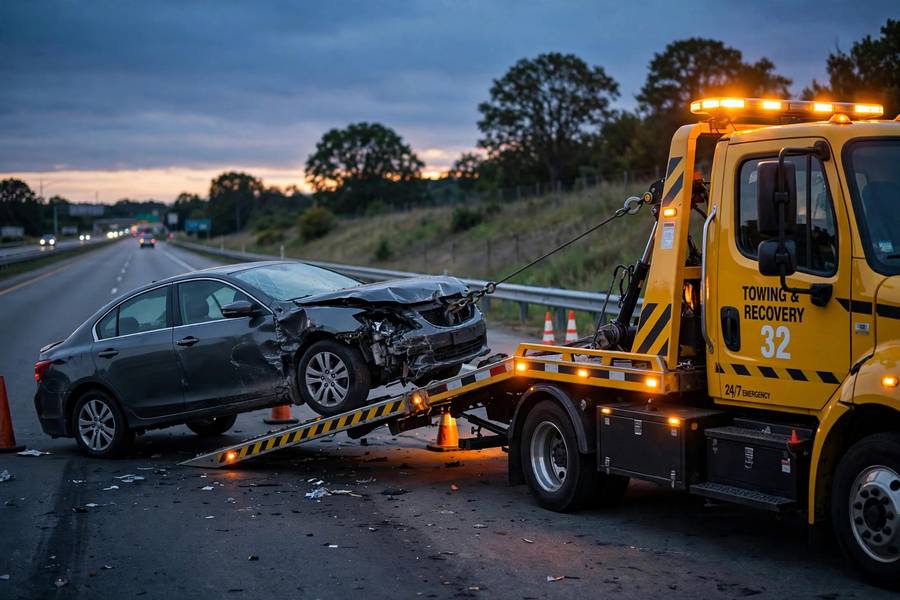
- If you don’t have fluid or the leak is severe: tow it. A tow costs $75-150. A rebuild costs $3,000-5,000. The math isn’t close.
The Damage Timeline: What Low Fluid Does Over Time
People ask “how bad can it be, really?” Here’s the progression I’ve seen play out:
Hours to days: Clutch slippage begins. You might not even notice at first — just a slightly soft shift here and there. Heat starts building beyond normal.
Days to weeks: Slipping becomes obvious. Shift quality degrades. The fluid that’s left is getting cooked by the excess heat, turning dark and losing its protective properties. Metal wear accelerates.
Weeks: Clutch friction material is significantly worn. Metal particles circulate in the degraded fluid, accelerating wear everywhere. The transmission may start throwing codes or going into limp mode (locked in one gear to protect itself).
Eventually: Clutch packs burned beyond function, hard parts scored, possibly a failed pump from cavitation. At this point you’re not servicing a transmission — you’re rebuilding or replacing one.
The cruel part: the early stages are cheap to fix (add fluid, fix a $20 seal). The late stages are not. Low fluid is one of the most expensive problems to ignore in all of car ownership.
Why Is It Low? Find the Leak
Transmissions don’t consume fluid. If it’s low, it’s leaking — full stop. Common sources, from cheapest to most painful:
- Pan gasket — the usual suspect. Seepage around the transmission pan. Gasket replacement is routine.
- Cooler lines and fittings — lines running to the radiator. Often just a fitting or a section of line.
- Axle seals — where the axles enter the transmission. Fluid flings onto nearby components.
- Dipstick tube seal — small, cheap, easy.
- Torque converter seal / front pump seal — fluid dripping from between the engine and transmission. This one’s labor-intensive because the transmission has to come out.
I’ve got a full rundown of transmission fluid leak symptoms — how to spot each type, what the drip patterns mean, and how urgent each one is. Find the leak, fix the leak, then keep an eye on the level for a while to confirm it’s actually sealed.
The $40 Decision: Top Off Now or Tow It
Let me put the “how far can I drive” question in dollars, because money makes the decision obvious in a way that mechanical warnings don’t.
A quart of the correct ATF or CVT fluid costs roughly $8–15 at the parts store. A tow truck costs $75–150 for a local pull. A replacement CVT costs $4,000–8,000 installed. A conventional automatic rebuild runs $2,500–4,500. Those four numbers are the entire decision tree.
If the level is only slightly low — fluid on the dipstick but below the “hot” mark, no slipping yet, no warning light — the correct move is the cheap one. Buy the correct fluid (the exact spec in your owner’s manual, not “universal” anything), top it off, and drive to a shop to find the leak. That $15 quart just bought you the cheapest possible outcome.
If it’s slipping, whining, or the light is on — the $40 gamble (a few quarts and hope) is the most expensive choice on the menu. Every mile you drive a slipping transmission converts a $15 problem into a $4,000 problem. A $100 tow is the bargain of the century compared to what slipping clutches cost per mile.
If you can’t check the level — sealed unit, no dipstick, stuck on the roadside — do not guess. A tow is $100. A dry CVT belt is $6,000. The tow wins every time.
I tell customers: when the number on the left is under $50 and the number on the right has four digits, you don’t need a mechanic’s advice. You need to stop negotiating with yourself and make the cheap call.
One more thing: if a dashboard warning light came on along with the symptoms, don’t guess at what the car is reporting — what the check engine light means breaks down the common triggers. A transmission-specific scan tells the full story, but knowing the basics keeps you from being sold a repair you don’t need.
Frequently Asked Questions
Short distances only, and gently. Low fluid causes clutch slippage, overheating, and accelerated wear. If the transmission is slipping badly or overheating, don’t drive it — tow it. Every mile on low fluid risks turning a cheap fix into a rebuild.
The transmission will quickly overheat, clutches will burn, and metal components will grind without lubrication. Driving with essentially no fluid can destroy a transmission in minutes to hours. If the fluid is gone, the car needs a tow, not a drive.
Check the dipstick with the engine running, in Park, on level ground, at operating temperature. Symptoms of low fluid include delayed engagement, slipping, harsh shifting, whining noises, and overheating warnings. A red puddle under the car confirms a leak.
It can. Low fluid causes slipping and overheating, which the transmission control module detects and reports as fault codes. But don’t wait for the light — check the level at the first sign of shifting problems.
Yes. If the fluid is low enough that the pump can’t build hydraulic pressure, the clutches won’t engage and the car won’t move in any gear. This is severe — add fluid or tow it to a shop for diagnosis.