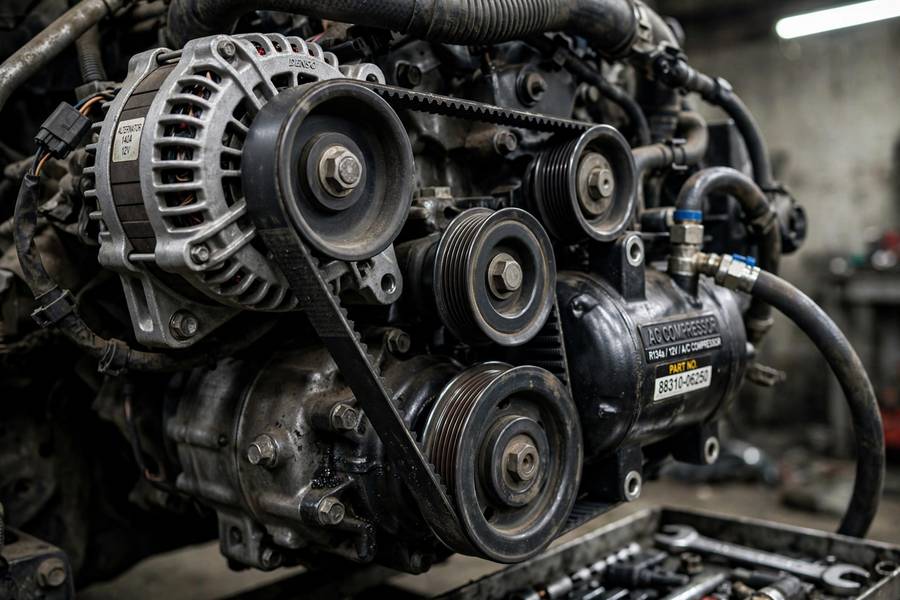
Open any modern hood and you’ll see it: one long belt snaking around half a dozen pulleys. That’s the serpentine belt, and despite looking like an afterthought, it’s one of the most critical parts in your engine bay. When it fails, everything it drives fails with it — sometimes within minutes.
Ten years in the shop, and serpentine belts taught me a useful lesson about cars: the cheapest parts often cause the most expensive failures. Let me explain what a serpentine belt is, what it does, how to tell when it’s dying, and what happens if you ignore it.
Contents
- What It Is and What It Drives
- Why “Serpentine”? (And What Came Before)
- How Long Do They Last?
- 7 Signs Yours Is Failing
- What Happens When It Breaks
- Replacement: Cost and What’s Involved
- The Tensioner and Pulleys (Don’t Ignore These)
What It Is and What It Drives
The serpentine belt is a single, continuous ribbed belt that drives multiple engine accessories off the crankshaft. On a typical car, it powers:
- Alternator — charges the battery and runs the electrics
- Power steering pump (on hydraulic systems — many newer cars are electric)
- Air conditioning compressor
- Water pump (on many engines — this is the critical one)
- Sometimes: smog pump, supercharger
One belt, many jobs. That’s the elegance and the vulnerability: a single point of failure for everything accessory-related. When the belt goes, you lose all of them simultaneously.
Modern belts are made of EPDM rubber (older ones were neoprene) — tougher, more heat-resistant, and longer-lived than the belts of the past. The ribs on the inside grip the pulleys; the flat backside sometimes drives components too.
Why “Serpentine”? (And What Came Before)
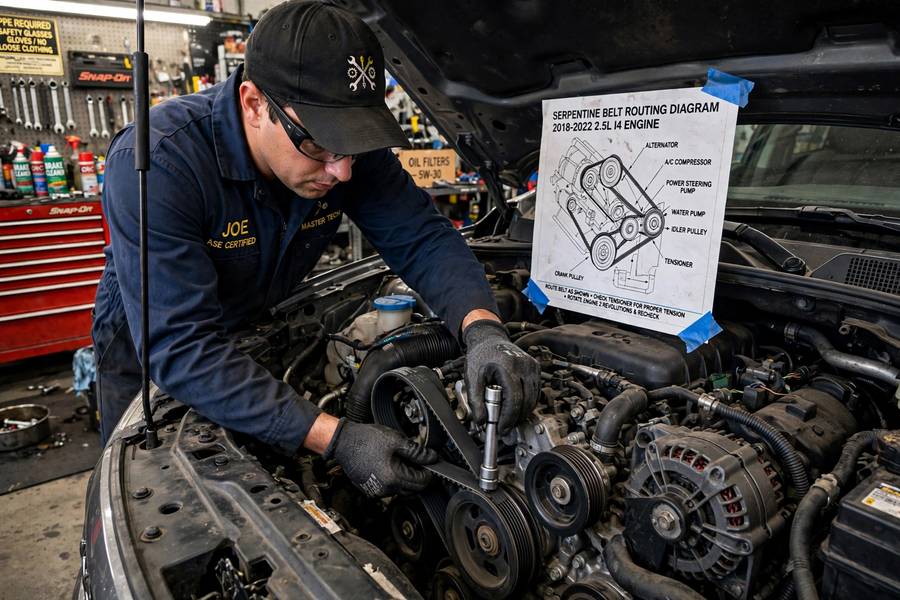
The name comes from the belt’s winding path — it snakes (“serpentines”) around multiple pulleys in a complex routing that looks almost decorative. There’s usually a routing diagram on a sticker under the hood or on the radiator support; photograph it before you touch anything.
Before serpentine belts (pre-1980s roughly), cars used multiple V-belts — separate belts for the alternator, power steering, AC, and so on. Each needed individual tensioning, they slipped more, and replacing one meant loosening others. The serpentine design consolidated everything into one self-tensioning belt: simpler, more reliable, easier to service. It was a genuine improvement, not just cost-cutting.
How Long Do They Last?
Modern EPDM serpentine belts typically last 60,000–100,000 miles. That’s roughly double the old neoprene belts.
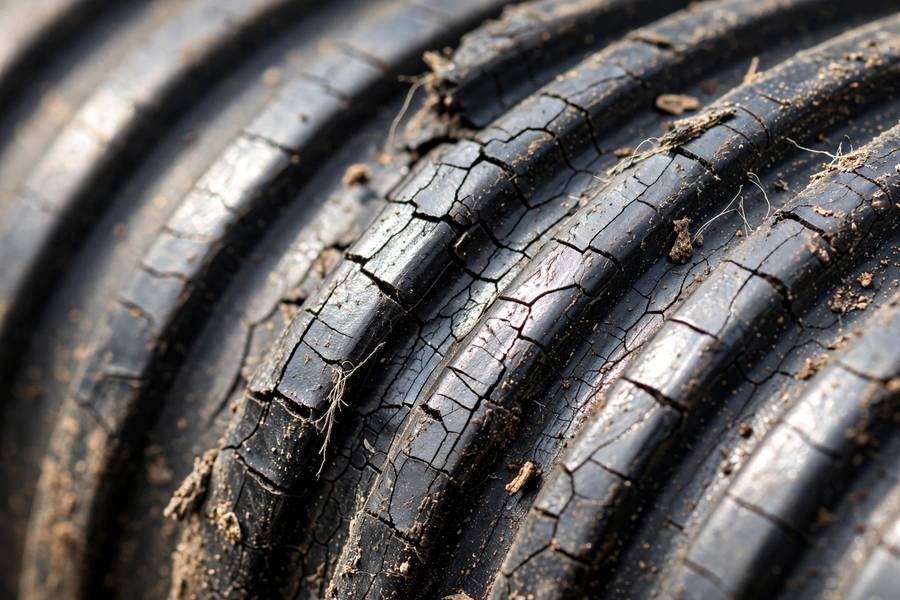
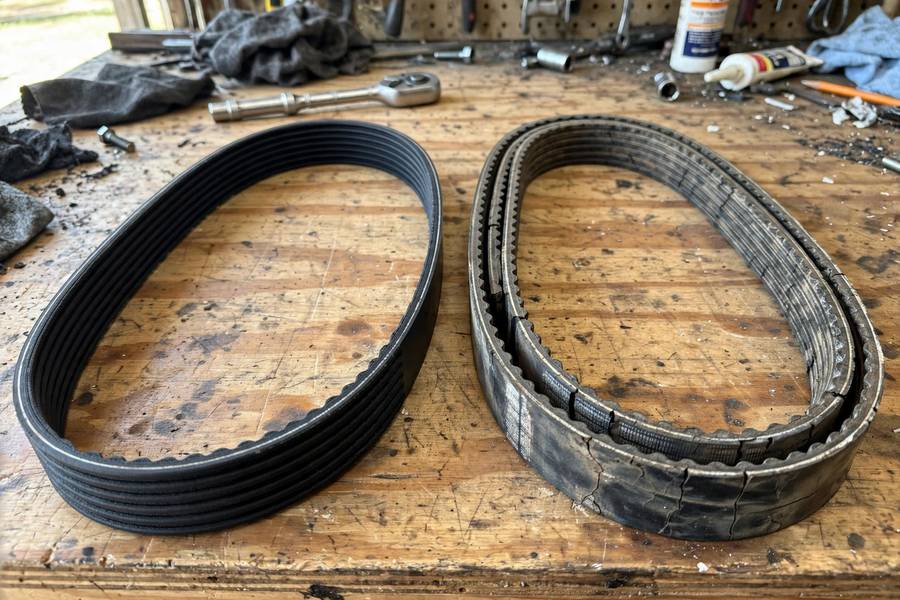
Here’s the catch I warn everyone about: EPDM belts don’t show wear the way old belts did. Neoprene belts cracked visibly when worn — you could see it. EPDM wears by losing rib material gradually, looking fine right up until it isn’t. The old “look for cracks” test doesn’t work anymore. By the time an EPDM belt shows cracks, it’s been dead for a while.
So don’t wait for visual confirmation. Go by mileage and age: if you’re past 80,000 miles or the belt is 7+ years old, have it inspected by someone who knows what EPDM wear looks like (a belt wear gauge tool measures rib depth — good shops have them).
7 Signs Yours Is Failing
From the shop, in rough order of appearance:
- Squealing on startup or acceleration. The classic. Usually the belt slipping on a pulley — from wear, contamination (oil or coolant on the belt), or a weak tensioner. A brief squeal in damp morning air can be normal; persistent squealing is not.
- Chirping that changes with engine speed. A rhythmic chirp tracking RPM often means a misaligned pulley or a belt wearing unevenly.
- Visible glazing — the belt’s ribbed side looks shiny and smooth instead of matte. Glazing = slipping = reduced grip.
- Cracks, fraying, or missing chunks. On EPDM this means severely overdue, but check anyway.
- Power steering feels heavy intermittently — the belt slipping on the PS pump pulley.
- Battery warning light + overheating together. The belt drives both the alternator and (often) the water pump. Both failing at once = belt problem until proven otherwise.
- AC stops blowing cold suddenly. If the compressor clutch isn’t engaging because the belt’s gone, the AC dies with everything else.
What Happens When It Breaks
This is the part that gets people’s attention. When the serpentine belt snaps or flies off:
- Power steering: gone immediately (hydraulic systems). The car becomes extremely hard to steer — manageable at speed, brutal in a parking lot.
- Alternator: gone. You’re running on battery alone — typically 20–30 minutes of driving before the battery dies and everything electrical shuts down. If that happens to you on the roadside, here’s how to jump start a car safely once you get a charge back.
- Water pump (if belt-driven): gone. The engine starts overheating within minutes. This is the killer — keep driving and you’ll warp the head or worse.
- AC: gone. Uncomfortable, not dangerous.
The correct response to a snapped belt: pull over safely and shut it off as soon as the temperature starts climbing. Do not “try to make it home” while overheating. A $150 belt job becomes a $3,000 engine job very quickly when heat is involved.
Some engines drive the water pump with the timing belt/chain instead — in which case a serpentine failure strands you (no charging, no steering) but won’t overheat the engine. Know which type you have; it changes the urgency calculus.
Replacement: Cost and What’s Involved
The good news: this is one of the cheaper professional repairs.
- Belt alone: $25–75 for the part
- Labor: 0.5–1 hour on most cars ($75–150)
- Total at a shop: typically $100–200
- DIY: the belt plus basic hand tools — very doable on most 4-cylinder engines
Some cars are miserable (transverse V6s with the belt buried against the frame rail — looking at you, several someones), but most are straightforward: release the tensioner with a wrench, slip the old belt off, route the new one per the diagram, release the tensioner. Take a photo of the routing before you start. I say this from experience — “I’ll remember” is famous last words.
Always replace the belt before a long trip if it’s due. A belt never breaks in your driveway; it breaks at night, in the rain, 40 miles from anywhere. While you’re in DIY maintenance mode, cleaning your car’s headlights is another cheap job that makes night driving dramatically safer.
The Tensioner and Pulleys (Don’t Ignore These)
Here’s the pro tip that separates a lasting repair from a repeat failure: the belt is often not the real problem.
The automatic tensioner keeps the belt tight via a spring-loaded pulley. When the tensioner’s spring weakens or its bearing wears, the belt slips and squeals — and a new belt on a bad tensioner will fail early. Similarly, idler pulleys have bearings that wear out; a seized idler will shred a new belt in days.
My rule in the shop: at belt replacement mileage, inspect the tensioner and idlers. Spin each pulley by hand — they should spin smoothly and silently. Any grinding, wobbling, or noise means replacement. Many techs (me included) recommend replacing the tensioner with the belt as preventive maintenance — the parts are cheap compared to doing the job twice.
A complete job — belt, tensioner, idlers — might run $250–400 at a shop. That’s still cheap insurance against being stranded, and it means you won’t think about the front of your engine for another 80,000 miles.
Timing Belt vs Serpentine Belt: Don’t Confuse Them
Last point of confusion I clear up constantly in the shop: the serpentine belt is not the timing belt, and mixing them up leads to bad decisions.
Serpentine (accessory) belt: outside the engine, visible, drives accessories (alternator, AC, power steering, sometimes water pump). When it breaks, accessories stop — annoying, sometimes urgent, but the engine’s internals are unharmed. Replacement: $100–200.
Timing belt/chain: inside the engine (behind covers), synchronizes the crankshaft and camshaft — it times the valves to the pistons. When it breaks on an interference engine, pistons hit valves and the engine destroys itself internally. Replacement: $500–1,000+ (belt) and it’s mileage-critical.
The practical difference: a serpentine belt failure strands you; a timing belt failure can total the engine. They have different replacement intervals, different costs, and wildly different consequences. When someone says “my belt broke,” the first question is always which belt — and now you know why, and which answer should worry you.
Both are rubber (or chain) loops doing vital jobs, but they live in different worlds. Maintain both on schedule; panic about only one.
Frequently Asked Questions
A serpentine belt is a single continuous ribbed belt that drives multiple engine accessories — alternator, power steering pump, AC compressor, and often the water pump — off the crankshaft. It’s called “serpentine” for its winding path around the pulleys.
Modern EPDM serpentine belts last 60,000–100,000 miles. Unlike old neoprene belts, they don’t crack visibly when worn — they lose rib material gradually — so go by mileage and age rather than appearance.
You lose power steering, battery charging, and air conditioning simultaneously — and if your water pump is belt-driven, the engine overheats within minutes. Pull over safely and shut off the engine if the temperature climbs.
Typically $100–200 at a shop ($25–75 parts, 0.5–1 hour labor). Replacing the tensioner and idler pulleys at the same time adds cost ($250–400 total) but prevents repeat failures.
Briefly, but get it checked soon. Squealing means the belt is slipping — from wear, contamination, or a weak tensioner. A slipping belt can fail suddenly, leaving you without power steering, charging, or (critically) water pump circulation.