Car forums treat this like a religious war. The CVT camp preaches efficiency; the automatic camp preaches durability and soul. I’ve wrenched on both, driven both for years, and here’s my honest take: neither is “better.” They’re different tools for different jobs, and the right choice depends on how you drive and what you value.
If you’re still fuzzy on the CVT side of this fight, read my breakdown of what a CVT transmission is and how it works first. For the deep dive on how a conventional automatic does its thing with planetary gears and a torque converter — that’s a separate article for another day. Here, it’s the head-to-head.
Table of Contents
- The Quick Version
- CVT Pros
- CVT Cons
- Conventional Automatic Pros
- Conventional Automatic Cons
- Fuel Economy: The Real Numbers
- Driving Feel: The Subjective Battle
- Reliability and Repair Costs
- Which Should You Buy
- Frequently Asked Questions
The Quick Version
Short on time? Here’s the whole comparison in one paragraph:
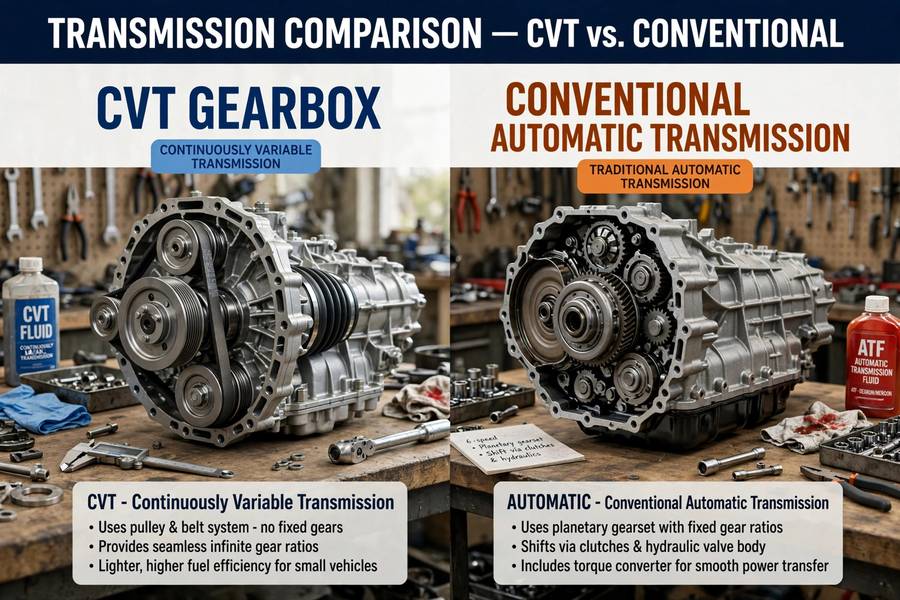
A CVT (continuously variable transmission) uses a belt and pulleys to offer infinite ratios — it’s smoother and typically 5–10% more fuel-efficient, but it can feel disconnected (“rubber band” sensation), is more sensitive to maintenance neglect, and costs more to replace. A conventional automatic uses fixed gears and a torque converter — it feels familiar and responsive, handles high torque and towing better, and is generally more forgiving of missed maintenance, but it’s slightly less efficient and heavier. Both last 150,000–200,000 miles with proper care.
Now the details, because the details are where buying decisions get made.
CVT Pros
Better fuel economy. This is the CVT’s headline act and it’s real. By holding the engine at its most efficient RPM in every situation, a CVT typically beats an equivalent conventional automatic by 5–10% in real-world fuel economy. On a car that gets 30 mpg, that’s 1.5–3 mpg — meaningful over 150,000 miles.
Smoother power delivery. No shifts means no shift shock. Acceleration is one continuous pull. In stop-and-go traffic, this is genuinely pleasant — no hunting between gears, no lurching.
Simpler mechanical design. A CVT has far fewer moving parts than an 8 or 10-speed automatic. No planetary gear sets, no clutch packs for each gear, no complex valve body managing shift logic. Fewer parts means fewer things to break — in theory.
Lighter and more compact. CVTs are generally lighter than multi-speed automatics, which helps both efficiency and packaging in small cars.
Always in the “right” ratio. A 10-speed automatic is close to the ideal ratio most of the time. A CVT is exactly at it, always. Climbing a grade, the CVT finds the perfect ratio for the load instead of bouncing between two gears.
CVT Cons
The driving feel. The infamous rubber-band effect: engine holds one RPM, speed climbs, and your brain insists something is wrong. Manufacturers mask it with fake shift points, but enthusiasts still find CVTs soulless. If you love driving, this matters.
Maintenance sensitivity. This is the big practical downside. A conventional automatic tolerates neglected fluid better than a CVT does. Skip fluid changes on a CVT and you’re gambling with the belt and pulleys. Skip them on a regular automatic and you’ll probably still be fine for a while. (My full take on how long CVT transmissions realistically last digs into this in detail — it’s part of this same CVT series.)
Expensive to replace. When a CVT fails, shops rarely rebuild them — they replace the whole unit. A CVT replacement typically runs $3,500–$7,500 depending on the vehicle. Conventional automatics are more commonly (and sometimes more cheaply) rebuilt.
Torque limitations. Belt-and-pulley systems handle moderate torque fine but struggle with high-torque applications. This is why you don’t see CVTs in heavy-duty trucks, big V8s, or serious tow vehicles. High-performance applications are off the table.
Towing capacity. Related to the above — CVT-equipped vehicles generally have lower tow ratings. If you tow regularly, this alone may settle the debate.
Conventional Automatic Pros
Familiar, engaging feel. Gears shift, the engine note rises and falls, and everything feels the way decades of driving taught you to expect. For driving enthusiasts, this connection matters — a lot.
Proven durability under abuse. Conventional automatics are tough. They handle missed fluid changes, heavy loads, and hard driving better than CVTs. Fleet vehicles, trucks, and taxis have run them for hundreds of thousands of miles.
Better for towing and high torque. Planetary gear sets laugh at torque that would shred a CVT belt. If your life involves trailers, boats, or heavy loads, the conventional automatic isn’t just better — it’s the only real option.
Cheaper and easier to service. Every transmission shop on earth knows conventional automatics. Parts are plentiful, rebuilds are routine, and competition keeps prices sane.
More engaging in sporty driving. Paddle shifters on a real gearbox give you actual control. On most CVTs, the paddles just move between fake shift points — theater, not control.

Conventional Automatic Cons
Slightly worse fuel economy. All those gears add weight and mechanical complexity, and even a 10-speed can’t match the CVT’s perfect-ratio advantage. The gap is narrowing as automatics add more speeds, but the CVT still wins on paper and usually in practice.
Shift hunting. Ever driven an automatic that can’t decide between two gears on a grade? That constant shifting is annoying and wears the transmission. Modern 8–10 speeds hunt less, but it still happens.
Heavier and more complex. More gears means more parts, more weight, and more things that can eventually wear. A 10-speed automatic is a marvel of engineering — and a marvel with a lot of clutch packs to service.
Shift shock. Even the best automatics occasionally produce a noticeable shift — a little lurch on a downshift, a firm kick on a hard upshift. CVTs never do this.
Fuel Economy: The Real Numbers
Let’s get concrete. Take a compact sedan offered with both transmission types (several models have been sold both ways over the years):
- The CVT version typically rates 2–4 mpg better combined.
- Over 15,000 miles a year at $3.50/gallon, that’s roughly $150–$300 in annual savings.
- Over a 150,000-mile ownership, the CVT saves roughly $1,500–$3,000 in fuel.
But — and this is the part the efficiency crowd skips — a single CVT replacement wipes out a decade of fuel savings. If the CVT costs $2,000 more to replace than the automatic would have cost to rebuild, the math gets murky. The fuel economy advantage is real, but it’s not the whole financial story.
Driving Feel: The Subjective Battle
I’ll be straight with you: I prefer driving a good conventional automatic. The shifts, the engine note, the sense of mechanical connection — it just feels right to me. A CVT, even a good one, feels like driving a really efficient appliance.
But I’m a car guy. For my neighbor who commutes 45 minutes in traffic and cares about nothing except getting to work cheaply and comfortably, the CVT is objectively the better transmission. She doesn’t want shift feel. She wants smooth, quiet, and cheap to run.
Here’s my rule of thumb: if driving is a chore you want minimized, get the CVT. If driving is something you enjoy, get the automatic. Neither choice is wrong — they’re optimized for different humans.
Reliability and Repair Costs
The reliability question deserves its own article — and it has one in this CVT series, covering whether CVT transmissions are reliable across manufacturers. The short version:
- Both designs last 150,000–200,000 miles with proper maintenance.
- CVTs punish neglect harder. The conventional automatic is the more forgiving design.
- CVT replacement costs more ($3,500–$7,500) because whole-unit replacement is the norm.
- Conventional automatics are more commonly rebuilt, and the competitive repair market keeps rebuild costs in the $2,500–$5,000 range.
- Manufacturer matters enormously on the CVT side. A Toyota or Honda CVT is a different reliability proposition than an early-2010s Nissan unit.
Which Should You Buy
Here’s my honest buying advice, no agenda:
Buy the CVT if: fuel economy is your top priority, you mostly commute or cruise, you don’t tow, you enjoy smooth and quiet over sporty, and you’re willing to change the fluid on schedule. The efficiency gains are real and the driving experience is genuinely relaxing.
Buy the conventional automatic if: you tow anything, you enjoy driving and want shift feel, you tend to skip maintenance intervals (be honest with yourself), you want the cheapest possible long-term repair bills, or you’re buying a high-torque vehicle.
Avoid if: someone tells you one is universally better. The person selling you certainty on this question is selling you something.
One last thing: test-drive both back to back if you can. Ten minutes behind the wheel tells you more about the driving-feel question than any article — including this one. The numbers narrow the choice; your gut makes it.

Frequently Asked Questions
Neither is universally better. CVTs win on fuel economy and smoothness; conventional automatics win on driving feel, towing capacity, and forgiveness of missed maintenance. The right choice depends on your driving style and needs.
Yes — typically 5–10% better in real-world driving, because the CVT always holds the engine at its most efficient RPM instead of picking from fixed gears.
Conventional automatics are generally cheaper to repair. They’re more commonly rebuilt ($2,500–$5,000), while failed CVTs are usually replaced as a whole unit ($3,500–$7,500).
No. Belt-and-pulley CVTs have lower torque limits, so CVT-equipped vehicles have lower tow ratings. For regular towing, a conventional automatic (or a truck) is the better choice.
With proper maintenance, yes — both average 150,000–200,000 miles. But CVTs punish neglected maintenance harder, so the automatic is the more forgiving choice for owners who skip service intervals.